LIBER XXV · CAPUT 10
EBULUM; SIX REMEDIES
Latine · Mayhoff 1906
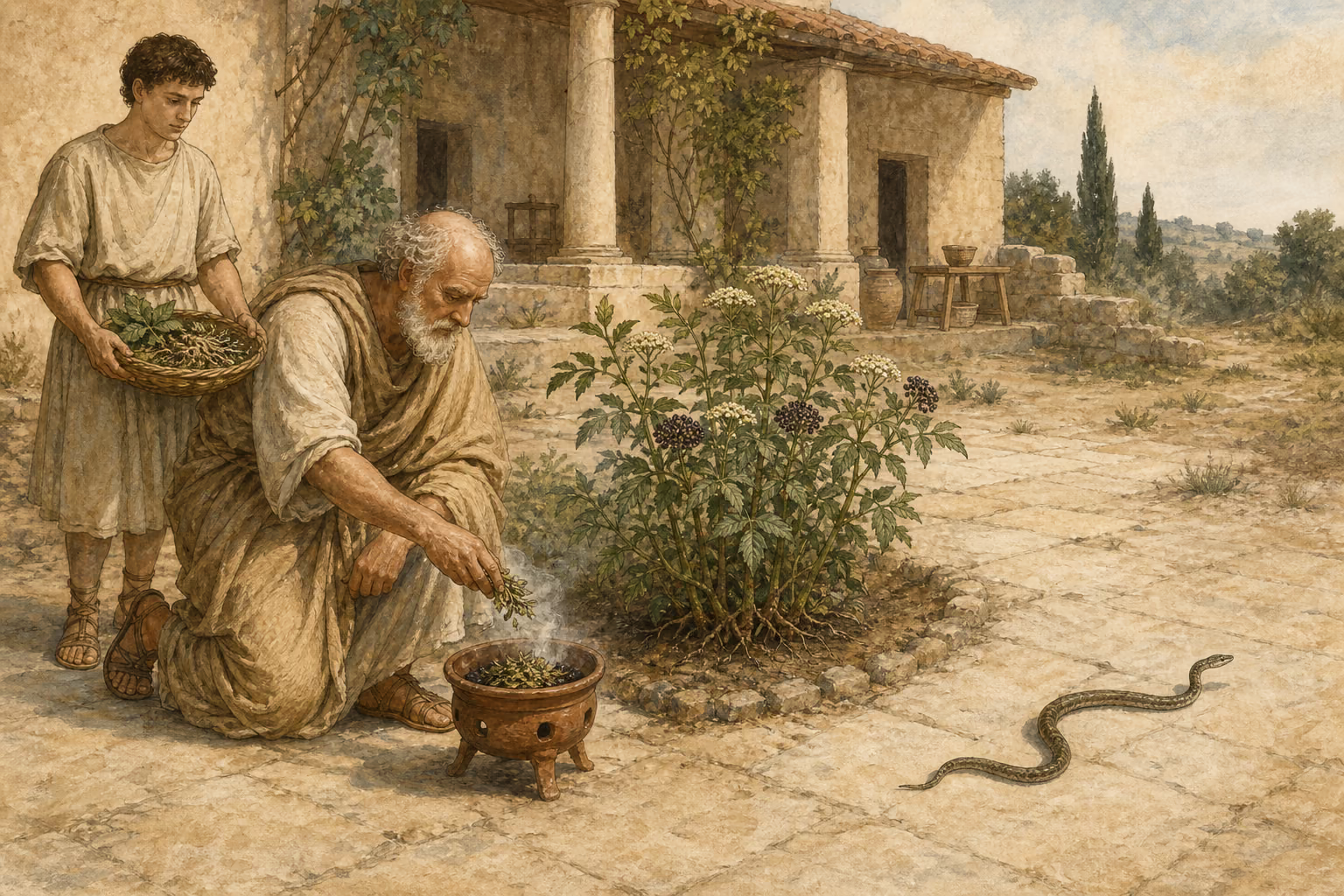
Ebuli quoque, quam nemo ignorat, fumo fugantur serpentes.
Privatim adversatur scorpionibus polemoniae radix, vel adalligata tantum, item phalangio ac ceteris minoribus venenatis, scorpionibus aristolochia, agaricum obolis IIII in vini mixti cyathis totidem, verbenaca et phalangio cum vino aut posca, item quinquefolium, daucum.
Verbascum Graeci phlomon vocant. genera habet prima duo: album, in quo mas intellegitur, alterum nigrum, in quo femina. tertium genus non nisi in silvis invenitur. sunt folia brassicae latiora, pilosa, caulis erectus, cubitali amplior. semen nigrum inutile, radix una, crassitudine digiti. nascuntur in campestribus. silvestri folia elelisphaci, alta, ramis lignosis. sunt et phlomides duae hirsutae, rotundis foliis, humiles. tertia lychnitis vocatur, ab allis thryallis, foliis ternis aut cum plurimum quaternis, crassis pinguibusque, ad lucernarum lumina aptis. aiunt in foliis eius, quam feminam diximus, ficus omnino non putrescere. distingui genera haec paene supervacuum est, cum sint omnia eiusdem effectus. contra scorpiones bibitur radix cum ruta ex aqua, magna amaritudine, sed effectu pari.
Thelyphonon herba ab alis scorpion vocatur propter similitudinem radicis. cuius tactu moriuntur scorpiones; itaque contra eorum ictus bibitur. scorpionem mortuum si quis helleboro candido linat, revivescere aiunt. thelyphonon omnem quadripedem necat inposita verendis radice, folio quidem intra eundem diem. quod est simile cyclamino, ipsa geniculata. nascitur in opacis.—Scorpionibus adversatur et Vettonicae sucus ac plantaginis.
Sunt et ranis venena, rubetis maxime, vidimusque Psyllos in certamen e patinis candefactis admittentes, ociore etiam quam aspidum pernicie. auxiliatur phrynion in vino pota. aliqui neurada appellant, alii poterion, floribus parvis, radicibus multis, nervosis, bene olentibus. item alcima, quam alii damasonion, alii lyron appellant. folia erant plantaginis, nisi angustiora essent et magis laciniosa convexaque in terrain, alias etiam venosa similiter, caule simplici, tenui, cubitali, capite thyrsi, radicibus densis, tenuibus ut veratri nigri, acribus, odoratis, pinguibus. nascitur in aquosis. alterum genus eiusdem in silvis, nigrius, maioribus foliis. in usu radices utriusque adversus ranas et lepores marinos drachmae pondere in vini potu. lepori marino adversatur et cyclaminos. veneni vim canis quoque rabidi morsus habent, contra quos erit cynorrhodum, de quo diximus; plantago et ad omnes bestiarum morsus pota atque inlita, Vettonica ex mero vetere.
Peristereos vocatur caule alto, foliato, cacumine in alios caules se spargens, columbis admodum familiaris, unde et nomen. hanc habentes negant latrari a canibus.
Proxima ab his malis venena sunt, quae sibimet ipsi homines excogitant. contra haec omnia magicasque artes erit primum illud Homericum moly, dein Mithridatia ac scordotis. et centaurium potu omnia mala medicamenta exigit per alvum, Vettonicae semen in mulso aut passo vel farina drachma in vini veteris cyathis IIII; vomere cogendi atque iterum bibere. iis, qui cotidie gustent earn, nulla nocitura mala medicamenta tradunt. poto veneno aristolochia subvenit eadem mensura qua contra serpentes, quinquefolii sucus, agaricum, postquam vomuerint, denarii pondere ex aquae mulsae cyathis III.
Antirrinum vocatur sive anarrinon lychnis agria, simile lino, radice nulla flore hyacinthi, seine vituli narium. et hoc perunctos venustiores fieri nec ullo malo medicamento laedi posse vel si quis in bracchiali habeat, arbitrantur Magi. similiter ea, quam eupliam vocant, traduntque ea perunctos commendatioris esse famae. Artemisiam quoque secum habentibus negant nocere mala medicamenta aut bestiam ullam, ne solem quidem; bibitur et haec ex vino.—Adversus opium alcima privatim potens traditur, pota ut adversus ranas.
Pericarpum bulbi genus est. duae eius species: cortice rubro, alterum nigro, papaveri simile, sed vis maior quam priori, utrique autem in excalfaciendo. ideo contra cicutam datur, contra quam et tus et panaces, Chironium praecipue; hoc et contra fungos.
English · Bostock & Riley 1855–57
A fumigation, too, of ebulum, a plant known to every one, will put serpents to flight.
The root of polemonia, even worn as an amulet only, is particularly useful for repelling the attacks of scorpions, as also the phalangium and other small insects of a venomous nature. For injuries inflicted by the scorpion, aristolochia is also used, or agaric, in doses of four oboli to four cyathi of wine. For the bite of the phalangium, vervain is employed, in combination with wine or oxycrate: cinquefoil, too, and daucus, are used for a similar purpose.
Verbascum has the name of “phlomos” with the Greeks. Of this plant there are two principal kinds; the white, which is considered to be the male, and the black, thought to be the female. There is a third kind, also, which is only found in the woods. The leaves of these plants are larger than those of the cabbage, and have a hairy surface: the stem is upright, and more than a cubit in height, and the seed black, and never used. The root is single, and about the thickness of the finger. The two principal kinds are found growing in champaign localities. The wild verbascum has leaves like those of elelisphacus, but of an elongated form; the branches are ligneous.
There are also two varieties of the phlomis, hairy plants, with rounded leaves, and but little elevated above the surface of the earth. A third kind, again, is known as the “lychnitis” by some persons, and as the “thryallis” by others: it has three leaves only, or four at the very utmost, thick and unctuous, and well adapted for making wicks for lamps. The leaves of the phlomos which we have mentioned as the female plant, if wrapped about figs, will preserve them most efficiently from decay, it is said. It seems little better than a loss of time to give the distinguishing characteristics of these three kinds, the effects of them all being precisely the same.
For injuries inflicted by scorpions, an infusion of the root is taken, with rue, in water. Its bitterness is intense, but it is quite as efficacious as the plants already mentioned.
The thelyphonon is a plant known as the “scorpio” to some, from the peculiar form of its roots, the very touch of which kills the scorpion: hence it is that it is taken in drink for stings inflicted by those reptiles. If a dead scorpion is rubbed with white hellebore, it will come to life, they say. The thelyphonon is fatal to all quadrupeds, on the application of the root to the genitals. The leaf too, which bears a resemblance to that of cyclaminos, is productive of a similar effect, in the course of the same day. It is a jointed plant, and is found growing in unbrageous localities. Juice of betony or of plantago is a preservative against the venom of the scorpion.
Frogs, too, have their venom, the bramble-frog in particular, and I myself have seen the Psylli, in their exhibitions, irritate them by placing them upon flat vessels made red hot, their bite being fatal more instantaneously than the sting even of the asp. One remedy for their poison is the phrynion, taken in wine, which has also the additional names of “neuras” and “poterion:” it bears a small flower, and has numerous fibrous roots, with an agreeable smell.
Similar too, are the properties of the alisma, known to some persons as the “damasonion,” and as the “lyron” to others. The leaves of it would be exactly those of the plantago, were it not that they are narrower, more jagged at the edges, and bent downwards in a greater degree. In other respects, they present the same veined appearance as those of the plantago. This plant has a single stem, slender, a cubit in height, and terminated by a spreading head. The roots of it are numerous, thin like those of black hellebore, acrid, unctuous, and odoriferous: it is found growing in watery localities.
There is another kind also, which grows in the woods, of a more swarthy colour, and with larger leaves. The root of them both is used for injuries inflicted by frogs and by the sea-hare, in doses of one drachma taken in wine. Cyclaminos, too, is an antidote for injuries inflicted by the sea-hare.
The bite of the mad dog has certain venomous properties, as an antidote to which we have the cynorrhodos, of which we have spoken elsewhere already. The plantago is useful for the bites of all kinds of animals, either taken in drink or applied topically to the part affected. Betony is taken on similar occasions, in old wine, unmixed.
The name of peristereos is given to a plant with a tall stem, covered with leaves, and throwing out other stems from the top. It is much sought by pigeons, to which circumstance it owes its name. Dogs will never bark, they say, at persons who have this plant about them.
Closely approaching in their nature to these various kinds of poisons, are those which have been devised by man for his own destruction. In the number of antidotes to all these artificial poisons as well as to the spells of sorcery, the very first place must be accorded to the moly of Homer; next to which come the mithridatia, scordotis, and centaury. The seed of betony carries off all kinds of noxious substances by stool; being taken for the purpose in honied wine or raisin wine, or else pulverized, and taken, in doses of one drachma, in four cyathi of old wine: in this last case, however, the patient must bring it off the stomach by vomit and then repeat the dose. Persons who accustom themselves to take this plant daily, will never experience any injury, they say, from substances of a poisonous nature.
When a person has taken poison, one most powerful remedy is aristolochia, taken in the same proportions as those used for injuries inflicted by serpents. The juice, too, of cinquefoil is given for a similar purpose; and in both cases, after the patient has vomited, agaric is administered, in doses of one denarius, in three cyathi of hydromel.
The name of antirrhinum or anarrhinon is given to the lychnis agria, a plant which resembles flax in appearance, is destitute of root, has a flower like that of the hyacinth, and a seed similar in form to the muzzle of a calf. According to what the magicians say, persons who rub themselves with this plant improve their personal appearance thereby; and they may ensure themselves against all noxious substances and poisons, by wearing it as a bracelet.
The same is the case, too, with the plant to which they give the name of “euclea,” and which, they tell us, rubbed upon the person, will ensure a more extended consideration. They say, too, that if a person carries artemisia about him, he will be ensured against all noxious drugs, the attacks of wild beasts of every kind, and sunstroke even. This last plant is taken also in wine, in cases of poisoning by opium. Used as an amulet, or taken in drink, it is said to be particularly efficacious for injuries inflicted by frogs.
The pericarpum is a kind of bulbous plant. There are two varieties of it; one with a red outer coat, and the other, similar is appearance to the black poppy, and possessed of greater virtues than the first. They are both, however, of a warming nature, for which reason, they are administered to persons who have taken hemlock, a poison for which frankincense and panaces are used, chironion in particular. This last, too, is given in cases of poisoning by fungi.