LIBER XXV · CAPUT 9
THE ARGEMONIA: FOUR REMEDIES
Latine · Mayhoff 1906
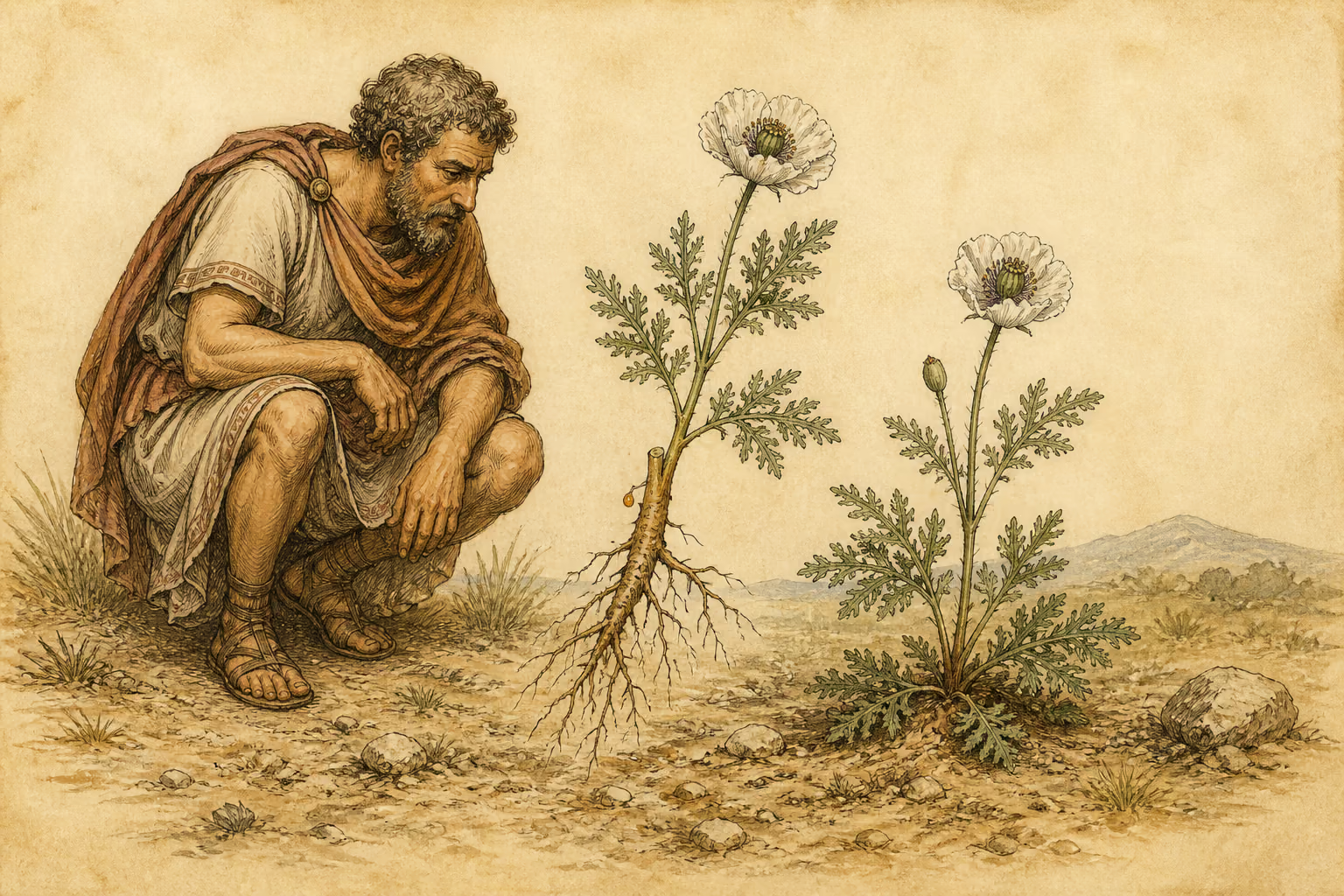
argemonia quoque radicis denarii pondere in vini cyathis III poto. plura de ea convenit dici ceterisque, qua primum nominabuntur, in eo autem genere medendi primum nominari quamque, in quo maxime valebit. folia habet qualia anemone, divisa apii modo, caput in cauliculo papaveris silvestris, item radicem, sucum croci colore acrem et acutum. nascitur in arvis. apud nos tria genera eius faciunt et id demum probant, cuius radix tus redoleat.
Agaricum ut fungus nascitur in arboribus circa Bosporum colore candido; dantur oboli III contriti cum binis cyathis aceti mulsi. id, quod in Gallia nascitur, infirmius habetur. praeterea mas spissior amariorque — hic et capitis dolores facit—, femina solutior. initio gustus dulcis mox in amaritudinem transit.
Echios utriusque generis puleio similis, foliis coronat; datur drachmis II ex vini cyathis IIII. item altera, quae lanugine distinguitur spinosa, cui et capitula viperae similia sunt; haec ex vino et aceto. quidam echion personatam vocant, cuius folio nullum est latius, grandes lappas ferentem; huius radicem decoctam ex aceto dant potui.—Hyoscyamum contusum cum foliis ex vino datur peculiariter contra aspidas.
Nulla tamen Romanae nobilitatis plus habet quam hiera botane. aliqui aristereon, nostri verbenacam vocant. haec est quam legatos ferre ad hostes indicavimus; hac lovis mensa verritur, domus purgantur lustranturque. genera eius duo: foliosa, quam feminam putant, mas rarioribus foliis. ramuli utriusque plures, tenues, cubitales, angulosi, folia minora quam quercus angustioraque, divisuris maioribus, flos glaucus, radix longa, tenuis. nascitur ubique in planis aquosis. quidam non distingunt et unum omnino genus faciunt, quoniam utraque eosdem effectus habeat. utraque sortiuntur Galli et praecinunt responsa, sed Magi utique circa hanc insaniunt: hac perunctos inpetrare quae velint, febres abigere, amicitias conciliare nullique non morbo mederi. colligi debere circa canis ortum ita, ne luna aut sol conspiciat, favis ante et melle terrae ad piamentum datis; circumscriptam ferro effodi sinistra manu et in sublime tolli; siccari in umbra separatim folia, caulem, radicem. aiunt, si aqua spargatur triclinium, in qua maduerit, laetiores convictus fieri. adversus serpentes conteritur ex vino.
Est similis verbasco herba, quae saepe fallit pro ea capta, foliis minus candidis, cauliculis pluribus, flore luteo. haec abiecta blattas in se contrahit ideoque Romae blattaria vocatur.
Molemonium sucum lacteum emittit concrescentem cummis modo, umidis locis. datur denarii pondus in vino.
Quinquefolium nulli ignotum est, cum etiam fraga gignendo commendetur; Graeci pentapetes aut pentaphyllon aut chamaezelon vocant. cum effoditur, rubram habet radicem; haec inarescens nigrescit et angulosa fit. nomen a numero foliorum. et ipsa herba incipit et desinit cum vite. adhibetur et purgandis domibus.
Adversus serpentes bibitur et eius radix, quae sparganion vocatur, ex vino albo.
Dauci genera quattuor fecit Petronius Diodotus, quae persequi nihil attinet, cum sint differentiae duae, probatissimi in Creta, mox in Achaia et ubicumque in siccis nati, feniculi similitudiue, candidioribus foliis et minoribus hirsutisque, caule pedali recto, radice suavissimi gustus et odoris. hoc in saxosis nascitur meridianis; reliqua genera ubique nascuntur terrenis collibus limitibusque, nec nisi pingui solo..... foliis coriandri, caule cubitali, capitibus rotundis, saepe pluribus quam ternis, radice lignosa et, cum inaruit, supervacua. semen huius cumino simile, prioris milio, album, acre, odoratum omnibus et fervens. secundum priore vehementius est ideoque parce sumi debet. si iam maxime tertium genus facere libeat, est simile staphylino, quod pastinacam erraticam appellant, semine oblongo, radice dulci. omnia haec et hieme et aestate sunt intacta quadripedi nisi post abortus. ex allis usus seminis, ex Cretico radicis et magis ad serpentes. bibitur e vino drachma una, datur et quadripedibus percussis.
Therionarca alia quam magica et in nostro orbe nascitur, fruticosa, foliis subviridibus, flore roseo. serpentes necat. cuicumque admota ferae et haec torporem adfert.
Persollata, quam nemo ignorat, Graeci arcion vocant, folia habet maiora etiam cucurbitis et hirsutiora nigrioraque et crassiora, radicem albam et grandem. haec ex vino bibitur denariorum II pondere; item cyclamini radix contra serpentes omnes. folia habet minora quam hedera nigrioraque et tenuiora, sine angulis, in quibus albicant maculae, caule exiguo, inani, floribus purpureis, radice lata, ut rapum videri possit, cortice nigro. nascitur in umbrosis. a nostris tuber terrae vocatur, in omnibus serenda domibus, si verum est, ubi sata sit, nihil nocere mala medicamenta; amuletum vocant. narrant et ebrietatem repraesentari addita in vinum. radix et siccata, scillae modo concisa reponitur; decoquitur eadem ad crassitudinem mellis. suum tamen venenum ei est, traduntque, si praegnans radicem eam transgrediatur, abortum fieri.
Est et altera cyclaminos cognomine cissanthemos, geniculatis caulibus supervacuis a priore distans, circa arbores se volvens, acinis hederae, sed mollibus, flore candido, specioso, radice supervacua. acini tantum in usu, gustu acres et lenti. siccantur in umbra tusique dividuntur in pastillos.
Mihi et tertia cyclaminos demonstrata est cognomine chamaecissos, uno omnino folio, radice ramosa, qua pisces necabantur.
Sed inter prima celebratur peucedanum, laudatissima in Arcadia, mox Samothrace. caulis ei tenuis, longus, feniculo similis, iuxta terram foliosus, radice nigra, crassa, gravi odore, sucosa. gignitur in montibus opacis, foditur exitu autumni. placent tenerrimae et altissimae radices. hae conciduntur in quaternos digitos osseis cultellis funduntque sucum in umbra, capite prius et naribus rosaceo perunctis, ne vertigo sentiatur. et alius sucus invenitur caulibus adhaerens; incisi quoque manant. probatur crassitudine mellea, colore rufo, odore suaviter gravi, fervens gustu. hic in usu et radix et decoctum eius plurimis medicamentis, suco tamen efficacissimo, qui resolvitur amaris amygdalis aut ruta contra serpentes bibiturque et ex oleo perunctos tuetur. —
English · Bostock & Riley 1855–57
The argemonia, too, is remedial in such cases; the root of it being taken, in doses of one denarius, in three cyathi of wine. It will be as well, however, to enter into some further details in reference to this plant and others, which I shall have occasion next to mention; it being my intention first to describe, under each head, those plants which are the most efficacious for the treatment of the affection under consideration.
The argemonia has leaves like those of the anemone, but divided like those of parsley: the head grows upon a slender stem resembling that of the wild poppy, and the root is also very similar to that of the same plant. The juice is of a saffron colour, acrid and pungent: the plant is commonly found in the fields of this country. Among us there are three varieties of it distinguished, the one being the most highly approved of, the root of which smells like frankincense.
Agaric is found growing in the form of a fungus of a white colour, upon the trees in the vicinity of the Bosporus. It is administered in doses of four oboli, beaten up in two cyathi of oxymel. The kind that grows in Galatia is generally looked upon as not so efficacious. The male agaric is firmer than the other, and more bitter; it is productive too of head-ache. The female plant is of a looser texture; it has a sweet taste at first, which speedily changes into a bitter flavour.
Of the echios there are two kinds; one of which resembles pennyroyal in appearance, and has a concave leaf. It is administered, in doses of two drachmæ, in four cyathi of wine. The other kind is distinguished by a prickly down, and bears small heads resembling those of vipers: it is usually taken in wine and vinegar. Some persons give the name of “echios personata” to a kind of echios with larger leaves than the others, and burrs of considerable size, resembling that of the lappa. The root of this plant is boiled and administered in vinegar. Henbane, pounded with the leaves on, is taken in wine, for the sting of the asp in particular.
But among the Romans there is no plant that enjoys a more extended renown than hierabotane known to some persons as “peristereon,” and among us more generally as “verbenaca.” It is this plant that we have already mentioned as being borne in the hands of envoys when treating with the enemy, with this that the table of Jupiter is cleansed, with this that houses are purified and due expiation made. There are two varieties of it: the one that is thickly covered with leaves is thought to be the female plant; that with fewer leaves, the male. Both kinds have numerous thin branches, a cubit in length, and of an angular form. The leaves are smaller than those of the quercus, and narrower, with larger indentations. The flower is of a grey colour, and the root is long and thin. This plant is to be found growing everywhere, in level humid localities. Some persons make no distinction between these two varieties, and look upon them as identical, from the circumstance of their being productive of precisely similar effects.
The people in the Gallic provinces make use of them both for soothsaying purposes, and for the prediction of future events; but it is the magicians more particularly that give utterance to such ridiculous follies in reference to this plant. Persons, they tell us, if they rub themselves with it will be sure to gain the object of their desires; and they assure us that it keeps away fevers, conciliates friendship, and is a cure for every possible disease; they say, too, that it must be gathered about the rising of the Dog-star—but so as not to be shone upon by sun or moon—and that honey-combs and honey must be first presented to the earth by way of expiation. They tell us also that a circle must first be traced around it with iron; after which it must be taken up with the left hand, and raised aloft, care being taken to dry the leaves, stem, and root, separately in the shade. To these statements they add, that if the banqueting couch is sprinkled with water in which it has been steeped, merriment and hilarity will be greatly promoted thereby.
As a remedy for the stings of serpents, this plant is bruised in wine.
There is a plant very similar in appearance to verbascum, so much so, indeed, as to be frequently gathered for it by mistake. The leaves, however, are not so white, the stems are more numerous, and the flower is of a yellow colour. Thrown upon the ground, this plant attracts black beetles to it, whence its Roman appellation “blattaria.”
Lemonium furnishes a milky juice, which thickens like gum. It grows in moist, watery localities, and is generally administered, in doses of one denarius, in wine.
There is no one to whom quinquefolium is unknown, being recommended by a sort of strawberry which it bears: The Greeks give it the name of pentapetes, pentaphyllon, and chamæzelon. The root, when taken up, is red; but as it dries it becomes black and angular. Its name is derived from the number of its leaves: it puts forth and withers with the leaves of the vine. This plant also is employed in the purification of houses.
The root, too, of the plant known as the sparganion, is taken in white wine, as a remedy for the stings of serpents.
Petronius Diodotus has distinguished four kinds of daucus, which it would be useless here to describe, the varieties being in reality but two in number. The most esteemed kind is that of Crete, the next best being the produce of Achaia, and of all dry localities. It resembles fennel in appearance, only that its leaves are whiter, more diminutive, and hairy on the surface. The stem is upright, and a foot in length, and the root has a remarkably pleasant taste and smell. This kind grows in stony localities with a southern aspect.
The inferior sorts are found growing everywhere, upon declivities for instance, and in the hedges of fields, but always in a rich soil. The leaves are like those of coriander, the stem being a cubit in length, the heads round, often three or more in number, and the root ligneous, and good for nothing when dry. The seed of this kind is like that of cummin, while that of the first kind bears a resemblance to millet; in all cases it is white, acrid, hot, and odoriferous. The seed of the second kind has more active properties than that of the first; for which reason it should be used more sparingly.
If it is considered really desirable to recognize a third variety of the daucus, there is a plant of this nature very similar to the staphylinos, known as the “pastinaca erratica,” with an oblong seed and a sweet root. Quadrupeds will touch none of these plants, either in winter or in summer, except indeed, after abortion. The seed of the various kinds is used, with the exception of that of Crete, in which case it is the root that is employed; this root being particularly useful for the stings of serpents. The proper dose is one drachma, taken in wine. It is administered also to cattle when stung by those reptiles.
The therionarca, altogether a different plant from that of the Magi, grows in our own climates, and is a branchy plant, with greenish leaves, and a rose-coloured flower. It has a deadly effect upon serpents, and the very contact of it is sufficient to benumb a wild beast, of whatever kind it be.
The persolata, a plant known to every one, and called “arcion” by the Greeks, has a leaf, larger, thicker, more swarthy, and more hairy than that of the gourd even, with a large white root. This plant also is taken, in doses of two denarii, in wine.
So too, the root of cyclaminos is good for injuries inflicted by serpents of all kinds. It has leaves smaller than those of ivy, thinner, more swarthy, destitute of angles, and covered with whitish spots. The stem is thin and hollow, the flowers of a purple colour, and the root large and covered with a black rind; so much so, in fact, that it might almost be taken for the root of rape. This plant grows in umbrageous localities, and by the people of our country is known as the “tuber terræ.” It ought to be grown in every house, if there is any truth in the assertion that wherever it grows, noxious spells can have no effect. This plant is also what is called an “amulet;” and taken in wine, they say, it produces all the symptoms and appearances of intoxication. The root is dried, cut in pieces, like the squill, and put away for keeping. When wanted, a decoction is made of it, of the consistency of honey. Still, however, it has some deleterious properties; and a pregnant woman, it is said, if she passes over the root of it, will be sure to miscarry.
There is also another kind of cyclaminos, known by the additional name of “cissanthemos;” the stems of it, which are jointed, are good for nothing. It is altogether different from the preceding plant, and entwines around the trunks of trees. It bears a berry similar to that of the ivy, but soft; and the flower is white and pleasing to the sight. The root is never used. The berries are the only part of it in use, being of an acrid, viscous taste. They are dried in the shade, after which they are pounded and divided into lozenges.
A third kind of cyclaminos has also been shown to me, the additional name of which is “chamæcissos.” It consists of but a single leaf, with a branchy root, formerly employed for killing fish.
But in the very first rank among these plants, stands peucedanum, the most esteemed kind of which is that of Arcadia, the next best being that of Samothrace, The stem resembles that of fennel, is thin and long, covered with leaves close to the ground, and terminating in a thick black juicy root, with a powerful smell. It grows on umbrageous mountains, and is taken up at the end of autumn. The largest and tenderest roots are the most esteemed; they are cut with bone-knives into slips four fingers in length, and left to shed their juice in the shade; the persons employed taking the precaution of rubbing the head and nostrils with rose-oil, as a preservative against vertigo.
There is also another kind of juice, which adheres to the stems, and exudes from incisions made therein. It is considered best when it has arrived at the consistency of honey: the colour of it is red, and it has a strong but agreeable smell, and a hot, acrid taste. This juice, as well as the root and a decoction of it, enters into the composition of numerous medicaments, but the juice has the most powerful properties of the two. Diluted with bitter almonds or rue, it is taken in drink as a remedy for injuries inflicted by serpents. Rubbed upon the body with oil, it is a preservative against the attacks of those reptiles.