LIBER XXV · CAPUT 8
TWO VARIETIES OF THE PLANTAGO: FORTY-SIX REMEDIES
Latine · Mayhoff 1906
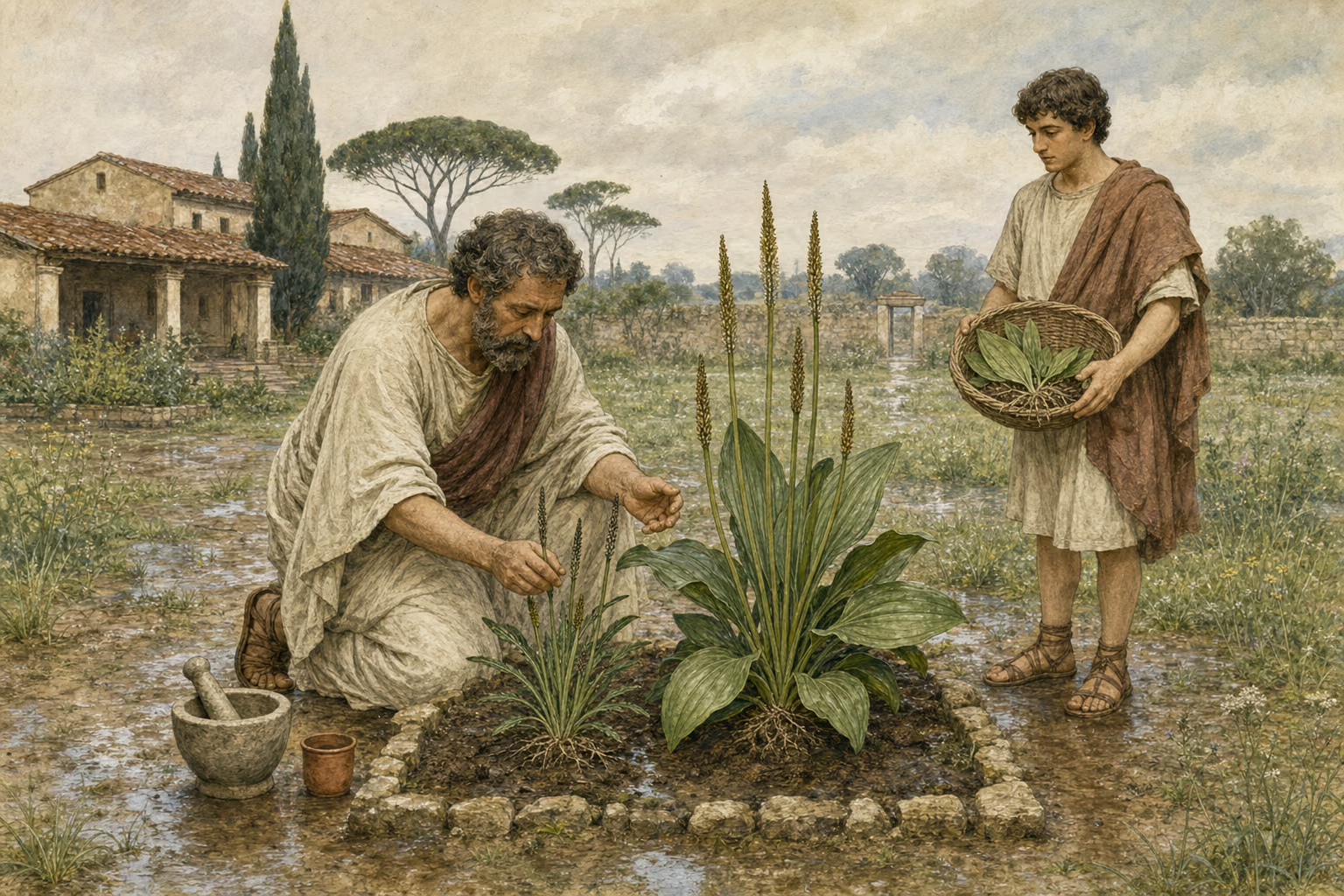
Celebravit et Themiso medicus vulgarem herbam plantaginem tamquam inventor volumine de ea edito. duo eius genera: minor angustioribus foliis et nigrioribus linguae pecorum similis, caule anguloso in terrain inclinato, in pratis nascens; altera maior, foliis laterum modo inclusa, quae quia septena sunt, quidam eam heptapleuron vocavere. huius et caulis cubitalis est. et ipsa in umidis nascitur, multo efficacior. mira vis in siccando densandoque corpore, cauterii vicem optinens. nulla res aeque sistit fluctiones, quas Graeci rheumatismos vocant.
Iungitur huic buglossos, boum linguae similis, cui praecipuum, quod in vinum deiecta animi voluptates auget et vocatur euphrosynum. iungitur et cynoglossos caninam linguam imitata, topiariis operibus gratissima. aiunt quae III thyrsos seminis emittat, eius radicem potam ex aqua ad tertianas prodesse, quae IIII, ad quartanas.—Est et alia similis ei, quae fert lappas minutas. eius radix pota ex aqua ranis et serpentibus adversatur.
Est et buphthalmus similis boum oculis, folio feniculi, circa oppida nascens, fruticosa caulibus, qui et manduntur decocti. quidam chalcan vocant. haec cum cera steatomata discutit.
Invenere herbas et universae gentes, Scythia primam eam, quae Scythice vocatur circa Maeotim nascens, praedulcem alias utilissimamque ad ea, quae asthmata vocant. magna et ea commendatio, quod in ore eam habentes sitim famemque non sentiunt. — Idem praestat apud eosdem hippace, distincta, quod in equis quoque eundem effectum habeat, traduntque his duabus herbis Scythas etiam in duodenos dies durare in fame sitique.
Ischaemonem Thracia invenit, qua ferunt sanguinem sisti non aperta modo vena, sed etiam praecisa. serpit in terra, milio similis, foliis asperis et lanuginosis. farcitur in nares, quae in Italia nascitur, et ciet sanguinem, eadem adalligata sistit.
Vettones in Hispania earn, quae Vettonica dicitur in Gallia, in Italia autem serratula, a Graecis cestros aut psychrotrophon, ante cunctas laudatissima. exit anguloso caule cubitorum II, a radice spargens folia fere lapathi, serrata, semine purpureo. folia siccantur in farinam plurimos ad usus. fit vinum ex ea et acetum stomaacho et claritati oculorum, tantumque gloriae habet, ut domus, in qua sata sit, tuta existimetur a piaculis omnibus.
In eadem Hispania inventa est Cantabrica per divi Augusti tempora a Cantabris reperta. nascitur ubique caule iunceo, pedali, in quo sunt flosculi oblongi veluti calathi, in his semen perquam minutum. nec alias defuere Hispaniae herbis exquirendis, ut in quibus etiam nunc hodie in more sit laetiore convictu potionem e centum herbis mulso additis credere saluberrimam suavissimamque. nec quisquam genera earum iam novit aut multitudinem, numerus tamen constat in nomine.
Nostra aetas meminit herbam in Marsis repertam. nascitur et in Aequicolis circa vicum Nervesiae; vocatur consiligo. prodest, ut demonstrabimus suo loco, deploratis in phthisi.
Invenit nuper et Servilius Democrates e primis medentium quam appellavit Hiberida, quamquam ficto nomini inventione eius adsignata carmine. nascitur maxime circa vetera monumenta parietinasque et inculta itinerum; floret semper, folio nasturci, caule cubitali, semine vix ut aspici possit. radici odor nasturci. usus aestate efficacior et recenti tantum; tunditur difficulter. coxendicibus et articulis omnibus cum axungia modica utilissima, viris plurimum quaternis horis, feminis minus dimidio adalligata, ut deinde in balineis descendatur in calidam et postea oleo ac vino perunguatur corpus, diebusque vicenis interpositis idem fiat, si qua admonitio doloris supersit. hoc modo rheumatismos omnes sanat occultos. inponitur non in ipsa inflammatione, sed inminuta.
Animalia quoque invenere herbas, in primisque chelidoniam. hac enim hirundines oculis pullorum in nido... restituuntque visum, ut quidam volunt, etiam erutis oculis. genera eius duo: maior fruticosa, folio pastinacae erraticae ampliore, ipsa altitudine II cubitorum, colos albicans, flos luteus; minori folia hederae rotundiora, minus candida. sucus croci, mordax, semen papaveris. florent adventu hirundinum, discessu marcescunt. sucus florentibus exprimitur et in aereo vase cum melle Attico leniter cinere ferventi decoquitur, singulari remedio contra caligines oculorum. utuntur et per se suco et in collyriis, quae chelidonia appellantur ab ea.
Inveniunt et canes qua fastidium vincunt eamque in nostro conspectu mandunt, sed ita, ut numquam intellegatur, quae sit; etenim depasta cernitur. notata est haec animalis eius malignitas in alia herba maior. percussus enim a serpente mederi sibi quadam dicitur, sed illam homine spectante non decerpit.
Simplicius cervae monstravere elaphoboscon, de qua diximus, item helxinen a partu dictam, ostendere, ut indicavimus, dictamnum vulneratae pastu statim telis decidentibus. non est alibi quam in Creta, ramis praetenue, puleio simile, fervens et acre gustu. foliis tantum utuntur; flos nullus aut semen aut caulis, radix tenuis ac supervacua. et in Creta autem non spatiose nascitur mireque capris expetitur. pro eo est pseudodictamnum multis in terris nascens, folio simile, ramulis minoribus, a quibusdam chondris vocatum. minoris effectus statim intellegitur; dictamnum enim minima potione accendit os. qui legere eas, in ferula aut harundine condunt praeligantque, ne potentia evanescat. sunt qui dicant utramque nasci multifariam, sed deteriores in agris pinguibus, veram quidem dictamnum non nisi in asperis. est et tertium genus dictamnum vocatum, sed neque facie neque effectu simile, folio sisymbri, ramis maioribus, praecedente persuasione illa, quicquid in Creta nascatur, infinito praestare ceteris eiusdem generis alibi genitis, proxime quod in Parnaso. alioqui herbiferum esse et Pelium montem in Thessalia et Telethrium in Euboea et totam Arcadiam ac Laconicam tradunt, Arcades quidem non medicaminibus uti, sed lacte circa ver, quoniam tum maxime sucis herbae turgeant medicenturque ubera pascuis. bibunt autem vaccinum, quoniam boves omnivori fere sunt in herbis. potentia earum per quadripedes etiamnum duobus claris exemplis manifesta fit. circa Abderam et limitem, qui Diomedis vocatur, equi pasti inflammantur rabie, circa Potnias vero et asini.
Inter nobilissimas aristolochiae nomen dedisse gravidae videntur, quoniam essetἀρίστη λεχούσαις. nostri malum terrae vocant et quattuor genera eius servant: unum tuberibus radicis rotundis, foliis inter malvam et hederam, nigrioribus mollioribusque, alterum masculae, radice longa, IIII digitorum longitudine, baculi crassitudine, tertium longissimae, tenuitate vitis novellae, cuius sit praecipua vis, quae et clematitis vocatur, ab aliis Cretica. omnes colore buxeo, caulibus parvis, flore purpureo. ferunt baculas parvas, ut cappari. valent radice tantum. est et quae plistolochia vocatur, quarti generis, tenuior quam proxime dicta, densis radicis capillamentis, iunci plenioris crassitudine. hanc quidem polyrrhizon cognominant. odor omnium medicatus, sed oblongae radici tenuiorique gratior; carnosi enim est corticis, unguentis quoque nardinis conveniens. nascuntur pinguibus locis et campestribus. effodere eas messibus tempestivum; indesquamato terreno servantur. maxime tamen laudatur Pontica et in quocumque genere ponderosissima quaeque, medicinis aptior rotunda, contra serpentes oblonga, in summa tamen gloria est ea, si modo a conceptu admota vulvis in carne bubula mares figurat, ut traditur. piscatores Campaniae radicem eam, quae rotunda est, venenum terrae vocant, coramque nobis contusam mixta calce in mare sparsere. advolant pisces cupiditate mira statimque exanimati fluitant. quae polyrrhizos cognominatur convulsis, contusis, ex alto praecipitatis radice pota ex aqua utilissima esse traditur, semine pleuriticis et nervis, confirmare, excalfacere, eadem satyrion esse.
Verum et effectus ususque dicendi sunt ordiendumque malorum omnium pessimo est, serpentium ictu. medentur ergo Britannica herba, panacis omnium generum radix e vino, Chironii et flos et semen potum inlitumve ex vino et oleo, privatim quae cunila bubula appellatur, Polemonia vel Philetaeris radicis drachmis IIII in mero, Teucria, sideritis, scordotis ex vino, privatim ad angues, pota et inlita sive suco sive folio sive decocto, centaurii maioris radix drachma in vini albi cyathis III, Gentiana praecipue adversus angues II drachmis cum pipere et ruta in vini cyathis VI, sive viridis sive sicca. et Lysimachiae odorem fugiunt. datur ex vino percussis chelidonia; morsibus inponitur Vettonica praecipue, cui vis tanta perhibetur, ut inclusae circulo eius serpentes ipsae sese interimant flagellando. datur ad ictus semen eius denarii pondere cum III cyathis vini vel farina drachmis III sextario aquae —farina etinponitur —, Cantabrica, dictamnum, aristolochia radicis drachma in vini hemina, sed saepius bibenda. prodest et inlita ex aceto; similiter plistolochia, quin omnino suspensa supra focum fugat e domibus serpentes;
English · Bostock & Riley 1855–57
The physician Themiso, too, has conferred some celebrity upon the plantago, otherwise a very common plant; indeed he has written a treatise upon it, as though he had been the first to discover it. There are two varieties; one, more diminutive than the other, has a narrower and more swarthy leaf, strongly resembling a sheep’s tongue in appearance: the stem of it is angular and bends downwards, and it is generally found growing in meadow lands. The larger kind has leaves enclosed with ribs at the sides, to all appearance, from the fact of which being seven in number, the plant has been called “heptapleuron” by some. The stem of it is a cubit in height, and strongly resembles that of the turnip. That which is grown in a moist soil is considered much the most efficacious: it is possessed of marvellous virtues as a desiccative and as an astringent, and has all the effect of a cautery. There is nothing that so effectually arrests the fluxes known by the Greeks as “rheumatismi.”
To an account of the plantago may be annexed that of the buglossos, the leaf of which resembles an ox tongue. The main peculiarity of this plant is, that if put into wine, it promotes mirth and hilarity, whence it has obtained the additional name of “euphrosynum.”
To this plant we may also annex an account of the cynoglossos, the leaf of which resembles a dog’s tongue, and which produces so pleasing an effect in ornamental gardening. The root, it is said, of the kind which bears three stems surmounted with seed, is very useful, taken in water, for tertian, and of that with four stems, for quartan, fevers.
There is another plant very similar to it, which bears diminutive burrs resembling those of the lappa: the root of it, taken in water, is curative of wounds inflicted by frogs or serpents.
There is the buphthalmos also, so called from its resemblance to an ox’s eye, and with a leaf like that of fennel. It grows in the vicinity of towns, and is a branchy plant, with numerous stems, which are boiled and eaten. Some persons give it the name of “cachla.” In combination with wax, it disperses scirrhi.
Entire nations, too, have been the discoverers of certain plants. The Scythæ were the first to discover the plant known as “scythice,” which grows in the vicinity of the Palus Mæotis. Among its other properties, this plant is remarkably sweet, and extremely useful for the affection known as “asthma.” It is also possessed of another great recommendation—so long as a person keeps it in his month, he will never experience hunger or thirst.
The hippace, another plant that grows in Scythia, is possessed of similar properties: it owes its name to the circumstance that it produces the like effect upon horses. By the aid of these two plants, the Scythæ, they say, are enabled to endure hunger and thirst, so long as twelve days even.
The Thracians were the first to discover the ischæmon, which, it is said, has the property of stanching the flow of blood, not only when a vein has been opened, but when it has been cut asunder even. This is a creeping plant; it is like millet in appearance, and the leaves of it are rough and lanuginous. It is used as a plug for the nostrils. The kind that grows in Italy, attached to the body as an amulet, has the property of arresting hæmorrhage.
The Vettones, a people of Spain, were the original discoverers of the plant known as the “vettonica” in Gaul, the “serratula” in Italy, and the “cestros” or “psychotrophon” in Greece. This is a plant more highly esteemed than any other: it puts forth an angular stem two cubits in height, and throws out leaves from the root, with serrated edges, and closely resembling those of lapathum. The seed of it is purple: the leaves are dried and powdered, and used for numerous purposes. There is a wine also prepared from it, and a vinegar, remarkably beneficial to the stomach and the eyesight. Indeed, this plant enjoys so extraordinary a reputation, that it is a common belief even that the house which contains it is insured against misfortunes of every kind.
In Spain, too, is found the cantabrica, which was first discovered by the nation of the Cantabri in the time of the late Emperor Augustus. It grows everywhere in those parts, having a stem like that of the bulrush, a foot in height, and bearing small oblong flowers, like a calathus in shape, and enclosing an extremely diminutive seed.
Nor indeed, in other respects, have the people of Spain been wanting in their researches into the nature of plants; for at the present day even it is the custom in that country, at their more jovial entertainments, to use a drink called the hundred-plant drink, combined with a proportion of honied wine; it being their belief, that the wine is rendered more wholesome and agreeable by the admixture of these plants. It still remains unknown to us, what these different plants are, or in what number exactly they are used: as to this last question, however, we may form some conclusion from the name that is given to the beverage.
Our own age, too, can remember the fact of a plant being discovered in the country of the Marsi. It is found growing also in the neighbourhood of the village of Nervesia, in the territory of the Æquicoli, and is known by the name of “consiligo.” It is very useful, as we shall have occasion to mention in the appropriate place, in cases of phthisis where recovery is considered more than doubtful.
It is but very lately, too, that Servilius Democrates, one of our most eminent physicians, first called attention to a plant to which he gave the name of iberis, a fanciful appellation only, bestowed by him upon this discovery of his in the verses by him devoted to it. This plant is found mostly growing in the vicinity of ancient monuments, old walls, and overgrown footpaths: it is an evergreen, and its leaves are like those of nasturtium, with a stem a cubit in height, and a seed so diminutive as to be hardly perceptible; the root, too, has just the smell of nasturtium. Its properties are more strongly developed in summer, and it is only used fresh-gathered: there is considerable difficulty in pounding it.
Mixed with a small proportion of axle-grease, it is extremely useful for sciatica and all diseases of the joints; the application being kept on some four hours at the utmost, when used by the male sex, and about half that time in the case of females. Immediately after its removal, the patient must take a warm bath, and then anoint the body all over with oil and wine—the same operation being repeated every twenty days, so long as there are any symptoms of pain remaining. A similar method is adopted for the cure of all internal defluxions; it is never applied, however, so long as the inflammation is at its height, but only when it has somewhat abated.
The brute animals also have been the discoverers of certain plants: among them, we will name chelidonia first of all. It is by the aid of this plant that the swallow restores the sight of the young birds in the nest, and even, as some persons will have it, when the eyes have been plucked out. There are two varieties of this plant; the larger kind has a branchy stem, and a leaf somewhat similar to that of the wild parsnip, but larger. The plant itself is some two cubits in height, and of a whitish colour, that of the flower being yellow. The smaller kind has leaves like those of ivy, only rounder and not so white. The juice of it is pungent, and resembles saffron in colour, and the seed is similar to that of the poppy.
These plants blossom, both of them, at the arrival of the swallow, and wither at the time of its departure. The juice is extracted while they are in flower, and is boiled gently in a copper vessel on hot ashes, with Attic honey, being esteemed a sovereign remedy for films upon the eyes. This juice is employed also, unmixed with any other substance, for the eyesalves, which from it take their name of “chelidonia.”
Dogs, too, are in the habit of seeking a certain plant, as a stimulant to the appetite; but although they eat it in our presence, it has never yet been discovered what it is, it being quite impossible to recognize it when seen half-chewed. There has also been remarked another bit of spitefulness in this animal, though in a much greater degree, in reference to another plant. When stung by a serpent, it cures itself, they say, by eating a certain herb, taking care, however, never to gather it in presence of man.
The hind, with a much greater degree of frankness, has discovered to us the elaphoboscon, a plant of which we have already spoken, and which is also called “helxine,” from the assistance it affords those animals in yeaning.
It is the hind, too, that, as already stated, first made us acquainted with dictamnon, or dittany; for when wounded, it eats some of this plant, and the weapon immediately falls from the body. This plant grows nowhere but in Crete. The branches of it are remarkably thin; it resembles pennyroyal in appearance, and is hot and acrid to the taste. The leaves are the only part employed, it being destitute of blossom, seed, and stem: the root is thin, and never used. In Crete even, it is found growing only in a very limited locality, and is sought by goats with singular avidity.
In place of it, the pseudodictamnum is employed, a plant that is found growing in many countries. In leaf it is similar to the other, but the branches are more diminutive: by some persons it is known as “chondris.” Its properties not being so strongly developed, the difference is immediately recognized: for an infusion of the very smallest piece of the real dittany, is sufficient to burn the mouth. The persons who gather it are in the habit of enclosing it in a stem of fennel-giant or in a reed, which they close at the ends that the virtues of it may not escape. Some persons say, that both plants grow indiscriminately in numerous localities, the inferior sort being the produce of rich soils, and the genuine dittany being found nowhere but in rugged, uncultivated spots.
There is, again, a third plant called “dictamnum,” which, however, has neither the appearance nor the properties of the other plant so called; the leaves of it are like those of sisymbrium, but the branches are larger.
There has long been this impression with reference to Crete, that whatever plant grows there is infinitely superior in its properties to a similar plant the produce of any other country; the second rank being given to the produce of Mount Parnassus. In addition to this, it is generally asserted that simples of excellent quality are found upon Mount Pelion in Thessaly, Mount Teleuthrius in Eubœa, and throughout the whole of Arcadia and Laconia. Indeed, the Arcadians, they say, are in the habit of using, not the simples themselves, but milk, in the spring season more particularly; a period at which the field plants are swollen with juice, and the milk is medicated by their agency. It is cows’ milk in especial that they use for this purpose, those animals being in the habit of feeding upon nearly every kind of plant. The potent properties of plants are manifested by their action upon four-footed animals in two very remarkable instances: in the vicinity of Abdera and the tract known as the Boundary of Diomedes, the horses, after pasturing, become inflamed with frantic fury; the same is the case, too, with the male asses, in the neighbourhood of Potniæ.
In the number of the most celebrated plants is the aristolochia, which would appear to have derived its name from females in a state of pregnancy, as being ἀρίστη λοχούσαις. Among us, however, it is known as the “malum terræ,” or apple of the earth, four different varieties of it being distinguished. One of these has a root covered with tubercles of a rounded shape, and leaves of a mixed appearance, between those of the mallow and the ivy, only softer and more swarthy. The second kind is the male plant, with an elongated root some four fingers in length, and the thickness of a walking-stick. A third variety is extremely thin and long, similar to a young vine in appearance: it has the most strongly-marked properties of them all, and is known by the additional names of “clematitis,” and “cretica.” All these plants are the colour of boxwood, have a slender stem, and bear a purple flower and small berries like those of the caper: the root is the only part that is possessed of any virtues.
There is also a fourth kind, the name given to which is “plistolochia;” it is more slender than the one last mentioned, has a root thickly covered with filaments, and is about as thick as a good-sized bulrush: another name given to it is “polyrrhizos.” The smell of all these plants is medicinal, but that of the one with an oblong root and a very slender stem, is the most agreeable: this last, in fact, which has a fleshy outer coat, is well adapted as an ingredient for nardine unguents even. They grow in rich champaign soils, and the best time for gathering them is harvest; after the earth is scraped from off them, they are put by for keeping.
The aristolochia that is the most esteemed, however, is that which comes from Pontus; but whatever the soil may happen to be, the more weighty it is, the better adapted it is for medicinal purposes. The aristolochia with a round root is recommended for the stings of serpents, and that with an oblong root * * * * But in this is centred its principal reputation; applied to the uterus with raw beef, as a pessary, immediately after conception, it will ensure the birth of male issue, they say. The fishermen on the coasts of Campania give the round root the name of “poison of the earth;” and I myself have seen them pound it with lime, and throw it into the sea; immediately on which the fish flew towards it with surprising avidity, and being struck dead in an instant, floated upon the surface.
The kind that is known as “polyrrhizos,” is remarkably good, they say, for convulsions, contusions, and falls with violence, an infusion of the root being taken in water: the seed, too, is useful for pleurisy and affections of the sinews. It is considered, too, to be possessed of warming and strengthening properties, similar to those of satyrion, in fact.
But it will be as well now to mention the various uses made of these plants, and the effects produced by them, beginning with that most dangerous of all evils that can befall us, stings inflicted by serpents. In such cases the plant britannica effects a cure, and the same is the case with the root of all the varieties of panaces, administered in wine. The flower, too, and seed of panaces chironion are taken in drink, or applied externally with wine and oil: cunila bubula, too, is looked upon as particularly useful for this purpose, and the root of polemonia or philetæris is taken in doses of four drachmæ in unmixed wine. Teucria, sideritis, and scordotis, are used in wine, plants particularly good, all of them, for injuries inflicted by snakes; the juice or leaves, or else a decoction of them, being taken in drink or applied to the wound. For a similar purpose also, the root of the greater centaury is taken, in doses of one drachma to three cyathi of white wine. Gentian, too, is particularly good for the stings of snakes, taken either fresh or dried, in doses of two drachmæ, mixed with rue and pepper in six cyathi of wine. The odour, too, of lysimachia puts serpents to flight.
Chelidonia is also given in wine to persons who have been stung; and betony in particular is used as an external application to the wound, a plant the virtues of which are so extraordinary, it is said, that if a circle of it is traced around a serpent, it will lash itself to death with its tail. The seed of this plant is also administered in such cases, in doses of one denarius to three cyathi of wine; or else it is dried and powdered, and applied to the wound, in the proportion of three denarii of powder to one sextarius of water.
Cantabrica, dittany, and aristolochia, are also similarly used, one drachma of the root of this last plant being taken every now and then in a semisextarius of wine. It is very useful too, rubbed in with vinegar, and the same is the case, also, with plistolochia: indeed it will be quite sufficient to suspend this last over the hearth, to make all serpents leave the house.