LIBER XXV · CAPUT 7
CLYMENUS: TWO REMEDIES
Latine · Mayhoff 1906
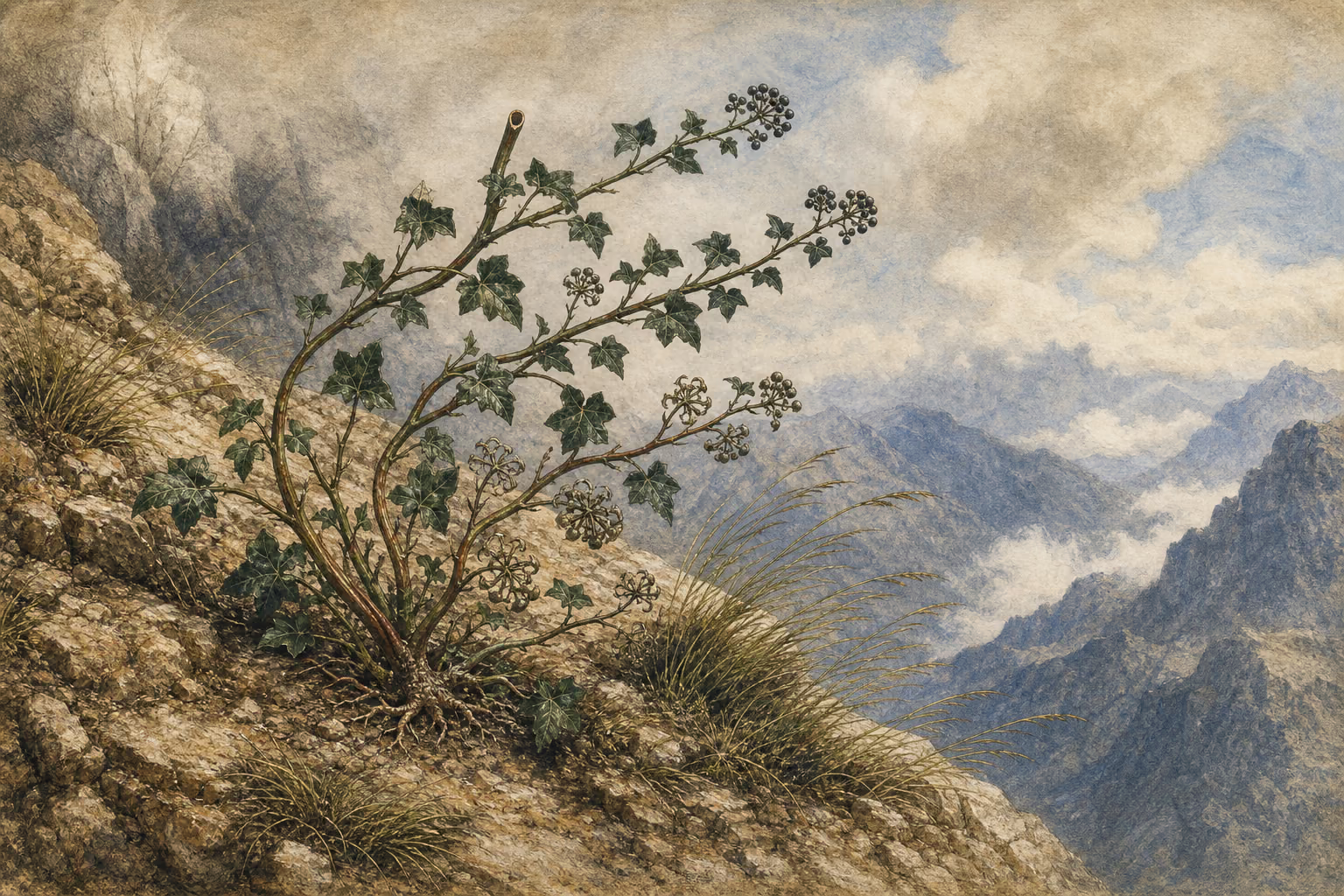
Clymenus a rege herba appellata est, hederae foliis, ramosa, caule inani articulis praecincta, odore gravi et semine hederae, silvestribus et montuosis nascens. quibus morbis pota medeatur, dicemus, sed hic indicandum est, dum medeatur, sterilitatem pota etiam viris fieri. Graeci plantagini similem esse dixerunt, caule quadrato, folliculis cum semine inter se inplexis veluti polyporum cirris. et sucus autem in usu, vi summa in refrigerando.
Gentianam invenit Gentius rex Illyriorum, ubique nascentem, Illyrico tamen praestantissimam, folio fraxini, sed magnitudine lactucae, caule tenero, pollicis crassitudine, cavo et inani, ex intervallis foliato, III aliquando cubitorum, radice lenta, subnigra, sine odore, aquosis montibus subalpinis plurima. usus in radice et suco. radicis natura est excalfactoria, sed praegnantibus non bibenda.
Invenit et Lysimachus quae ab eo nomen retinet, celebrata Erasistrato. folia habet salicis viridia, florem purpureum, fruticosa ramulis erectis, odore acri. gignitur in aquosis. vis eius tanta est, ut iumentis discordantibus iugo inposita asperitatem cohibeat.
Mulieres quoque hanc gloriam adfectavere, in quibus Artemisia uxor Mausoli adoptata herba, quae antea parthenis vocabatur. sunt qui ab Artemide Ilithyia cognominatam putent, quoniam privatim medeatur feminarum malis. est autem absinthii modo fruticosa, maioribus foliis pinguibusque. ipsius duo genera: altior latioribus foliis, altera tenera tenuioribus et non nisi in maritimis nascens. sunt qui in mediterraneis eodem nomine appellent, simplici caule, minimis foliis, floris copiosi, erumpentis cum uva maturescit, odore non iniucundo. quam quidam botryn, alii ambrosiam vocant, talis in Cappadocia nascitur.
Nymphaea nata traditur nympha zelotypia erga Herculem mortua—quare Heracleon vocant aliqui, alii rhopalon a radice clavae simili—, ideoque eos, qui biberint eam XII diebus, coitu genituraque privari. laudatissima in Orchomenia et Marathone. Boeoti mallon vocant et semen edunt. nascitur in aquosis, foliis magnis in summa aqua et aliis ex radice, flore lilio simili et, cum defloruit, capite papaveris, levi caule. secatur autumno radix nigra, in sole siccatur. adversatur ita lieni. est et alia nymphaea in Thessalia, amne Penio, radice alba, capite luteo, rosae magnitudine.
Invenit et patrum nostrorum aetate rex Iuba quam appellavit Euphorbeam medici sui nomine. frater is fuit Musae, a quo divum Augustum conservatum indicavimus. iidem fratres instituere a balineis frigida multa corpora adstringere; antea non erat mos nisi calida tantum lavari, sicut apud Homerum etiam invenimus. sed Iubae volumen quoque extat de ea herba et clarum praeconium. invenit eam in monte Atlante, specie thyrsi, foliis acanthinis. vis tanta est, ut e longinquo sucus excipiatur incisa conto; subitur excipulis ventriculo haedino. umor lactis videtur defluens; siccatus cum coiit, turis effigiem habet. qui colligunt, clarius vident. contra serpentes medetur quaculnque parte percussa vertice inciso et medicamento addito ibi. Gaetuli, qui legunt, taedio lacte adulterant, sed discernitur igni; id enim, quod sincerum non est, fastidiendum odorem habet. multum infra hunc sucum est qui in Gallia fit ex herba chamelaea, granum cocci ferente. fractus hammoniaco similis est, etiam levi gustu os accensum diu detinens et magis ex intervallo, donec fauces quoque siccet.
English · Bostock & Riley 1855–57
Clymenus is a plant so called, after a certain king. It has leaves like those of ivy, numerous branches, and a hollow, jointed stem. The smell of it is powerful, and the seed like that of ivy: it grows in wild and mountainous localities. We shall have to state hereafter, of what maladies it is curative, taken in drink, but it is as well to take the present opportunity of remarking that, while effecting a cure, in the male sex it neutralizes the generative powers.
The Greeks speak of this plant as being similar to the plantago in appearance, with a square stem, and a seed in capsules, interlaced like the arms of the polypus. The juice of this plant, too, is used, being possessed of refreshing properties in a very high degree.
Gentian was first discovered by Gentius, king of Illyria. It is a plant to be found everywhere, but that of Illyria is the finest. It has a leaf like that of the ash, but equal in size to a lettuce-leaf: the stem is tender, about the thickness of the thumb, hollow and empty, and covered with leaves at regular intervals. This stem is sometimes three cubits in length, and the root is flexible, swarthy, and inodorous. It is found in the greatest abundance in humid localities at the foot of the Alps. The root and juice are the parts of it that are used: the root is possessed of certain warming properties, but it should never be taken by women in a state of pregnancy.
King Lysimachus first discovered the plant which from him has received the name of lysimachia, and the merits of which have been so highly extolled by Erasistratus. This plant has green leaves resembling those of the willow, and a purple blossom: it has all the appearance of a shrub, the branches are erect, and it has a pungent smell. It is found growing in watery soils. The properties of it are so extremely powerful, that if placed upon the yoke when beasts of burden are restive, it will be sure to overcome all stubbornness on their part.
Women too have even affected an ambition to give their name to plants: thus, for instance, Artemisia, the wife of King Mausolus, adopted the plant, which before was known by the name of “parthenis.” There are some persons, however, who are of opinion that it received this surname from the goddess Artemis Ilithyia, from the fact of its being used for the cure of female complaints more particularly. It is a plant with numerous branches, like those of wormwood, but the leaves of it are larger and substantial.
There are two varieties of it; one has broader leaves than the other, which last is of a slender form, with a more diminutive leaf, and grows nowhere but in maritime districts.
Some persons again, give this name to a plant which grows more inland, with a single stem, extremely diminutive leaves, and numerous blossoms which open at the ripening of the grape, and the odour of which is far from unpleasant. In addition to this name, this last plant is known as “botrys” to some persons, and “ambrosia” to others: it grows in Cappadocia.
The plant called “nymphæa,” owes its name, they say, to a Nymph who died of jealousy conceived on account of Hercules, for which reason it is also known as “heracleon” by some. By other persons, again, it is called “rhopalon,” from the resemblance of its root to a club. * * * * and hence it is that those who take it in drink become impotent for some twelve days, and incapacitated for procreation. That of the first quality is found in Orchomenia and at Marathon: the people of Bœotia call it “madon,” and use the seed for food. It grows in spots covered with water; the leaves of it are large, and float upon the surface, while others are to be seen springing from the roots below. The flower is very similar to a lily in appearance, and after the plant has shed its blossom, the place of the flower is occupied by a head like that of the poppy. The stem is slender, and the plant is usually cut in autumn. The root, of a swarthy hue, is dried in the sun; garlic manifests a peculiar antipathy to it.
There is another nymphæa also, which grows in the river Peneus, in Thessaly: the root of it is white, and the head yellow, about the size of a rose.
In the time, too, of our fathers, King Juba discovered a plant, to which he gave the name of “euphorbia,” in honour of his physician, Euphorbus, the brother of the same Musa, whom we have mentioned as having saved the life of the late Emperor Augustus. It was these brothers who introduced the practice of douching the body with large quantities of cold water, immediately after the bath, for the purpose of bracing the system: whereas in former times, as we find stated in the works of Homer even, it was the practice to wash the body with warm water only. With reference to euphorbia, there is a treatise still in existence, written upon it by King Juba, in which he highly extols its merits; he discovered it growing upon Mount Atlas, and describes it as resembling a thyrsus in appearance, and bearing leaves like those of the acanthus.
The properties of this plant are so remarkably powerful, that the persons engaged in collecting the juices of it are obliged to stand at a considerable distance. The incisions are made with a long pole shod with iron, the juice flowing into receivers of kid-leather placed beneath. The juice has all the appearance of milk, as it exudes, but when it has coagulated and dried, it assumes the form and consistency of frankincense. The persons engaged in collecting it, find their sight improved thereby. This juice is an excellent remedy for the stings of serpents: in whatever part of the body the wound may have been inflicted, the practice is to make an incision in the crown of the head, and there introduce the medicament. The Gætuli who collect it, are in the habit of adulterating it with warm milk; a fraud, however, easily to be detected by the agency of fire, that which is not genuine emitting a most disgusting smell.
Much inferior to this is the juice extracted, in Gaul, from the chamelæa, a plant which bears the grain of Cnidos. When broken asunder, it resembles hammoniacum in appearance; and however slightly tasted, it leaves a burning sensation in the mouth, which lasts a considerable time, and increases every now and then, until, in fact, it has quite parched the fauces.