LIBER XXVII · CAPUT 10
GLAUCION: THREE REMEDIES. DIAGLAUCIA: TWO REMEDIES
Latine · Mayhoff 1906
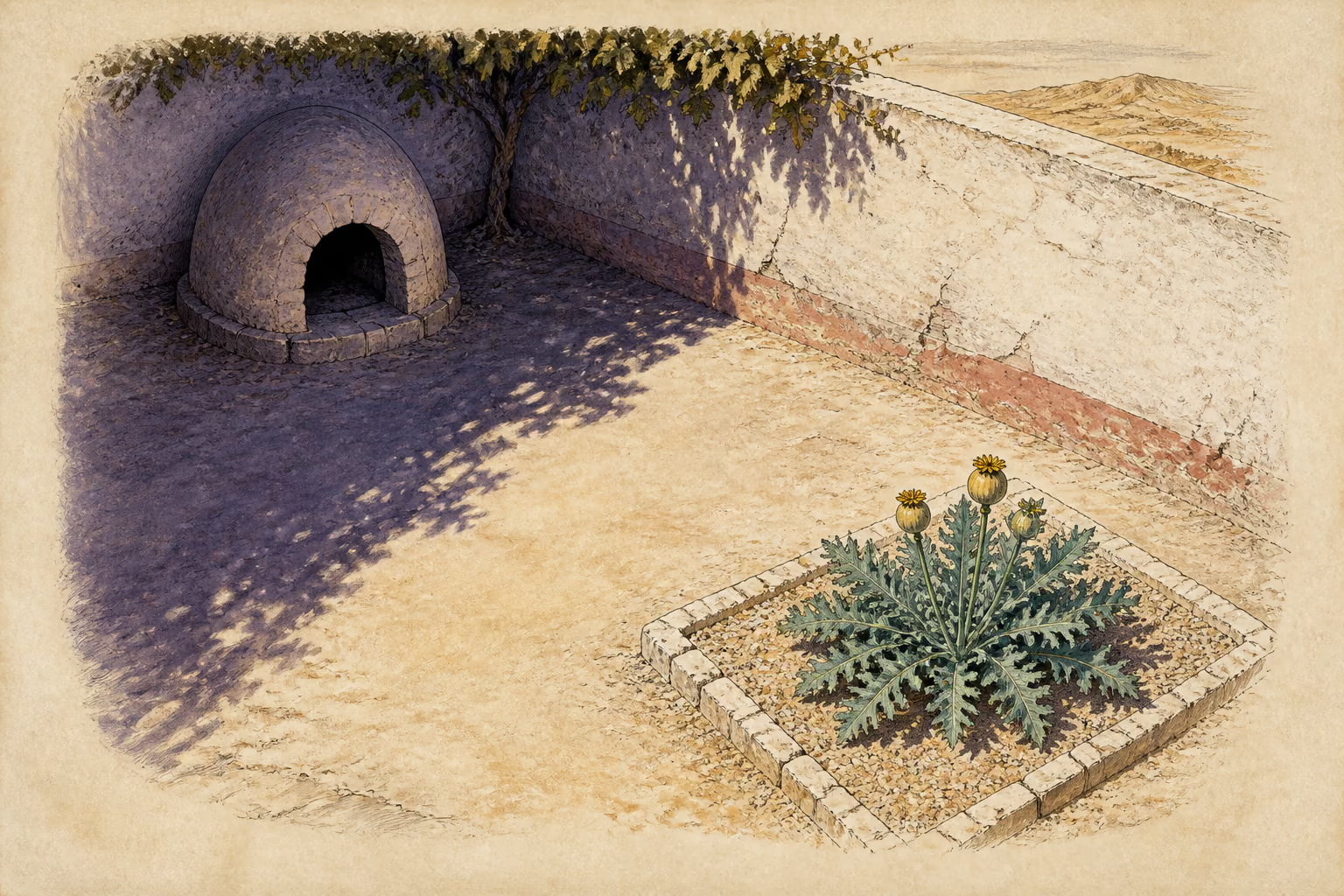
Glaucion in Syria et Parthia nascitur, humilis herba, densis foliis fere papaveris, minoribus tamen sordidioribusque, odoris taetri, gustus amari cum adstrictione. granum habet crocei coloris. hoc in olla fictili luto circumlita in clibanis calfaciunt, deinde exempto sucum exprimunt eiusdem nominis. usus et suci et foliorum, si terantur, adversus epiphoras, quae universo impetu cadant. hinc temperatur collyrium, quod medici dia glauciu vocant.—(lactis quoque ubertas intermissa restituitur; sumitur huius rei causa ex aqua). — Glycyside, quam aliqui Paeoniam aut pentorobon vocant, caulem habet II palmorum, comitantibus II aut III, subrutilum, cute lauri, folia qualia isatis, pinguiora rotundioraque et minora, semen in siliquis, aliud grano rubente, aliud nigro. duo autem genera sunt: femina existimatur cuius radicibus ceu balani longiores circiter VIII aut VI adhaerent. mas plures non habet, quoniam una radice nixus est palmi altitudine, candida, quae gustu adstringit. feminae folia murram redolent et densiora sunt. nascuntur in silvis. tradunt nocte effodiendas, quonian interdiu periculosum sit pico Martio inpetum in oculos faciente; radix vero cum effodiatur, periculum esse, ne sedes procidat, magna vanitate ad ostentationem rei fictum arbitror. usus in iis diversus. rubra grana rubentes menses sistunt XV fere pota in vino nigro. nigra grana vulvis medentur ex passo aut vino totidem pota. radix omnes ventris dolores sedat in vino alvumque purgat, sanat opisthotonum, morbum regium, renes, vesicam, arteriam autem et stomachum decocta in vino, alvumque sistit. estur etiamin alimentis, sed in medendo IIII drachmae satis sunt. grana nigra auxiliantur et suppressionibus nocturnis in vino pota quo dictum est numero, stomachicis vero et rosionibus et esse ea et inlinere prodest. suppurationes quoque discutiuntur, recentes nigro semine, veteres rubro. utrumque auxiliatur a serpente percussis et pueris contra calculos incipientes stranguria. — Gnaphalium aliqui chamaezelon vocant, cuius foliis albis mollibusque pro tomento utuntur; sane et similia sunt. datur in vino austero ad dysinteriam, ventris solutiones mensesque mulierum sistit. infunditur autem tenesmo. inlinitur et putrescentibus ulcerum.— Gallidragam vocat Xenocrates leucacantho similem, palustrem et spinosam, caule ferulaceo, alto, cui summo capite inhaereat simile ovo. in hoc crescente aestate vermiculos nasci tradit, quos pyxide conditos adalligari cum pane bracchio ab ea parte, qua dens doleat, mireque ilico dolorem tolli. valere non diutius anno et ita, si terrain non adtigerint.
Holcus in saxis nascitur siccis. aristas habet in cacumine, tenui culmo, quale hordeum restibile. haec circa caput alligata vel circa lacertum educit e corpore aristas. quidam ob id aristida vocant.— Hyoseris intubo similis, sed minor et tactu asperior, vulneribus contusa praeclare medetur. — Holosteon sine duritia est herba, ex adverso appellata a Graecis sicut fel dulce, radice tenuis usque in capillamenti speciem, longitudine IIII digitorum, ceu gramen foliis angustis, adstringens gustu. nascitur in collibus terrenis. usus eius ad vulsa, rupta in vino potae. volnera quoque conglutinat, nam et carnes, dum cocuntur, addita. — Hippophaeston nascitur in spinis, ex quibus fiunt aënae fulloniae, sine cauliculo, sine flore, capitulis tantum inanibus et foliis parvis, multis, herbacei coloris. radiculae albae, molles. sucus earum exprimitur aestate ad solvendam alvum in obolis, maxime in comitialibus morbis et tremulis, hydropicis, contra vertigines, orthopnoeas, paralysis incipientes. —
English · Bostock & Riley 1855–57
Glaucion grows in Syria and Parthia; it is a plant of stunted growth, and thickly covered with leaves, like those of the poppy in appearance, only smaller and of a more repulsive aspect: it has an offensive smell, and a bitter, astringent taste. The seed, which is of a saffron colour, is put into a vessel coated with potter’s clay, and heated in an oven; when taken out, a juice is extracted, which is known by the same name as the plant. This juice and the leaves, bruised, are used for defluxions of the eyes, which disappear in an instant, under this treatment: an eye-salve, too, is prepared from the juice, known as “diaglaucia,” to medical men. The milk, when the secretion of it is stopped, is restored by the agency of this plant, for which purpose it is taken in water.
The glycyside, by some called “pæonia” or “pentorobos,” has a stem two cubits in length, accompanied by two or three others, and of a reddish colour, with a bark like that of the laurel. The leaves are similar to those of isatis, but more unctuous, rounder, and more diminutive; the seed is enclosed in capsules, some being red and some black, there being two varieties of the plant. The female plant is generally thought to be the one to the root of which some six or eight bulbs are attached, of an elongated form; those of the male plant being more in number, as it throws out more roots than one, a palm in length, and of a white colour: it has also an astringent taste. The leaves of the female plant smell like myrrh, and lie closer together than those of the male.
Both plants grow in the woods, and they should always be taken up at night, it is said; as it would be dangerous to do so in the day-time, the woodpecker of Mars being sure to attack the eyes of the person so engaged. It is stated also that the person, while taking up the root, runs great risk of being attacked with procidence of the anus: all this, however, I take to be so much fiction, most frivolously invented to puff off their supposed marvellous properties. Both plants are used for various purposes: the red seed, taken in red wine, about fifteen in number, arrest menstruation; while the black seed, taken in the same proportion, in either raisin or other wine, are curative of diseases of the uterus. The root, taken in wine, allays all kinds of pains in the bowels, and acts as a purgative; it cures opisthotony also, jaundice, nephritic diseases, and affections of the bladder. Boiled in wine, it is used for diseases of the trachea and stomach, and acts astringently upon the bowels. It is eaten also by beasts of burden, but when wanted for remedial purposes, four drachmæ are sufficient.
The black seed is useful as a preventive of night-mare, being taken in wine, in number above stated: it is very good, too, to eat this seed, and to apply it externally, for gnawing pains of the stomach. Suppurations are also dispersed, when recent, with the black seed, and when of long standing, with the red: both kinds are very useful, too, for wounds inflicted by serpents, and in cases where children are troubled with calculi, being employed at the crisis when strangury first makes its appearance.
Gnaphalium is called “chamæzelon” by some: its white, soft, leaves are used as flock, and, indeed, there is no perceptible difference. This plant is administered in astringent wine, for dysentery: it arrests looseness of the bowels and the catamenia, and is used as an injection for tenesmus. It is employed topically for putrid sores.
Xenocrates gives the name of “gallidraga” to a plant which resembles the leucacanthus, and grows in the marshes. It is a prickly plant, with a tall, ferulaceous stem, surmounted with a head somewhat similar to an egg in appearance. When this head is growing, in summer, small worms, he says, are generated, which are put away in a box for keeping, and are attached as an amulet, with bread, to the arm on the side on which tooth-ache is felt; indeed it is quite wonderful, he says, how soon the pain is removed. These worms, however, are of no use after the end of a year, or in cases where they have been allowed to touch the ground.
Holcus is a plant that grows in arid, stony, spots: it has an ear at the end of a fine stem, and looks like barley that has put forth again when cut. Attached to the head or around the arm, it extracts spikes of corn adhering to the flesh; for which reason, some persons give it the name of “aristis.”
Hyoseris resembles endive in appearance, but is a smaller plant, and rougher to the touch: pounded and applied to wounds, it heals them with remarkable rapidity.
The holosteon, so called by the Greeks by way of antiphrasis, (in the same way that they give the name of “sweet” to the gall,) is a plant destitute of all hardness, of such extreme fineness as to resemble hairs in appearance, four fingers in length, and very similar to hay-grass. The leaves of it are narrow, and it has a rough flavour: it grows upon elevated spots composed of humus. Taken in wine, it is used for ruptures and convulsions. It has the property, also, of closing wounds; indeed, if applied to pieces of meat it will solder them together.
The hippophæston is one of those prickly plants which fullers use in their coppers; it has neither stem nor flower, but only diminutive, empty heads, numerous small leaves of a grass-green colour, and small, soft, white roots. From these roots a juice is extracted in summer, which, taken in doses of three oboli, acts as a purgative; being used for this purpose in cases of epilepsy, fits of trembling, dropsy, vertigo, hardness of breathing, and incipient paralysis.