LIBER XXVII · CAPUT 11
THE HYPOGLOSSA: ONE REMEDY
Latine · Mayhoff 1906
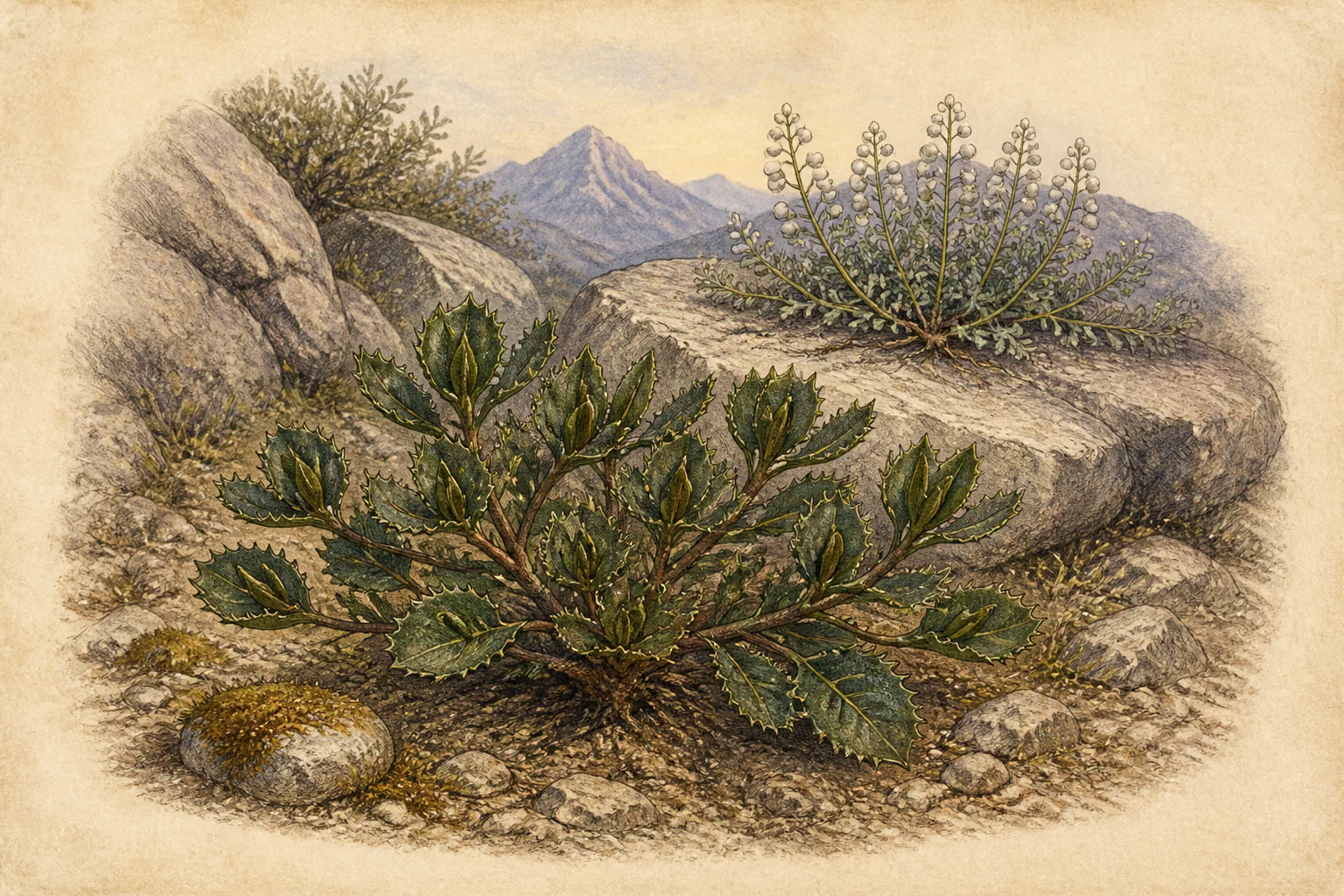
Hypoglossa folia habet figura silvestris myrti, coma spinosa, et in his ceu linguas folio parvo exeunte de foliis. capitis dolores corona ex iis inposita minuit.— Hypecoon in segetibus nascitur, foliis rutae. natura eius eadem quae papaveris suco.
Idaeae herbae folia sunt quae oxymyrsines. adh aerent iis velut pampini, in quibus flos. ipsa alvum mensesque et omnem abundantiam sanguinis sistit spissandi cohibendique natura. — Isopyron aliqui phaselion vocant, quoniam folium, quod est aneso simile, in passeoli pampinos torquetur. capitula sunt in summo caule tenuia, plena seminis melanthi, contra tussim et cetera pectoris vitia cum melle aut aqua mulsa, item iocineri utilissimi.
Lathyris folia habet multa lactucae similia, tenuiora, germina multa, in quibus semen tuniculis continetur, ut capparis, quae cum inaruere, eximuntur grana piperis magnitudine, candida, dulcia, facilia purgatu. haec vicena in aqua pura aut mulsa pota hydropicos sanant; trahunt et bilem. qui vehementius purgari volunt, cum folliculis ipsis sumunt ea, nam stomachum laedunt; itaque inventum est ut cum pisce aut iure gallinacei sumerentur.— Leontopetalon alii rapadion vocant, folio brassicae, caule semipedali. alae numerosae, semen in cacumine in siliqiis ciceris modo, radix rapo similis, grandis, nigra. nascitur in arvis. radix adversatur omnibus serpentium generibus ex vino pota, nec alia res celerius proficit. datur et ischiadicis. — Lycapsos longioribus quam lactucae foliis crassioribusque, cauli longo hirsutis adgnatis, multis, cubitalibus, flore parvo, purpureo; nascitur in campestribus. inlinitur cum farina hordeacea igni sacro; sudores in febribus movet suco aquae calidae admixto. — Inter omnes herbas lithospermo mihil est mirabilius. aliqui exonychon vocant, alii διὸς πυρόν, alii ʽἡρακλέους. herba quincuncialis fere, foliis duplo maioribus quam rutae, ramulis surculosis, crassitudine iunci. gerit iuxta folia singulas veluti barbulas et in earum cacuminibus lapillos candore et rotunditate margaritarum, magnitudine ciceris, duritia vero lapidea. ipsi, qua pediculis adhaereant, cavernulas habent et intus semen. nascitur et in Italia, sed laudatissimum in Creta, nec quicquam inter herbas maiore equidem miraculo aspexi. tantus est decor velut aurificum arte alternis inter folia candicantibus margaritis, tam exquisita difficultas lapidis ex herba nascentis. iacere atque humi serpere auctores tradunt; ego volsam, non haerentem vidi. his lapillis drachmae pondere potis in vino albo calculos frangi pellique constat et stranguriam discuti. neque in alia herbarum fides est certior, ad quam medicinam nata sit, talis autem eius species, ut etiam sine auctore visu statim nosci possit.— Lapis vulgaris iuxta flumina fert muscum siccum, canum. hic fricatur altero lapide addita hominis saliva; illo lapide tangitur inpetigo. qui tangit, dicit:
φεύγετε κανθαρίδες, λύκος ἄγριος αἷμα διώκει.
Limeum herba appellatur a Gallis, qua sagittas in venatu tingunt medicamento, quod venenum cervarium vocant. ex hac in III modios salivati additur quantum in unam sagittam addi solet; ita offa demittitur boum faucibus in morbis. alligari postea ad praesepia oportet, donec purgentur—insanire enim solent—; si sudor insequetur, aqua frigida perfundi. — Leuce Mercuriali similis nomen ex causa accepit, per medium folium candida linea transcurrente, quare mesoleucon quidam vocant. sucus eius fistulas sanat, ipsa contrita carcinomata. fortassis eadem sit quae leucas appellatur, contra marina omnia venena efficax. speciem eius auctores non tradunt nec aliud quam silvestrem latioribus foliis esse, efficaciorem hanc semine acriore.— Leucographis qualis esset, scriptum non repperi, quod eo magis miror, quoniam utilis proditur sanguinem excreantibus III obolis cum croco, item coeliacis, trita ex aqua et adposita profluvio feminarum, oculorum quoque medicamentis et explendis ulceribus, quae fiant in teneris partibus.
English · Bostock & Riley 1855–57
The hypoglossa is a plant with leaves like those of the wild myrtle, of a concave form, prickly, and presenting another small leaf within, resembling a tongue in shape. A wreath made of these leaves, placed upon the head, alleviates headache.
Hypecoön is a plant found growing in corn-fields, with leaves like those of rue. Its properties are similar to those of juice of poppies.
The Idæan plant has leaves like those of the oxymyrsine; to which leaves a sort of tendril adheres, that bears a flower. This plant arrests diarrhœa, the catamenia, when in excess, and all kinds of hæmorrhage. It is of an astringent and repercussive nature.
The isopyron is called “phasiolon” by some, from the circumstance that the leaf of it, which resembles that of anise, assumes a spiral form like the tendrils of the phasiolus. At the summit of the stem, it bears small heads full of a seed like that of melanthium. These heads, taken with honey or hydromel, are good for cough and other affections of the chest; they are extremely useful also for liver complaints.
The lathyris has numerous leaves like those of the lettuce, with numbers of small buds, in which the seed is contained, enclosed in envelopes like that of the caper. When these buds are dry, the seeds, about the size of a peppercorn, are taken out: they are white, sweet, and easily cleansed from the husk. Twenty of them, taken in pure water or in hydromel, are curative of dropsy, and carry off bile. Persons who require a stronger purgative, take them with the husks on. They are apt, however, to be injurious to the stomach; for which reason a plan has been adopted of taking them with fish or else chicken broth.
The leontopetalon is called “pardalion” by some: it has a leaf like that of the cabbage, and a stem half a foot in height, with numerous lateral branches, and a seed at the extremities of them, enclosed in pods like those of the chick-pea. The root resembles that of rape, and is large and black: it grows in plough lands. The root, taken in wine, neutralizes the venom of all kinds of serpents; indeed, there is nothing known that is more speedily efficacious for that purpose. It is given also for sciatica.
The lycapsos has longer and thicker leaves than those of the lettuce, and a long, hairy stem, with numerous offshoots a cubit in length; the flower is diminutive, and of a purple colour; it grows in champaign localities. In combination with barley-meal, it is used as an application for erysipelas: the juice of it, mixed with warm water, is employed as a sudorific, in fevers.
Among all the plants, however, there is none of a more marvellous nature than the lithospermum, sometimes called “exonychon,” “diospyron,” or “heracleos.” It is about five inches in height, with leaves twice the size of those of rue, and small ligneous branches, about the thickness of a rush. It bears close to the leaves a sort of fine beard or spike, standing by itself, on the extremity of which there are small white stones, as round as a pearl, about the size of a chick-pea, and as hard as a pebble. These stones, at the part where they adhere to the stalk, have a small cavity, and contain a seed within.
This plant is found in Italy, no doubt, but that of Crete is the most esteemed. Among all the plants, there is none that I ever contemplated with greater admiration than this; so beauteous is the conformation, that it might be fancied that the hand of an artist had arranged a row of lustrous pearls alternately among the leaves; so exquisite too the nicety in thus making a stone to grow upon a plant! The authorities say that this is a creeping plant, and that it lies upon the ground; but for my own part, I have only seen it when plucked, and not while growing. It is well known that these small stones, taken in doses of one drachma, in white wine, break and expel urinary calculi, and are curative of strangury. Indeed, there is no plant that so instantaneously proclaims, at the mere sight of it, the medicinal purposes for which it was originally intended; the appearance of it, too, is such, that it can be immediately recognized, without the necessity of having recourse to any botanical authority.
There grows near running streams, a dry, white moss, upon ordinary stones. One of these stones, with the addition of human saliva, is rubbed against another; after which the first stone is used for touching impetigo, the party so doing uttering these words:—
Φεύγετε κανθαρίδες, λύκος ἄγριος αἷμα διώκει
“Cantharides begone, a wild wolf seeks your blood.”
Limeum is the name given by the Gauls to a plant, in a preparation of which, known to them as “deer’s poison,” they dip their arrows when hunting. To three modii of salivating mixture they put as much of the plant as is used for poisoning a single arrow; and a mess of it is passed down the throat, in cases where oxen are suffering from disease, due care being taken to keep them fastened to the manger till they have been purged, as they are generally rendered frantic by the dose. In case perspiration supervenes, they are drenched all over with cold water.
Leuce, a plant resembling mercurialis, has received its name from the circumstance that a white line runs through the middle of the leaf; for which reason also, some give it the name of “mesoleucon.” The juice of this plant is curative of fistula, and the plant itself, bruised, is good for carcinomata. It is probably the same plant as that called “leucas,” so remarkably efficacious for the venom of all kinds of marine animals. Authors have not given a description of it, beyond telling us that the wild leucas has larger leaves than the other, and has properties more strongly developed: they state also that the seed of the cultivated kind is the more acrid of the two.
I have not found a description given by any writer of the leucographis; a thing I am the more surprised at, as they tell us that it is good for the cure of spitting of blood, taken in doses of three oboli with saffron; as also that it is useful for cœliac affections, applied beaten up in water, and in cases of excessive menstruation. They state also that it enters into the composition of ophthalmic preparations, and that it fills up ulcers on the more tender parts of the body with new flesh.