LIBER XXVII · CAPUT 4
ÆTHIOPIS: FOUR REMEDIES
Latine · Mayhoff 1906
Aethiopis folia habet phlomo similia, magna ac multa et hirsuta, ab radice, caulem quadriangulum, scabrum, similem arctio, multis concavum alis, semen ervo simile, candidum, geminum, radices numerosas, longas, plenas, molles, glutinosas gustu. siccae nigrescunt indurescuntque, ut cornua videri possint. praeter Aethiopiam nascuntur et in Ida monte Troadis et in Messenia. colliguntur autumno, siccantur in sole aliquot diebus, ne situm sentiant. medentur volvis potae in vino albo, ischiadicis, pleuriticis, faucibus scabris decoctae potui dantur. sed quae ex Aethiopia venit, eximie atque ilico prodest. — Ageraton ferulacea est, duorum palmorum altitudine, origano similis, flore bullis aureis. huius ustae nidor urinam ciet volvasque purgat, tanto magis insidentibus. causa nominis [non haec, sed] quoniam diutissime non marcescit. — Aloe scillae similitudinem habet, maior et pinguioribus foliis, ex obliquo striata. caulis eius tener est, rubens medius, non dissimilis antherici, radice una, ceu palo in terram demissa; ipsa gravis odore, gustu amara. laudatissima ex India adfertur, sed nascitur et in Asia, non tamen ea to utuntur nisi ad volnera recentibus foliis, mirifice enim conglutinant suco. ob id in turbinibus cadorum eam serunt ut aizoum maius. quidam et caulem ante maturitatem seminis incidunt suci gratia, aliqui et folia. invenitur et per se lacrima adhaerens; ergo pavimentandum ubi sata sit censent, ut lacrima non absorbeatur. fuere qui traderent in Iudaea super Hierosolyma metallicam eius naturam, sed nulla magis inproba est, neque alia nigrior est aut umidior. erit ergo optima pinguis ac nitida, rufi coloris, friabilis et iocineris modo coacta, facile liquescens; inprobanda nigra et dura, harenosa, quaeque gustu intellegitur, cummi adulterata et acacia. natura eius spissare, densare et leniter calfacere; usus multi, sed principalis alvum solvere, cum paene sola medicamentorum, quae id praestant, confirmet etiam stomachum, adeo non infestet ulla vi contraria. bibitur drachma, ad stomachi vero dissolutionem in II cyathis aquae tepidae vel frigidae coclearis mensura bis terve in die ex intervallis, ut res exigit, purgationis autem causa plurimum III drachmis, efficacior, si pota ea sumatur cibus. capillum fluentem continet cum vino austero capite contra pilum peruncto. dolorem capitis sedat temporibus et fronti inposita ex aceto et rosaceo dilutiorque infusa. oculorum vitia omnia sanari ea convenit, privatim prurigines et scabritiem genarum, item insignita ac livida inlita cum melle, maxime Pontico, tonsillas, gingivas et omnia oris ulcera, sanguinis excreationes, si modicae sint, drachma ex aqua, si minus, ex aceto pota. vulnerum quoque sanguinem et undecumque fluentem sistit per se vel ex aceto. alias etiam est vulneribus utilissima ad cicatricem perducens. eadem inspergitur exulceratis genitalibus virorum, condylomatis rimisque sedis, alias ex vino, alias ex passo, alias sicca per se, ut exigat mitiganda curatio aut coercenda. haemorrhoidum quoque abundantiam leniter sistit. dysinteriae infunditur et, si difficilius concoquantur cibi, bibitur a cena modico intervallo et in regio morbo III obolis ex aqua; devorantur et pilulae cum melle decocto aut resina terebinthina ad purganda interiora. digitorum pterygia tollit. oculorum medicamentis lavatur, ut quod sit harenosissimum subsidat, aut torretur in testa pinnaque subinde versatur, ut possit aequaliter torreri.— Alcea folia habet similia verbenacae, quae aristereon cognominatur, caules II aut IIII, foliorum plenos, florem rosae, radices albas cum plurimum VI, cubitales, obliquas. nascitur in pingui solo nec sicco. usus radicis ex vino vel aqua dysintericis, alvo citae, ad rupta, convulsa.— Alypon cauliculus est, molli capite, non dissimile betae, acre gustu ac lentum mordensque vehementer et accendens. alvum solvit in aqua mulsa addito sale modico. minima potio II drachmarum, media IIII, maxima VI, eximia purgatione quibus datur e gallinaceoiure. — Alsine, quam quidam myosoton appellant, nascitur in lucis, unde et alsine dicta est. incipit a media hieme, arescit aestate media. cum prorepit, musculorum aures imitatur foliis. sed aliam docebimus esse quae iustius myosotis vocetur. haec eadem erat quae helxine, nisi minor minusque hirsuta esset. nascitur in hortis et maxime parietibus. cum teritur, odorem cucumeris reddit. usus eius ad collectiones inflammationesque, item eadem omnia quae helxines, sed infirmius. epiphoris peculiariter inponitur, item verendis ulceribusque cum farina hordeacia. sucus eius auribus infunditur. — Androsaces herba est alba, amara, sine foliis, folliculos in cirris habens et in his semen. nascitur in maritimis Syriae. maxime datur hydropicis drachmis II tusa aut decocta in aqua vel aceto vel vino; vehementer enim urinas ciet. datur et podagricis inliniturque. idem effectus et seminis. — Androsaemon sive, ut alii appellavere, ascyron non absimile est hyperico, de qua diximus, cauliculis maioribus densioribusque et magis rubentibus. folia alba, rutae figura, semen papaveris nigri. comae tritae sanguineo suco manant; odor est resinosus. gignitur in vineis, fere medio autumno effoditur suspenditurque. usus ad purgandam alvum tusae cum semine potaeque matutino vel a cena II drachmis in aqua mulsa vel vino vel aqua pura, potionis totius sextario. trahit bilem, prodest ischiadi maxime, sed postero die capparis radicem resinae permixtam devorare oportet drachmae pondere iterumque quadridui intervallo eadem facere, a purgatione autem ipsa robustiores vinum bibere, infirmiores aquam. inponitur et podagris et ambustis, et volneribus cohibens sanguinem. — Ambrosia vagi nominis et circa alias herbas fluctuati unam habet certam, densam, ramosam, tenuem, III fere palmorum, tertia parte radice breviore, foliis rutae circa imum caulem. in ramulis semen est uvis dependentibus, odore vinoso, qua de causa botrys a quibusdam vocatur, ab aliis Artemisia. Coronantur illa Cappadoces. usus eius ad ea, quae discuti opus sit.— Anonim quidam ononida malunt vocare, ramosam, as similem faeno Graeco, nisi fruticosior hirsutiorque esset. odore iucunda, post ver spinosa. estur etiam muria condita, recens vero margines ulcerum erodit. radix decoquitur in posca dolori dentium. eadem cum melle pota calculos pellit. comitialibus datur in oxymelite decocta ad dimidias. — Anagyros, quam aliqui acopon vocant, fruticosa est, gravis odore, flore oleris, semen in corniculis non brevibus gignit, simile renibus, quod durescit per messes. folia collectionibus inponuntur difficulterque parientibus adalligantur ita, ut a partu statim auferantur. quod si emortuus haereat et secundae mensesque morentur, drachma bibuntur in passo folia. sic et suspiriosis dantur et in vino vetere ad phalangiorum morsus. radix discutiendis concoquendisque adhibetur, semen commanducatum vomitiones facit.— Anonymos non inveniendo nomen invenit. adfertur e Scythia, celebrata Hicesio, non parvae auctoritatis medico, item Aristogitoni in volneribus praeclara, ex aqua tusa inposita, pota vero mammis praecordiisve percussis, item sanguinem excreantibus. putavere et bibendam volneratis. fabulosa arbitror quae adiciuntur, recentem eam, si uratur, in ferrum aut aes feruminari.—
English · Bostock & Riley 1855–57
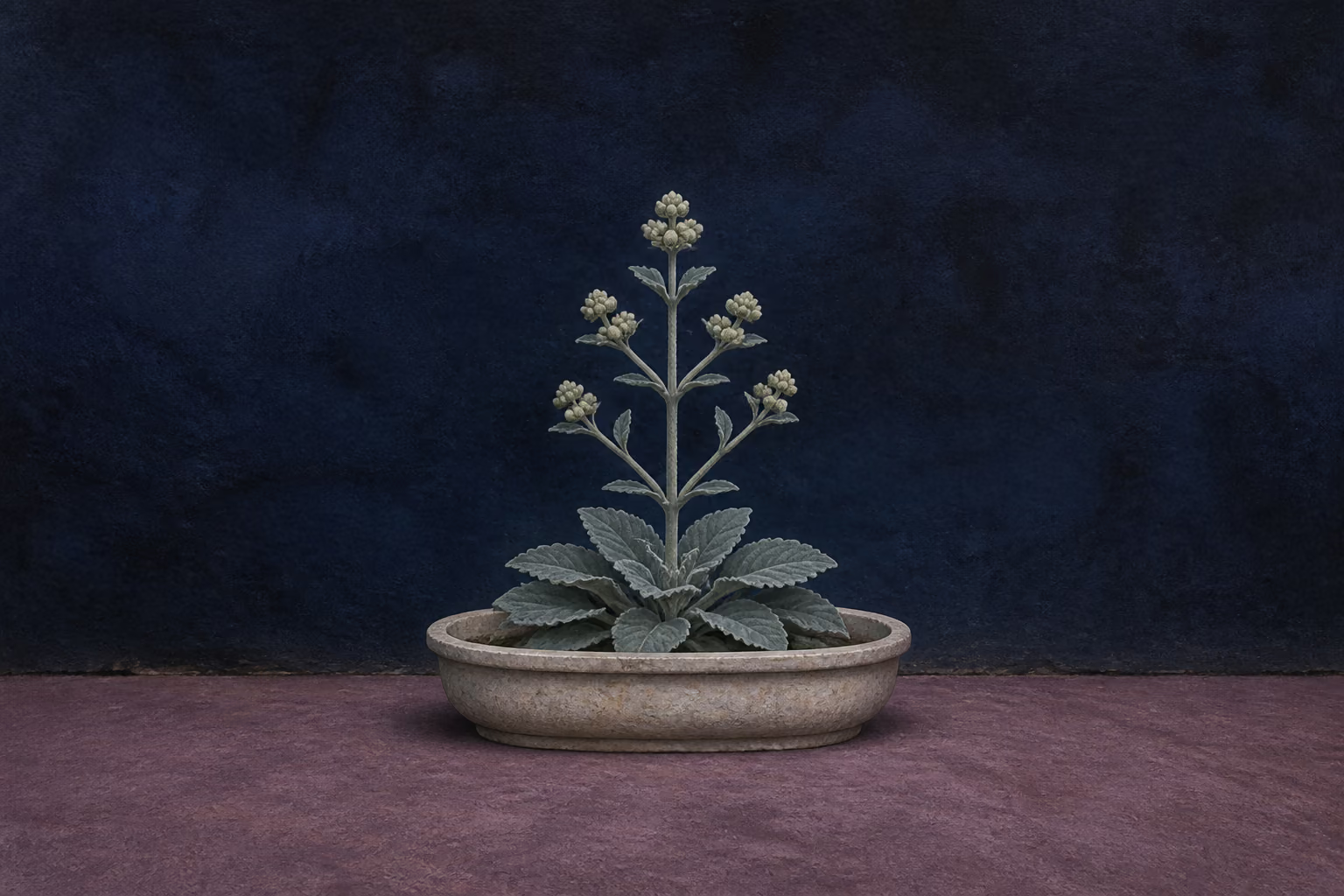
Æthiopis is a plant with leaves resembling those of phlomos, large, numerous, hairy, and springing from the root. The stem is square, rough, similar to that of arction in appearance, and with numerous axillary concavities. The seed resembles that of the fitch, being white and twofold; the roots are several in number, long, fleshy, soft, and of a viscous taste; when dry they turn black and hard, and might easily be taken for horns. In addition to Æthiopia, this plant grows upon Mount Ida in Troas, and in Messenia. The roots are gathered in autumn, and left to dry for some days in the sun, to prevent them from turning mouldy. Taken in white wine they are curative of affections of the uterus, and a decoction of them is administered for sciatica, pleurisy, and eruptions of the throat. The kind, however, which comes from Æthiopia, is by far the best, and gives instantaneous relief.
Ageraton is a ferulaceous plant, a couple of palms in height, similar to origanum in appearance, and bearing flowers like balls of gold. Used as a fumigation, this plant acts as a diuretic; and as a detergent upon the uterus, when used in a sitting bath more particularly. Its name has been given to it, from the circumstance that it keeps a very long time without fading.
The aloe bears a resemblance to the squill, except that it is larger, and has more substantial leaves, with streaks running obliquely. The stem is tender, red in the middle, and not unlike that of the anthericus. It has a single root, which runs straight downwards, like a stake driven into the ground; its smell is powerful, and it has a bitter taste. The most esteemed aloes are those imported from India, but it grows in the Asiatic provinces as well. This last kind, however, is never used, except that the leaves are applied fresh to wounds; indeed, these leaves, as well as the juice, are glutinous to a marvellous degree, and it is for this property that it is grown in vessels of a conical form, in the same way as the greater aizoüm. Some persons make incisions in the stem to obtain the juice, before the seed is ripe, while others, again, make them in the leaves as well. Tearlike drops are also found adhering to it, which exude spontaneously: hence it is that some recommend that the place should be paved where it is grown, to prevent this juice from being absorbed.
Some authors have stated, that there is found in Judæa, beyond Hierosolyma, a mineral aloe, but that it is inferior to the other kinds, being of a darker colour and more humid than any of the rest. Aloes of the finest quality should be unctuous and shining, of a red colour, brittle, compact, like the substance of liver, and easily liquefied. That which is hard and black should be rejected; the same, too, when it is mixed with sand or adulterated with gum and acacia, a fraud which, may be easily detected by the taste.
This plant is of an astringent nature, binding, and slightly calorific. It is employed for numerous purposes, but principally as a purgative, it being almost the only one of all the medicaments which produce that effect, that is at the same time a good stomachic, and does not exercise the slightest noxious influence upon the stomach. It is taken in doses of one drachma, and, in cases of derangement of the stomach, it is administered two or three times a day, in the proportion of one spoonful to two cyathi of warm or cold water, at intervals, according to the nature of the emergency. As a purgative it is mostly taken in doses of three drachmæ; and it operates still more efficaciously, if food is eaten directly afterwards. Used with astringent wine, it prevents the hair from falling off, the head being rubbed with it the contrary way of the hair, in the sun. Applied to the temples and forehead, with rose oil and vinegar, or used as an infusion, in a more diluted form, it allays head-ache. It is generally agreed that it is remedial for all diseases of the eyes, but more particularly for prurigo and scaly eruptions of the eye-lids; as also for marks and bruises, applied in combination with honey, Pontic honey in particular.
It is employed, also, for affections of the tonsillary glands and gums, for all ulcerations of the mouth, and for spitting of blood, if not in excess—the proper dose being one drachma, taken in water or else vinegar. Used by itself, or in combination, with vinegar, it arrests hæmorrhage, whether proceeding from wounds or from other causes. In addition to these properties, it is extremely efficacious for the cure of wounds, producing cicatrization very rapidly: it is sprinkled also upon ulcerations of the male organs, and is applied to condylomata and chaps of the fundament, either in common wine, raisin wine, or by itself in a dry state, according as a mollifying or restrictive treatment is required. It has the effect, also, of gently arresting hæmorrhoidal bleeding, when in excess. In cases of dysentery, it is used as an injection, and where the digestion is imperfect it is taken shortly after the evening meal. For jaundice, it is administered in doses of three oboli, in water. As a purgative for the bowels, it is taken in pills, with boiled honey or turpentine. It is good also for the removal of hangnails. When employed in ophthalmic preparations, it is first washed, that the more gravelly portions of it may subside; or else it is put over the fire in a pipkin, and stirred with a feather from time to time, that the whole of it may be equally warmed.
Alcea is a plant with leaves, resembling those of vervain, known also as “peristereon,” some three or four stems covered with leaves, a flower like that of the rose, and white roots, at most six in number, a cubit in length, and running obliquely. It grows in a soil that is rich without being dry. The root is given in wine or water, for dysentery, diarrhœa, ruptures, and convulsions.
The alypon has a small stem, with a soft head, and is not unlike beet in appearance. It has an acrid, viscous taste, extremely pungent and burning. Taken in hydromel, with a little salt, it acts as a purgative. The smallest dose is two drachmæ, a moderate dose, four, and the largest, six. When used as a purgative, it is taken in chicken broth.
Alsine, a plant known as “myosoton” to some, grows in the woods, to which fact it is indebted for its name of “alsine.” It begins to make its appearance at mid-winter, and withers in the middle of summer. When it first puts forth, the leaves bear a strong resemblance to the ears of mice. We shall have occasion, however, to speak of another plant which may, with much more justice, be called “myosotis.” As for alsine, it would be the same thing as helxine, were it not that it is smaller and not so hairy. It grows in gardens and upon walls more particularly: when rubbed, it emits a smell like that of cucumber. It is used for abscesses, inflammations, and all those purposes for which helxine is employed; its properties, however, are not so active. It is applied topically, also, to defluxions of the eyes, and to sores upon the generative organs, and ulcerations, with barley meal. The juice is used as an injection for the ears.
The androsaces is a white plant, bitter, without leaves, and bearing arms surmounted with follicules, containing the seed. It grows in the maritime parts of Syria, more particularly. This plant is administered for dropsy, in doses of two drachmæ, pounded or boiled, in either water, wine, or vinegar: it acts most powerfully as a diuretic. It is used also for gout, either taken internally or used as a liniment. The seed is possessed of similar properties.
Androsæmon or, as some persons call it, “ascyron,” is not unlike hypericon, a plant of which we have spoken already: the stems, however, are larger, redder, and lie more closely together. The leaves are of a white colour, and like those of rue in shape; the seed resembles that of the black poppy, and the upper branches, when bruised, emit a red juice the colour of blood: these branches have also a resinous smell.
This plant grows in vineyards, and it is usually in the middle of autumn that it is taken up and hung to dry. Used as a purgative, it is bruised with the seed, and taken in the morning or just after the evening meal, in doses of two drachmæ, in hydromel, wine, or pure water, the draught amounting to one sextarius in all. It carries off bile, and is particularly good for sciatica; but in this last case, caper root must be taken with resin the day after, the dose being one drachma, to be repeated every four days: after being purged, it is the practice for the patient, if in robust health, to take wine, but if in a weak state of body, water. It is employed topically, also, for gout, burns, and wounds, as it tends to arrest the flow of blood.
Ambrosia is a vague name, which has fluctuated between various plants: there is one, however, which has been more particularly designated by this appellation, a branchy, shrub-like plant, with a thin stem, some three palms in height; the root of it is one third shorter, and the leaves, towards the lower part of the stem, resemble those of rue. Its diminutive branches bear a seed which hangs down in clusters, and has a vinous smell: hence it is that by some persons the plant is called “botrys,” while to others it is known as “artemisia.” The people of Cappadocia use it for garlands. It is employed in medicine as a resolvent.
The anonis, by some called “ononis” in preference, is a branchy plant, and similar to fenugreek in appearance, except that it is more shrub-like and more hairy. It has an agreeable smell, and becomes prickly after spring. It is pickled in brine for eating. Applied fresh to ulcers, it cauterizes the margins of them. For the cure of tooth-ache, the root is boiled in oxycrate: taken in drink, with honey, the root expels urinary calculi. For epilepsy, it is administered in oxymel, boiled down to one half.
The anagyros, known to some by the name of “acopon,” is a shrub-like plant, with an offensive smell, and a blossom like that of the cabbage. The seed grows in small hornlike pods of considerable length and resembles a kidney in shape; it hardens about the time of harvest. The leaves of this plant are applied to gatherings, and are attached to the person in cases of difficult parturition, care being taken to remove them the moment after delivery. In cases where the extraction of the dead fœtus is attended with difficulty, or where the after-birth or catamenia are retarded, the leaves are taken, in doses of one drachma, in raisin wine. The leaves are administered in the same manner for asthma: they are prescribed also in old wine, for injuries inflicted by the phalangium. The root is employed medicinally as a resolvent and maturative: the seed, chewed, acts as an emetic.
The anonymos, through not having a name, has at last found one. It is brought from Scythia, and has been highly extolled by Hicesius, a physician of no small repute, as also by Aristogiton. Bruised in water and applied, it is remarkably useful for wounds, and taken in drink it is good for blows upon the chest or mamillæ, as also for spitting of blood: it has been thought, too, that it might be advantageously taken in a potion for wounds. I am of opinion that the additional statement, to the effect that, burnt fresh, it acts as a solder to iron or copper, is wholly fabulous.