LIBER XXVII · CAPUT 7
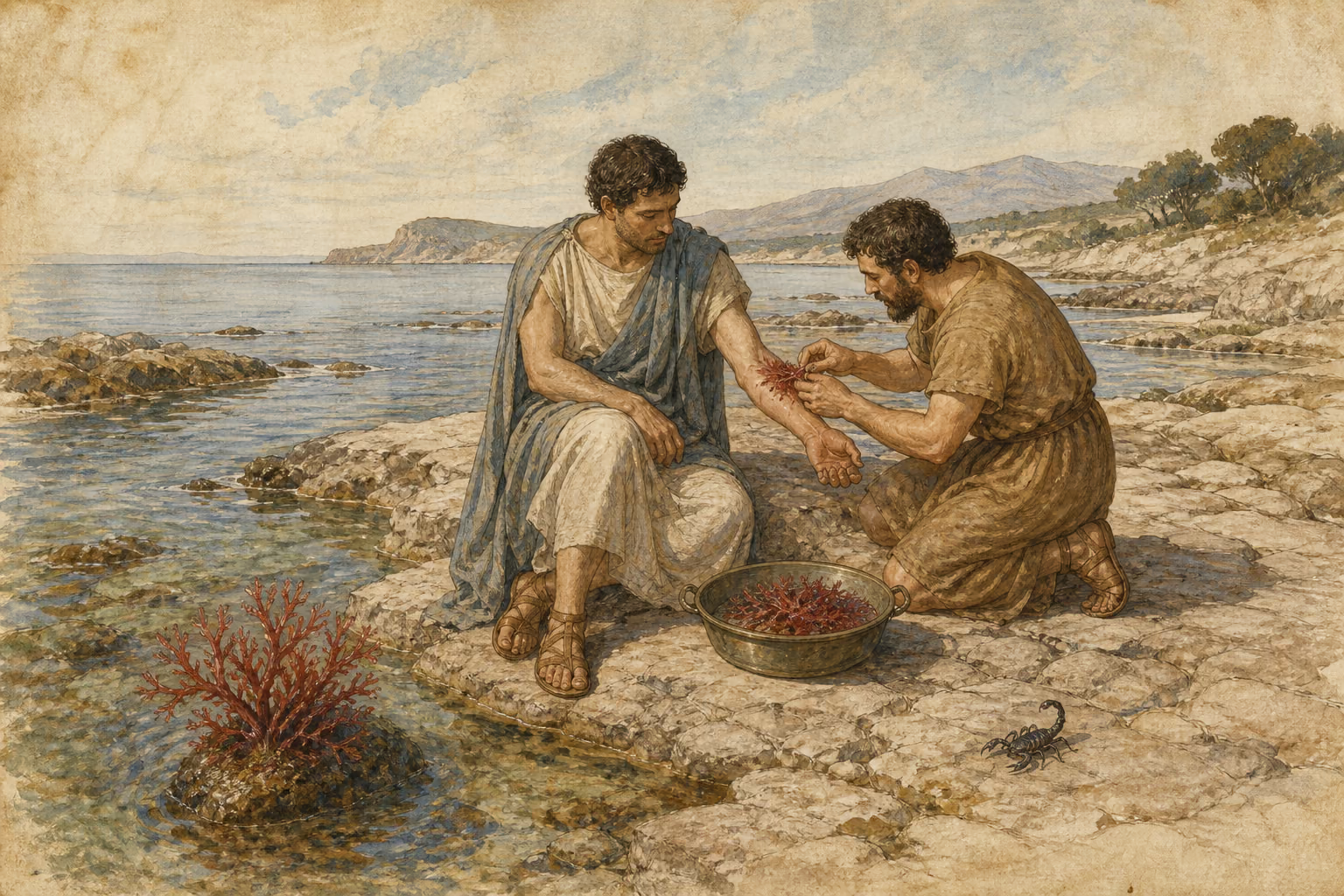
ALGA RUFA OR RED SEA-WEED: ONE REMEDY
Latine · Mayhoff 1906
alga rufa scorpionum ictibus.— Actaea gravi foliorum odore, caulibus asperis, geniculatis, semine nigro ut hederae, bacis mollibus, nascitur in opacis et asperis aquosisque. datur acetabulo pleno interioribus feminarum morbis. — Ampelos agria vocatur herba foliis duris, cineracei coloris, qualem in satis diximus, viticulis longis, callosis, rubentibus qualiter flos quam Iovis flammam appellamus. in uvolis fert semen simile Punici mali acinis. radix eius decocta in aquae cyathis ternis, additis vini Coi cyathis II, alvum solvit leniter ideoque hydropicis datur. uvolae vitia cutis in facie mulierum emendant. ischiadicos quoque uti hac herba prodest tusa cum foliis et inlita cum suco suo.
Absinthii genera plura sunt: Santonicum appellatur e Galliae civitate, Ponticum e Ponto, ubi pecora pinguescunt illo et ob id sine felle reperiuntur, neque aliud praestantius, multoque Italicum amarius, sed medulla Pontici dulcis. de usu eius convenit, herbae facillimae atque inter paucas utilissimae, praeterea sacris populi Romani celebratae peculiariter, siquidem Latinarum feriis quadrigae certant in Capitolio victorque absinthium bibit, credo, sanitatem praemio dari honorifice arbitratis maioribus. stomachum corroborat, et ob hoc sapor eius in vina transfertur, ut diximus. bibitur et decoctum aqua ac postea nocte et die refrigeratum sub diu; decoci VI drachmis foliorum cum ramis suis in caelestis aquae sextariis III oportet, nec non salem addi vetustissimi usus est. bibitur et madefacti dilutum; ita enim appelletur hoc genus. diluti ratio ut, quisquis fuerit modus aquae, tegatur per triduum. tritum raro in usu est, sicut et sucus expressi. exprimitur autem, cum primum semen turgescit, madefactum aqua triduo recens aut siccum VII diebus, dein coctum in aēneo vaso ad tertias x heminis in aquae sextariis XLV iterumque percolatum, herba electa, coquitur ad crassitudinem mellis, qualiter ex minore centaurio quaeritur sucus. sed hic [absinthii] inutilis stomacho capitique est, cum sit ille decoctus saluberrimus. namque adstringit stomachum bilemque detrahit, urinam ciet, alvum emollit et in dolore sanat, ventris animalia pellit, malaciam stomachi et inflationes discutit cum sile et nardo Gallico, aceti exiguo addito, fastidia absterget, concoctiones adiuvat, cruditates detrahit cum ruta et pipere et sale. antiqui purgationis causa dabant cum marinae aquae veteris sextario seminis VI drachmas cum III salis, mellis cyatho; efficacius purgat duplicate sale. diligenter autem teri debet propter difficultatem. quidam et in polenta dedere supra dictum pondus, addito puleio, alii pueris [folia] in fico sicca, ut amaritudinem fallerent. thoracem purgat cum iride sumptum. in regio morbo crudum bibitur cum apio aut adianto. adversus inflationes calidum paulatim sorbetur ex aqua, iocineris causa cum Gallico nardo, lienis cum aceto aut pulte aut fico sumitur. adversatur fungis ex aceto, item visco, cicutae ex vino et muris aranei morsibus, draconi marino, scorpionibus. oculorum claritati multum confert, epip]horis cum passo inponitur, suggillatis cum melle. aures decocti eius vapor suffitu sanat aut, si manent sanie, cum melle tritum. urinam ac menses cient III IIIIve ramuli cum Gallici nardi radice una, cyathis aquae VI, menses privatim cum melle sumptum et in vellere adpositum. anginae subvenit cum melle et nitro. epinyctidas ex aqua sanat, volnera recentia prius quam aqua tangantur inpositum, praeterea capitis ulcera. peculiariter ilibus inponitur cum Cypria cera aut cum fico. sanat et pruritus. non est dandum in febri. nausiam maris arcet in navigationibus potum, inguinum tumorem in ventrali habitum. somnos adlicit olfactum aut inscio sub capite positum. vestibus insertum tineas arcet. culices ex oleo perunctis abigit et fumo, si uratur. atramentum librarium ex diluto eius temperatum litteras a musculis tuetur. capillum denigrat absinthii cinis unguento rosaceoque permixtus. — Est et absinthium marinum, quod quidam seriphum vocant, probatissimum in Taposiri Aegypti. huius ramum Isiaci praeferre sollemne habent. angustius priore minusque amarum, stomacho inimicum, alvum mollit pellitque animalia interaneorum. bibitur cum oleo et sale aut in farinae trimestris sorbitione dilutum. coquitur quantum manus capiat in aquae sextario ad dimidias.
English · Bostock & Riley 1855–57
Red sea-weed is useful as an application for the sting of the scorpion.
Actæa has leaves with a powerful smell, rough knotted stems, a black seed like that of ivy, and soft berries. It grows in umbrageous, rugged, watery localities; and is used, in doses of one full acetabulum, for female complaints.
Ampelos agria, or wild vine, is the name of a plant with leaves of an ashy colour, as already stated in our description of the cultivated plants, and long, tough twigs of a red hue, like that of the flower which we have mentioned, when speaking of violets, under the name of “flame of Jove.” It bears a seed which resembles the grains of the pomegranate. The root, boiled in three cyathi of water, with the addition of two cyathi of Coan wine, is slightly laxative to the bowels, and is consequently given for dropsy. It is curative also of uterine affections, and of spots upon the face in females. It is found a good plan for patients afflicted with sciatica to use the juice of this plant, bruised, applied topically, with the leaves.
There are numerous kinds of absinthium; the Santonic, for instance, so called from a city in Gaul, and the Pontic, which comes from Pontus, where the cattle are fattened upon it—a diet which causes them to be destitute of gall. The Pontic wormwood, we may remark, is of the finest quality, superior to that of Italy, and much more bitter; the pith, however, of the Pontic wormwood is sweet. As to its general utility, a plant so commonly found and applied to such numerous uses, people are universally agreed; but with the Romans more particularly it has been always held in the highest esteem, from the fact of its being employed in their religious ceremonials. Thus, for instance, upon the Latin Festival, it is the custom to have a race of four-horsed chariots in the Capital, and for the conqueror to be presented with a draught of wormwood; from the circumstance, no doubt, that our forefathers were of opinion that good health was the most valuable reward they could bestow upon his skill.
This plant is very strengthening to the stomach, and hence it is that wines are flavoured with it, as already stated. A decoction of it in water is also taken, the following being the method employed in preparing it. Six drachmæ of the leaves are boiled, with the branches, in three sextarii of rain water, and the preparation is then left to cool in the open air a day and a night. Salt, too, should be added to it. When old, it is utterly useless. A dilution of wormwood steeped in water is also used, such being the name given to this method of preparing it. This dilution is made by leaving the vessel covered up for three days, any kind of water being used. Pounded wormwood is but rarely employed, and the same with the extracted juice of the seed. In cases, however, where it is extracted, the seed is subjected to pressure as soon as it begins to swell, after which it is soaked for three days in water, if used fresh, and seven, if dry. It is then boiled in a copper vessel, in the proportion of ten heminæ to forty-five sextarii of water, after which it is strained off and boiled gently to the consistency of honey, in the same way as the juice is extracted from the smaller centaury. The juice, however, of wormwood, thus extracted, is bad for the head and stomach; whereas the decoction, on the other hand, is wholesome in the highest degree, as it acts astringently upon the stomach, carries off bile, is a powerful diuretic, has a soothing effect upon the bowels, and assuages pains in the intestines. With the addition of sile, Gallic nard, and a little vinegar, it dispels nausea and flatulency, and expels intestinal worms. It removes qualmishness, promotes the digestion, and, with the addition of rue, pepper, and salt, disperses crudities of the stomach.
The ancients were in the habit of giving wormwood as a purgative, the dose being six drachmæ of the seed with three of salt and one cyathus of honey, in one sextarius of sea water kept for some time. This preparation, however, is rendered more efficacious by doubling the proportion of salt; the seed, too, must be bruised with the greatest care, as there is considerable difficulty in pounding it. Some authorities have prescribed the dose above mentioned to be given in polenta, with the addition of pennyroyal; while others recommend the leaves to be given to children in a dried fig, to disguise their bitterness. Taken with iris, wormwood acts as a detergent upon the thoracic organs: for jaundice it is used raw, with parsley or adiantum. In cases of flatulency, it is sipped every now and then, warmed in water; for liver complaints it is taken with Gallic nard, and for diseases of the spleen, with vinegar, pap, or figs. Taken in vinegar it neutralizes the bad effects of fungi and of viscus: in wine it is an antidote to the poison of hemlock, and to the bite of the shrew-mouse, and is curative of wounds inflicted by the sea-dragon and the scorpion. It contributes also very greatly to the improvement of the sight, and is used as an external application, with raisin wine, for defluxions of the eyes, and with honey, for bruises.
The steam of a decoction of wormwood is curative of affections of the ears; and when they are attacked with running sores, a liniment of wormwood bruised with honey is applied. Three or four sprigs of wormwood, with one root of Gallic nard, taken in six cyathi of water, act as a diuretic and as an emmenagogue; indeed, if taken with honey, or employed as a pessary with wool, it has especial virtues as an emmenagogue. In combination with honey and nitre it is useful for quinzy, and an infusion of it in water is good for epinyctis. A topical application is made of it for recent wounds, provided always they have not been touched with water: it is employed also for ulcers upon the head. In combination with Cyprian wax or figs, it is highly recommended as a plaster for the iliac regions: it is curative also of prurigo, but it must never be administered in fevers. Taken in drink, it is a preventive of sea sickness; and, worn attached to the body, beneath an apron, it arrests inguinal swellings. The smell of it induces sleep, a similar effect being produced by placing it under the pillow unknown to the party. Kept among clothes it preserves them from worms, and used as a liniment, with oil, or burnt as a fumigation, it has the effect of driving away gnats.
Writing ink, mixed with an infusion of wormwood, effectually protects the writings from the attacks of mice. Ashes of wormwood, mixed with rose unguent, stain the hair black.
There is a sea wormwood also, known as “seriphum” by some, the most esteemed being that of Taposiris in Egypt. Those initiated in the mysteries of Isis carry a branch of it in the hand. It has a narrower leaf than the preceding plant, and is not so bitter; it is injurious to the stomach, has a laxative effect upon the bowels, and expels intestinal worms. It is taken in drink with oil and salt; or else an infusion of it is taken in a pottage made of meal of three-month wheat. When employed as a decoction, a handful is used to one sextarius of water, the mixture being boiled down to one half.