LIBER XXVII · CAPUT 8
THE BALLOTES, MELAMPRASION, OR BLACK LEEK: THREE REMEDIES
Latine · Mayhoff 1906
Balloten alio nomine porrum nigrum Graeci vocant, herbam fruticosam angulosis caulibus, nigris, hirsutis, foliis vestientibus maioribus quam porri et nigrioribus, graveolentibus. vis eius efficax adversus canis morsus ex sale foliis tritis inpositae, item ad condylomata coctis cinere in folio oleris. purgat et sordida ulcera cum melle. — Botrys fruticosa herba est luteis ramulis. semen circa totos nascitur, folia cichorio similia. invenitur in torrentium ripis. medetur orthopnoicis. hoc Cappadoces ambrosiam vocant, alii Artemisiam.— Brabilla spissandi vim habet cotonei mali modo, nec amplius de ea tradunt auctores. — Bryon marinum herba sine dubitatione est lactucae foliis similis, rugosa velut contracta, sine caule ab una radice exeuntibus foliis. nascitur in scopulis maxime testisque terra conprehensis. praecipua siccandi spissandique vis ei et collectiones inflammationesque omnes inhibendi, praecipue podagrae et quicquid refrigerari opus sit. — Bupleuri semen ad ictus serpentium dari reperio foverique plagas decocta ea herba adiectis foliis mori aut origani.
Catanancen Thessalam herbam, qualis sit, describi a nobis supervacuum est, cum sit usus eius ad amatoria tantum. illud non ab re est dixisse ad detegendas magicas vanitates, electam ad hunc usum coniectura, quoniam arescens contraheret se ad speciem unguium milui exanimati. eadem ex casa et cemos silebitur nobis.— Calyx duorum generum est. una similis aro nascitur in arationibus, colligitur ante quam inarescat. usus eosdem habet quos aris, at bibitur radix quoque huius ad exinaniendas alvos mensesque mulierum, item caules cum foliis in leguminibus decocti sanant tenesmon. alterum genus eius quidam anchusam vocant, alii rhinocliam. folia lactucae longiora, plumosa, radice rubra, quae ignes sacros cum flore polentae sanat inposita, iocineris autem vitia in vino albo pota. — Circaea trychno sativo similis est, flore nigro, pusillo, parvo semine milii nascente in quibusdam corniculis, radice semipedali, triplici fere aut quadruplici, alba, odorata, gustus calidi. nascitur in apricis saxis. diluitur in vino bibiturque ad dolorem vulvae et vitia —macerari oportet in sextariis III quadrantem radicis tusae nocte et die—et trahit eadem potione secundas, semine lac [minuit ] in vino aut mulsa aqua poto. — Cirsion cauliculus est tener II cubitorum, triangulo similis, foliis spinosis circumdatus. spinae molles sunt; folia bovis linguae similia, minora, subcandida, in cacumine capitula purpurea, quae solvuntur in lanugines. hanc herbam radicemve eius adalligatam dolores varicum sanare tradunt. — Crataegonon spicae tritici simile est, multis calamis ex una radice emicantibus multorumque geniculorum, in opacis, semine milii, vehementer aspero gustu, quod si bibant ex vino ante cenam III obolis in cyathis aquae totidem mulier ac vir ante conceptum diebus XL, virilis sexus partum futurum aiunt. et alia est crataegonos, quae thelygonos vocetur; differentia intellegitur lenitate gustus. sunt qui florem crataegoni bibentes mulierum intra XL diem concipere tradant. eadem sanant ulcera vetera nigra cum melle et explent sinus ulcerum et atropha carnosiora faciunt, purulenta expurgant; panos discutiunt, podagras collectionesque omnes leniunt, peculiariter mammarum. Theophrastus arboris genus intellegi voluit crataegon sive crataegona, quam Itali aquifolium vocant. — Crocodileon chamaeleonis herbae nigrae figuram habet, radice longa, aequaliter crassa, odoris asperi. nascitur in sabuletis. pota sanguinem per nares pellit copiosum crassumque; itaet lienes consumere dicitur. — Cynosorchim aliqui orchim vocant, foliis oleae, mollibus, ternis per semipedem longitudinis in terra stratis, radice bulbosa, oblonga, duplici ordine, superiore quae durior est, inferiore quae mollior. eduntur, ut bulbi coctae, in vineis fere inventae. ex his radicibus si maiorem edant viri, mares generari dicunt, si minorem feminae, alterum sexum. in Thessalia molliorem in lacte caprino viri bibunt ad stimulandos coitus, duriorem vero ad inhibendos. adversantur altera alteri.— Chrysolachanum in pineto lactucae simile nascitur. sanat nervos incisos, si confestim inponatur. et alibi genus chrysolachani traditur, flore aureo, foliis oleris. coctum estur ut olus molle. haec herba adalligata morbum regium habentibus ita, ut spectari ab his possit, sanare id malum traditur. de chrysolachano nec satis dici scio nec plura reperio. namque et hoc vitio laboravere proximi utique herbarii nostri, quod ipsis notas veluti vulgares strictim et nominibus tantum indicavere, tamquam coagulo terrae alvum sisti, stranguriam dissolvi, si bibatur ex aqua aut vino, cuculli folia trita cum aceto serpentium ictibus et scorpionum mederi. quidam hanc alio nomine strumum appellant, alii Graece strych- num. acinos habet nigros; ex his cyathus suci cum mulsi II medetur lumbis, item capitis dolori cum rosaceo infusus, ipsa strumae inlita.— Peculiaris est Alpinis maxime fluminibus conferva appellata a conferuminando, spongea aquarum dulcium verius quam muscus aut herba, villosae densitatis atque fistulosae. curatum ea scio omnibus fere ossibus confractis prolapsum ex arbore alta putatorem, circumdata universo corpori, aquam suam adspergentibus, quotiens inaresceret, raroque nec nisi deficientem herbam mutationis causa resolventibus, convaluisse vix credibili celeritate. —
English · Bostock & Riley 1855–57
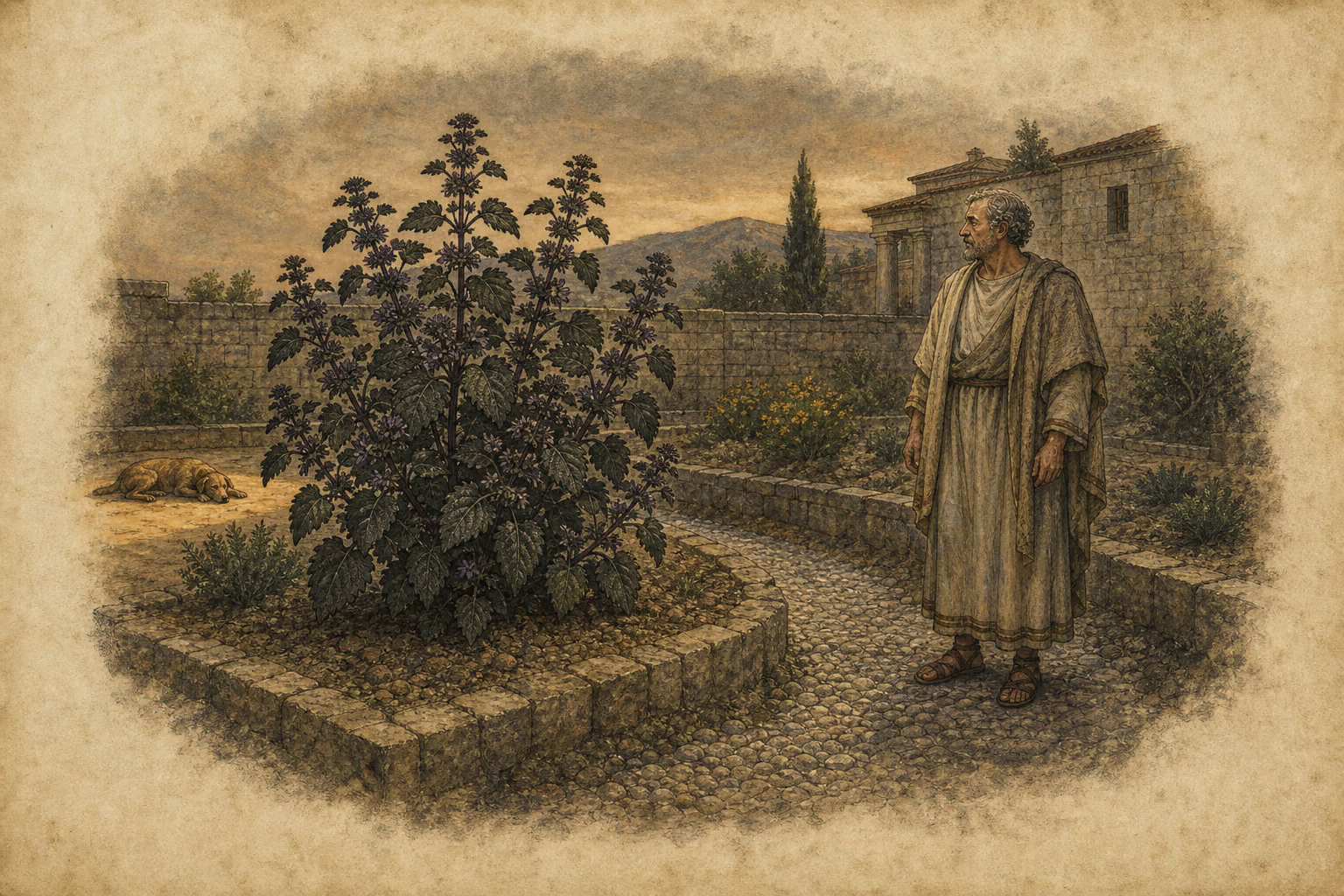
The Greeks give to the ballotes the other name of “melamprasion,” meaning “black leek.” It is a branchy plant, with black angular stems, covered with hairy leaves, larger and darker than those of the leek, and possessed of a powerful smell. The leaves, bruised and applied with salt, are highly efficacious for bites inflicted by dogs: cooked upon hot ashes and applied in a cabbage leaf, they are curative of condylomata. Mixed with honey, this plant acts as a detergent upon sordid ulcers.
Botrys is a shrublike plant, which has small yellow branches, with the seed growing all round them, and leaves resembling those of endive. It is found upon the banks of running streams, and is used for the cure of hardness of breathing. The people of Cappadocia call this plant “ambrosia,” others again, “artemisia.”
The brabyla is possessed of astringent properties like those of the quince, but beyond this, authors give no particulars relative to it.
Sea bryon is a plant, no doubt, with leaves like those of the lettuce, of a wrinkled, pursed appearance, and destitute of stem, the leaves arising from a single root: it grows upon rocks more particularly, and shells sunk in the sand. It has desiccative and astringent qualities in a very high degree, properties which render it useful for reducing all kinds of abscesses and inflammations, those attendant upon gout in particular. It is good also for all affections which stand in need of cooling applications.
I find it stated that seed of bupleuron is given for injuries inflicted by serpents; and that the wound is fomented with a decoction of the plant, in combination with leaves of the mulberry or of origanum.
The catanance is a Thessalian plant, which it would be a mere loss of time to describe, seeing that it is only used as an ingredient in philtres. In order, however, to expose the follies of the magical art, it may not be out of place to remark that this plant has been selected for the above-named purpose, from the fact that, as it withers, it gradually contracts and assumes the shape of the claws of a dead kite.
For a similar reason we shall give no description of the plant called “cemos.”
Of the calyx there are two kinds. One of these resembles arum, and is found growing in ploughed soils; the proper time for gathering it being before it begins to wither. It is employed for the same purposes as arum; and an infusion of the root is taken as a purgative and as an emmenagogue. The stalks, boiled with the leaves and some pulse, are curative of tenesmus.
The other kind of calyx is known by some persons as “anchusa,” and by others as “onoclia.” The leaves are like those of the lettuce, but longer, and with a downy surface. The root is red, and is employed topically, in combination with fine polenta, for the cure of erysipelas: taken internally with white wine, it is good for affections of the liver.
The circæa resembles the cultivated trychnon in appearance. It has a small swarthy flower, a diminutive seed, like millet, growing in small horn-shaped pods, and a root half a foot in length, generally triple or fourfold, white, odoriferous, and hot in the mouth. It is found growing upon rocks exposed to the sun. An infusion of it is prepared with wine, and administered for pains and affections of the uterus: to make it, three ounces of the pounded root should be steeped in three sextarii of wine a day and a night. This potion is effectual also for bringing away the after-birth. The seed of this plant, taken in wine or hydromel, diminishes the milk in nursing women.
The cirsion is a plant consisting of a diminutive and delicate stem, two cubits in height, of a triangular form, and covered with prickly leaves. The prickles on the leaves are downy, and the leaves themselves resemble those of buglossos in shape, but are smaller, and of a whitish colour. At the summit of the plant there are small purple heads, which fall off in the shape of down. This plant or the root of it, worn as an amulet, it is said, is curative of the pains attendant upon varicose veins.
The cratægonon is similar to an ear of corn in appearance. It is formed of numerous shoots, springing from a single root, and full of joints. It grows in umbrageous localities, and has a seed like that of millet, with a remarkably acrid taste. If a man and woman, before the evening meal, take three oboli of this seed in three cyathi of water, for forty days consecutively, before the conception of their issue, it will be sure to be of the male sex, they say.
There is another cratægonon, known also as “thelygonos,” and distinguished from the last mentioned plant by the mildness of the taste. Some persons assert that females, if they take the blossom of this plant in drink, will be sure to conceive before the end of forty days. These plants, used in combination with honey, are curative of black ulcers of a chronic nature; they also fill the concavities made by fistulous ulcers with new flesh, and restore such parts of the body as are wasted by atrophy. They act as a detergent upon purulent sores, disperse inflammatory tumours, and alleviate gout and all kind of abscesses, those of the mamillæ in particular.
Under the name of “cratægos” or “cratægon,” Theophrastus speaks of the tree known in Italy as the “aquifolia.”
The crocodileon resembles the black chamæleon in shape: the root is long, of an uniform thickness, and possessed of a pungent smell. It is found growing in sandy soils. Taken in drink, it causes a copious discharge of coagulated blood at the nostrils, and in this way, it is said, diminishes the volume of the spleen.
The cynosorchis, by some called “orchis,” has leaves like those of the olive, soft, three in number, half a foot in length, and lying upon the ground. The root is bulbous, oblong, and divided into two portions, the upper one hard, and the lower one soft. These roots are eaten boiled, like bulbs, and are mostly found growing in vineyards. If males eat the upper part, they will be parents of male issue, they say, and females, if they eat the lower part, of female. In Thessaly, the men take the soft portion in goats’ milk as an aphrodisiac, and the hard part as an antaphrodisiac. Of these parts, the one effectually neutralizes the action of the other.
The chrysolachanum grows in pine plantations, and is similar to the lettuce in appearance. It heals wounds of the sinews, if applied without delay. There is another kind of chrysolachanum mentioned, with a golden flower, and a leaf like that of the cabbage: it is boiled and eaten as a laxative vegetable. This plant, worn as an amulet by a patient suffering from jaundice, provided it be always kept in sight, is a cure for that disease, it is said. I am not certain whether this is all that might be said about the chrysolachanum, but, at all events, it is all that I have found respecting it; for it is a very general fault on the part of our more recent herbalists, to confine their account of plants to the mere name, with a very meagre description of the peculiar features of the plant,—just as though, forsooth, they were universally known. Thus, they tell us, for instance, that a plant known as “coagulum terræ,” acts astringently upon the bowels, and that it dispels strangury, taken in water or in wine.
The leaves of the cucubalus, they tell us, bruised with vinegar, are curative of the stings of serpents and of scorpions. Some persons call this plant by the name of “strumus,” while others give it the Greek name of “strychnon:” its berries are black. The juice of these berries, administered in doses of one cyathus, in two cyathi of honied wine, is curative of lumbago; an infusion of them with rose oil is used for headache, and they are employed as an application for scrofulous sores.
The conferva is peculiar to running streams, those of the Alpine regions more particularly; receiving its name from “conferrumino,” to solder together. Properly speaking, it is rather a fresh-water sponge than a moss or a plant, being a dense, porous mass of filaments. I know an instance where a man, who fell to the ground while lopping a tree of considerable height, and broke nearly every bone of his body, was cured by the agency of this plant. The patient’s body was covered all over with conferva, the application being continually sprinkled with water the moment it began to dry, and only removed for the purpose of changing it when the plant gave signs of losing its virtues. It is hardly credible with what rapidity he recovered.