LIBER XXXI · CAPUT 6
THE METHOD OF CONVEYING WATER
Latine · Mayhoff 1906
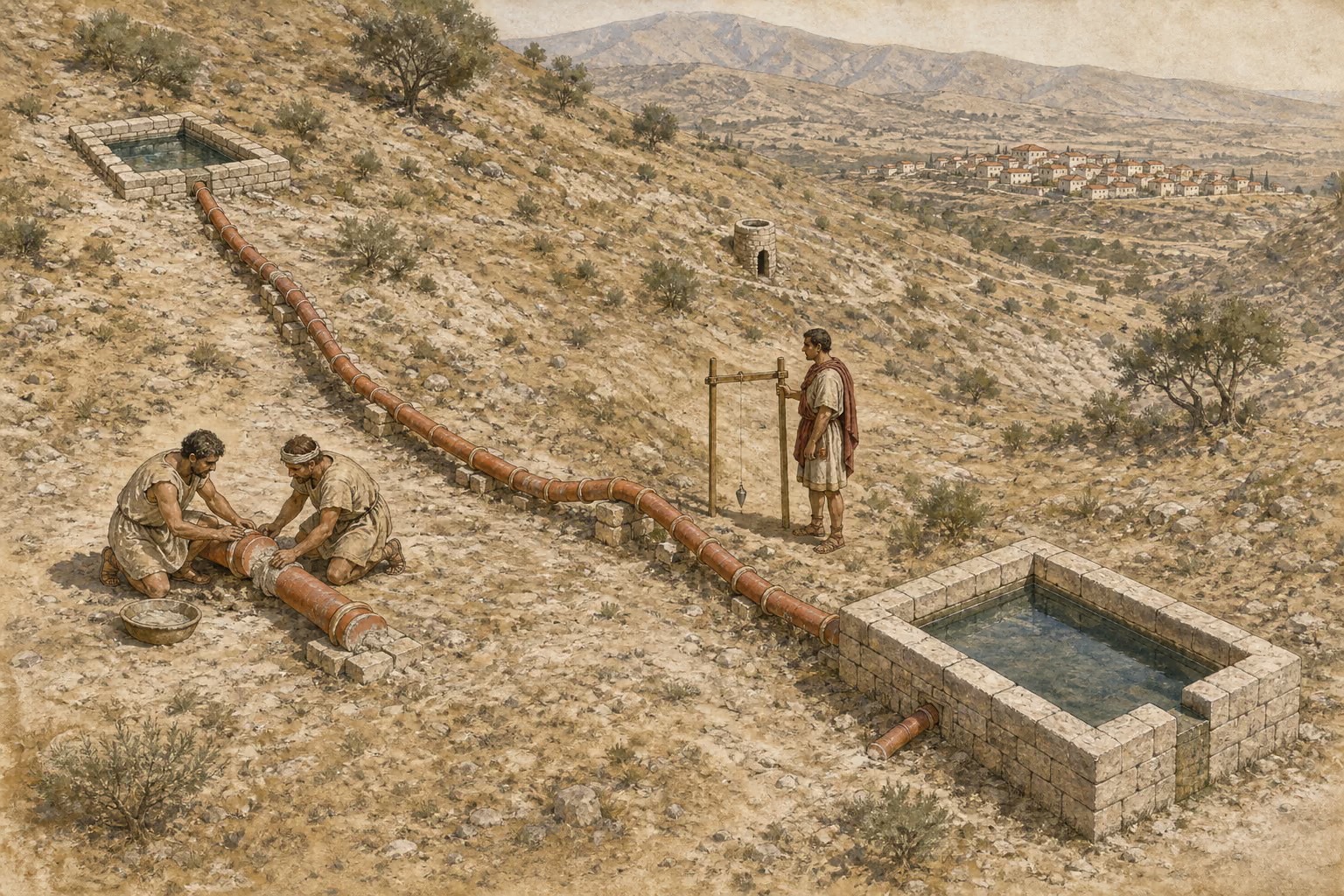
Ceterum a fonte duci fictilibus tubis utilissimum est crassitudine binum digitorum, commissuris pyxidatis ita, ut superior intret, calce viva ex oleo levigatis. libramentum aquae in centenos pedes sicilici minimum erit, si cuniculo veniet, in binos actus lumina esse debebunt. quam surgere in sublime opus fuerit, plumbo veniat. subit altitudinem exortus sui. si longiore tractu veniet, subeat crebro descendatque, ne libramenta pereant. fistulas denum pedum longitudinis esse legitimum est et, si quinariae erunt, sexagena pondo pendere, si octonariae, centena, si denariae, centena vicena ac deinde ad has portiones. denaria appellatur cuius lamnae latitudo, antequam curvetur, digitorum X est, dimidioque eius quinaria. in anfractu omni collis quinariam fieri, ubi dometur impetus, necessarium est, item castella, prout res exiget.
Homerum calidorum fontium mentionem non fecisse demiror, cum alioqui lavari calida frequenter induceret, videlicet quia medicina tune non erat haec, quae nunc aquarum perfugio utitur. est autem utilis sulpurata nervis, aluminata paralyticis aut simili modo solutis, bituminata aut nitrosa, qualis Cutilia est, bibendo itaque purgationibus. plerique in gloria ducunt plurimis horis perpeti calorem earum, quod est inimicissimum, namque paulo diutius quam balineis uti oportet ac postea frigida dulci, nec sine oleo discedentes, quod vulgus alienum arbitratur, idcirco non alibi corporibus magis obnoxiis, quippe et vastitate odoris capita replentur et frigore infestantur sudantia, reliqua corporum parte mersa. similis error quam plurimo potu gloriantium, vidique iam turgidos bibendo in tantum, ut anuli integerentur cute, cum reddi non posset hausta multitudo aquae. nec hoc ergo fieri convenit sine crebro salis gustu. utuntur et caeno fontium ipsorum utiliter, sed ita, si inlitum sole inarescat. nec vero omnes, quae sint calidae, medicatas esse credendum, sicut in Segesta Siciliae, Larisa Troade, Magnesia, Melo, Lipara. nec decolor species aeris argentive, ut multi existimavere, medicaminum argumentum est, quando nihil eorum in Patavinis fontibus, ne odoris quidem differentia aliqua deprehendetur.
Medendi modus idem et in marinis erit, quae calefiunt ad nervorum dolores, feruminanda a fracturis ossa, contusa, item corpora siccanda, qua de causa et frigido mari utuntur. praeterea est alius usus multiplex, principalis vero navigandi phthisi adfectis, ut diximus, aut sanguine egesto, sicut proxime Annaeum Gallionem fecisse post consulatum meminimus. neque enim Aegyptus propter se petitur, sed propter longinquitatem navigandi. quin et vomitiones ipsae instabili volutatione commotae plurimis morbis capitis, oculorum, pectoris medentur omnibusque, propter quae helleborum bibitur. aquam vero maris per sese efficaciorem discutiendis tumoribus putant medici, si illa decoquatur hordeacia farina, ad parotidas. emplastris etiam, maxime albis, et malagmatis miscent; prodest et infusa crebro ictu. bibitur quoque, quamvis non sine iniuria stomachi, ad purganda corpora bilemque atram aut sanguinem concretum reddendum alterutra parte. quidam et in quartanis dedere eam bibendam et in tenesmis articulariisque morbis adservatam in hoc ut vetustate virus deponentem, aliqui decoctam, omnes ex alto haustam nullaque dulcium mixtura corruptam. in quo usu praecedere vomitum volunt. tunc quoque acetum aut vinum et aquam miscent. qui puram dedere, raphanos supermandi ex mulso aceto iubent, ut ad vomitiones revocent. clysteribus quoque marinam infundunt tepefactam. testium quidem tumores fovendo non aliud praeferunt, item pernionum vitio ante ulcera, simili modo pruritibus, psoris et lichenum curationi. lendes quoque et taetra capitis animalia hac curantur. et liventia reducit eadem ad colorem. in quibus curationibus post marinam aceto calido fovere plurimum prodest. quin et ad ictus venenatos salutaris intellegitur, ut phalangiorum et scorpionum, et ptyade aspide respersis; calida autem in his adsumitur. suffitur eadem cum aceto capitis doloribus. tormina quoque et choleras calida infusa clysteribus sedant. difficilius perfrigescunt marina calefacta. mammas sororientes, praecordia maciemque corporis piscinae maris corrigunt, aurium gravitatem, capitis dolores cum aceto ferventium vapor.rubiginem ferro marinae celerrime exterunt, pecorum quoque scabiem sanant lanasque emolliunt.
Nec ignoro haec mediterraneis supervacua videri posse. verum et hoc cura providit inventa ratione, qua sibi quisque aquam maris faceret. illud in ea ratione mirum, si plus quam sextarius salis in IIII sextarios aquae mergatur, vinci aquam salemque non liquari. cetero sextarius salis cum III aquae sextariis salsissimi maris vim et naturam implet. moderatissimum autem putant supra dictam aquae mensuram octonis cyathis salis temperari, quoniam ita et nervos excalefaciat et corpus non exasperet.
Inveteratur et quod vocant thalassomeli aequis portionibus maris, mellis, imbris. ex alto et ad hunc usum advehunt fictilique vaso et picato condunt. prodest ad purgationes maxime sine stomachi vexatione et sapore grato et odore.— Hydromeli quoque ex imbre puro cum melle temperabatur quondam, quod daretur adpetentibus vini aegris veluti innocentiore potu, damnatum iam multis annis, isdem vitiis quibus vinum nec isdem utilitatibus.— Quia saepe navigantes defectu aquae dulcis laborant, haec quoque subsidia demonstrabimus. expansa circa navem vellera madescunt accepto halitu maris, quibus dulcis umor exprimitur, item demissae reticulis in mare concavae e cera pilae vel vasa inania opturata dulcem intra se colligunt umorem. nam in terra marina aqua argilla percolata dulcescit.
Luxata corpora et hominum et quadrupedum natando in cuius libeat generis aqua facillime in artus redeunt.— Est et in metu peregrinantium ut temptent valitudinem aquae ignotae. hoc cavent e balineis egressi static frigidam suspectam hauriendo.— Muscus, qui in aqua fuerit, podagris inlitus prodest, idem oleo admixto talorum dolori tumorique. spuma aquae adfrictu verrucas tollit, nec non harena litorum maris, praecipue tennis et sole candens; in medicina est siccandis corporibus coopertis hydropicorum aut rheumatismos sentientium.
Et hactenus de aquis, nunc de aquatilibus. ordiemur autem, ut in reliquis, a principalibus eorum, quae sunt salsa ac spongea.
English · Bostock & Riley 1855–57
The most convenient method of making a watercourse from the spring is by employing earthen pipes, two fingers in thickness, inserted in one another at the points of junction—the one that has the higher inclination fitting into the lower one—and coated with quick-lime macerated in oil. The inclination, to ensure the free flow of the water, ought to be at least one-fourth of an inch to every hundred feet; and if the water is conveyed through a subterraneous passage, there should be air-holes let in at intervals of every two actus. Where the water is wanted to ascend aloft, it should be conveyed in pipes of lead: water, it should be remembered, always rises to the level of its source. If, again, it is conveyed from a considerable distance, it should be made to rise and fall every now and then, so as not to lose its motive power. The proper length for each leaden pipe is ten feet; and if the pipe is five fingers in circumference its weight should be sixty pounds; if eight feet, one hundred; if ten, one hundred and twenty; and so on in the same proportion.
A pipe is called “a ten-finger” pipe when the sheet of metal is ten fingers in breadth before it is rolled up; a sheet one half that breadth giving a pipe “of five fingers.” In all sudden changes of inclination in elevated localities, pipes of five fingers should be employed, in order to break the impetuosity of the fall: reservoirs, too, for branches should be made as circumstances may demand.
I am surprised that Homer has made no mention of hot springs, when, on the other hand, he has so frequently introduced the mention of warm baths: a circumstance from which we may safely conclude that recourse was not had in his time to mineral waters for their medicinal properties, a thing so universally the case at the present day. Waters impregnated with sulphur are good for the sinews, and aluminous waters are useful for paralysis and similar relaxations of the system. Those, again, which are impregnated with bitumen or nitre, the waters of Cutilia, for example, are drunk as a purgative.
Many persons quite pride themselves on enduring the heat of mineral waters for many hours together; a most pernicious practice, however, as they should be used but very little longer than the ordinary bath, after which the bather should be shampooed with cold water, and not leave the bath without being rubbed with oil. This last operation, however, is commonly regarded as altogether foreign to the use of mineral baths; and hence it is, that there is no situation in which men’s bodies are more exposed to the chances of disease, the head becoming saturated with the intensity of the odours exhaled, and left exposed, perspiring as it is, to the coldness of the atmosphere, while all the rest of the body is immersed in the water.
There is another mistake, also, of a similar description, made by those who pride themselves upon drinking enormous quantities of these waters; and I myself have seen persons, before now, so swollen with drinking it that the very rings on their fingers were entirely concealed by the skin, owing to their inability to discharge the vast quantities of water which they had swallowed. It is for this reason, too, that these waters should never be drunk without taking a taste of salt every now and then. The very mud, too, of mineral springs may be employed to good purpose; but, to be effectual, after being applied to the body, it must be left to dry in the sun.
It must not be supposed, however, that all hot waters are of necessity medicated, those of Segesta in Sicily, for example, of Larissa, Troas, Magnesia, Melos, and Lipara. Nor is the very general supposition a correct one, that waters, to be medicinal, must of necessity discolour copper or silver; no such effect being produced by those of Patavium, or there being the slightest difference perceptible in the smell.
Sea-water also is employed in a similar manner for the cure of diseases. It is used, made hot, for the cure of pains in the sinews, for reuniting fractured bones, and for its desiccative action upon the body: for which last purpose, it is also used cold. There are numerous other medicinal resources derived from the sea; the benefit of a sea-voyage, more particularly, in cases of phthisis, as already mentioned, and where patients are suffering from hæmoptosis, as lately experienced, in our own memory, by Annæus Gallio, at the close of his consulship: for it is not for the purpose of visiting the country, that people so often travel to Egypt, but in order to secure the beneficial results arising from a long sea-voyage. Indeed, the very sea-sickness that is caused by the rocking of the vessel to and fro, is good for many affections of the head, eyes, and chest, all those cases, in fact, in which the patient is recommended to drink an infusion of hellebore. Medical men consider sea-water, employed by itself, highly efficacious for the dispersion of tumours, and, boiled with barley-meal, for the successful treatment of imposthumes of the parotid glands: it is used also as an ingredient in plasters, white plasters more particularly, and for emollient poultices. Sea-water is very good, too, employed as a shower-bath; and it is taken internally, though not without injury to the stomach, both as a purgative and as an expellent, by vomit and by alvine evacuation, of black bile or coagulated blood, as the case may be.
Some authorities prescribe it, taken internally, for quartan fevers, as also for tenesmus and diseases of the joints; purposes for which it is kept a considerable time, to mellow with age, and so lose its noxious properties. Some, again, are for boiling it, but in all cases it is recommended to be taken from out at sea, and untainted with the mixture of fresh water, an emetic also being taken before using it. When used in this manner, vinegar or wine is generally mixed with the water. Those who give it unmixed, recommend radishes with oxymel to be eaten upon it, in order to provoke vomiting. Sea-water, made hot, is used also as an injection; and there is nothing in existence preferred to it as a fomentation for swellings of the testes, or for chilblains before they ulcerate. It is similarly employed, also, for the cure of prurigo, itch-scab, and lichens. Lice and other foul vermin of the head, are removed by the application of sea-water, and lividities of the skin are restored to their natural colour; it being a remarkably good plan, in such cases, after applying the sea-water, to foment the parts with hot vinegar.
It is generally considered, too, that sea-water is highly efficacious for the stings of venomous insects, those of the phalangium and scorpion, for example, and as an antidote to the poisonous secretions of the asp, known as the “ptyas;” in all which cases it is employed hot. Fumigations are also made of it, with vinegar, for the cure of head-ache; and, used warm as an injection, it allays griping pains in the bowels and cholera. Things that have been heated in sea-water are longer than ordinary in cooling. A sea-water bath is an excellent corrective for swelling of the bosoms in females, affections of the thoracic organs, and emaciation of the body. The steam also of sea-water boiled with vinegar, is used for the removal of hardness of hearing and head-ache. An application of sea-water very expeditiously removes rust upon iron; it is curative also of scab in sheep, and imparts additional softness to the wool.
I am by no means unaware that these details may very possibly appear superfluous to persons who live at a distance from the sea; but scientific research has made provision against this objection, by discovering a method of enabling every one to make sea-water for himself. It is a singular fact in connexion with this discovery, that if more than one sextarius of salt is put into four sextarii of water, the liquefying properties of the water will be overpowered, and the salt will no longer melt. On the other hand, again, a mixture of one sextarius of salt with four sextarii of water, acts as a good substitute for the efficacy and properties of the very saltest sea-water. The most reasonable proportion, however, is generally thought to be eight cyathi of salt, diluted in the quantity of water above mentioned; a preparation which has been found to have a warming effect upon the sinews, without in any degree chafing the body.
There is also a composition made to ripen for use, known as “thalassomeli,” and prepared with equal parts of sea-water, honey, and rain-water. For this purpose, also, the water is brought from out at sea, and the preparation is kept in an earthen vessel well pitched. It acts most efficiently as a purgative, and without in the least fatiguing the stomach; the taste, too, and smell of it, are very agreeable.
Hydromeli, also, was a mixture formerly made with pure rain-water and honey, and was prescribed for patients who were anxious for wine, as being a more harmless drink. For these many years past, however, it has been condemned, as having in reality all the inconveniences of wine, without the advantages.
As persons out at sea often suffer great inconvenience from the want of fresh water, we will here describe some methods of obviating it. Fleeces are spread round the ship, and on becoming moistened with the exhalations arising from the sea, the water is wrung from them, and found to be quite fresh. Hollow balls of wax, also, or empty vessels sealed at the mouth, upon being let down into the sea in a net, become filled with water that is fresh and potable. On shore, too, sea-water may be made fresh, by filtering it through argillaceous earth.
By swimming in water of any kind, sprains of the limbs in man or beast are reduced with the greatest facility. Persons when travelling, are sometimes apprehensive that the use of water, the quality of which is unknown to them, may prove injurious to their health: as a precaution against this, they should drink the suspected water cold, immediately after leaving the bath.
Moss which has grown in water is excellent as a topical application for gout; and, in combination with oil, it is good for pains and swellings in the ankles. The foam that floats upon the surface of the water, used as a friction, causes warts to disappear. The sand, too, of the sea-shore, that more particularly which is very fine and burnt white by the heat of the sun, is used remedially for its desiccative properties, the bodies of dropsical or rheumatic patients being entirely covered with it.
Thus much with reference to water itself; we will now turn to the aquatic productions, beginning, as in all other instances, with the principal of them, namely, salt and sponge.