LIBER XXXIII · CAPUT 12
STATUES OF SILVER
Latine · Mayhoff 1906
Argenti usum in statuas primum divi Augusti temporum adulatione transisse falso existimatur. iam enim triumpho Magni Pompei reperimus translatam Pharnacis, qui primus regnavit in Ponto, argenteam statuam, item Mithridatis Eupatoris et currus aureos argenteosque. argentum succedit aliquando et auro luxu feminarum plebis compedes sibi facientium, quas induere aureas mos tritior vetet. vidimus et ipsi Arellium Fuscum motum equestri ordine ob insignem calumniam, cum celebritatem adsectarentur adulescentium scholae, argenteos anulos habentem. et quid haec attinet colligere, cum capuli militum ebore etiam fastidito caelentur argento, vaginae catellis, baltea lamnis crepitent, iam vero paedagogia in transitu virilitatis custodiantur argento, feminae laventur et nisi argentea solia fastidiant, eademque materia et cibis et probris serviat? videret haec Fabricius et stratas argento mulierum balineas ita, ut vestigio locus non sit, cum viris lavantium! Fabricius, qui bellicos imperatores plus quam pateram et salinum habere ex argento vetabat, videret hinc dona fortium fieri aut in haec frangi! heu mores, Fabrici nos pudet!
Mirum auro caelando neminem inclaruisse, argento multos. maxime tamen laudatus est Mentor, de quo supra diximus. quattuor paria ab eo omnino facta sunt, ac iam nullum extare dicitur Ephesiae Dianae templi aut Capitolini incendiis. Varro se et aereum signum eius habuisse scribit. proximi ab eo in admiratione Acragas et Boëthus et Mys fuere. exstant omnium opera hodie in insula Rhodiorum, Boëthi apud Lindiam Minervam, Acragantis in templo Liberi patris in ipsa Rhodo Centauros Bacchasque caelati scyphi, Myos in eadem aede Silenos et Cupidines. Acragantis et venatio in scyphis magnam faram habuit. post hos celebratus est Calamis, et Antipatro qui Satyrum in phiala gravatum somno conlocavisse verius quam caelasse dictus est..., Stratonicus mox Cyzicenus, Tauriscus. item Ariston et Eunicus Mitylenaei laudantur et Hecataeus et circa Pompei Magni aetatem Pasiteles, Posidonius Ephesius [hedys], Thracides, qui proelia armatosque caelavit, Zopyrus, qui Areopagitas et iudicium Orestis in duobus scyphis HS |XII| aestimatis. fuit et Pytheas, cuius II unciae $X$ X??? venierunt: Ulixes et Diomedes erant in phialae emblemate Palladium subripientes. fecit idem et cocos magiriscia appellatos parvolis potoriis et e quibus ne exemplaria quidem liceret exprimere; tam opportuna iniuriae subtilitas erat. habuit et Teucer crustarius famam, subitoque ars haec ita exolevit, ut sola iam vetustate censeatur usuque attritis caelaturis sic,ne figura discerni possit, auctoritas constet. —(Argentum medicatis aquis inficitur atque adflatu salso, sicut in mediterraneis Hispaniae.)—
In argenti et auri metallis nascuntur etiamnum pigmenta, sil et caeruleum. sil proprie limus est. optimum ex eo quod Atticum vocatur, pretium in pondo libras $X$ II; proximum marmorosum dimidio Attici pretio. tertium genus est pressum, quod alii Scyricum vocant, ex insula Scyro, iam et ex Achaia, quo utuntur ad picturae umbras, pretium in libras HS bini; dupondiis vero detractis quod lucidum vocant, e Gallia veniens. hoc autem et Attico ad lumina utuntur, ad abacos non nisi marmoroso, quoniam marmor in eo resistit amaritudini calcis. effoditur et ad xx ab urbe lapidem in montibus; postea uritur pressum appellantibus qui adulterant. sed esse falsum exustumque, amaritudine apparet et quoniam resolutum in pulverem est. sile pingere instituere primi Polygnotus et Micon, Attico dumtaxat. secuta aetas hoc ad lumina usa est, ad umbras autem Scyrico et Lydio. Lydium Sardibus emebatur, quod nunc omittunt.
English · Bostock & Riley 1855–57
It is generally believed, but erroneously, that silver was first employed for making statues of the deified Emperor Augustus, at a period when adulation was all the fashion: for I find it stated, that in the triumph celebrated by Pompeius Magnus there was a silver statue exhibited of Pharnaces, the first king of Pontus, as also one of Mithridates Eupator, besides chariots of gold and silver.
Silver, too, has in some instances even supplanted gold; for the luxurious tastes of the female plebeians having gone so far as to adopt the use of shoe-buckles of gold, it is considered old-fashioned to wear them made of that metal. I myself, too, have seen Arellius Fuscus —the person whose name was erased from the equestrian order on a singularly calumnious charge, when his school was so thronged by our youth, attracted thither by his celebrity—wearing rings made of silver. But of what use is it to collect all these instances, when our very soldiers, holding ivory even in contempt, have the hilts of their swords made of chased silver? when, too, their scabbards are heard to jingle with their silver chains, and their belts with the plates of silver with which they are inlaid?
At the present day, too, the continence of our very pages is secured by the aid of silver: our women, when bathing, quite despise any sitting-bath that is not made of silver: while for serving up food at table, as well as for the most unseemly purposes, the same metal must be equally employed! Would that Fabricius could behold these instances of luxuriousness, the baths of our women—bathing as they do in company with the men—paved with silver to such an extent that there is not room left for the sole of the foot even! Fabricius, I say, who would allow of no general of an army having any other plate than a patera and a salt-cellar of silver.—Oh that he could see how that the rewards of valour in our day are either composed of these objects of luxury, or else are broken up to make them! Alas for the morals of our age! Fabricius puts us to the blush.
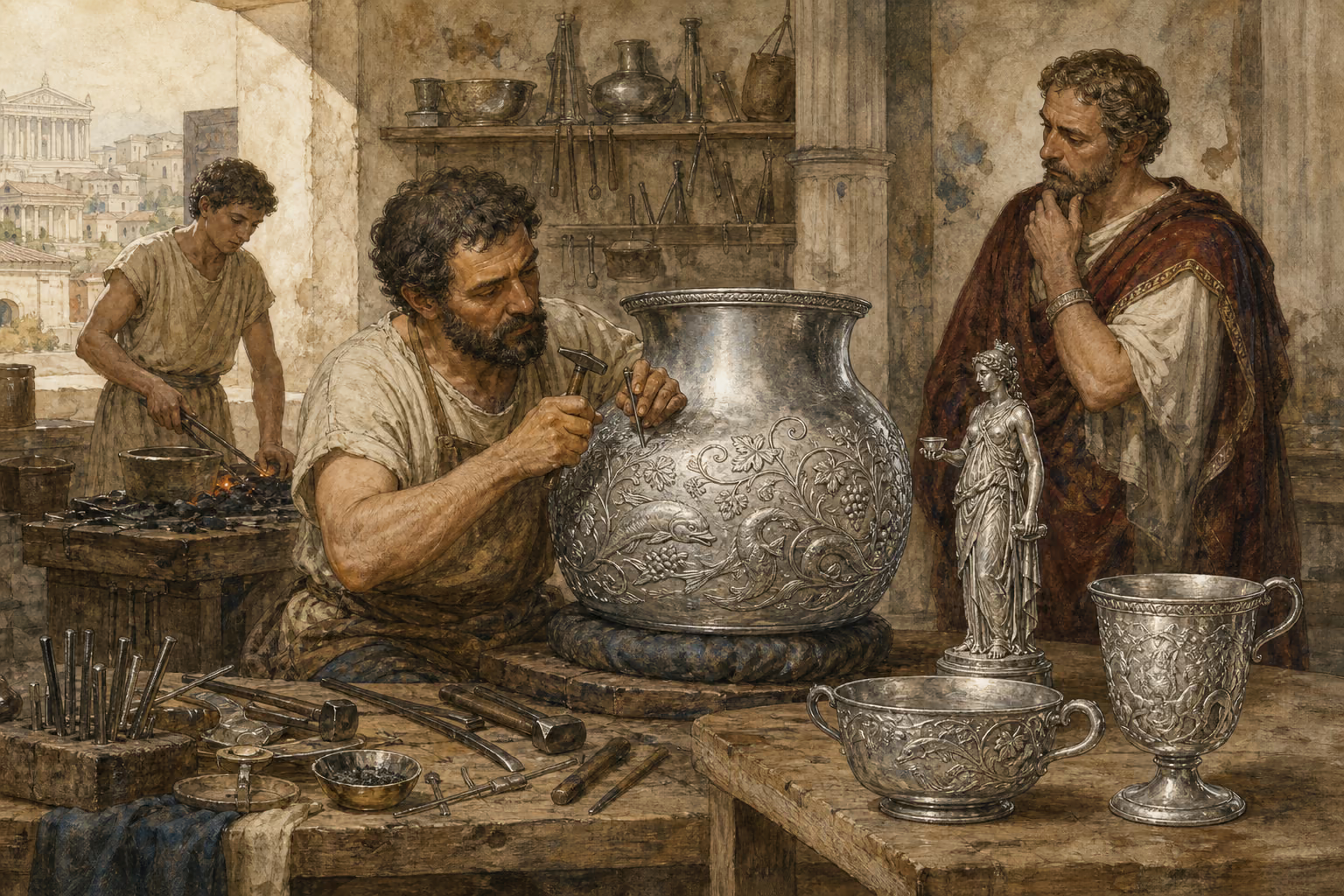
It is a remarkable fact that the art of chasing gold should have conferred no celebrity upon any person, while that of embossing silver has rendered many illustrious. The greatest renown, however, has been acquired by Mentor, of whom mention has been made already. Four pairs [of vases] were all that were ever made by him; and at the present day, not one of these, it is said, is any longer in existence, owing to the conflagrations of the Temple of Diana at Ephesus and of that in the Capitol. Varro informs us in his writings that he also was in possession of a bronze statue, the work of this artist. Next to Mentor, the most admired artists were Acragas, Boëthus, and Mys. Works of all these artists are still extant in the Isle of Rhodes; of Boëthus, in the Temple of Minerva, at Lindus; of Acragas, in the Temple of Father Liber, at Rhodes, consisting of cups engraved with figures in relief of Centaurs and Bacchantes; and of Mys, in the same temple, figures of Sileni and Cupids. Representations also of the chase by Acragas on drinking cups were held in high estimation.
Next to these in repute comes Calamis. Antipater too, it has been said, laid, rather than engraved, a Sleeping Satyr upon a drinking-bowl. Next to these come Stratonicus of Cyzicus, and Tauriscus: Ariston also, and Eunicus, of Mytilene are highly praised; Hecatæus also, and, about the age of Pompeius Magnus, Pasiteles, Posidonius of Ephesus, Hedystratides who engraved battle-scenes and armed warriors, and Zopyrus, who represented the Court of the Areopagus and the trial of Orestes, upon two cups valued at twelve thousand sesterces. There was Pytheas also, a work of whose sold at the rate of ten thousand denarii for two ounces: it was a drinking-bowl, the figures on which represented Ulysses and Diomedes stealing the Palladium. The same artist engraved also, upon some small drinking-vessels, kitchen scenes, known as “magiriscia;” of such remarkably fine workmanship and so liable to injury, that it was quite impossible to take copies of them. Teucer too, the inlayer, enjoyed a great reputation.
All at once, however, this art became so lost in point of excellence, that at the present day ancient specimens are the only ones at all valued; and only those pieces of plate are held in esteem the designs on which are so much worn that the figures cannot be distinguished.
Silver becomes tainted by the contact of mineral waters, and of the salt exhalations from them, as in the interior of Spain, for instance.
In the mines of gold and silver there are some other pigments also found, sil and cæruleum. Sil is, properly speaking, a sort of slime. The best kind is that known as Attic sil; the price of which is two denarii per pound. The next best kind is the marbled sil, the price of which is half that of the Attic kind. A third sort is the compressed sil, known to some persons as Scyric sil, it coming from the Isle of Scyros. Then, too, there is the sil of Achaia, which painters make use of for shadow-painting, and the price of which is two sesterces per pound. At a price of two asses less per pound, is sold the clear sil, which comes from Gaul. This last kind, as well as the Attic sil, is used for painting strong lights: but the marbled sil only is employed for colouring compartitions, the marble in it offering a resistance to the natural acridity of the lime. This last kind is extracted also from some mountains twenty miles distant from the City. When thus extracted, it is submitted to the action of fire; in which form it is adulterated by some, and sold for compressed sil. That it has been burnt, however, and adulterated, may be very easily detected by its acridity, and the fact that it very soon crumbles into dust.
Polygnotus and Micon were the first to employ sil in painting, but that of Attica solely. The succeeding age used this last kind for strong lights only, and employed the Scyric and Lydian kinds for shadow painting. The Lydian sil used to be bought at Sardes; but at the present day we hear nothing of it.