LIBER XXXIII · CAPUT 13
CÆRULEUM
Latine · Mayhoff 1906
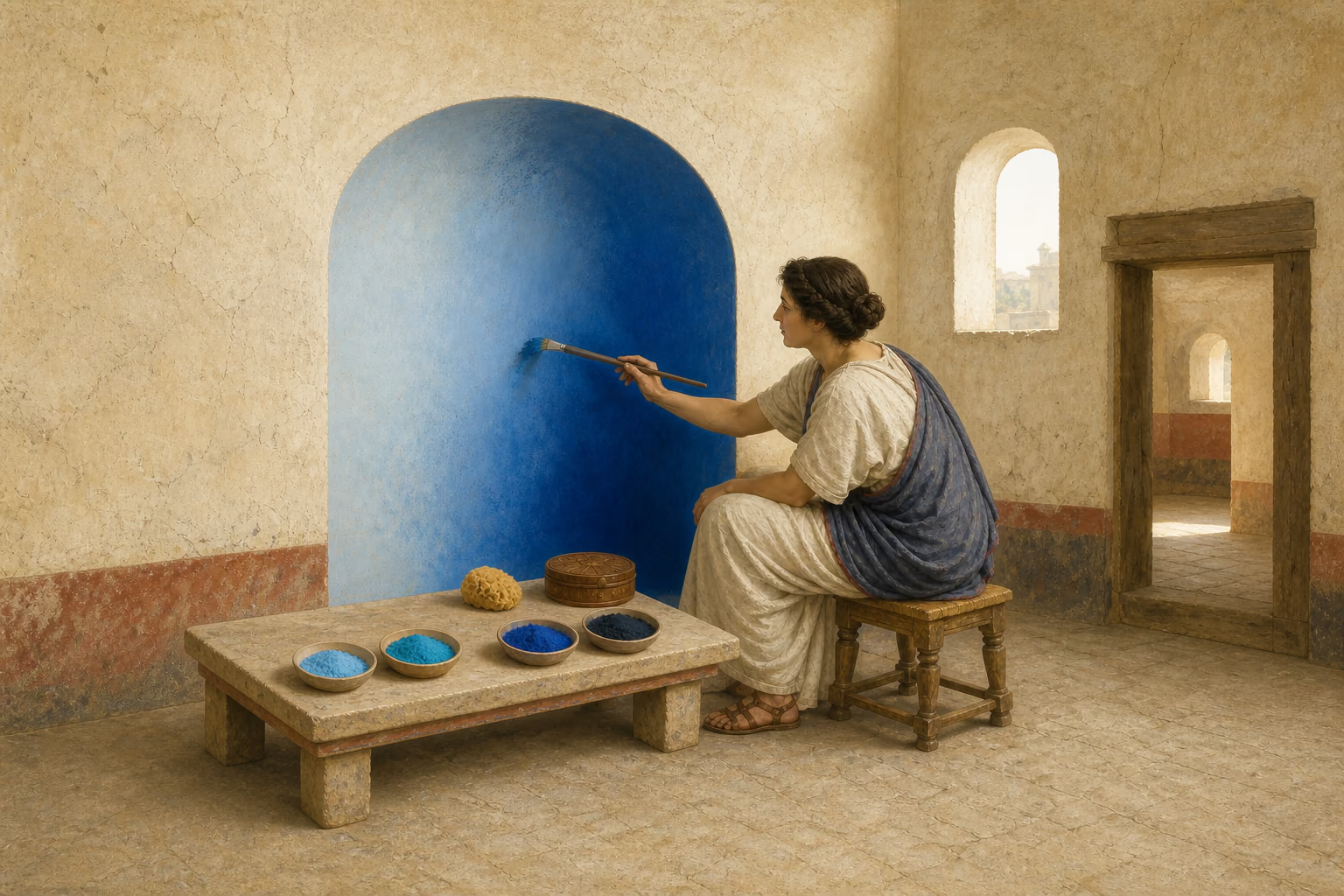
Caeruleum harena est. huius genera tria fuere antiquitus: Aegyptium maxime probatur; Scythicummox diluitur facile et, cum teritur, in quattuor colores mutatur, candidiorem nigrioremve et crassiorem tenuioremve; praefertur huic etiamnum Cyprium. accessit his Puteolanum et Hispaniense, harena ibi confici coepta. tinguitur autem omne et in sua coquitur herba bibitque sucum. reliqua confectura eadem quae chrysocollae.
Ex caeruleo fit quod vocatur lomentum, perficitur id lavando terendoque. hoc est caeruleo candidius. pretia eius $X$ X in libras, caerulei $X$ VIII. usus in creta; calcis inpatiens. nuper accessit et Vestorianum, ab auctore appellatum. fit ex Aegyptii levissima parte; pretium eius in libras $X$ I. idem et Puteolani usus, praeterque ad fenestras; cylon vocant.—Non pridem adportari et Indicum coeptum est, cuius pretium $X$ VII. ratio in pictura ad incisuras, hoc est umbras dividendas ab lumine.— Est et vilissimum genus lomenti, quod tritum vocant, quinis assibus aestimatum.
Caerulei sinceri experimentum in carbone ut flagret; fraus viola arida decocta in aqua sucoque per linteum expresso in cretam Eretriam. vis in medicina ut purget ulcera; itaque et emplastris adiciunt, item causticis. teritur autem difficillime.—Sil in medendo leniter mordet adstringitque et explet ulcera. uritur in fictilibus, ut prosit.
Pretia rerum, quae usquam posuimus, non ignoramus alia aliis locis esse et omnibus paene mutari annis, prout navigatione constiterint aut ut quisque mercatus sit aut aliquis praevalens manceps annonam flagellet, non obliti Demetrium a tota Seplasia Neronis principatu accusatum apud consules; poni tamen necessarium fuit quae plerumque erant Romae, ut exprimeretur auctoritas rerum.
English · Bostock & Riley 1855–57
Cæruleum is a kind of sand. In former times there were three kinds of it; the Egyptian, which was the most esteemed of all; the Scythian, which is easily dissolved, and which produces four colours when pounded, one of a lighter blue and one of a darker blue, one of a thicker consistency and one comparatively thin; and the Cyprian, which is now preferred as a colour to the preceding. Since then, the kinds imported from Puteoli and Spain have been added to the list, this sand having of late been prepared there. Every kind, however, is submitted to a dyeing process, it being boiled with a plant used particularly for this purpose, and imbibing its juices. In other respects, the mode of preparing it is similar to that of chrysocolla. From cæruleum, too, is prepared the substance known as “lomentum,” it being washed and ground for the purpose. Lomentum is of a paler tint than cæruleum; the price of it is ten denarii per pound, and that of cæruleum but eight. Cæruleum is used upon a surface of clay, for upon lime it will not hold. A more recent invention is the Vestorian cæruleum, so called from the person who first manufactured it: it is prepared from the finer parts of Egyptian cæruleum, and the price of it is eleven denarii per pound. That of Puteoli is used in a similar manner, as also for windows: it is known as “cylon.”
It is not so long since that indicum was first imported to Rome, the price being seventeen denarii per pound. Painters make use of it for incisures, or in other words, the division of shadows from light. There is also a lomentum of very inferior quality, known to us as “ground” lomentum, and valued at only five asses per pound.
The mode of testing the genuineness of cæruleum, is to see whether it emits a flame, on being laid upon burning coals. One method of adulterating it is to boil dried violets in water, and then to strain the liquor through linen into Eretrian clay.
Cæruleum has the medicinal property of acting as a detergent upon ulcers. Hence it is, that it is used as an ingredient in plasters, as also in cauteries. As to sil, it is pounded with the greatest difficulty: viewed as a medicament, it is slightly mordent and astringent, and fills up the cavities left by ulcers. To make it the more serviceable, it is burnt in earthen vessels.
The prices of things, which I have in different places annexed, vary, I am well aware, according to the locality, and experience a change almost every year: variations dependent upon the opportunities afforded for navigation, and the terms upon which the merchant may have purchased the article. It may so happen, too, that some wealthy dealer has engrossed the market, and so enhanced the price: for I am by no means forgetful of the case of Demetrius, who in the reign of the Emperor Nero was accused before the consuls by the whole community of the Seplasia. Still, however, I have thought it necessary to annex the usual price of each commodity at Rome, in order to give some idea of their relative values.