LIBER XXXIII · CAPUT 3
OTHER USES MADE OF GOLD, BY FEMALES
Latine · Mayhoff 1906
Deorum honoris causa in sacris nihil aliud excogitatum est quam ut auratis cornibus hostiae, maiores dumtaxat, immolarentur. sed in militia quoque in tantum adolevit haec luxuria, ut M. Bruti e Philippicis campis epistulae reperiantur frementis fibulas tribunicias ex auro geri. ita, Hercules? idem enim tu, Brute, mulierum pedibus aurum gestatum tacuisti. et nos sceleris arguimus ilium, qui primus auro dignitatem per anulos fecit! habeant in lacertis iam quidem et viri, quod ex Dardanis venit—itaque et Dardanium vocabatur; viriolae Celtice dicuntur, viriae Celtiberice—; habeant feminae in armillis digitisque totis, collo, auribus, spiris; discurrant catenae circa latera et in secreto margaritarum sacculi e collo dominarum auro pendeant, ut in somno quoque unionum conscientia adsit: etiamne pedibus induetur atque inter stolam plebemque hunc medium feminarum equestrem ordinem faciet? honestius viri paedagogiis id damus, balineasque dives puerorum forma convertit. iam vero et Harpocraten statuasque Aegyptiorum numinum in digitis viri quoque portare incipiunt. fuit et alia Claudii principatu differentia insolens iis, quibus admissiones liberae ius dedissent imaginem principis ex auro in anulo gerendi magna criminum occasione, quae omnia salutaris exortus Vespasiani imperatoris abolevit aequaliter publicando principem. de anulis aureis usuque eorum hactenus sit dictum.
Proximum scelus fuit eius, qui primus ex auro denarium signavit, quod et ipsum latet auctore incerto. populous Romanus ne argento quidem signato ante Pyrrhum regem devictum usus est. libralis—unde etiam nunc libella dicitur et dupondius—adpendebatur assis; quare aeris gravis poena dicta, et adhuc expensa in rationibus dicuntur, item inpendia et dependere, quin et militum stipendia, hoc est stipis pondera, dispensatores, libripendes, qua consuetudine in iis emptionibus, quae mancipi sunt, etiam nunc libra interponitur. Servius rex primus signavit aes. antea rudi usos Romae Timaeus tradit. signatum est nota pecudum, unde et pecunia appellata. maximus census cxx assium fuit illo rege, et ideo haec prima classis.—Argentum signatum anno urbis CCCCLXXXV, Q. Ogulnio C. Fabio cos., quinque annis ante primum Punicum bellum. et placuit denarium pro x libris aeris valere, quinarium pro v, sestertium pro dupondio ac semisse. librale autem pondus aeris inminutum est bello Punico primo, cum inpensis res p. non sufficeret, constitutumque ut asses sextantario pondere ferirentur. ita quinque partes lucri factae, dissolutumque aes alienum. nota aeris eius fuit ex altera parte lanus geminus, ex altera rostrum navis, in triente vero et quadrante rates. quadrans antea teruncius vocatus a tribus unciis. postea Hannibale urguente Q. Fabio Maximo dictatore asses unciales facti, placuitque denarium XVI assibus permutari, quinarium octonis, sestertium quaternis. ita res p. dimidium lucrata est, in militari tamen stipendio semper denarius pro x assibus datus est. notae argenti fuere bigae atque quadrigae; inde bigati quadrigatique dicti. mox lege Papiria semunciarii asses facti. Livius Drusus in tribunatu plebei octavam partem aeris argento miscuit. is, qui nune victoriatus appellatur, lege Clodia percussus est; antea enim hic nummus ex Illyrico advectus mercis loco habebatur. est autem signatus Victoria, et inde nomen.—Aureus nummus post annos LI percussus est quam argenteus ita, ut scripulum valeret sestertios vicen os, quod efficit in libram ratione sestertii, qui tune erat, V???DCCLX. postea placuit $X$; XXXX signari ex auri libris, paulatimque principes inminuere pondus, et novisissime Nero ad xxxxv.
Sed a nummo prima origo avaritiae faenore ex- cogitato quaestuosaque segnitia, nec paulatim: exarsit rabie quadam non iam avaritia, sed fames auri, utpote cum Septumuleius, C. Gracchi familiaris, auro rependendum caput eius abscisum ad Opimium tulerit plumboque in os addito parricidio suo rem p. etiam circumscripserit; nec iam Quiritium aliquis, sed universo nomine Romano infami rex Mithridates Aquilio duci capto aurum in os infudit. haec parit habendi cupido! pudet intuentem nomina ista, quae subinde nova Graeco sermone excogitantur insperso argenteis vasis auro et incluso, quibus deliciis pluris veneunt inaurata quam aurea, cum sciamus interdixisse castris suis Spartacum, ne quis aurum haberet aut argentum. tanto plus fuit animi fugitivis nostris! Messalla orator prodidit Antonium triumvirum aureis usum vasis in omnibus obscenis desideriis, pudendo crimine etiam Cleopatrae. summa apud exteros licentiae fuerat Philippum regem poculo aureo pulvinis subdito dormire solitum, Hagnonem Teium, Alexandri Magni praefectum, aureis clavis suffigere crepidas: Antonius solus contumelia naturae vilitatem auro fecit. o dignum proscriptione, sed Spartaci!
Equidem miror populum Romanum victis gentibus in tributo semper argentum imperasse, non aurum, sicut Carthagini cum Hannibale victae octingenta milia, xvi pondo annua in quinquaginta annos, nihil auri. nec potest videri paenuria mundi id evenisse. iam Midas et Croesus inrinitum possederant, iam Cyrus devicta Asia pondo XXIIII invenerat praeter vasa aurumque factum et in eo solium, platanum, vitem. qua victoria argenti D??? talentorum reportavit et craterem Semiramidis, cuius pondus xv talentorum colligebat. talentum Aegyptium pondo LXXX patere M. Varro tradit. iam regnaverat in Colchis Saulaces Aeetae subolis, qui terram virginem nactus plurimum auri argentique eruisse dicitur in Suanorum gente, et alioqui velleribus aureis incluto regno. et illius aureae camarae, argenteae trabes et columnae atque parastaticae narrantur victae Sesostri, Aegypti regi tam superbo, ut prodatur annis quibusque sorte reges singulos e subiectis iungere ad currum solitus atque ita triumphare!
Et nos fecimus quae posteri fabulosa arbitrentur. Caesar, qui postea dictator fuit, primus in aedilitate munere patris funebri omni apparatu harenae argenteo usus est, ferasque etiam argenteis vasis incessivere tum primum noxii, quod iam etiam in municipiis aemulantur. C. Antonius ludos scaena argentea fecit, item L. Murena; Gaius princeps in circo pegma duxit, in quo fuere argenti pondo CXXIIII. Claudius successor eius, cum de Brittannia triumpharet, inter coronas aureas VII pondo habere quam contulisset Hispania citerior, VIIII quam Gallia comata, titulis indicavit. huius deinde successor Nero Pompei theatrum operuit auro in unum diem, quo Tiridati Armeniae regi ostenderet. et quota pars ea fuit aureae domus ambientis urbem!
Auri in aerario populi R. fuere Sex. Iulio L. Aurelio cos., septem annis ante bellum Punicum tertium, pondo XVII CCCCX, argenti XXII LXX, et in numerato |LXI|XXXV CCCC, Sexto lulio L. Marcio cos., hoc est belli socialis initio, auri.... |XVI|XX DCCCXXXI. C. Caesar primo introitu urbis civili bello suo ex aerario protulit laterum aureorum XV, argenteorum XXX, et in numerato |CCC|. nec fuit aliis temporibus res p. locupletior. intulit et Aemilius Paulus Perseo rege victo e Macedonica praeda |MMM|, a quo tempore populus Romanus tributum pendere desiit.
Laquearia, quae nunc et in privatis domibus auro teguntur, post Carthaginem eversam primo in Capitolio inaurata sunt censura L. Mummi. inde transiere in camaras quoque et parietes, qui iam et ipsi tamquam vasa inaurantur, cum varie sua aetas de Catulo existimaverit, quod tegulas aereas Capitoli inaurasset.
Primos inventores auri, sicut metallorum fere omnium, septimo volumine diximus. praecipuam gratiam huic materiae fuisse arbitror non colore, qui clarior in argento est magisque diei similis, ideo militaribus signis familiarior, quoniam longius fulget, manifesto errore eorum, qui colorem siderum placuisse in auro arbitrantur, cum in gemma aliisque rebus non sit praecipuus. nec pondere aut facilitate materiae praelatum est ceteris metallis, cum cedat per utrumque plumbo, sed quia rerum uni nihil igne deperit, tuto etiam in incendiis rogisque. quin immo quo saepius arsit, proficit ad bonitatem, aurique experimentum ignis est, ut simili colore rubeat ignescatque et ipsum; obrussam vocant. primum autem bonitatis argumentum quam difficillime accendi. praeterea mirum, prunae violentissimi ligni indomitum palea citissime ardescere atque, ut purgetur, cum plumbo coqui. altera causa pretii maior, quod minimum usus deterit, cum argento, aere, plumbo lineae praeducantur manusque sordescant decidua materia. nec aliud laxius dilatatur aut numerosius dividitur, utpote cuius unciae in septingenas quinquagenas pluresque bratteas quaternum utroque digitorum spargantur. crassissimae ex iis Praenestinae vocantur, etiamnum retinente nomen Fortunae inaurato fidelissime ibi simulacro. proxima brattea quaestoria appellatur. Hispania striges vocat auri parvolas massas. super omnia solum in massa aut ramento capitur. cum cetera in metallis reperta igni perficiantur, hoc static aurum est consummatamque materiam suam protinus habet, cum ita invenitur. haec enim inventio eius naturalis est; alia, quam dicemus, coacta. super cetera non robigo ulla, non aerugo, non aliud ex ipso, quod consumat bonitatem minuatve pondus. iam contra salis et aceti sucos, domitores rerum, constantia superat omnia, superque netur ac texitur lanae modo vel sine lana. tunica aurea triumphasse Tarquinium Priscum Verrius docet; nos vidimus Agrippinam Claudi principis, edente eo navalis proelii spectaculum, adsidentem et indutam paludamento aureo textili sine alia materia. Attalicis vero iam pridem intexitur, invento regum Asiae.
Marmori et iis, quae candefieri non possunt, ovi candido inlinitur, ligno glutini ratione conposita; leucophorum vocant. quid sit hoc aut quemadmodum fiat, suo loco docebimus. aes inaurari argento vivo aut certe hydrargyro legitimum erat, de quis dicemus illorum naturam reddentes. excogitata fraus est, namque aes cruciatur in primis accensumque restinguitur sale, aceto, alumine, postea exharenatur, an satis recoctum sit, splendore deprehendente, iterumque exhalatur igni, ut possit edomitum mixtis pumice, alumine, argento vivo inductas accipere bratteas. alumen et in purgando vim habet qualem esse diximus plumbo.
English · Bostock & Riley 1855–57
To honour the gods at their sacrifices, no greater mark of honour has been thought of than to gild the horns of the animals sacrificed—that is, of the larger victims only. But in warfare, this species of luxury made such rapid advances, that in the Epistles of M. Brutus from the Plains of Philippi, we find expressions of indignation at the fibulæ of gold that were worn by the tribunes. Yes, so it is, by Hercules! and yet you, the same Brutus, have not said a word about women wearing gold upon their feet; while we, on the other hand, charge him with criminality who was the first to confer dignity upon gold by wearing the ring. Let men even, at the present day, wear gold upon the arms in form of bracelets—known as “dardania,” because the practice first originated in Dardania, and called “viriolæ” in the language of the Celts, “viriæ” in that of Celtiberia, let women wear gold upon their arms and all their fingers, their necks, their ears, the tresses of their hair; let chains of gold run meandering along their sides; and in the still hours of the night let sachets filled with pearls hang suspended from the necks of their mistresses, all bedizened with gold, so that in their very sleep even they may still retain the consciousness that they are the possessors of such gems: but are they to cover their feet as well with gold, and so, between the stola of the matrons and the garb of the plebeians, establish an intermediate or equestrian order of females? Much more becomingly do we accord this distinction to our pages, and the adorned beauty of these youths has quite changed the features of our public baths.
At the present day, too, a fashion has been introduced among the men even, of wearing effigies upon their fingers representing Harpocrates and other divinities of Egypt. In the reign of Claudius, also, there was introduced another unusual distinction, in the case of those to whom was granted the right of free admission, that, namely, of wearing the likeness of the emperor engraved in gold upon a ring: a circumstance that gave rise to vast numbers of informations, until the timely elevation of the Emperor Vespasianus rendered them impossible, by proclaiming that the right of admission to the emperor belonged equally to all. Let these particulars suffice on the subject of golden rings and the use of them.
The next crime committed against the welfare of mankind was on the part of him who was the first to coin a denarius of gold, a crime the author of which is equally unknown. The Roman people made no use of impressed silver even before the period of the defeat of King Pyrrhus. The “as” of copper weighed exactly one libra; and hence it is that we still use the terms “libella” and “dupondius.” Hence it is, too, that fines and penalties are inflicted under the name of “æs grave,” and that the words still used in keeping accounts are “expensa,” “impendia,” and “dependere.” Hence, too, the word “stipendium,” meaning the pay of the soldiers, which is nothing more than “stipis pondera; and from the same source those other words, “dispensatores” and “libripendes.” It is also from this circumstance that in sales of slaves, at the present day even, the formality of using the balance is introduced.
King Servius was the first to make an impress upon copper. Before his time, according to Timæus, at Rome the raw metal only was used. The form of a sheep was the first figure impressed upon money, and to this fact it owes its name, “pecunia.” The highest figure at which one man’s property was assessed in the reign of that king was one hundred and twenty thousand asses, and consequently that amount of property was considered the standard of the first class.
Silver was not impressed with a mark until the year of the City 485, the year of the consulship of Q. Ogulnius and C. Fabius, five years before the First Punic War; at which time it was ordained that the value of the denarius should be ten libræ of copper, that of the quinarius five libræ, and that of the sestertius two libræ and a half. The weight, however, of the libra of copper was diminished during the First Punic War, the republic not having means to meet its expenditure: in consequence of which, an ordinance was made that the as should in future be struck of two ounces weight. By this contrivance a saving of five-sixths was effected, and the public debt was liquidated. The impression upon these copper coins was a two-faced Janus on one side, and the beak of a ship of war on the other: the triens, however, and the quadrans, bore the impression of a ship. The quadrans, too, had, previously to this, been called “teruncius,” as being three unciæ in weight. At a later period again, when Hannibal was pressing hard upon Rome, in the dictatorship of Q. Fabius Maximus, asses of one ounce weight were struck, and it was ordained that the value of the denarius should be sixteen asses, that of the quinarius eight asses, and that of the sestertius four asses; by which last reduction of the weight of the as the republic made a clear gain of one half. Still, however, so far as the pay of the soldiers is concerned, one denarius has always been given for every ten asses. The impressions upon the coins of silver were two-horse and four-horse chariots, and hence it is that they received the names of “bigati” and “quadrigati.”
Shortly after, in accordance with the Law of Papirius, asses were coined weighing half an ounce only. Livius Drusus, when tribune of the people, alloyed the silver with one-eighth part of copper. The coin that is known at the present day as the “victoriatus,” was first struck in accordance with the Clodian Law: before which period, a coin of this name was imported from Illyricum, but was only looked upon as an article of merchandize. The impression upon it is a figure of Victory, and hence its name.
The first golden coin was struck sixty-two years after that of silver, the scruple of gold being valued at twenty sesterces; a computation which gave, according to the value of the sesterce then in use, nine hundred sesterces to each libra of gold. In later times, again, an ordinance was made, that denarii of gold should be struck, at the rate of forty denarii to each libra of gold; after which period, the emperors gradually curtailed the weight of the golden denarius, until at last, in the reign of Nero, it was coined at the rate of forty-five to the libra.
But the invention of money opened a new field to human avarice, by giving rise to usury and the practice of lending money at interest, while the owner passes a life of idleness: and it was with no slow advances that, not mere avarice only, but a perfect hunger for gold became inflamed with a sort of rage for acquiring: to such a degree, in fact, that Septimuleius, the familiar friend of Caius Gracchus, not only cut off his head, upon which a price had been set of its weight in gold, but, before bringing it to Opimius, poured molten lead into the mouth, and so not only was guilty of the crime of parricide, but added to his criminality by cheating the state. Nor was it now any individual citizen, but the universal Roman name, that had been rendered infamous by avarice, when King Mithridates caused molten gold to be poured into the mouth of Aquilius the Roman general, whom he had taken prisoner: such were the results of cupidity.
One cannot but feel ashamed, on looking at those new-fangled names which are invented every now and then, from the Greek language, by which to designate vessels of silver filagreed or inlaid with gold, and the various other practices by which such articles of luxury, when only gilded, are made to sell at a higher price than they would have done if made of solid gold: and this, too, when we know that Spartacus forbade any one of his followers to introduce either gold or silver into the camp—so much more nobleness of mind was there in those days, even in our runaway slaves.
The orator Messala has informed us that Antonius the triumvir made use of golden vessels when satisfying the most humiliating wants of nature, a piece of criminality that would have reflected disgrace upon Cleopatra even! Till then, the most consummate instances of a similar licentiousness had been found among strangers only—that of King Philip, namely, who was in the habit of sleeping with a golden goblet placed beneath his pillows, and that of Hagnon of Teos, a commander under Alexander the Great, who used to fasten the soles of his sandals with nails of gold. It was reserved for Antonius to be the only one thus to impart a certain utility to gold, by putting an insult upon Nature. Oh how righteously would he himself have been proscribed! but then the proscription should have been made by Spartacus.
For my own part, I am much surprised that the Roman people has always imposed upon conquered nations a tribute in silver, and not in gold; Carthage, for instance, from which, upon its conquest under Hannibal, a ransom was exacted in the shape of a yearly payment, for fifty years, of eight hundred thousand pounds’ weight of silver, but no gold. And yet it does not appear that this could have arisen from there being so little gold then in use throughout the world. Midas and Crœsus, before this, had possessed gold to an endless amount: Cyrus, already, on his conquest of Asia, had found a booty consisting of twenty-four thousand pounds’ weight of gold, in addition to vessels and other articles of wrought gold, as well as leaves of trees, a plane-tree, and a vine, all made of that metal.
It was through this conquest too, that he carried off five hundred thousand talents of silver, as well as the vase of Semiramis, the weight of which alone amounted to fifteen talents, the Egyptian talent being equal, according to Varro, to eighty of our pounds. Before this time too, Saulaces, the descendant of Æëtes, had reigned in Colchis, who, on finding a tract of virgin earth, in the country of the Suani, extracted from it a large amount of gold and silver, it is said, and whose kingdom besides, had been famed for the possession of the Golden Fleece. The golden arches, too, of his palace, we find spoken of, the silver supports and columns, and pilasters, all of which he had come into possession of on the conquest of Sesostris, king of Egypt; a monarch so haughty, that every year, it is said, it was his practice to select one of his vassal kings by lot, and yoking him to his car, celebrate his triumph afresh.
We, too, have done things that posterity may probably look upon as fabulous. Cæsar, who was afterwards dictator, but at that time ædile, was the first person, on the occasion of the funeral games in honour of his father, to employ all the apparatus of the arena in silver; and it was on the same occasion that for the first time criminals encountered wild beasts with implements of silver, a practice imitated at the present day in our municipal towns even.
At the games celebrated by C. Antonius the stage was made of silver; and the same was the case at those celebrated by L. Muræna. The Emperor Caius had a scaffold introduced into the Circus, upon which there were one hundred and twenty-four thousand pounds’ weight of silver. His successor Claudius, on the occasion of his triumph over Britain, announced by the inscriptions that among the coronets of gold, there was one weighing seven thousand pounds’ weight, contributed by Nearer Spain, and another of nine thousand pounds, presented by Gallia Comata. Nero, who succeeded him, covered the Theatre of Pompeius with gold for one day, the occasion on which he displayed it to Tiridates, king of Armenia. And yet how small was this theatre in comparison with that Golden Palace of his, with which he environed our city.
In the consulship of Sextus Julius and Lucius Aurelius, seven years before the commencement of the Third Punic War, there was in the treasury of the Roman people seventeen thousand four hundred and ten pounds’ weight of uncoined gold, twenty-two thousand and seventy pounds’ weight of silver, and in specie, six million one hundred and thirty-five thousand four hundred sesterces.
In the consulship of Sextus Julius and Lucius Marcius, that is to say, at the commencement of the Social War, there was in the public treasury one million six hundred and twenty thousand eight hundred and thirty-one pounds’ weight of gold. Caius Cæsar, at his first entry into Rome, during the civil war which bears his name, withdrew from the treasury fifteen thousand pounds’ weight in gold ingots, thirty thousand pounds’ weight in uncoined silver, and in specie, three hundred thousand sesterces: indeed, at no period was the republic more wealthy. Æmilius Paulus, too, after the defeat of King Perseus, paid into the public treasury, from the spoil obtained in Macedonia, three hundred millions of sesterces, and from this period the Roman people ceased to pay tribute.
The ceilings which, at the present day, in private houses even, we see covered with gold, were first gilded in the Capitol, after the destruction of Carthage, and during the censorship of Lucius Mummius. From the ceilings this luxuriousness has been since transferred to the arched roofs of buildings, and the party-walls even, which at the present day are gilded like so many articles of plate: very different from the times when Catulus was far from being unanimously approved of for having gilded the brazen tiles of the Capitol!
We have already stated, in the Seventh Book, who were the first discoverers of gold, as well as nearly all the other metals. The highest rank has been accorded to this substance, not, in my opinion, for its colour, (which in silver is clearer and more like the light of day, for which reason silver is preferred for our military ensigns, its brightness being seen at a greater distance); and those persons are manifestly in error who think that it is the resemblance of its colour to the stars that is so prized in gold, seeing that the various gems and other things of the same tint, are in no such particular request. Nor yet is it for its weight or malleability that gold has been preferred to other metals, it being inferior in both these respects to lead—but it is because gold is the only substance in nature that suffers no loss from the action of fire, and passes unscathed through conflagrations and the flames of the funeral pile. Nay, even more than this, the oftener gold is subjected to the action of fire, the more refined in quality it becomes; indeed, fire is one test of its goodness, as, when submitted to intense heat, gold ought to assume a similar colour, and turn red and igneous in appearance; a mode of testing which is known as “obrussa.”
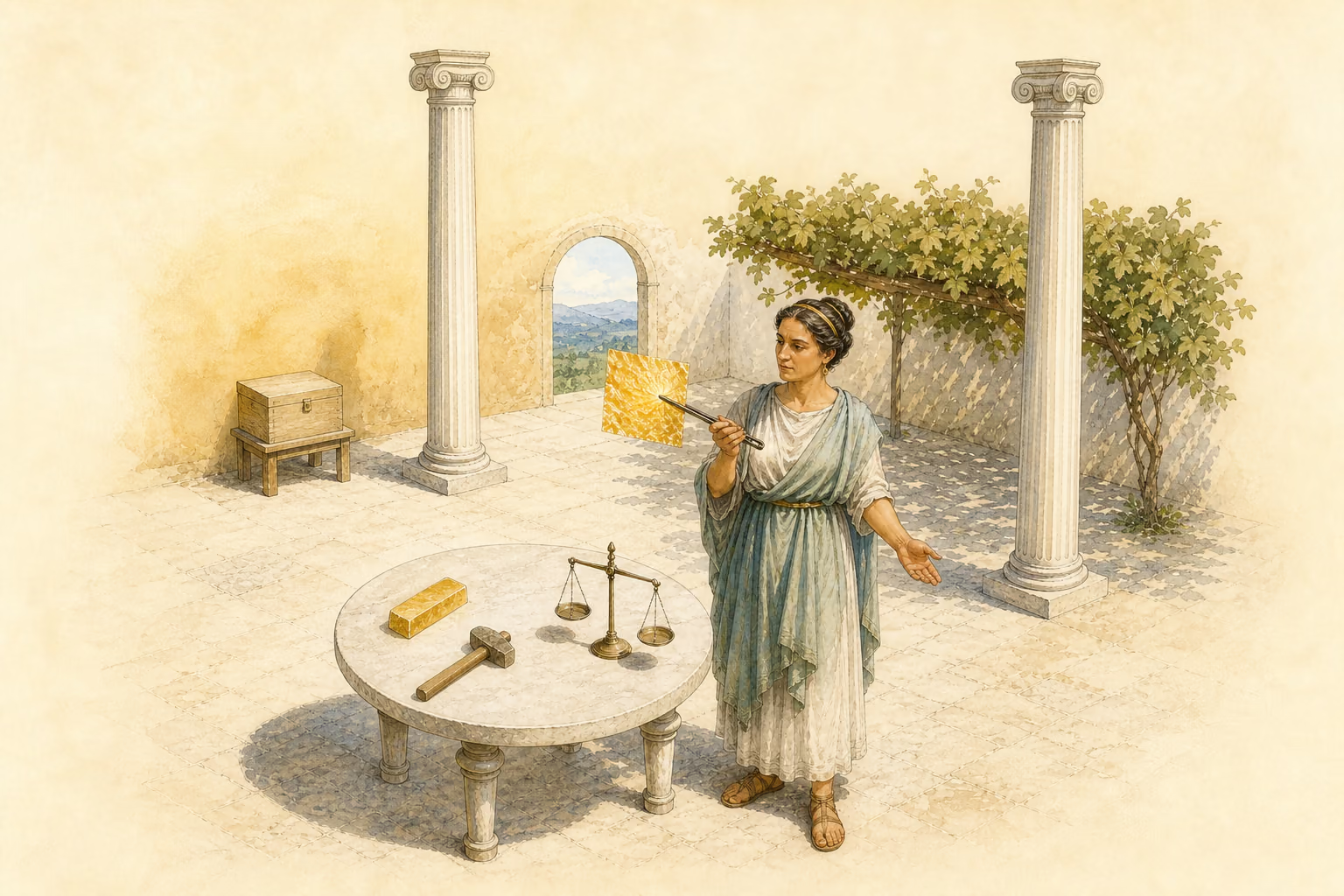
The first great proof, however, of the goodness of gold, is its melting with the greatest difficulty; in addition to which, it is a fact truly marvellous, that though proof against the most intense fire, if made with wood charcoal, it will melt with the greatest readiness upon a fire made with chaff; and that, for the purpose of purifying it, it is fused with lead. There is another reason too, which still more tends to enhance its value, the fact that it wears the least of all metals by continual use: whereas with silver, copper, and lead, lines may be traced, and the hands become soiled with the substance that comes from off them. Nor is there any material more malleable than this, none that admits of a more extended division, seeing that a single ounce of it admits of being beaten out into seven hundred and fifty leaves, or more, four fingers in length by the same in breadth. The thickest kind of gold-leaf is known as “leaf of Præneste,” it still retaining that name from the excellence of the gilding upon the statue of Fortune there. The next in thickness is known as the “quæstorian leaf.” In Spain, small pieces of gold are known by the name of “striges.”
A thing that is not the case with any other metal, gold is found pure in masses or in the form of dust; and whereas all other metals, when found in the ore, require to be brought to perfection by the aid of fire, this gold that I am speaking of is gold the moment it is found, and has all its component parts already in a state of perfection. This, however, is only such gold as is found in the native state, the other kinds that we shall have to speak of, being refined by art. And then, more than anything else, gold is subject to no rust, no verdigris, no emanation whatever from it, either to alter its quality or to lessen its weight. In addition to this, gold steadily resists the corrosive action of salt and vinegar, things which obtain the mastery over all other substances: it admits, too, beyond all other metals, of being spun out and woven like wool. Verrius tells us that Tarquinius Priscus celebrated a triumph, clad in a tunic of gold; and I myself have seen Agrippina, the wife of the Emperor Claudius, on the occasion of a naval combat which he exhibited, seated by him, attired in a military scarf made entirely of woven gold without any other material. For this long time past, gold has been interwoven in the Attalic textures, an invention of the kings of Asia.
On marble and other substances which do not admit of being brought to a white heat, gilt is laid with glair of egg, and on wood by the aid of a glutinous composition, known as “leucophoron:” what this last is, and how it is prepared, we shall state on the appropriate occasion. The most convenient method for gilding copper would be to employ quicksilver, or, at all events, hydrargyros; but with reference to these substances, as we shall have occasion to say when describing the nature of them, methods of adulteration have been devised. To effect this mode of gilding, the copper is first well hammered, after which it is subjected to the action of fire, and then cooled with a mixture of salt, vinegar, and alum. It is then cleansed of all extraneous substances, it being known by its brightness when it has been sufficiently purified. This done, it is again heated by fire, in order to enable it, when thus prepared, with the aid of an amalgam of pumice, alum, and quicksilver, to receive the gold leaf when applied. Alum has the same property of purifying copper, that we have already mentioned us belonging to lead with reference to gold.