LIBER XXXIII · CAPUT 4
HOW GOLD IS FOUND
Latine · Mayhoff 1906
Aurum invenitur in nostro orbe, ut omittamus Indicum a formicis aut apud Scythas grypis erutum, tribus modis: fluminum ramentis, ut in Tago Hispaniae, Pado Italiae, Hebro Thraciae, Pactolo Asiae, Gange Indiae, nec ullum absolutius aurum est, ut cursu ipso attrituque perpolitum. alio modo puteorum scrobibus effoditur aut in ruina montium quaeritur; utraque ratio dicatur.
Aurum qui quaerunt, ante omnia segutilum tollunt; ita vocatur indicium. alveus hic est harenae, quae lavatur, atque ex eo, quod resedit, coniectura capitur.invenitur aliquando in summa tellure protinus rara felicitate, ut nuper in Delmatia principatu Neronis singulis diebus etiam quinquagenas libras fundens. cum ita- inventum est in summo caespite, talutium vocant, si et aurosa tellus subest. cetero montes Hispaniarum, aridi sterilesque et in quibus nihil aliud gignatur, huic bono fertiles esse coguntur.
Quod puteis foditur, canalicium vocant, alii canaliense, marmoris glareae inhaerens, non illo modo, quo in oriente sappiro atque Thebaico aliisque in gemmis scintillat, sed micas amplexum marmoris. vagantur hi venarum canales per latera puteorum et huc illuc, inde nomine invento, tellusque ligneis columnis suspenditur. quod effossum est, tunditur, lavatur, uritur, molitur. farinam a pila scudem vocant; argentum, quod exit a fornace, sudorem. quae e camino iactatur spurcitia in omni metallo scoria appellatur. haec in auro tunditur iterumque coquitur. catini fiunt ex tasconio; hoc est terra alba similis argillae, neque enim alia flatum ignemque et ardentem materiam tolerat.
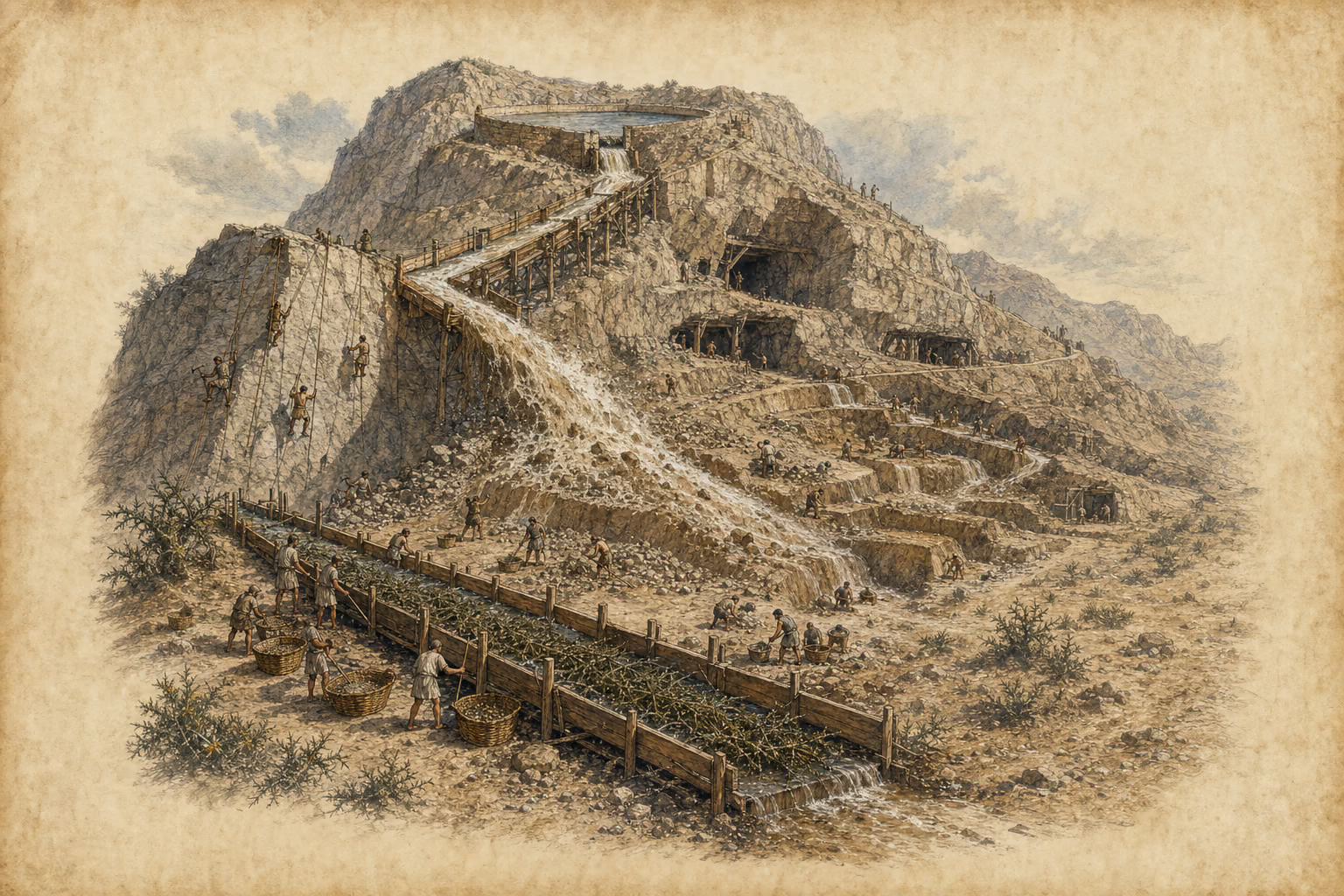
Tertia ratio opera vicerit Gigantum. cuniculis per magna spatia actis cavantur montes lucernarum ad lumina; eadem mensura vigiliarum est, multisque mensibus non cernitur dies. arrugias id genus vocant. siduntque rimae subito et opprimunt operatos, ut iam minus temerarium videatur e profundo maris petere margaritas atque purpuras. tanto nocentiores fecimus terras! relinquuntur itaque fornices crebri montibus sustinendis. occursant in utroque genere silices; hos igne et aceto rumpunt, saepius vero, quoniam id cuniculos vapore et fumo strangulat, caedunt fractariis CL libras ferri habentibus egeruntque umeris noctibus ac diebus per tenebras proximis tradentes; lucem novissimi cernunt. si longior videtur silex, latus sequitur fossor ambitque. et tamen in silice facilior existimatur opera; est namque terra ex quodam argillae genere glarea mixta—gangadiam vocant—prope inexpugnabilis. cuneis eam ferreis adgrediuntur et isdem malleis nihilque durius putant, nisi quod inter omnia auri fames durissima est. peracto opere cervices fornicum ab ultimo caedunt. dat signum ruina, eamque solus intellegit in cacumine eius montis vigil. hic voce, nutu evocari iubet operas pariterque ipse devolat. mons fractus cadit ab sese longe fragore qui concipi humana mente non possit, aeque et flatu incredibili. spectant victores ruinam naturae. nec tamen adhuc aurum est nec sciere esse, cum foderent, tantaque ad pericula et inpendia satis causae fuit sperare quod cuperent. alius par labor ac vel maioris inpendii: flumina ad lavandam hanc ruinam iugis montium obiter duxere a centesimo plerumque lapide; corrugos vocant, a conrivatione credo. mille et hic labores: praeceps esse libramentum oportet, ut ruat verius quam fluat; itaque altissimis partibus ducitur. convalles et intervalla substructis canalibus iunguntur. alibi rupes inviae caeduntur sedemque trabibus cavatis praebere coguntur. qui caedit, funibus pendet, ut procul intuenti species ne ferarum quidem, sed alitum fiat. pendentes maiore ex parte librant et lineas itineri praeducunt, quaque insistentis vestigiis hominis locus non est, amnes trahuntur ab homine. vitium lavandi est, si fluens amnis lutum inportet; id genus terrae urium vocant. ergo per silices calculosve ducunt et urium evitant. ad capita deiectus in superciliis montium piscinae cavantur ducenos pedes in quasque partes et in altitudinem denos. emissaria in iis quina pedum quadratorum ternum fere relinquuntur, ut replete stagno excussis opturamentis erumpat torrens tanta vi, ut saxa provolvat. alius etiamnum in plano labor. fossae, per quas profluat, cavantur—agogas vocant—; hae sternuntur gradatim ulice. frutex est roris marini similis, asper aurumque retinens. latera cluduntur tabulis, ac per praerupta suspenduntur canales. ita profluens terra in mare labitur ruptusque mons diluitur, ac longe terras in mare his de causis iam promovit Hispania. in priore genere quae exhauriuntur inmenso labore, ne occupent puteos, in hoc rigantur. aurum arrugia quaesitum non coquitur, sed statim suum est. inveniuntur ita massae, nec non in puteis, et denas excedentes libras; palagas, alii palacurnas, iidem quod minutum est balucem vocant. ulex siccatur, uritur, et cinis eius lavatur substrato caespite herboso, ut sidat aurum. vicena milia pondo ad hunc modum annis singulis Asturiam atque Callaeciam et Lusitaniam praestare quidam prodiderunt, ita ut plurimum Asturia gignat. neque in alia terrarum parte tot saeculis perseverat haec fertilitas. Italiae parci vetere interdicto patrum diximus; alioqui nulla fecundior metallorum quoque erat tellus. extat lex censoria Victumularum aurifodinae in Vercellensi agro, qua cavebatur, ne plus quinque milia hominum in opere publicani haberent.
Aurum faciendi est etiamnum una ratio ex auripigmento, quod in Syria foditur pictoribus in summa tellure, auri colore, sed fragile lapidum specularium modo. invitaveratque spes Gaium principem avidissimum auri; quam ob rem iussit excoqui magnum pondus et plane fecit aurum excellens, sed ita parvi ponderis, ut detrimentum sentiret propter avaritiam expertus, quamquam auripigmenti librae $X$ IIII permutarentur. nec postea temptatum ab ullo est.
Omni auro inest argentum vario pondere, aliubi decuma parte, aliubi octava. in uno tantum Callaeciae metallo, quod vocant Albucrarense, tricensima sexta portio invenitur; ideo ceteris praestat. ubicumque quinta argenti portio est, electrum vocatur. scobes hae reperiuntur in canaliensi. fit et cura electrum argento addito. quod si quintam portionem excessit, incudibus non resistit. vetusta et electro auctoritas Homero teste, qui Menelai regiam auro, electro, argento, ebore fulgere tradit. Minervae templum habet Lindos insulae Rhodiorum, in quo Helena sacravit calicem ex electro; adicit historia, mammae suae mensura. electri natura est ad lucernarum lumina clarius argento splendere. quod est nativum, et venena deprehendit. namque discurrunt in calicibus arcus caelestibus similes cum igneo stridore et gemina ratione praedicunt.
Aurea statua prima omnium nulla inanitate et antequam ex aere aliqua modo fieret, quam vocant holosphyraton, in templo Anaetidis posita dicitur quo situ terrarum nomen hoc signavimus, numine gentibus illis sacratissimo. direpta ea est Antonii Parthicis rebus, scitumque narratur veteranorum unius Bononiae hospitali divi Augusti cena, cum interrogatus esset, sciretne eum, qui primus violasset id numen, oculis membrisque captum exspirasse; respondit enim cum maxime Augustum e crure eius cenare seque illum esse totumque sibi censum ex ea rapina. hominum primus et auream statuam et solidam LXX circiter olympiade Gorgias Leontinus Delphis in templo posuit sibi. tantus erat docendae artis oratoriae quaestus.
Aurum pluribus modis pollet in remediis volneratisque et infantibus adplicatur, ut minus noceant quae inferantur veneficia. est et ipsi superlato vis malefica, gallinarum quoque et pecuariorum feturis. remedium abluere inlatum et spargere eos, quibus mederi velis. torretur et cum salis gemino pondere, triplici misyis ac rursus cum II salis portionibus et una lapidis, quem schiston vocant. ita virus trahit rebus una crematis in fictili vase, ipsum purum et incorruptum. reliquus cinis servatus in fictili olla ex aqua inlitus lichenas in facie —lomento eo convenit ablui—, fistulas etiam sanat et quae vocantur haemorroides. quodsi tritus pumex adiciatur, putria ulcera et taetri odoris emendat, ex melle vero decoctum cum melanthio inlitum umbilico leniter solvit alvum. auro verrucas curari M. Varro auctor est.
English · Bostock & Riley 1855–57
Gold is found in our own part of the world; not to mention the gold extracted from the earth in India by the ants, and in Scythia by the Griffins. Among us it is procured in three different ways; the first of which is, in the shape of dust, found in running streams, the Tagus in Spain, for instance, the Padus in Italy, the Hebrus in Thracia, the Pactolus in Asia, and the Ganges in India; indeed, there is no gold found in a more perfect state than this, thoroughly polished as it is by the continual attrition of the current.
A second mode of obtaining gold is by sinking shafts or seeking it among the debris of mountains; both of which methods it will be as well to describe. The persons in search of gold in the first place remove the “segutilum,” such being the name of the earth which gives indication of the presence of gold. This done, a bed is made, the sand of which is washed, and, according to the residue found after washing, a conjecture is formed as to the richness of the vein. Sometimes, indeed, gold is found at once in the surface earth, a success, however, but rarely experienced. Recently, for instance, in the reign of Nero, a vein was discovered in Dalmatia, which yielded daily as much as fifty pounds’ weight of gold. The gold that is thus found in the surface crust is known as “talutium,” in cases where there is auriferous earth beneath. The mountains of Spain, in other respects arid and sterile, and productive of nothing whatever, are thus constrained by man to be fertile, in supplying him with this precious commodity.
The gold that is extracted from shafts is known by some persons as “canalicium,” and by others as “canaliense;” it is found adhering to the gritty crust of marble, and, altogether different from the form in which it sparkles in the sapphirus of the East, and in the stone of Thebais and other gems, it is seen interlaced with the molecules of the marble. The channels of these veins are found running in various directions along the sides of the shafts, and hence the name of the gold they yield—“canalicium.” In these shafts, too, the superincumbent earth is kept from falling in by means of wooden pillars. The substance that is extracted is first broken up, and then washed; after which it is subjected to the action of fire, and ground to a fine powder. This powder is known as “apitascudes,” while the silver which becomes disengaged in the furnace has the name of “sudor” given to it. The impurities that escape by the chimney, as in the case of all other metals, are known by the name of “scoria.” In the case of gold, this scoria is broken up a second time, and melted over again. The crucibles used for this purpose are made of “tasconium,” a white earth similar to potter’s clay in appearance; there being no other substance capable of withstanding the strong current of air, the action of the fire, and the intense heat of the melted metal.
The third method of obtaining gold surpasses the labours of the Giants even: by the aid of galleries driven to a long distance, mountains are excavated by the light of torches, the duration of which forms the set times for work, the workmen never seeing the light of day for many months together. These mines are known as “arrugiæ;” and not unfrequently clefts are formed on a sudden, the earth sinks in, and the workmen are crushed beneath; so that it would really appear less rash to go in search of pearls and purples at the bottom of the sea, so much more dangerous to ourselves have we made the earth than the water! Hence it is, that in this kind of mining, arches are left at frequent intervals for the purpose of supporting the weight of the mountain above. In mining either by shaft or by gallery, barriers of silex are met with, which have to be driven asunder by the aid of fire and vinegar; or more frequently, as this method fills the galleries with suffocating vapours and smoke, to be broken to pieces with bruising-machines shod with pieces of iron weighing one hundred and fifty pounds: which done, the fragments are carried out on the workmen’s shoulders, night and day, each man passing them on to his neighbour in the dark, it being only those at the pit’s mouth that ever see the light. In cases where the bed of silex appears too thick to admit of being penetrated, the miner traces along the sides of it, and so turns it. And yet, after all, the labour entailed by this silex is looked upon as comparatively easy, there being an earth—a kind of potter’s clay mixed with gravel, “gangadia” by name, which it is almost impossible to overcome. This earth has to be attacked with iron wedges and hammers like those previously mentioned, and it is generally considered that there is nothing more stubborn in existence—except indeed the greed for gold, which is the most stubborn of all things.
When these operations are all completed, beginning at the last, they cut away the wooden pillars at the point where they support the roof: the coming downfall gives warning, which is instantly perceived by the sentinel, and by him only, who is set to watch upon a peak of the same mountain. By voice as well as by signals, he orders the workmen to be immediately summoned from their labours, and at the same moment takes to flight himself. The mountain, rent to pieces, is cleft asunder, hurling its debris to a distance with a crash which it is impossible for the human imagination to conceive; and from the midst of a cloud of dust, of a density quite incredible, the victorious miners gaze upon this downfall of Nature. Nor yet even then are they sure of gold, nor indeed were they by any means certain that there was any to be found when they first began to excavate, it being quite sufficient, as an inducement to undergo such perils and to incur such vast expense, to entertain the hope that they shall obtain what they so eagerly desire.
Another labour, too, quite equal to this, and one which entails even greater expense, is that of bringing rivers from the more elevated mountain heights, a distance in many instances of one hundred miles perhaps, for the purpose of washing these debris. The channels thus formed are called “corrugi,” from our word “corrivatio,” I suppose; and even when these are once made, they entail a thousand fresh labours. The fall, for instance, must be steep, that the water may be precipitated, so to say, rather than flow; and it is in this manner that it is brought from the most elevated points. Then, too, vallies and crevasses have to be united by the aid of aqueducts, and in another place impassable rocks have to be hewn away, and forced to make room for hollowed troughs of wood; the person hewing them hanging suspended all the time with ropes, so that to a spectator who views the operations from a distance, the workmen have all the appearance, not so much of wild beasts, as of birds upon the wing. Hanging thus suspended in most instances, they take the levels, and trace with lines the course the water is to take; and thus, where there is no room even for man to plant a footstep, are rivers traced out by the hand of man. The water, too, is considered in an unfit state for washing, if the current of the river carries any mud along with it. The kind of earth that yields this mud is known as “urium;” and hence it is that in tracing out these channels, they carry the water over beds of silex or pebbles, and carefully avoid this urium. When they have reached the head of the fall, at the very brow of the mountain, reservoirs are hollowed out, a couple of hundred feet in length and breadth, and some ten feet in depth. In these reservoirs there are generally five sluices left, about three feet square; so that, the moment the reservoir is filled, the floodgates are struck away, and the torrent bursts forth with such a degree of violence as to roll onwards any fragments of rock which may obstruct its passage.
When they have reached the level ground, too, there is still another labour that awaits them. Trenches—known as “agogæ” —have to be dug for the passage of the water; and these, at regular intervals, have a layer of ulex placed at the bottom. This ulex is a plant like rosemary in appearance, rough and prickly, and well-adapted for arresting any pieces of gold that may be carried along. The sides, too, are closed in with planks, and are supported by arches when carried over steep and precipitous spots. The earth, carried onwards in the stream, arrives at the sea at last, and thus is the shattered mountain washed away; causes which have greatly tended to extend the shores of Spain by these encroachments upon the deep. It is also by the agency of canals of this description that the material, excavated at the cost of such immense labour by the process previously described, is washed and carried away; for otherwise the shafts would soon be choked up by it.
The gold found by excavating with galleries does not require to be melted, but is pure gold at once. In these excavations, too, it is found in lumps, as also in the shafts which are sunk, sometimes exceeding ten pounds even. The names given to these lumps are “palagæ,” and “palacurnæ,” while the gold found in small grains is known as “baluce.” The ulex that is used for the above purpose is dried and burnt, after which the ashes of it are washed upon a bed of grassy turf, in order that the gold may be deposited thereupon.
Asturia, Gallæcia, and Lusitania furnish in this manner, yearly, according to some authorities, twenty thousand pounds’ weight of gold, the produce of Asturia forming the major part. Indeed, there is no part of the world that for centuries has maintained such a continuous fertility in gold. I have already mentioned that by an ancient decree of the senate, the soil of Italy has been protected from these researches; otherwise, there would be no land more fertile in metals. There is extant also a censorial law relative to the gold mines of Victumulæ, in the territory of Vercellæ, by which the farmers of the revenue were forbidden to employ more than five thousand men at the works.
There is also one other method of procuring gold; by making it from orpiment, a mineral dug from the surface of the earth in Syria, and much used by painters. It is just the colour of gold, but brittle, like mirror-stone, in fact. This substance greatly excited the hopes of the Emperor Caius, a prince who was most greedy for gold. He accordingly had a large quantity of it melted, and really did obtain some excellent gold; but then the proportion was so extremely small, that he found himself a loser thereby. Such was the result of an experiment prompted solely by avarice: and this too, although the price of the orpiment itself was no more than four denarii per pound. Since his time, the experiment has never been repeated.
In all gold ore there is some silver, in varying proportions; a tenth part in some instances, an eighth in others. In one mine, and that only, the one known as the mine of Albucrara, in Gallæcia, the proportion of silver is but one thirty-sixth: hence it is that the ore of this mine is so much more valuable than that of others. Whenever the proportion of silver is one-fifth, the ore is known also by the name of “electrum;” grains, too, of this metal are often found in the gold known as “canaliense.” An artificial electrum, too, is made, by mixing silver with gold. If the proportion of silver exceeds one-fifth, the metal offers no resistance on the anvil.
Electrum, too, was highly esteemed in ancient times, as we learn from the testimony of Homer, who represents the palace of Menelaüs as refulgent with gold and electrum, silver and ivory. At Lindos, in the island of Rhodes, there is a temple dedicated to Minerva, in which there is a goblet of electrum, consecrated by Helena: history states also that it was moulded after the proportions of her bosom. One peculiar advantage of electrum is, its superior brilliancy to silver by lamp-light. Native electrum has also the property of detecting poisons; for in such case, semicircles, resembling the rainbow in appearance, will form upon the surface of the goblet, and emit a crackling noise, like that of flame, thus giving a twofold indication of the presence of poison.
The first statue of massive gold, without any hollowness within, and anterior to any of those statues of bronze even, which are known as “holosphyratæ,” is said to have been erected in the Temple of the goddess Anaïtis. To what particular region this name belongs, we have already stated, it being that of a divinity held in the highest veneration by the nations in that part of the world. This statue was carried off during the wars of Antonius with the people of Parthia; and a witty saying is told, with reference to it, of one of the veterans of the Roman army, a native of Bononia. Entertaining on one occasion the late Emperor Augustus at dinner, he was asked by that prince whether he was aware that the person who was the first to commit this violence upon the statue, had been struck with blindness and paralysis, and then expired. To this he made answer, that at that very moment Augustus was making his dinner off of one of her legs, for that he himself was the very man, and to that bit of plunder he had been indebted for all his fortune.
As regards statues of human beings, Gorgias of Leontini was the first to erect a solid statue of gold, in the Temple at Delphi, in honour of himself, about the seventieth Olympiad: so great were the fortunes then made by teaching the art of oratory!
Gold is efficacious as a remedy in many ways, being applied to wounded persons and to infants, to render any malpractices of sorcery comparatively innocuous that may be directed against them. Gold, however, itself is mischievous in its effects if carried over the head, in the case of chickens and lambs more particularly. The proper remedy in such case is to wash the gold, and to sprinkle the water upon the objects which it is wished to preserve. Gold, too, is melted with twice its weight of salt, and three times its weight of misy; after which it is again melted with two parts of salt and one of the stone called “schistos.” Employed in this manner, it withdraws the natural acridity from the substances torrefied with it in the crucible, while at the same time it remains pure and incorrupt; the residue forming an ash which is preserved in an earthen vessel, and is applied with water for the cure of lichens on the face: the best method of washing it off is with bean-meal. These ashes have the property also of curing fistulas and the discharges known as “hæmorrhoides:” with the addition, too, of powdered pumice, they are a cure for putrid ulcers and sores which emit an offensive smell.
Gold, boiled in honey with melanthium and applied as a liniment to the navel, acts as a gentle purgative upon the bowels. M. Varro assures us that gold is a cure for warts.