LIBER XXXIII · CAPUT 5
CHRYSOCOLLA
Latine · Mayhoff 1906
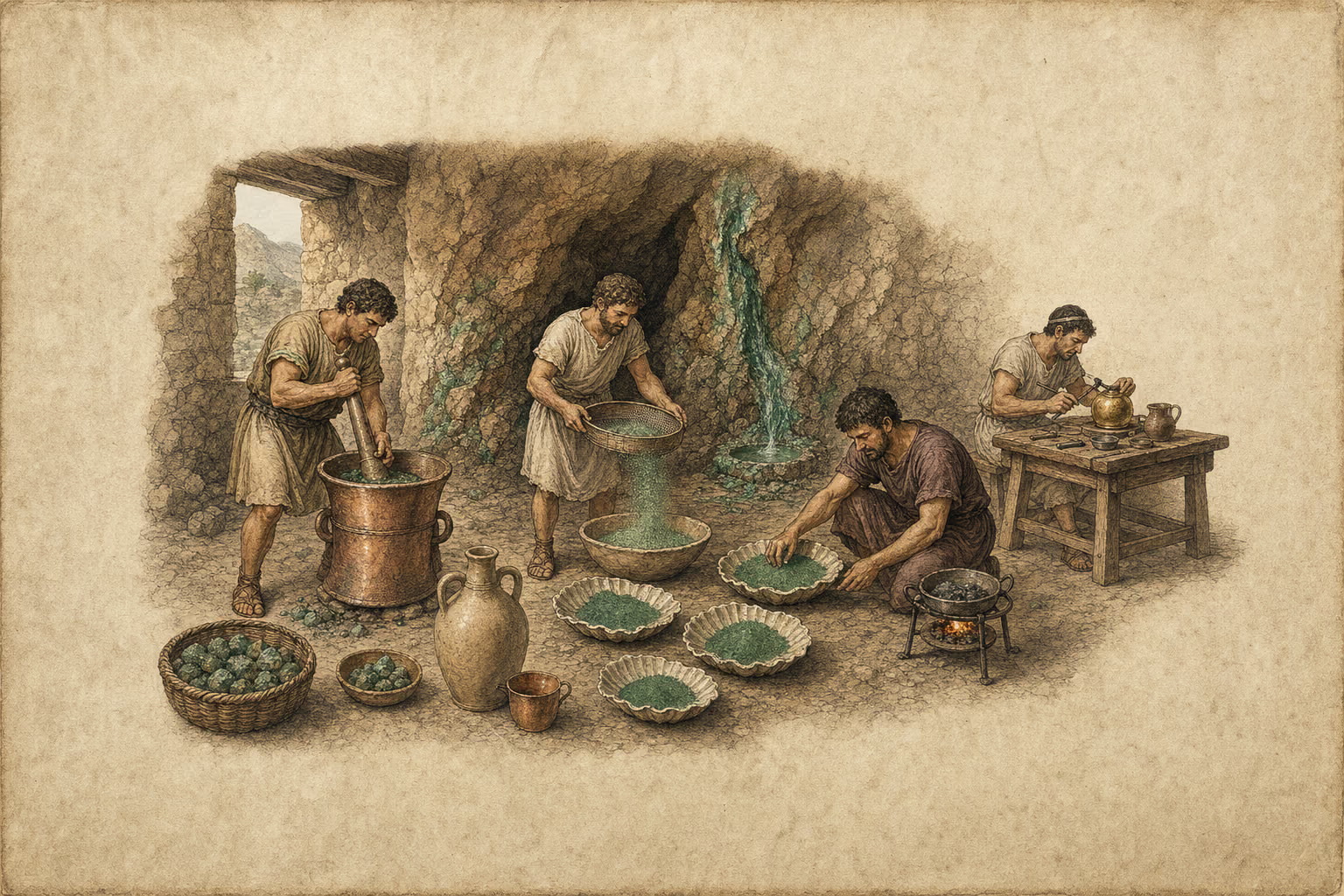
Chrysocolla umor est in puteis, quos diximus, per venam auri defluens crassescente limo rigoribus hibernis usque in duritiam pumicis. laudatiorem eandem in aerariis metallis et proximam in argentariis fieri conpertum est. invenitur et in plumbariis, vilior etiam auraria. in omnibus autem his metallis fit et cura multum infra naturalem illam inmissis in venam aquis leniter hieme tota usque in Iunium mensem, dein siccatis Iunio et Iulio, ut plane intellegatur nihil aliud chrysocolla quam vena putris. nativa duritia maxime distat; uvam vocant. et tamen illa quoque herba, quam lutum appellant, tinguitur. natura est, quae lino lanaeve, ad sucum bibendum. tunditur in pila, dein tenui cribro cernitur, postea molitur ac deinde tenuius cribratur. quidquid non transmeat, repetitur in pila, dein molitur. pulvis semper in catinos digeritur et ex aceto maceratur, ut omnis duritia solvatur, ac rursus tunditur, dein lavatur, in conchis siccatur, tum tinguitur alumine schisto et herba supra dicta pingiturque, antequam pingat. refert quam bibula docilisque sit. nam nisi rapuit colorem, adduntur et scytanum atque turbistum; ita vocant medicamenta sorbere cogentia.
Cum tinxere pictores, orobitin vocant eiusque duo genera faciunt: elutam, quae servatur in lomentum, et liquidam globulis sudore resolutis. haec utraque genera in Cypro fiunt. laudatissima autem est in Armenia, secunda in Macedonia, largissima in Hispania; summa commendationis, ut colorem in herba segetis laete virentis quam simillime reddat. visumque iam est Neronis principis spectaculis harenam circi chrysocolla sterni, cum ipse concolori panno aurigaturus esset. indocta opificum turba tribus eam generibus distinguit: asperam, quae taxatur in libras $X$ VII, mediam quae $X$ v, attritam, quam et herbaceam vocant, $X$ III. sublinunt autem harenosam, priusquam inducant, atramento et paraetonio. haec sunt tenacia eius, colore blanda. paraetonium, quoniam est natura pinguissimum et propter levorem tenacissimum, atramento aspergitur, ne paraetonii candor pallorem chrysocollae adferat. luteam putant a luto herba dictam, quam ipsam caeruleo subtritam pro chrysocolla inducunt, vilissimo genere atque fallacissimo.
Usus chrysocollae et in medicina est ad purganda volnera cum cera atque oleo. eadem per se arida siccat et contrahit. datur et in angina orthopnoeave lingenda cum melle. concitat vomitiones, miscetur et collyriis ad cicatrices oculorum ac viridibus emplastris ad dolores mitigandos, cicatrices trahendas. hanc chrysocollam medici acesim appellant, quae non est orobitis. chrysocollam et aurifices sibi vindicant adglutinando auro, et inde omnes appellatas similiter virentes dicunt. temperatur autem Cypria aerugine et pueri inpubis urina addito nitro teriturque Cyprio aere in Cypriis mortariis; santernam vocant nostri. ita feruminatur aurum, quod argentosum vocant. signum est, si addita santerna nitescit. e diverso aerosum contrahit se hebetaturque et difficulter feruminatur. ad id glutinum fit auro et septima argenti parte ad supra dicta additis unaque tritis.
Contexique par est reliqua circa hoc, ut universa naturae contingat admiratio. auro glutinum est tale, argilla ferro, cadmea aeris massis, alumen lamnis, resina plumbo et marmori, at plumbum nigrum albo iungitur ipsumque album sibi oleo, item stagnum aeramentis, stagno argentum.—Pineis optume lignis aes ferrumque funditur, sed et Aegyptio papyro, paleis aurum.—Calx aqua accenditur et Thracius lapis, idem oleo restinguitur, ignis autem aceto maxime et visco et ovo.—Terra minime flagrat, carboni vis maior exusto iterumque flagranti.
English · Bostock & Riley 1855–57
Chrysocolla is a liquid which is found in the shafts already mentioned, flowing through the veins of gold; a kind of slime which becomes indurated by the cold of winter till it has attained the hardness even of pumice. The most esteemed kind of it, it has been ascertained, is found in copper-mines, the next best being the produce of silver-mines: it is found also in lead-mines, but that found in combination with gold ore is much inferior.
In all these mines, too, an artificial chrysocolla is manufactured; much inferior, however, to the native chrysocolla. The method of preparing it consists in introducing water gradually into a vein of metal, throughout the winter and until the month of June; after which, it is left to dry up during the months of June and July: so that, in fact, it is quite evident that chrysocolla is nothing else but the putrefaction of a metallic vein. Native chrysocolla, known as “uva,” differs from the other in its hardness more particularly; and yet, hard as it is, it admits of being coloured with the plant known as “lutum.” Like flax and wool, it is of a nature which imbibes liquids. For the purpose of dyeing it, it is first bruised in a mortar, after which, it is passed through a fine sieve. This done, it is ground, and then passed through a still finer sieve; all that refuses to pass being replaced in the mortar, and subjected once more to the mill. The finest part of the powder is from time to time measured out into a crucible, where it is macerated in vinegar, so that all the hard particles may be dissolved; after which, it is pounded again, and then rinsed in shell-shaped vessels, and left to dry. This done, the chrysocolla is dyed by the agency of schist alum and the plant above-mentioned; and thus is it painted itself before it serves to paint. It is of considerable importance, too, that it should be absorbent and readily take the dye: indeed, if it does not speedily take the colour, scytanum and turbistum are added to the dye; such being the name of two drugs which compel it to absorb the colouring matter.
When chrysocolla has been thus dyed, painters call it “orobitis,” and distinguish two kinds of it, the cleansed orobitis, which is kept for making lomentum, and the liquid, the balls being dissolved for use by evaporation. Both these kinds are prepared in Cyprus, but the most esteemed is that made in Armenia, the next best being that of Macedonia: it is Spain, however, that produces the most. The great point of its excellence consists in its producing exactly the tint of corn when in a state of the freshest verdure. Before now, we have seen, at the spectacles exhibited by the Emperor Nero, the arena of the Circus entirely sanded with chrysocolla, when the prince himself, clad in a dress of the same colour, was about to exhibit as a charioteer.
The unlearned multitude of artisans distinguish three kinds of chrysocolla; the rough chrysocolla, which is valued at seven denarii per pound; the middling, worth five denarii; and the bruised, also known as the “herbaceous” chrysocolla, worth three denarii per pound. Before laying on the sanded chrysocolla, they underlay coats of atramentum and parætonium, substances which make it hold, and impart a softness to the colours. The parætonium, as it is naturally very unctuous, and, from its smoothness, extremely tenacious, is laid on first, and is then covered with a coat of atramentum, lest the parætonium, from its extreme whiteness, should impart a paleness to the chrysocolla. The kind known as “lutea,” derives its name, it is thought, from the plant called “lutum;” which itself is often pounded with cæruleum instead of real chrysocolla, and used for painting, making a very inferior kind of green and extremely deceptive.
Chroysocolla, too, is made use of in medicine. In combination with wax and oil, it is used as a detergent for wounds; and used by itself in the form of a powder, it acts as a desiccative, and heals them. In cases, too, of quinsy and hardness of breathing, chrysocolla is prescribed, in the form of an electuary, with honey. It acts as an emetic also, and is used as an ingredient in eye-salves, for the purpose of effacing cicatrizations upon the eyes. In green plasters too, it is used, for soothing pain and making scars disappear. This kind of chrysocolla is known by medical men as “acesis,” and is altogether different from orobitis.
The goldsmiths also employ a chrysocolla of their own, for the purpose of soldering gold; and it is from this chrysocolla, they say, that all the other substances, which present a similar green, have received their name. This preparation is made from verdigris of Cyprian copper, the urine of a youth who has not arrived at puberty, and a portion of nitre. It is then pounded with a pestle of Cyprian copper, in a copper mortar, and the name given to the mixture is “santerna.” It is in this way that the gold known as “silvery” gold is soldered; one sign of its being so alloyed being its additional brilliancy on the application of santerna. If, on the other hand, the gold is impregnated with copper, it will contract, on coming in contact with the santerna, become dull, and only be soldered with the greatest difficulty: indeed, for this last kind of gold, there is a peculiar solder employed, made of gold and one-seventh part of silver, in addition to the materials above-mentioned, the whole beaten up together.
While speaking on this subject, it will be as well to annex the remaining particulars, that our admiration may here be drawn to all the marvels presented by Nature in connection therewith. The proper solder for gold is that above described; for iron, potter’s clay; for copper, when in masses, cadmia, and in sheets, alum; for lead and marble, resin. Lead is also united by the aid of white lead; white lead with white lead, by the agency of oil; stannum, with copper file-dust; and silver, with stannum.
For smelting copper and iron, pine-wood is the best, Egyptian papyrus being also very good for the purpose. Gold is melted most easily with a fire made of chaff. Limestone and Thracian stone are ignited by the agency of water, this last being extinguished by the application of oil. Fire, however, is extinguished most readily by the application of vinegar, viscus, and unboiled eggs. Earth will under no circumstance ignite. When charcoal has been once quenched, and then again ignited, it gives out a greater heat than before.