LIBER XXXIII · CAPUT 7
MINIUM: FOR WHAT RELIGIOUS PURPOSES IT WAS USED BY THE ANCIENTS
Latine · Mayhoff 1906
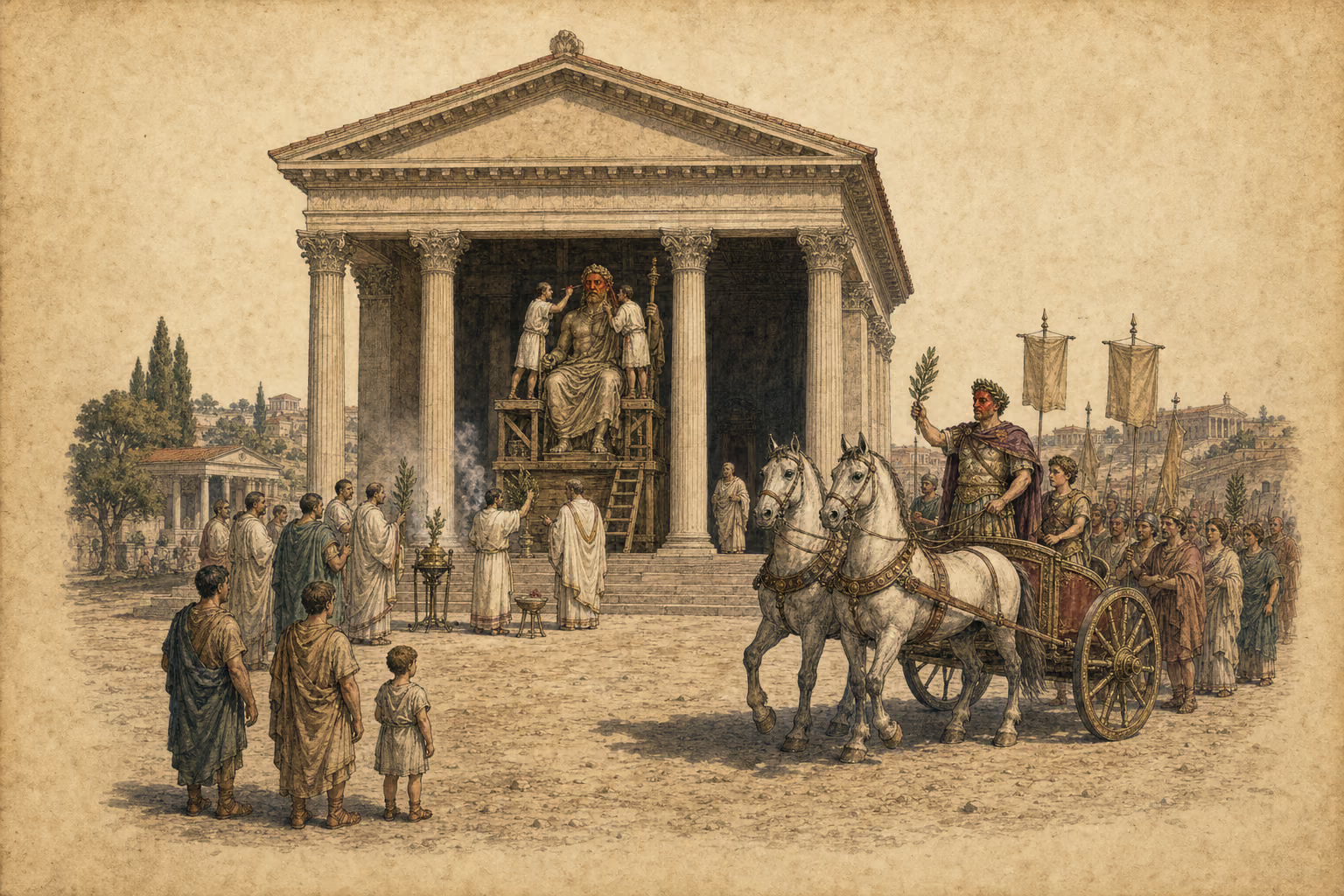
In argentariis metallis invenitur minium quoque, et nunc inter pigmenta magnae auctoritatis et quondam apud Romanos non solum maximae, sed etiam sacrae. enumerat auctores Verrius, quibus credere necesse sit Iovis ipsius simulacri faciem diebus festis minio inlini solitam triumphantiumque corpora; sic Camillum triumphasse; hac religione etiamnum addi in unguenta cenae triumphalis et a censoribus in primis Iovem miniandum locari. cuius rei causam equidem miror, quamquam et hodie id expeti constat Aethiopum populis totosque eo tingui proceres, hunc ibi deorum simulacris colorem esse. quapropter diligentius persequemur omnia de eo.
Theophrastus Lxxxx annis ante Praxibulum Atheniensium magistratum—quod tempus exit in urbis nostrae CCCXLVIIII annum—tradit inventum minium a Callia Atheniense initio sperante aurum excoqui posse harenae rubenti in metallis argenti; hanc fuisse originem eius, reperiri autem iam tum in Hispania, sed durum et harenosum, item apud Colchos in rupe quadam inaccessa, ex qua iaculantes decuterent; id esse adulterum, optimum vero supra Ephesum Cilbianis agris harena cocci colorem habente, hanc teri, dein lavari farinam et quod subsidat iterum lavari; differentiam artis esse, quod alii minium faciant prima lotura, apud alios id esse dilutius, sequentis autem loturae optimum.
Auctoritatem colori fuisse non miror. iam enim Troianis temporibus rubrica in honore erat Homero teste, qui naves ea commendat, alias circa pigmenta picturasque rarus. milton vocant Graeci miniumque cinnabarim. unde natus error inscitia nominum. sic enim appellant illi saniem draconis elisi elephantorum morientium pondere permixto utriusque animalis sanguine, ut diximus, neque est alius colos, qui in pictura proprie sanguinem reddat. illa cinnabaris antidotis medicamentisque utilissima est. at, Hercules, medici, quia cinnabarim vocant, utuntur hoc minio, quod venenum esse paulo mox docebimus.
Cinnabari veteres quae etiam nunc vocant monochromata pingebant. pinxerunt et Ephesio minio, quod derelictum est, quia curatio magni operis erat. praeterea utrumque nimis acre existimabatur. ideo transiere ad rubricam et sinopidem, de quibus suis locis dicam. cinna- baris adulteratur sanguine caprina aut sorvis tritis. pretium sincerae nummi L.
Iuba minium nasci et in Carmania, tradit, Timagenes et in Aethiopia, sed neutro ex loco invehitur ad nos nec fere aliunde quam ex Hispania, celeberrimo Sisaponensi regione in Baetica miniario metallo vectigalibus populi Romani, nullius rei diligentiore custodia. non licet ibi perficere id, excoctique Romam adfertur vena signata, ad bina milia fere pondo annua, Romae autem lavatur, in vendendo pretio statuta lege, ne modum excederet HS LXX in libras. sed adulteratur multis modis, unde praeda societati. namque est alterum genus omnibus fere argentariis itemque plumbariis metallis, quod fit exusto lapide venis permixto, non ex illo, cuius vomicam argentum vivum appellavimus—is enim et ipse in argentum excoquitur—, sed ex aliis simul repertis. steriles etiam plumbi micae. deprehenduntur solo colore nec nisi in fornacibus rubescentes exustique tunduntur in farinam. hoc est secundarium minium perquam paucis notum, multum infra naturales illas harenas. hoc ergo adulteratur minium in officinis sociorum, et vilius Syrico. quonam modo Syricum fiat suo loco docebimus; sublini autem Syrico minium compendi ratio demonstrat. et alio modo pingentium furto opportunum est, plenos subinde abluentium penicillos. sidit autem in aqua constatque furantibus. sincero cocci nitor esse debet, secundarii autem splendor in parietibus sentitplumbaginem. quamquam hoc robigo quaedam metalli est. Sisaponensibus autem miniariis sua vena harenae sine argento. excoquitur auri modo; probatur auro candente, fucatum enim nigrescit, sincerum retinet colorem. invenio et calce adulterari, ac simili ratione ferri candentis lamna, si non sit aurum deprehendi. inlito solis atque lunae contactus inimicus. remedium, ut pariete siccato cera Punica cum oleo liquefacta candens saetis inducatur iterumque admotis gallae carbonibus inuratur ad sudorem usque, postea candelis subigatur ac deinde lintels puris, sicut et marmora nitescunt. qui minium in officinis poliunt, faciem laxis vesicis inligant, ne in respirando pernicialem pulverem trahant et tamen super illas spectent. minium in voluminum quoque scriptura usurpatur clarioresque litteras vel in muro vel in marmore, etiam in sepulchris, facit.
English · Bostock & Riley 1855–57
It is also in silver-mines that minium is found, a pigment held at the present day in very high estimation; and by the Romans in former times not only held in the highest estimation, but used for sacred purposes as well. Verrius enumerates certain authors, upon whose testimony we find it satisfactorily established that it was the custom upon festivals to colour the face of the statue of Jupiter even with minium, as well as the bodies of triumphant generals; and that it was in this guise that Camillus celebrated his triumph. We find, too, that it is through the same religious motives that it is employed at the present day for colouring the unguents used at triumphal banquets, and that it is the first duty of the censors to make a contract for painting the statue of Jupiter with this colour.
For my own part, I am quite at a loss for the origin of this usage; but it is a well-known fact, that at the present day even, minium is in great esteem with the nations of Æthiopia, their nobles being in the habit of staining the body all over with it, and this being the colour appropriated to the statues of their gods. I shall therefore use all the more diligence in enquiring into all the known facts respecting it.
Theophrastus states that, ninety years before the magistracy of Praxibulus at Athens—a date which answers to the year of our City, 439—minium was discovered by Callias the Athenian, who was in hopes to extract gold, by submitting to the action of fire the red sand that was found in the silver-mines. This, he says, was the first discovery of minium. He states, also, that in his own time, it was already found in Spain, but of a harsh and sandy nature; as also in Colchis, upon a certain inaccessible rock there, from which it was brought down by the agency of darts. This, however, he says, was only an adulterated kind of minium, the best of all being that procured in the Cilbian Plains, above Ephesus, the sand of which has just the colour of the kermes berry. This sand, he informs us, is first ground to powder and then washed, the portion that settles at the bottom being subjected to a second washing. From this circumstance, he says, arises a difference in the article; some persons being in the habit of preparing their minium with a single washing, while with others it is more diluted. The best kind, however, he says, is that which has undergone a second washing.
I am not surprised that this colour should have been held in such high esteem; for already, in the days of the Trojan War, rubrica was highly valued, as appears from the testimony of Homer, who particularly notices the ships that were coloured with it, whereas, in reference to other colours and paintings, he but rarely notices them. The Greeks call this red earth “miltos,” and give to minium the name of “cinnabaris,” and hence the error caused by the two meanings of the same word; this being properly the name given to the thick matter which issues from the dragon when crushed beneath the weight of the dying elephant, mixed with the blood of either animal, as already described. Indeed this last is the only colour that in painting gives a proper representation of blood. This cinnabaris, too, is extremely useful as an ingredient in antidotes and various medicaments. But, by Hercules! our physicians, because minium also has the name of “cinnabaris,” use it as a substitute for the other, and so employ a poison, as we shall shortly show it to be.
The ancients used to paint with cinnabaris those pictures of one colour, which are still known among us as “monochromata.” They painted also with the minium of Ephesus: but the use of this last has been abandoned, from the vast trouble which the proper keeping of the picture entailed. And then besides, both these colours were thought to be too harsh; the consequence of which is, that painters have now adopted the use of rubrica and of sinopis, substances of which I shall make further mention in the appropriate places.
Cinnabaris is adulterated by the agency of goats’ blood, or of bruised sorb-apples. The price of genuine cinnabaris is fifty sesterces per pound.
According to Juba minium is also a production of Carmania, and Timagenes says that it is found in Æthiopia. But from neither of those regions is it imported to Rome, nor, indeed, from hardly any other quarter but Spain; that of most note coming from Sisapo, a territory of Bætica, the mine of minium there forming a part of the revenues of the Roman people. Indeed there is nothing guarded with a more constant circumspection; for it is not allowable to reduce and refine the ore upon the spot, it being brought to Rome in a crude state and under seal, to the amount of about two thousand pounds per annum. At Rome, the process of washing is performed, and, in the sale of it, the price is regulated by statute; it not being allowed to exceed seventy sesterces per pound. There are numerous ways, however, of adulterating it, a source of considerable plunder to the company.
For there is, in fact, another kind of minium, found in most silver-mines as well as lead-mines, and prepared by the calcination of certain stones that are found mixed with the metallic vein—not the minerals, however, to the fluid humours of which we have given the name of quicksilver; for if those are subjected to the action of fire they will yield silver—but another kind of stone that is found with them. These barren stones, too, may be recognized by their uniform leaden colour, and it is only when in the furnace that they turn red. After being duly calcined they are pulverized, and thus form a minium of second-rate quality, known to but very few, and far inferior to the produce of the native sand that we have mentioned. It is with this substance, then, as also with syricum, that the genuine minium is adulterated in the manufactories of the company. How syricum is prepared we shall describe in the appropriate place. One motive, however, for giving an under-coat of syricum to minium, is the evident saving of expense that results therefrom. Minium, too, in another way affords a very convenient opportunity to painters for pilfering, by washing their brushes, filled with the colouring matter, every now and then. The minium of course falls to the bottom, and is thus so much gained by the thief.
Genuine minium ought to have the brilliant colour of the kermes berry; but when that of inferior quality is used for walls, the brightness of it is sure to be tarnished by the moisture, and this too, although the substance itself is a sort of metallic mildew. In the mines of Sisapo, the veins are composed exclusively of the sandy particles of minium, without the intermixture of any silver whatever; the practice being to melt it like gold. Minium is assayed by the agency of gold in a state of incandescence: if it has been adulterated, it will turn black, but if genuine, it retains its colour. I find it stated also that minium is adulterated with lime; the proper mode of detecting which, is similarly to employ a sheet of red hot iron, if there should happen to be no gold at hand.
To objects painted with minium the action of the sun and moon is highly injurious. The proper method of avoiding this inconvenience, is to dry the wall, and then to apply, with, a hair brush, hot Punic wax, melted with oil; after which, the varnish must be heated, with an application of gall-nuts, burnt to a red heat, till it quite perspires. This done, it must be smoothed down with rollers made of wax, and then polished with clean linen cloths, like marble, when made to shine. Persons employed in the manufactories in preparing minium protect the face with masks of loose bladder-skin, in order to avoid inhaling the dust, which is highly pernicious; the covering being at the same time sufficiently transparent to admit of being seen through.
Minium is employed also for writing in books; and the letters made with it being more distinct, even on gold or marble, it is used for the inscriptions upon tombs.