LIBER XXXIV · CAPUT 11
THE SCORIA OF COPPER
Latine · Mayhoff 1906
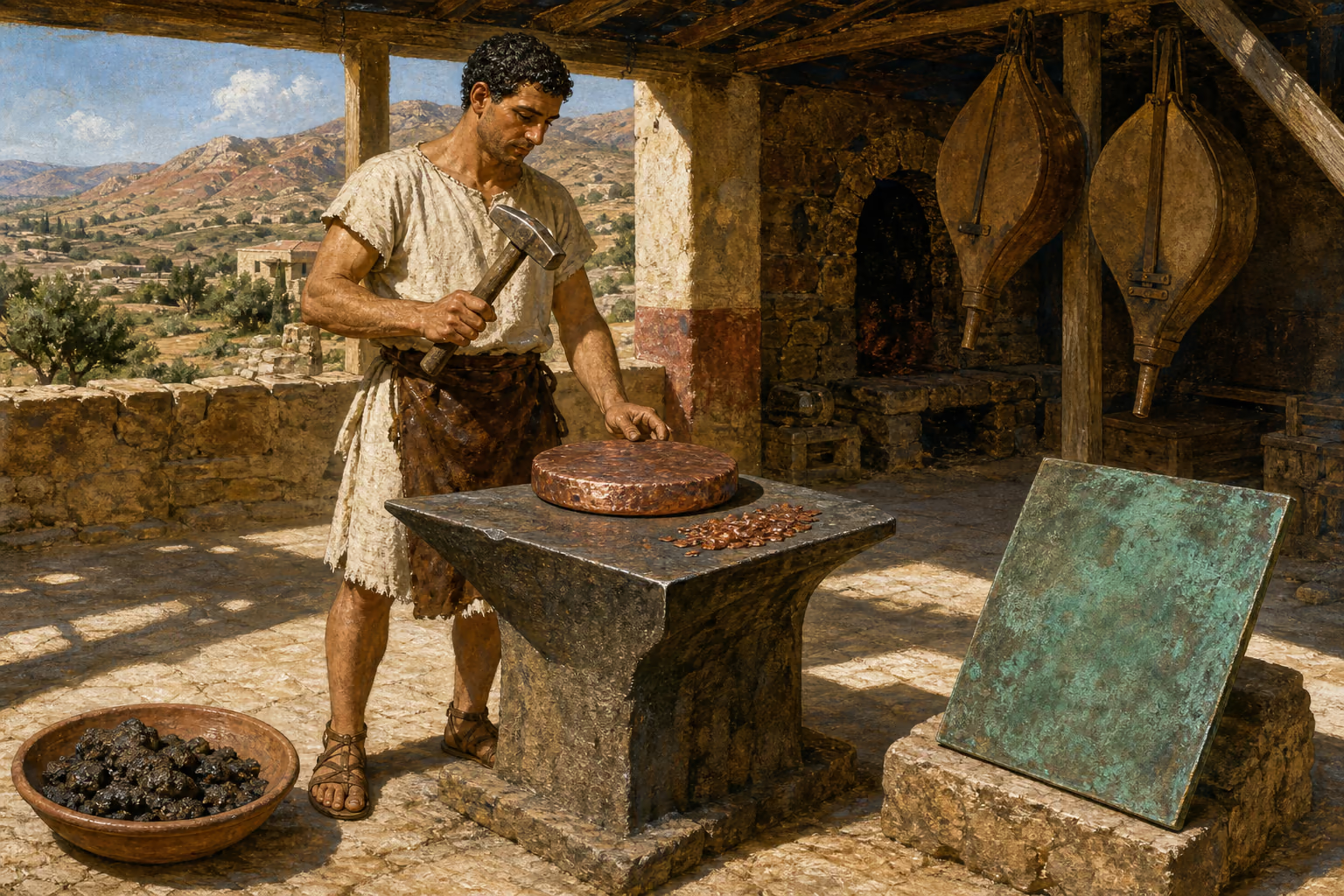
Et scoria aeris simili modo lavatur, minore effectu quam ipsum aes. sed et aeris flos medicinae utilis est. fit aere fuso et in alias fornaces tralato; ibi flatu crebriore excutiuntur veluti milii squamae, quas vocant florem; cadunt autem, cum panes aeris aqua refrigerantur, rubentque similiter squamae aeris, quam vocant lepida, et sic adulteratur flos, ut squama veneat pro eo. est autem squama aeris decussa vi clavis, in quos panes aerei feruminantur, in Cypri maxime officinis. omnis differentia haec est, quod squama excutitur ictu isdem panibus, flos cadit sponte. squamae est alterum genus suptilius, ex summa scilicet lanugine decussum, quod vocant stomoma.
Atque haec omnia medici—quod pace eorum dixisse liceat—ignorant. parent nominibus: in tantum a conficiendis medicaminibus absunt, quod esse proprium medicinae solebat. nunc quotiens incidere in libellos, componere ex iis volentes aliqua, hoc est inpendio miserorum experiri commentaria, credunt Seplasiae omnia fraudibus corrumpenti. iam quidem facta emplastra et collyria mercantur, tabesque mercium aut fraus Seplasiae sic excitetur!
Et squama autem et flos uruntur in patinis fictilibus aut aereis, dein lavantur ut supra ad eosdem usus; squama et amplius narium carnosa vitia, item sedis, et gravitates aurium per fistulam in eas flatu inpulsa et uvas oris farina admota tollit et tonsillas cum melle. fit ex candido aere squama lounge Cypria inefficacior. nec non urina pueri prius macerant clavos panesque quidam excussuri squamam, teruntque et aqua pluvia lavant. dant et hydropicis eam drachmis II in mulsi hemina et inlinunt cum polline.
Aeruginis quoque magnus usus est. pluribus fit ea modis. namque et lapidi, ex quo coquitur aes, deraditur, et aere candido perforato atque in cadis suspenso super acetum acre opturatumque operculo. multo probatior est, si hoc idem squamis fiat. quidam vasa ipsa candidi aeris fictilibus condunt in acetum raduntque decumo die. alii vinaceis contegunt totidemque post dies radunt, alii delimatam aeris scobem aceto spargunt versantque spathis saepius die, donec absumatur. eandem scobem alii terere in mortariis aereis ex aceto malunt. ocissime vero contingit coronariorum recisamentis in acetum id additis. adulterant marmore trito maxime Rhodiam aeruginem, alii pumice aut cummi. praecipue autem fallit atramento sutorio adulterata; cetera enim dente deprehenduntur stridentia in frendendo. experimentum in vatillo ferreo, nam quae sincera est, suum colorem retinet, quae mixta atramento, rubescit. deprehenditur et papyro galla prius macerato, nigrescit enim statim aerugine inlita. deprehenditur et visu maligne virens. sed sive sinceram sive adulteram aptissimum est elui siccatamque in patina nova uri ac versari, donec favilla fiat; postea teritur ac reconditur. aliqui in crudis fictilibus urunt, donec figlinum percoquatur. nonnulli et tus masculum admiscent. lavatur autem aerugo sicut cadmea. vis eius collyriis oculorum aptissima et delacrimationibtus mordendo proficiens, sed ablui necessarium penicillis calidis, donec rodere desinat.— Hieracium vocatur collyrium, quod ea maxime constat. temperatur autem id hammoniaci unciis IIII, aeruginis Cypriae II, atramenti sutorii, quod chalcanthum vocant, totidem, misyos una, croci VI. haec omnia trita aceto Thasio colliguntur in pilulas, excellentis remedii contra initia glaucomatum et suffusionum, contra caligines aut scabritias et albugines et genarum vitia. cruda autem aerugo volnerariis emplastris miscetur. oris etiam gingivarumque exulcerationes mirifice emendat et labrorum ulcera cum oleo. quod si et cera addatur, purgat et ad cicatricem perducit. aerugo et callum fistularum erodit vitiorumque circa sedem sive per se sive cum hammoniaco inlita vel collyrii modo in fistulas adacta. eadem cum resinae terebinthinae tertia parte subacta lepras tollit.
English · Bostock & Riley 1855–57
The scoria, too, of copper is washed in the same manner; but the action of it is less efficacious than that of copper itself. The flower, too, of copper is also used in medicine; a substance which is procured by fusing copper, and then removing it into another furnace, where the repeated action of the bellows makes the metal separate into small scales, like the husks of millet, and known as “flower of copper.” These scales are also separated, when the cakes of metal are plunged into water: they become red, too, like the scales of copper known as “lepis,” by means of which the genuine flower of copper is adulterated, it being also sold under that name. This last is made by hammering nails that are forged from the cakes of metal. All these processes are principally carried on in the furnaces of Cyprus; the great difference between these substances being, that this lepis is detached from the cakes by hammering, whereas the flower falls off spontaneously.
There is another finer kind of scale which is detached from the surface of the metal, like a very fine down, and known as “stomoma.” But of all these substances, and even of their names, the physicians, if I may venture so to say, are quite ignorant, as appears by the names they give them; so unacquainted are they with the preparation of medicaments, a thing that was formerly considered the most essential part of their profession. At the present day, whenever they happen to find a book of recipes, if they wish to make any composition from these substances, or, in other words, to make trial of the prescription at the expense of their unhappy patients, they trust entirely to the druggists, who spoil everything by their fraudulent adulterations. For this long time past, they have even purchased their plasters and eye-salves ready made, and the consequence is, that the spoiled or adulterated wares in the druggists’ shops are thus got rid of.
Both lepis and flower of copper are calcined in shallow earthen or brazen pans; after which they are washed, as described above, and employed for the same purposes; in addition to which, they are used for excrescences in the nostrils and in the anus, as also for dullness of the hearing, being forcibly blown into the ears through a tube. Incorporated with meal, they are applied to swellings of the uvula, and, with honey, to swellings of the tonsils. The scales prepared from white copper are much less efficacious than those from Cyprian copper. Sometimes they first macerate the nails and cakes of copper in a boy’s urine; and in some instances, they pound the scales, when detached, and wash them in rain water. They are then given to dropsical patients, in doses of two drachmæ, with one semisextarius of honied wine: they are also made into a liniment with fine flour.
Verdigris is also applied to many purposes, and is prepared in numerous ways. Sometimes it is detached already formed, from the mineral from which copper is smelted: and sometimes it is made by piercing holes in white copper, and suspending it over strong vinegar in casks, which are closed with covers; it being much superior if scales of copper are used for the purpose. Some persons plunge vessels themselves, made of white copper, into earthen pots filled with vinegar, and scrape them at the end of ten days. Others, again, cover the vessels with husks of grapes, and scrape them in the same way, at the end of ten days. Others sprinkle vinegar upon copper filings, and stir them frequently with a spatula in the course of the day, until they are completely dissolved. Others prefer triturating these filings with vinegar in a brazen mortar: but the most expeditious method of all is to add to the vinegar shavings of coronet copper. Rhodian verdigris, more particularly, is adulterated with pounded marble; some persons use pumice-stone or gum.
The adulteration, however, which is the most difficult to detect, is made with copperas; the other sophistications being detected by the crackling of the substance when bitten with the teeth. The best mode of testing it is by using an iron fire-shovel; for when thus subjected to the fire, if pure, the verdigris retains its colour, but if mixed with copperas, it becomes red. The fraud may also be detected by using a leaf of papyrus, which has been steeped in an infusion of nut-galls; for it becomes black immediately upon the genuine verdigris being applied. It may also be detected by the eye; the green colour being unpleasant to the sight. But whether it is pure or adulterated, the best method is first to wash and dry it, and then to burn it in a new earthen vessel, turning it over until it is reduced to an ash; after which it is pounded and put by for use. Some persons calcine it in raw earthen vessels, until the earthenware becomes thoroughly baked: others again add to it male frankincense. Verdigris is washed, too, in the same manner as cadmia.
It affords a most useful ingredient for eye-salves, and from its mordent action is highly beneficial for watery humours of the eyes. It is necessary, however, to wash the part with warm water, applied with a fine sponge, until its mordency is no longer felt.
“Hieracium” is the name given to an eye-salve, which is essentially composed of the following ingredients; four ounces of sal ammoniac, two of Cyprian verdigris, the same quantity of the kind of copperas which is called “chalcanthum,” one ounce of misy and six of saffron; all these substances being pounded together with Thasian vinegar and made up into pills. It is an excellent remedy for incipient glaucoma and cataract, as also for films upon the eyes, eruptions, albugo, and diseases of the eye-lids. Verdigris, in a crude state, is also used as an ingredient in plasters for wounds. In combination with oil, it is wonderfully efficacious for ulcerations of the mouth and gums, and for sore lips. Used in the form of a cerate, it acts detergently upon ulcers, and promotes their cicatrization. Verdigris also consumes the callosities of fistulas and excrescences about the anus, either used by itself, applied with sal ammoniac, or inserted in the fistula in the form of a salve. The same substance, kneaded with one third part of resin of turpentine, removes leprosy.