LIBER XXXIV · CAPUT 12
SCOLEX OF COPPER; EIGHTEEN REMEDIES
Latine · Mayhoff 1906
Est et alterum genus aeruginis, quam vocant scoleca, in Cyprio aere trito alumine et sale aut nitro pari pondere cum aceto albo quam acerrimo. non fit hoc nisi aestuosissimis diebus circa canis ortum. teritur autemdone viride fiat contrahatque se vermiculorum specie, unde et nomen. quod vitiatum ut emendetur, II partes quam fuere aceti miscentur urinae pueri inpubis. idem autem in medicamentis et santerna efficit, qua diximus aurum feruminari. usus utriusque qui aeruginis. scolex fit et per se derasus aerario lapidi, de quo nunc dicemus.
Chalcitim vocant, ex quo et ipso aes coquitur. distat a cadmea, quod illa super terrain ex subdialibus petris caeditur, haec ex obrutis, item quod chalcitis friat se statim, mollis nature, ut videatur lanugo concreta. est et alia distinctio, quod chalcitis tria genera continent, aeris et misyos et soreos, de quibus singulis dicemus suis locis. habet autem aeris venas oblongas. probatur mellei coloris, gracili venarum discursu, friabilis nec lapidosa. putant et recentem utiliorem esse, quoniam inveterata sori fiat. vis eius ad excrescentia in ulceribus, sanguinem sistere, gingivas, uvam, tonsillas farina compescere, volvae vitiis in vellere inponi. cum suco vero porri verendorum additur emplastris. maceratur autem in fictili ex aceto, circumlito fimo diebus XL, et colorem croci trahit. tum admixto cadmeae pari pondere medicamentum efficit psoricon dictum. quod si II partes chalcitidis tertia cadmeae temperentur, acrius hoc idem fiat; etiamnum vehementius, si aceto quam vino temperetur; tosta vero efficacior fit ad eader omnia.
Sori Aegyptium maxime laudatur, multum superato Cyprio Hispaniensique et Africo, quamquam oculorum curationi quidam utilius putent Cyprium; sed in quacumque natione optimum cui maximum virus olfactu, tritumque pinguiter nigrescens et spongiosum. stomacho res contraria in tantum, ut quibusdam olfactum modo vomitiones moveat. et Aegyptium quidem tale, alterius nationis contritum splendescit ut misy et est lapidosius. prodest autem et dentium dolori, si contineatur atque colluat, et ulceribus oris gravibus quaeque serpant. uritur carbonibus ut chalcitis.
Misy aliqui tradiderunt fieri exusto lapide in scrobibus, flore eius luteo miscente se ligni pineae favillae. re vera autem e supra dicto fit lapide, concretum natura discretumque vi, optimum in Cypriorum officinis, cuius notae sunt friati aureae scintillae et, cum teratur, harenosa natura sine terra, chalcitidi similis. hoc admiscent qui aurum purgant. utilitas eius infusi cum rosaceo auribus purulentis et in lana inpositi capitis ulceribus. extenuat et scabritias oculorum inveteratas, praecipue utile tonsillis contraque anginas et suppurata. ratio ut XVI drachmae in hemina aceti coquantur addito melle, donee lentescat. sic ad supra dicta utile est. quotiens opus sit molliri vim eius, mel adspergitur. erodit et callum fistularum ex aceto foventium et collyriis additur, sistit et sanguinem ulceraque quae serpant quaeve putrescant, absumit et excrescentes carnes. peculiariter virilitatis vitiis utile et feminarum profluvium sistit.
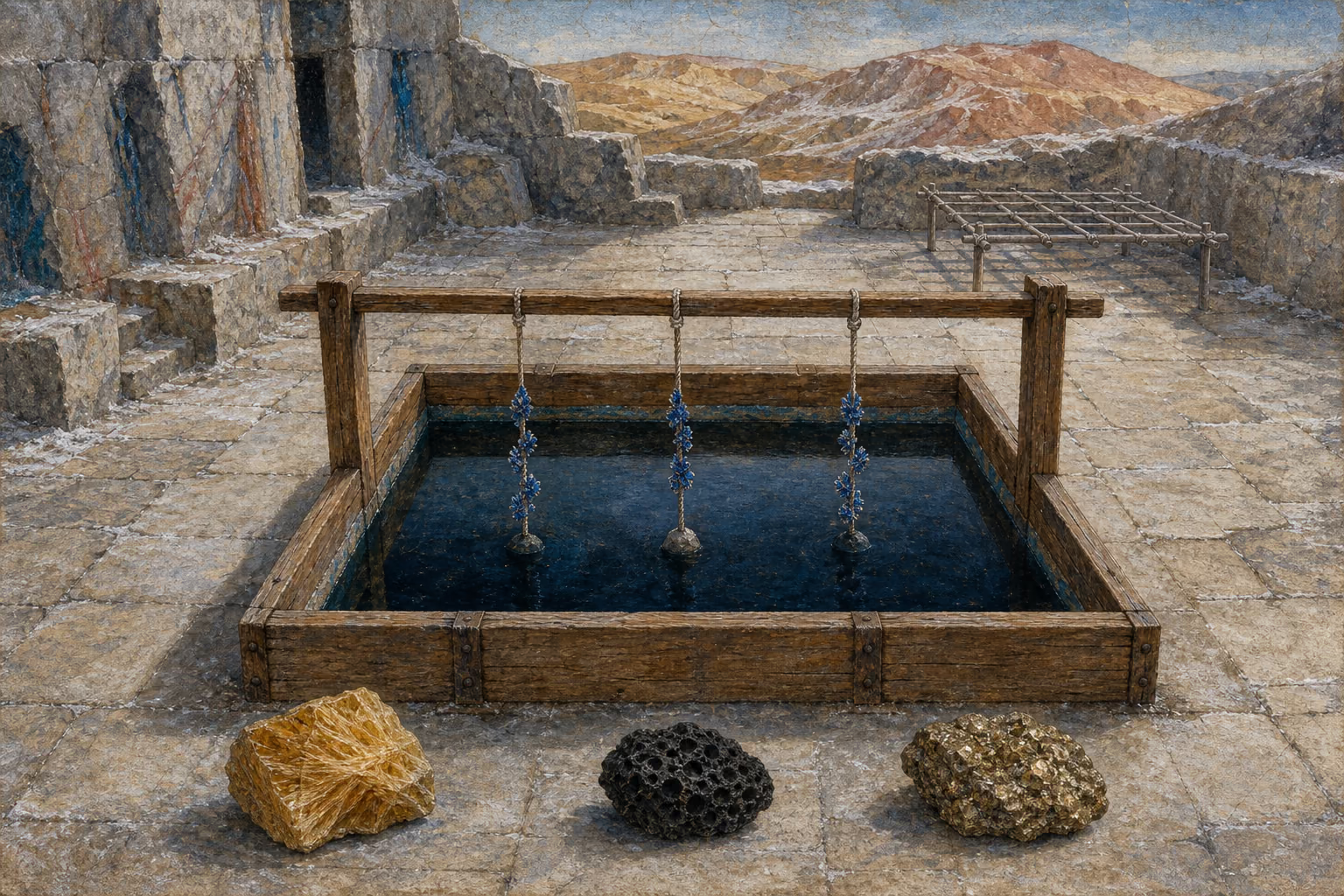
Graeci cognationem aeris nomine fecerunt et atramento sutorio; appellant enim chalcanthon. nec ullius aeque mira natura est. fit in Hispaniae puteis stagnisve id genus aquae habentibus. decoquitur ea admixta dulci pari mensura et in piscinas ligneas funditur. immobilibus super has transtris dependent restes lapillis extentae, quibus adhaerescens limus vitreis acinis imaginem quandam uvae reddit. exemptum ita siccatur diebus XXX. color est caeruleus perquam spectabili nitore, vitrumque esse creditur; diluendo fit atramentum tinguendis coriis. fit et pluribus modis: genere terrae eo in scrobes cavato, quorum e lateribus destillantes hiberno gelu stirias stalagmian vocant, neque est purius aliud. sed ex eo, candidum colorem sentiente viola, lonchoton appellant. fit et in saxorum catinis pluvia aqua conrivato limo gelante; fit et salis modo flagrantissimo sole admissas dulces aquas cogente. ideo quidam duplici differentia fossile aut facticium appellant, hoc pallidius et quantum colore, tantum bonitate deterius. probant maxime Cyprium in medicinae usu. sumitur ad pellenda ventris animalia drachmae pondere cum melle. purgat et caput dilutum ac naribus instillatum, item stomachum cum melle aut aqua mulsa sumptum. medetur et oculorum scabritiae dolorique et caligini et oris ulceribus. sistit et sanguinem narium, item haemorroidum. extrahit ossa fracta cum semine hyoscyami, suspendit epiphoras penicillo fronti inpositum, efficax et in emplastris ad purganda volnera et excrescentia ulcerum. tollit et uvas, vel si decocto tangantur, cum lini quoque semine superponitur emplastris ad dolores tollendos. quod ex eo candicat, in uno usu praefertur violaceis, ut gravitati aurium per fistulas inspiretur. volnera per se inlitum sanat, sed tinguit cicatrices. nuper inventum ursorum in harena et leonum ora spargere illo, tantaque est vis in adstringendo, ut non queant mordere.
English · Bostock & Riley 1855–57
There is another kind of verdigris also, which is called “scolex.” It is prepared by triturating in a mortar of Cyprian copper, alum and salt, or an equal quantity of nitre, with the very strongest white vinegar. This preparation is only made during the hottest days of the year, about the rising of the Dog-star. The whole is triturated until it becomes green, and assumes the appearance of small worms, to which it owes its name. This repulsive form is corrected by mixing the urine of a young child, with twice the quantity of vinegar. Scolex is used for the same medicinal purposes as santerna, which we have described as being used for soldering gold, and they have, both of them, the same properties as verdigris. Native scolex is also procured by scraping the copper ore of which we are about to speak.
Chalcitis is the name of a mineral, from which, as well as cadmia, copper is extracted by heat. It differs from cadmia in this respect, that this last is procured from beds below the surface, while chalcitis is detached from rocks that are exposed to the air. Chalcitis also becomes immediately friable, being naturally so soft as to have the appearance of a compressed mass of down. There is also this other distinction between them, that chalcitis is a composition of three other substances, copper, misy, and sory, of which last we shall speak in their appropriate places. The veins of copper which it contains are oblong. The most approved kind is of the colour of honey; it is streaked with fine sinuous veins, and is friable and not stony. It is generally thought to be most valuable when fresh, as, when old, it becomes converted into sory. It is highly useful for removing fleshy excrescences in ulcers, for arresting hæmorrhage, and, in the form of a powder, for acting astringently upon the gums, the uvula, and the tonsillary glands. It is applied in wool, as a pessary, for affections of the uterus; and with leek juice it is formed into plasters for diseases of the genitals. This substance is macerated for forty days in vinegar, in an earthen vessel luted with dung; after which it acquires a saffron colour. When this composition is mixed with an equal proportion of cadmia, it forms the medicament known as “psoricon.” If two parts of chalcitis are combined with one of cadmia, the medicament becomes more active; and it is rendered still more powerful if vinegar is used instead of wine. For all these purposes, calcined chalcitis is the most efficacious.
The sory of Egypt is the most esteemed, being considered much superior to that of Cyprus, Spain, and Africa; although some prefer the sory from Cyprus for affections of the eyes. But from whatever place it comes, the best is that which has the strongest odour, and which, when triturated, becomes greasy, black, and spongy. It is a substance so unpleasant to the stomach, that some persons are made sick merely by its smell. This is the case more particularly with the sory from Egypt. That from other countries, by trituration, acquires the lustre of misy, and is of a more gritty consistency. Held in the mouth, and used as a collutory, it is good for toothache. It is also useful for malignant ulcers of a serpiginous nature. It is calcined upon charcoal, like chalcitis.
Some persons have stated, that misy is formed by the calcination of the mineral, in trenches; its fine yellow powder becoming mixed with the ashes of the burnt fire-wood. The fact is, however, that though obtained from the mineral, it is already formed, and in compact masses, which require force to detach them. The best is that which comes from the manufactories of Cyprus, its characteristics being, that when broken, it sparkles like gold, and when triturated, it presents a sandy or earthy appearance, like chalcitis. Misy is used in the process of refining gold. Mixed with oil of roses, it is used as an injection for suppurations of the ears, and, in combination with wool, it is applied to ulcers of the head. It also removes inveterate granulations of the eye-lids, and is particularly useful for affections of the tonsils, quinsy, and suppurations. For these maladies, sixteen drachmæ should be mixed with one semisextarius of vinegar, and boiled with the addition of some honey, until it becomes of a viscous consistency; in which state it is applicable to the different purposes above mentioned. When its action is wanted to be modified, a sprinkling of honey is added. A fomentation of misy and vinegar removes the callosities of fistulous ulcers; it also enters into the composition of eye-salves. It arrests hæmorrhage, prevents the spreading of serpiginous and putrid ulcers, and consumes fleshy excrescences. It is particularly useful for diseases of the male generative organs, and acts as a check upon menstruation.
The Greeks, by the name which they have given to it, have indicated the relation between shoemakers’ black and copper; for they call it “chalcanthum.” Indeed there is no substance so singular in its nature. It is prepared in Spain, from the water of wells or pits which contain it in dissolution. This water is boiled with an equal quantity of pure water, and is then poured into large wooden reservoirs. Across these reservoirs there are a number of immovable beams, to which cords are fastened, and then sunk into the water beneath by means of stones; upon which, a slimy sediment attaches itself to the cords, in drops of a vitreous appearance, somewhat resembling a bunch of grapes. Upon being removed, it is dried for thirty days. It is of an azure colour, and of a brilliant lustre, and is often taken for glass. When dissolved, it forms the black dye that is used for colouring leather.
Chalcanthum is also prepared in various other ways: the earth which contains it being sometimes excavated into trenches, from the sides of which globules exude, which become concrete when exposed to the action of the winter frosts. This kind is called “stalagmia,” and there is none more pure. When its colour is nearly white, with a slight tinge of violet, it is called “lonchoton.” It is also prepared in pans hollowed out in the rocks; the rain water carrying the slime into them, where it settles and becomes hardened. It is also formed in the same way in which we prepare salt; the intense heat of the sun separating the fresh water from it. Hence it is that some distinguish two kinds of chalcanthum, the fossil and the artificial; the latter being paler than the former, and as much inferior to it in quality as it is in colour.
The chalcitis which comes from Cyprus is the most highly esteemed for the purposes of medicine, being taken in doses of one drachma with honey, as an expellent of intestinal worms. Diluted and injected into the nostrils, it acts detergently upon the brain, and, taken with honey or with hydromel, it acts as a purgative upon the stomach. It removes granulations upon the eye-lids, and is good for pains and films upon the eyes; it is curative also of ulcerations of the mouth. It arrests bleeding at the nostrils, and hæmorrhoidal discharges. In combination with seed of hyoscyamus, it brings away splinters of broken bones. Applied to the forehead with a sponge, it acts as a check upon defluxions of the eyes. Made up into plasters, it is very efficacious as a detergent for sores and fleshy excrescences in ulcers. The decoction of it, by the contact solely, is curative of swellings of the uvula. It is laid with linseed upon plasters which are used for relieving pains. The whitish kind is preferred to the violet in one instance only, for the purpose of being blown into the ears, through a tube, to relieve deafness. Applied topically by itself, it heals wounds; but it leaves a discoloration upon the scars. It has been lately discovered, that if it is sprinkled upon the mouths of bears and lions in the arena, its astringent action is so powerful as to deprive the animals of the power of biting.