LIBER XXXIV · CAPUT 14
IRON ORES
Latine · Mayhoff 1906
Proxime indicari debent metalla ferri. optumo pessimoque vitae instrumento est, siquidem hoc tellurem scindimus, arbores serimus, arbusta tondemus, vites squalore deciso annis omnibus cogimus invenescere, hoc exstruimus tecta, caedimus saxa, omnesque ad alios usus ferro utimur, sed eodem ad bella, caedes, latrocinia, non comminus solum, sed etiam missili volucrique, nunc tormentis excusso, nunc lacertis, nunc vero pinnato, quam sceleratissimam humani ingenii fraudem arbitror, siquidem, ut ocius mors perveniret ad hominem, alitem illam fecimus pinnasque ferro dedimus. quam ob rem culpa eius non naturae fiat accepta. aliquot experimentis probatum est posse innocens esse ferrum. in foedere, quod expulsis regibus populo Romano dedit Porsina, nominatim comprehensum invenimus, ne ferro nisi in agri cultu uteretur. et tum stilo osseo scribere institutum vetustissimi auctores prodiderunt. Magni Pompei in tertio consulatu extat edictum in tumultu necis Clodianae prohibentis ullum telum esse in urbe. et ars antiqua ipsa non defuit honorem mitiorem habere ferro quoque. Aristonidas artifex, cum exprimere vellet Athamantis furorem Learcho filio praecipitato residentem paenitentia, aes ferrumque miscuit, ut robigine eius per nitorem aeris relucente exprimeretur verecundiae rubor. hoc signum exstat hodie Rhodi. est in eadem urbe et ferreus Hercules, quem fecit Alcon laborum dei patientia inductus. videmus et Romae seyphos e ferro dicatos in templo Martis Ultoris. obstitit eadem naturae benignitas exigentis ab ferro ipso poenas robigine eademque providentia nihil in rebus mortalius facientis quam quod esset infestissimum mortalitati.
Ferri metalla ubique propemodum reperiuntur, quippe etiam insula Italiae Ilva gignente, minimaque difficultate adgnoscuntur colore ipso terrae manifesto. ratio eadem excoquendis venis; in Cappadocia tantum quaestio est, aquae an terrae fiat acceptum, quoniam perfusa Cer aso fluvio terra neque aliter ferrum e fornacibus reddit. differentia ferri numerosa. prima in genere terrae caelive: aliae molle tantum plumboque vicinum subministrant, aliae fragile et aerosum rotarumque usibus et clavis maxime fugiendum, cui prior ratio convenit; aliud brevitate sola placet clavisque caligariis, aliud robiginem celerius sentit. stricturae vocantur hae omnes, quod non in aliis metallis, a stringenda acie vocabulo inposito. et fornacium magna differentia est, nucleusque quidam ferri excoquitur in iis ad indurandam aciem, alioque modo ad densandas incudes malleorumve rostra. summa autem differentia in aqua, cui subinde candens inmergitur. haec alibi atque alibi utilior nobilitavit loca gloria ferri, sicuti Bilbilim in Hispania et Turiassonem, Comum in Italia, cum ferraria metalla in iis locis non sint. ex omnibus autem generibus palma Serico ferro est; Seres hoc cum vestibus suis pellibusque mittunt; secunda Parthico.- neque alia genera ferri ex mera acie tenmperantur, ceteris enim admiscetur mollior complexus. in nostro orbe aliubi vena bonitatem hanc praestat, ut in Noricis, aliubi factura, ut Sulmone, aqua ubi diximus, quippe cum exacuendo oleariae cotes aquariaeque differant et oleo delicatior fiat acies. mirumque, cum excoquatur vena, aquae modo liquari ferrum, postea in spongeas frangi. tenuiora ferramenta oleo restingui mos est, ne aqua in fragilitatem durentur. a ferro sanguis humanus se ulciscitur, contactum namque eo celerius robiginem trahit.
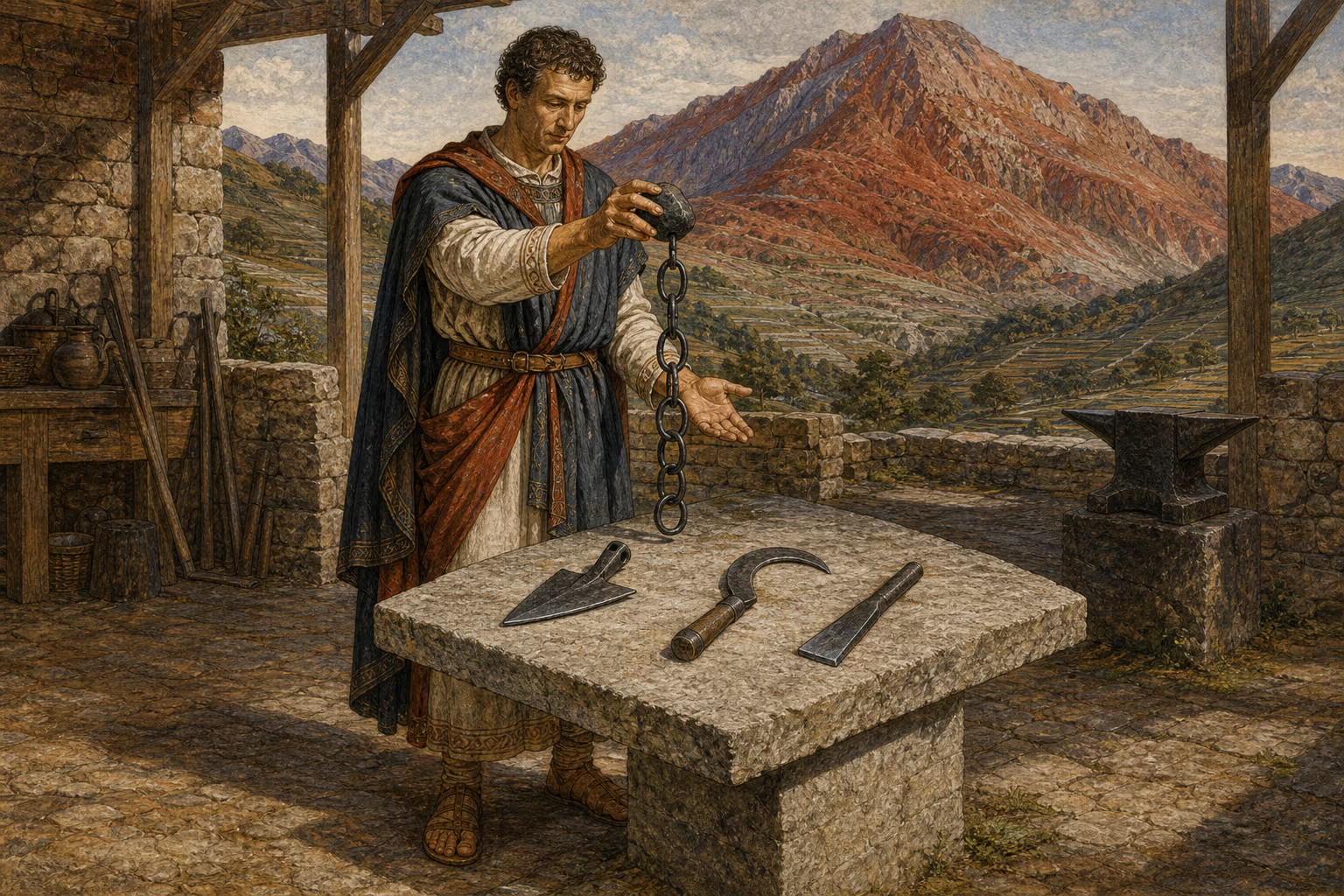
De magnete lapide suo loco dicemus concordiaque, quam cum ferro habet. sola haec materia virus ab eo lapide accipit retinetque longo tempore, aliud adprehendens ferrum, ut anulorum catena spectetur interdum. quod volgus imperitum appellat ferrum vivum, vulneraque talia asperiora fiunt. hic lapis et in Cantabria nascitur, non ut ille magnes verus caute continua, sed sparsa bulbatione—ita appellant—, nescio an vitro fundendo perinde utilis, nondum enim expertus est quisquam; ferrum utique inficit eadem vi.—Magnete lapide architectus Timochares Alexandriae Arsinoes templum concamarare incohaverat, ut in eo simulacrum e ferro pendere in aēre videretur. intercessit ipsius mors et Ptolemaei regis, qui id sorori suae iusserat fieri.— Metallorum omnium vena ferri largissima est Cantabriae. maritima parte, qua oceanus adluit, mons praealtus- incredibile dictu—totus ex ea materia est, ut in am- (?)bitu oceani diximus.
English · Bostock & Riley 1855–57
Next to copper we must give an account of the metal known as iron, at the same time the most useful and the most fatal instrument in the hand of mankind. For by the aid of iron we lay open the ground, we plant trees, we prepare our vineyard-trees, and we force our vines each year to resume their youthful state, by cutting away their decayed branches. It is by the aid of iron that we construct houses, cleave rocks, and perform so many other useful offices of life. But it is with iron also that wars, murders, and robberies are effected, and this, not only hand to hand, but from a distance even, by the aid of missiles and winged weapons, now launched from engines, now hurled by the human arm, and now furnished with feathery wings. This last I regard as the most criminal artifice that has been devised by the human mind; for, as if to bring death upon man with still greater rapidity, we have given wings to iron and taught it to fly. Let us therefore acquit Nature of a charge that here belongs to man himself.
Indeed there have been some instances in which it has been proved that iron might be solely used for innocent purposes. In the treaty which Porsena granted to the Roman people, after the expulsion of the kings, we find it expressly stipulated, that iron shall be only employed for the cultivation of the fields; and our oldest authors inform us, that in those days it was considered unsafe to write with an iron pen. There is an edict extant, published in the third consulship of Pompeius Magnus, during the tumults that ensued upon the death of Clodius, prohibiting any weapon from being retained in the City.
Still, however, human industry has not failed to employ iron for perpetuating the honours of more civilized life. The artist Aristonidas, wishing to express the fury of Athamas subsiding into repentance, after he had thrown his son Learchus from the rock, blended copper and iron, in order that the blush of shame might be more exactly expressed, by the rust of the iron making its appearance through the shining substance of the copper; a statue which still exists at Rhodes. There is also, in the same city, a Hercules of iron, executed by Alcon, the endurance displayed in his labours by the god having suggested the idea. We see too, at Rome, cups of iron consecrated in the Temple of Mars the Avenger. Nature, in conformity with her usual benevolence, has limited the power of iron, by inflicting upon it the punishment of rust; and has thus displayed her usual foresight in rendering nothing in existence more perishable, than the substance which brings the greatest dangers upon perishable mortality.
Iron ores are to be found almost everywhere; for they exist even in the Italian island of Ilva, being easily distinguished by the ferruginous colour of the earth. The method of working the ore is the same as that employed in the case of copper. In Cappadocia, however, it is peculiarly questionable whether this metal is present due to the water or to the earth; because, when the latter has been saturated with the water of a certain river, it yields, and then only, an iron that may be obtained by smelting.
There are numerous varieties of iron ore; the chief causes of which arise from differences in the soil and in the climate. Some earths produce a metal that is soft, and nearly akin to lead; others an iron that is brittle and coppery, the use of which must be particularly avoided in making wheels or nails, the former kind being better for these purposes. There is another kind, again, which is only esteemed when cut into short lengths, and is used for making hobnails; and another which is more particularly liable to rust. All these varieties are known by the name of “strictura,” an appellation which is not used with reference to the other metals, and is derived from the steel that is used for giving an edge. There is a great difference, too, in the smelting; some kinds producing knurrs of metal, which are especially adapted for hardening into steel, or else, prepared in another manner, for making thick anvils or heads of hammers. But the main difference results from the quality of the water into which the red-hot metal is plunged from time to time. The water, which is in some places better for this purpose than in others, has quite ennobled some localities for the excellence of their iron, Bilbilis, for example, and Turiasso in Spain, and Comum in Italy; and this, although there are no iron mines in these spots.
But of all the different kinds of iron, the palm of excellence is awarded to that which is made by the Seres, who send it to us with their tissues and skins; next to which, in quality, is the Parthian iron. Indeed, none of the other kinds of iron are made of the pure hard metal, a softer alloy being welded with them all. In our part of the world, a vein of ore is occasionally found to yield a metal of this high quality, as in Noricum for instance; but, in other cases, it derives its value from the mode of working it, as at Sulmo, for example, a result owing to the nature of its water, as already stated. It is to be observed also, that in giving an edge to iron, there is a great difference between oil-whetstones and water-whetstones, the use of oil producing a much finer edge. It is a remarkable fact, that when the ore is fused, the metal becomes liquefied like water, and afterwards acquires a spongy, brittle texture. It is the practice to quench smaller articles made of iron with oil, lest by being hardened in water they should be rendered brittle. Human blood revenges itself upon iron; for if the metal has been once touched by this blood it is much more apt to become rusty.
We shall speak of the loadstone in its proper place, and of the sympathy which it has with iron. This is the only metal that acquires the properties of that stone, retaining them for a length of time, and attracting other iron, so that we may sometimes see a whole chain formed of these rings. The lower classes, in their ignorance, call this “live iron,” and the wounds that are made by it are much more severe. This mineral is also found in Cantabria, not in continuous strata, like the genuine loadstone, but in scattered fragments, which they call “bullationes.” I do not know whether this species of ore is proper also for the fusion of glass, as no one has hitherto tried it; but it certainly imparts the same property as the magnet to iron. The architect Timochares, began to erect a vaulted roof of loadstone, in the Temple of Arsinoë, at Alexandria, in order that the iron statue of that princess might have the appearance of hanging suspended in the air: his death, however, and that of King Ptolemæus, who had ordered this monument to be erected in honour of his sister, prevented the completion of the project.