LIBER XXXIV · CAPUT 2
THE CORINTHIAN BRASS
Latine · Mayhoff 1906
fit et ex alio lapide, quem chalcitim appellant in Cypro, ubi prima aeris inventio, mox vilitas praecipua reperto in aliis terris praestantiore maximeque aurichalco, quod praecipuam bonitatem admirationemque diu optinuit nec reperitur longo iam tempore effeta tellure. proximum bonitate fuit Sallustianum in Ceutronum Alpino tractu, non longi et ipsum aevi, successitque ei Livianum in Gallia. utrumque a metallorum dominis appellatum, illud ab amico divi Augusti, hoc a coniuge. velocis defectus Livianum quoque; certe admodum exiguum invenitur. summa gloriae nunc in Marianum conversa, quod et Cordubense dicitur. hoc a Liviano cadmean maxime sorbet et aurichalci bonitatem imitatur in sestertiis dupondiariisque, Cyprio suo assibus contentis. et hactenus nobilitas in aere naturalis se habet.
Reliqua genera cura constant, quae suis locis reddentur, summa claritate ante omnia indicata. quondam aes confusum auro argentoque miscebatur, et tamen ars pretiosior erat; nunc incertum est, peior haec sit an materia, mirumque, cum ad infinitum operum pretia creverint, auctoritas artis extincta est. quaestus enim causa, ut omnia, exerceri coepta est quae gloriae solebat— ideo etiam deorum adscripta operi, cum proceres gentium claritatem et hac via quaererent—, adeoque exolevit fundendi aeris pretiosi ratio, ut iam diu ne fortuna quidem in ea re ius artis habeat.
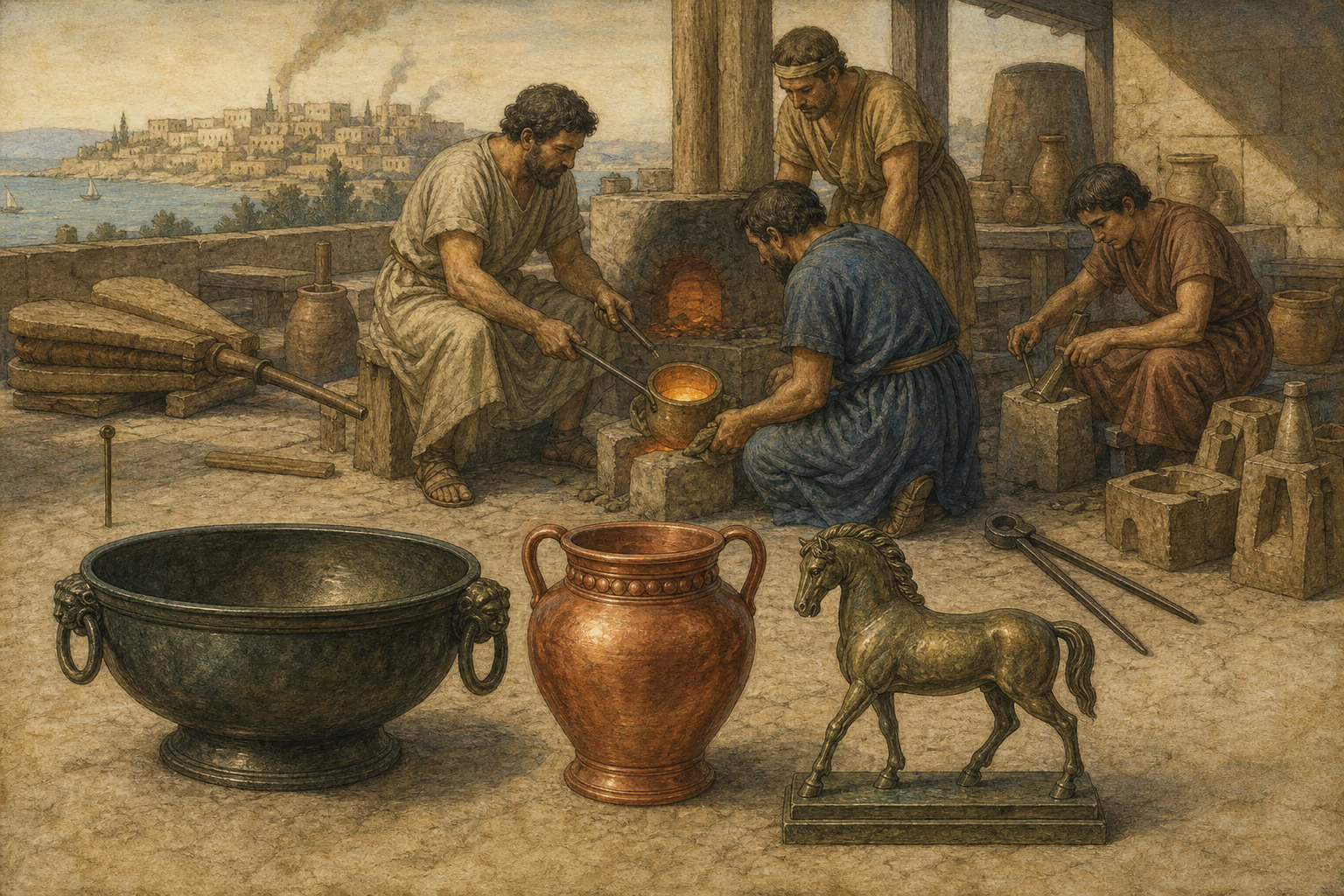
Ex illa autem antiqua gloria Corinthium maxime laudatur. hoc casus miscuit Corintho, cum caperetur, incensa, mireque circa id multorum adfectatio furit, quippe cum tradatur non alia de causa Verrem, quem M. Cicero damnaverat, proscriptum cum eo ab Antonio, quoniam Corinthiis cessurum se ei negavisset. ac mihi maior pars eorum simulare eam scientiam videtur ad segregandos sese a ceteris magis quam intellegere aliquid ibi suptilius; et hoc paucis docebo. Corinthus capta est olympiadis CLVIII anno tertio, nostrae urbis DCVIII, cum ante haec saecula fictores nobiles esse desissent, quorum isti omnia signa hodie Corinthia appellant. quapropter ad coarguendos eos ponemus artificum aetates; nam urbis nostrae annos ex supra dicta comparatione olympiadum colligere facile erit. sunt ergo vasa tantum Corinthia, quae isti elegantiores modo ad esculenta transferunt, modo in lucernas aut trulleos nullo munditiarum dispectu. eius tria genera: candidum argento nitore quam proxime accedens, in quo illa mixtura praevaluit; alterum, in quo auri fulva natura; tertium, in quo aequalis omnium temperies fuit. praeter haec est cuius ratio non potest reddi, quamquam hominis manu est; at fortuna temperatur in simu- lacris signisque illud suo colore pretiosum ad iocineris imaginem vergens, quod ideo hepatizon appellant, procul a Corinthio, longe tamen ante Aegineticum atque Deliacum, quae diu optinuere principatum.
Antiquissima aeris gloria Deliaco fuit, mercatus in Delo celebrante toto orbe, et ideo cura officinis. tricliniorum pedibus fulcrisque ibi prima aeris nobilitas, pervenit deinde et ad deum simulacra effigiemque hominum et aliorum animalium.
Proxima laus Aeginetico fuit, insula et ipsa eo nec quod ibi gigneretur, sed officinarum temperatura, nobilitata. bos aereus inde captus in foro boario est Romae. hoc erit exemplar Aeginetici aeris, Deliaci autem Iuppiter in Capitolio in Iovis Tonantis aede. illo aere Myron usus est, hoc Polycletus, aequales atque condiscipuli; sic aemulatio et in materia fuit.
English · Bostock & Riley 1855–57
In Cyprus, where copper was first discovered, it is also procured from another stone, which is called “chalcitis.” This, however, was afterwards considered of little value, a better kind having been found in other regions, especially that called “aurichalcum,” which was long in high request, on account of its excellent quality; but none of it has been found for this long time, the earth having been quite exhausted. The kind which was next in value was the Sallustian, procured from the Alpine district of the Centrones; but this did not last long, and was succeeded by the Livian, in Gaul. They both took their names from the owners of the mines; the former a friend of the Emperor Augustus, the latter that emperor’s wife. They soon failed, however, and in the Livian even there is now found but a very small quantity of ore. That which is at present held in the highest estimation is the Marian, likewise known as the Corduban; next to the Livian, this kind most readily absorbs cadmia, and becomes almost as excellent as aurichalcum for making sesterces and double asses, the Cyprian copper being thought good enough for the as. Thus much concerning the natural qualities of this metal.
The other kinds are made artificially, all of which will be described in the appropriate places, the more celebrated kinds first coming under our notice. Formerly a mixture was made of copper fused with gold and silver, and the workmanship in this metal was considered even more valuable than the material itself; but, at the present day, it is difficult to say whether the workmanship in it, or the material, is the worst. Indeed, it is wonderful, that while the value of these works has so infinitely increased, the reputation of the art itself is nearly extinct. But it would appear, that in this, as in every thing else, what was formerly done for the sake of reputation, is now undertaken for the mere purpose of gain. For whereas this art was ascribed to the gods themselves, and men of rank in all countries endeavoured to acquire fame by the practice of it, we have now so entirely lost the method of making this valuable compound by fusion, that, for this long time past, not even chance itself has assumed, in this department, the privilege which formerly belonged to art.
Next after the above compound, so celebrated in antiquity, the Corinthian metal has been the most highly esteemed. This was a compound produced by accident, when Corinth was burnt at the time of its capture. There has been a wonderful mania with many for gaining possession of this metal. It is even said, that Verres, whom M. Cicero caused to be condemned, was proscribed by Antonius, along with Cicero, for no other reason than his refusal to give up some specimens of Corinthian metal, which were in his possession. But most of these people seem to me to make a pretence of their discernment in reference to this metal, rather for the purpose of distinguishing themselves from the multitude, than from any real knowledge which they possess; and this I will briefly show.
Corinth was captured in the third year of the 158th Olympiad, being the year of the City, 608, some ages after the period when those artists flourished, who produced all the specimens of what these persons now call Corinthian metal. It is in order, therefore, to refute this opinion, that I shall state the age when these different artists lived; for, if we reckon according to the above-mentioned era of the Olympiads, it will be easy to compare their dates with the corresponding years of our City. The only genuine Corinthian vessels, then, are those which these men of taste metamorphose, sometimes into dishes, sometimes into lamps, or even into washing-basins, without any regard to decency. They are of three kinds; the white variety, approaching very nearly to the splendour of silver, and in which that metal forms a large proportion of the compound; a second kind, in which the yellow colour of gold predominates; and a third, in which all the metals are mixed in equal proportions. Besides these, there is another mixture, the composition of which it is impossible to describe, for although it has been formed into images and statues by the hand of man, it is chance that rules in the formation of the compound. This last is highly prized for its colour, which approaches to that of liver, and it is on this account that it is called “hepatizon:” it is far inferior to the Corinthian metal, but much superior to the Æginetan and Delian, which long held the first rank.
The Delian brass was the first that became famous, all the world coming to Delos to purchase it; and hence the attention paid to the manufacture of it. It was in this island that brass first obtained celebrity for the manufacture of the feet and supports of dining-couches. After some time it came to be employed for the statues of the gods, and the effigies of men and other animated beings.
The next most esteemed brass was the Æginetan; the island itself being rendered famous for its brass—not indeed that the metal was produced there, but because the annealing of the Æginetan manufactories was so excellent. A brazen Ox, which was taken from this island, now stands in the Forum Boarium at Rome. This is a specimen of the Æginetan metal, as the Jupiter in the Temple of Jupiter Tonans, in the Capitol, is of the Delian. Myron used the former metal and Polycletus the latter; they were contemporaries and fellow-pupils, but there was great rivalry between them as to their materials.