LIBER XXXIV · CAPUT 7
THAT THERE WERE STATUARIES IN ITALY ALSO AT AN EARLY PERIOD
Latine · Mayhoff 1906
Fuisse autem statuariam artem familiarem Italiae quoque et vetustam, indicant Hercules ab Euandro sacratus, ut produnt, in foro boario, qui triumphalis vocatur atque per triumphos vestitur habitu triumphali, praeterea Ianus geminus a Numa rege dicatus, qui pacis bellique argumento colitur digitis ita figuratis, ut CCCLXV dierum nota [aut per significationem anni temporis] et aevi esse deum indicent. signa quoque Tuscanica per terras dispersa quin in Etruria factitata sint, non est dubium. deorum tantum putarem ea fuisse, ni Metrodorus Scepsius, cui cognomen a Romani nominis odio inditum est, propter MM statuarum Volsinios expugnatos obiceret. mirumque mihi videtur, curm statuarum origo tam vetus Italiae sit, lignea potius aut fictilia deorum simulacra in delubris dicata usque ad devictam Asiam, unde luxuria.
Similitudines exprimendi quae prima fuerit origo, in ea, quam plasticen Graeci vocant, dici convenientius erit; etenim prior quam statuaria fuit. sed haec ad infinitum effloruit, multorum voluminum opere, si quis plura persequi velit; omnia enim quis possit? M. Scauri aedilitate signorum MMM in scaena tantum fuere temporario theatro. Mummius Achaia devicta replevit urbem, non relicturus filiae dotem; cur enim non cum excusatione ponatur? multa et Luculli invexere. Rhodi etiamnum III signorum esse Mucianus ter cos. prodidit, nec pauciora Athenis, Olympiae, Delphis superesse creduntur. quis ista mortalium persequi possit aut quis usus noscendi intellegatur? insignia maxime et aliqua de causa notata voluptarium sit attigisse artificesque celebrates nominavisse, singulorum quoque inexplicabili multitudine, cum Lysippus MD opera fecisse prodatur, tantae omnia artis, ut claritatem possent dare vel singula: numerum apparuisse defuncto eo, cum thesaurum effregisset heres; solitum enim ex manipretio cuiusque signi denarios seponere aureos singulos.
Evecta supra humanam fidem ars est successu, mox et audacia. in argumentum success unum exemplum adferam, nec deorum hominumve similitudinis expressae. aetas nostra vidit in Capitolio, priusquam id novissime conflagraret a Vitellianis incensum, in cella Iunonis canem ex aere volnus suum lambentem, cuius eximium miraculum et indiscreta veri similitudo non eo solum intellegitur, quod ibi dicata fuerat, verum et satisdatione; nam quoniam summa nulla par videbatur, capite tutelarios cavere pro ea institutum publice fuit. audaciae innumera sunt exempla. moles quippe excogitatas videmus statuarum, quas colossaeas vocant, turribus pares. talis est in Capitolio Apollo, tralatus a M. Lucullo ex Apollonia Ponti urbe, xxx cubitorum, D talentis factus; talis in campo Martio Iuppiter, a Claudio Caesare dicatus, qui devoratur Pompeiani theatri vicinitate; talis et Tarenti factus a Lysippo, XL cubitorum. mirum in eo quod manu, ut ferunt, mobilis ea ratio libramenti est, ut nullis convellatur procellis. id quidem providisse et artifex dicitur modico intervallo, unde maxime flatum opus erat frangi, opposita columna. itaque magnitudinem propter difficultatemque moliendi non attigit eum Fabius Verrucosus, cum Herculem, qui est in Capitolio, inde transferret. ante omnes autem in admiratione fuit Solis colossus Rhodi, quem fecerat Chares Lindius, Lysippi supra dicti discipulus. LXX cubitorum altitudinis fuit hoc simulacrum, post LXVI annum terrae motu prostratum, sed iacens quoque miraculo est. pauci pollicem eius amplectuntur, maiores sunt digiti quam pleraeque statuae. vasti specus hiant defractis membris; spectantur intus magnae molis saxa, quorum pondere stabiliverat eum constituens. duodecim annis tradunt effectum ccc talentis, quae contigerant ex apparatu Regis Demetrii relicto morae taedio obsessa Rhodo. sunt alii centum numero in eadem urbe colossi minores hoc, sed ubicumque singuli fuissent, nobilitaturi locum, praeterque hos deorum quinque, quos fecit Bryaxis.
Factitavit colossos et Italia. videmus certe Tuscanicum Apollinem in bibliotheca templi Augusti quinquaginta pedum a pollice, dubium aere mirabiliorem an pulchritudine. fecit et Sp. Carvilius Iovem, qui est in Capitolio, victis Samnitibus sacrata lege pugnantibus e pectoralibus eorum ocreisque et galeis. amplitudo tanta est, ut conspiciatur a Latiari Iove. e reliquiis limae suam statuam fecit, quae est ante pedes simulacri eius. habent in eodem Capitolio admirationem et capita duo, quae P.Len tulus cos. dicavit, alterum a Charete supra dicto factum, alterum fecit...dicus comparatione in tantum victus, ut artificum minime probabilis videatur. verum omnem amplitudinem statuarum eius generis vicit aetate nostra Zenodorus Mercurio facto in civitate Galliae Arvernis per annos decem, HS |CCCC| manipretii, postquam satis artem ibi adprobaverat, Romam accitus a Nerone, ubi destinatum illius principis simulacro colossum fecit CXIXS pedum in longitudinem, qui dicatus Soli venerationi est damnatis sceleribus illius principis. mirabamur officina non modo ex arilla similitudinem insignem, verum et de parvis admodum surculis quod primum operis instaurati fuit. ea statua indicavt interisse fundendi aeris scientiam, cum et Nero largiri aurum argentumque paratus esset et Zenodorus scientia fingendi caelandique nulli veterum postponeretur. statuam Arvernorum cum faceret provinciae Dubio Avito praesidente, duo pocula Calamidis manu caelata, quae Cassio Salano avunculo eius, praecetori suo, Germanicus Caesar adamata donaverat, aemulatus est, ut vix ulla differentia esset artis. quanto maior Zenodoro praestantia fuit, tanto magis deprehenditur aeris obliteratio.
English · Bostock & Riley 1855–57
Various circumstances prove, that the art of making statues was commonly practised in Italy at an early period. The statue in the Cattle Market is said to have been consecrated to Hercules by Evander; it is called the triumphal Hercules, and, on the occasion of triumphal processions, is arrayed in triumphal vestments. And then besides, King Numa dedicated the statue of the two-faced Janus; a deity who is worshipped as presiding over both peace and war. The fingers, too, are so formed as to indicate three hundred and sixty-five days, or in other words, the year; thus denoting that he is the god of time and duration.
There are also Etruscan statues dispersed in various parts of the world, which beyond a doubt were originally made in Etruria. I should have supposed that these had been the statues only of divinities, had not Metrodorus of Scepsis, who had his surname from his hatred to the Roman name, reproached us with having pillaged the city of Volsinii for the sake of the two thousand statues which it contained. It appears to me a singular fact, that although the origin of statues was of such great antiquity in Italy, the images of the gods, which were consecrated to them in their temples, should have been formed either of wood or of earthenware, until the conquest of Asia, which introduced luxury among us. It will be the best plan to enlarge upon the origin of the art of expressing likenesses, when we come to speak of what the Greeks call “plastice;” for the art of modelling was prior to that of statuary. This last, however, has flourished to such an extraordinary degree, that an account of it would fill many volumes, if we were desirous of making an extensive acquaintance with the subject: but as to learning everything connected with it, who could do it?
In the ædileship of M. Scaurus, there were three thousand statues erected on the stage of what was a temporary theatre only. Mummius, the conqueror of Achaia, filled the City with statues; he who at his death was destined not to leave a dowry to his daughter, for why not mention this as an apology for him? The Luculli also introduced many articles from abroad. Yet we learn from Mucianus, who was thrice consul, that there are still three thousand statues in Rhodes, and it is supposed that there are no fewer in existence at Athens, at Olympia, and at Delphi. What living mortal could enumerate them all? or of what utility would be such information? Still, however, I may, perhaps, afford amusement by giving some slight account of such of those works of art as are in any way remarkable, and stating the names of the more celebrated artists. Of each of these it would be impossible to enumerate all the productions, for Lysippus alone is said to have executed no less than fifteen hundred works of art, all of which were of such excellence that any one of them might have immortalized him. The number was ascertained by his heir, upon opening his coffers after his death, it having been his practice to lay up one golden denarius out of the sum which he had received as the price of each statue.
This art has arrived at incredible perfection, both in successfulness and in boldness of design. As a proof of successfulness, I will adduce one example, and that of a figure which represented neither god nor man. We have seen in our own time, in the Capitol, before it was last burnt by the party of Vitellius, in the shrine of Juno there, a bronze figure of a dog licking its wounds. Its miraculous excellence and its perfect truthfulness were not only proved by the circumstance of its having been consecrated there, but also by the novel kind of security that was taken for its safety; for, no sum appearing equal to its value, it was publicly enacted that the keepers of it should be answerable for its safety with their lives.
As to boldness of design, the examples are innumerable; for we see designed, statues of enormous bulk, known as colossal statues and equal to towers in size. Such, for instance, is the Apollo in the Capitol, which was brought by M. Lucullus from Apollonia, a city of Pontus, thirty cubits in height, and which cost five hundred talents: such, too, is the statue of Jupiter, in the Campus Martius, dedicated by the late Emperor Claudius, but which appears small in comparison from its vicinity to the Theatre of Pompeius: and such is that at Tarentum, forty cubits in height, and the work of Lysippus. It is a remarkable circumstance in this statue, that though, as it is stated, it is so nicely balanced as to be moveable by the hand, it has never been thrown down by a tempest. This indeed, the artist, it is said, has guarded against, by a column erected at a short distance from it, upon the side on which the violence of the wind required to be broken. On account, therefore, of its magnitude, and the great difficulty of moving it, Fabius Verrucosus did not touch it, when he transferred the Hercules from that place to the Capitol, where it now stands.
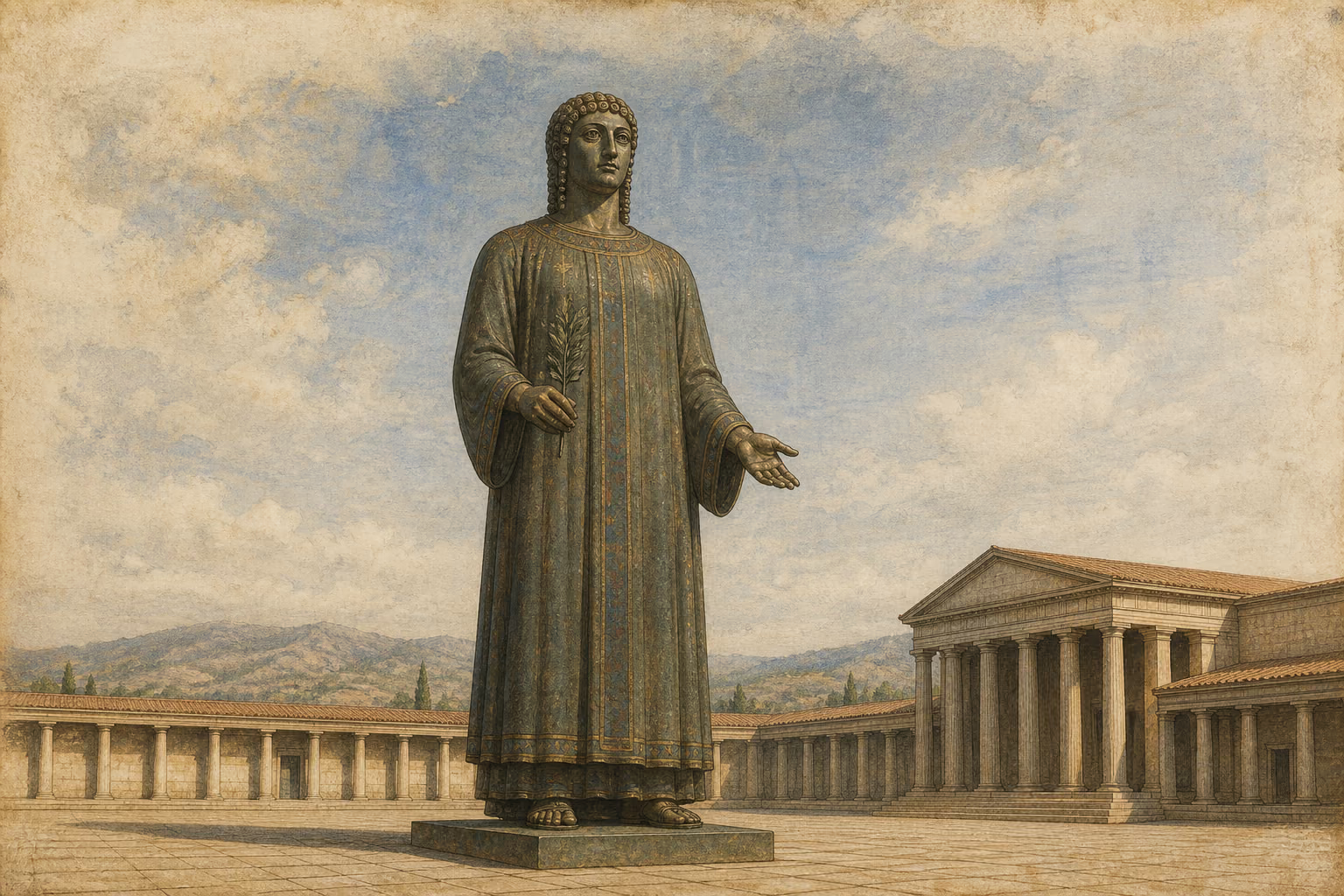
But that which is by far the most worthy of our admiration, is the colossal statue of the Sun, which stood formerly at Rhodes, and was the work of Chares the Lindian, a pupil of the above-named Lysippus; no less than seventy cubits in height. This statue, fifty-six years after it was erected, was thrown down by an earthquake; but even as it lies, it excites our wonder and admiration. Few men can clasp the thumb in their arms, and its fingers are larger than most statues. Where the limbs are broken asunder, vast caverns are seen yawning in the interior. Within it, too, are to be seen large masses of rock, by the weight of which the artist steadied it while erecting it. It is said that it was twelve years before this statue was completed, and that three hundred talents were expended upon it; a sum raised from the engines of warfare which had been abandoned by King Demetrius, when tired of the long-protracted siege of Rhodes. In the same city there are other colossal statues, one hundred in number; but though smaller than the one already mentioned, wherever erected, they would, any one of them, have ennobled the place. In addition to these, there are five colossal statues of the gods, which were made by Bryaxis.
Colossal statues used also to be made in Italy. At all events, we see the Tuscan Apollo, in the library of the Temple of Augustus, fifty feet in height from the toe; and it is a question whether it is more remarkable for the quality of the metal, or for the beauty of the workmanship. Spurius Carvilius also erected the statue of Jupiter which is seen in the Capitol, after he had conquered the Samnites, who fought in obedience to a most solemn oath; it being formed out of their breast-plates, greaves, and helmets, and of such large dimensions that it may be seen from the statue of Jupiter Latiaris. He made his own statue, which is at the feet of the other one, out of the filings of the metal. There are also, in the Capitol, two heads which are very much admired, and which were dedicated by the Consul P. Lentulus, one of them executed by the above-mentioned Chares, the other by Decius; but this last is so greatly excelled by the former, as to have all the appearance of being the work of one of the poorest of artists.
But all these gigantic statues of this kind have been surpassed in our own age by that of Mercury, made by Zenodotus for the city of the Arverni in Gaul, which was ten years in being completed, and the making of which cost four hundred thousand sesterces. Having given sufficient proof there of his artistic skill, he was sent for by Nero to Rome, where he made a colossal statue intended to represent that prince, one hundred and ten feet in height. In consequence, however, of the public detestation of Nero’s crimes, this statue was consecrated to the Sun. We used to admire in his studio, not only the accurate likeness in the model of clay, but in the small sketches also, which served as the first foundation of the work. This statue proves that the art of fusing [precious] brass was then lost, for Nero was prepared to furnish the requisite gold and silver, and Zenodotus was inferior to none of the ancients, either as a designer or as an engraver. At the time that he was working at the statue for the Arverni, he copied for Dubius Avitus, the then governor of the province, two drinking-cups, chased by the hand of Calamis, which had been highly prized by Germanicus Cæsar, and had been given by him to his preceptor Cassius Silanus, the uncle of Avitus; and this with such exactness, that they could scarcely be distinguished from the originals. The greater, then, the superiority of Zenodotus, the more certainly it may be concluded that the secret of fusing [precious] brass is lost.