LIBER XXXV · CAPUT 14
FORMACEAN WALLS
Latine · Mayhoff 1906
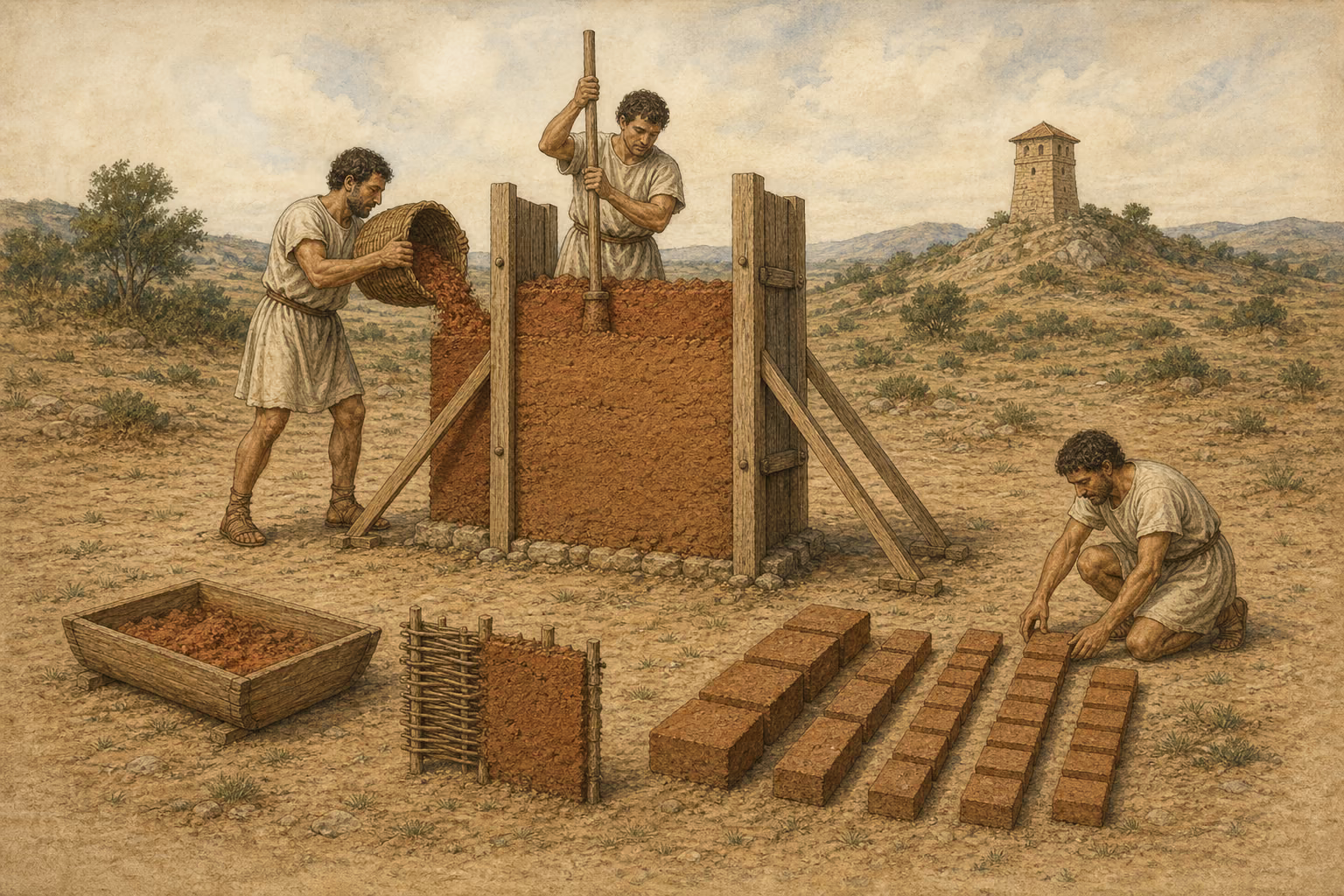
quid? non in Africa Hispaniaque e terra parietes, quos appellant formaceos, quoniam in forma circumdatis II utrimque tabulis inferciuntur verius quam struuntur, aevis durant, incorrupti imbribus, ventis, ignibus omnique caemento firmiores? spectat etiam nunc speculas Hannibalis Hispania terrenasque turres iugis montium inpositas. hinc et caespitum natura castrorum vallis accommodata contraque fluminum impetus aggeribus. inlini quidem crates parietum Into et lateribus crudis exstrui quis ignorat?
Lateres non sunt ex sabuloso neque harenoso multoque minus calculoso ducendi solo, sed e cretoso et albicante ant ex rubrica vel etiam e sabulo, masculo certe. finguntur optime vere, nam solstitio rimosi fiunt. aedificiis non nisi bimos probant, quia et intritam ipsam eorum, priusquam fingantur, macerari oportet. genera eorum fiunt tria: Lydion, quo nos utimur, longum sesquipedem, latum pedem, alterum tetradoron, tertium pentadoron. Graeci enim antiqui δῶρον palmum vocabant et ideo δῶρα munera, quia manu darentur; ergo a quattuor et quinque palmis, prout sunt, nominantur. eadem est et latitudo. minore privatis operibus, maiore in publicis utuntur in Graecia. Pitanae in Asia et in ulteriore Hispania civitatibus Maxilua et Callet fiunt lateres, qui siccati non merguntur in aqua. sunt enim e terra pumicosa, cum subigi potest, utilissima. Graeci, praeterquam ubi e silice fieri poterat structura, latericios parietes praetulere. sunt enin aeterni, si ad perpendiculum fiant. ideo et publica opera et regias domos sic struxere: murum Athenis, qui ad montem Hymettum spectat, Patris aedes Iovis et Herculis, quamvis lapideas columnas et epistylia circumdarent, domum Trallibus regiam Attali, item Sardibus Croesi, quam gerusian fecere, Halicarnasi Mausoli, quae etiam nunc durant. Lacedaemone quidem latericiis parietibus excisum opus tectorium propter excellentiam picturae ligneis formis inclusum Romam deportavere in aedilitate ad comitium exornandum Murena et Varro. cum opus per se mirum esset, tralatum tamen magis mirabantur. in Italia quoque latericius murus Arreti et Mevaniae est. Romae non fiunt talia aedificia, quia sesquipedalis paries non plus quam unam contignationem tolerat, cautumque est, ne communis crassior fiat, nec intergerivorum ratio patitur.
English · Bostock & Riley 1855–57
And then, besides, have we not in Africa and in Spain walls of earth, known as “formacean” walls? from the fact that they are moulded, rather than built, by enclosing earth within a frame of boards, constructed on either side. These walls will last for centuries, are proof against rain, wind, and fire, and are superior in solidity to any cement. Even at this day, Spain still beholds watch-towers that were erected by Hannibal, and turrets of earth placed on the very summits of her mountains. It is from the same source, too, that we derive the substantial materials so well adapted for forming the earth-works of our camps and embankments against the impetuous violence of rivers. What person, too, is unacquainted with the fact, that partitions are made of hurdles coated with clay, and that walls are constructed of unbaked bricks?
Earth for making bricks should never be extracted from a sandy or gravelly soil, and still less from one that is stony; but from a stratum that is white and cretaceous, or else impregnated with red earth. If a sandy soil must be employed for the purpose, it should at least be male sand, and no other. The spring is the best season for making bricks, as at midsummer they are very apt to crack. For building, bricks two years old are the only ones that are approved of; and the wrought material of them should be well macerated before they are made.
There are three different kinds of bricks; the Lydian, which is in use with us, a foot-and-a-half in length by a foot in breadth; the tetradoron; and the pentadoron; the word “doron” being used by the ancient Greeks to signify the palm —hence, too, their word “doron” meaning a gift, because it is the hand that gives.—These last two kinds, therefore, are named respectively from their being four and five palms in length, the breadth being the same. The smaller kind is used in Greece for private buildings, the larger for the construction of public edifices. At Pitane, in Asia, and in the cities of Muxilua and Calentum in Farther Spain, there are bricks made, which float in water, when dry; the material being a sort of pumice-earth, extremely good for the purpose when it can be made to unite. The Greeks have always preferred walls of brick, except in those cases where they could find silicious stone for the purposes of building: for walls of this nature will last for ever, if they are only built on the perpendicular. Hence it is, that the Greeks have built their public edifices and the palaces of their kings of brick; the wall at Athens, for example, which faces Mount Hymettus; the Temples of Jupiter and Hercules at Patræ, although the columns and architraves in the interior are of stone; the palace of King Attalus at Tralles; the palace of Crœsus at Sardes, now converted into an asylum for aged persons; and that of King Mausolus at Halicarnassus; edifices, all of them, still in existence.
Muræna and Varro, in their ædileship, had a fine fresco painting, on the plaster of a wall at Lacedæmon, cut away from the bricks, and transported in wooden frames to Rome, for the purpose of adorning the Comitium. Admirable as the work was of itself, it was still more admired after being thus transferred. In Italy also there are walls of brick, at Arretium and Mevania. At Rome, there are no buildings of this description, because a wall only a foot-and-a-half in thickness would not support more than a single story; and by public ordinance it has been enacted that no partition should exceed that thickness; nor, indeed, does the peculiar construction of our party-walls admit of it.