LIBER XXXV · CAPUT 15
SULPHUR, AND THE SEVERAL VARIETIES OF IT: FOURTEEN REMEDIES
Latine · Mayhoff 1906
Haec sint dicta de lateribus. in terrae autem reliquis generibus vel maxime mira natura est sulpuris, quo plurima domantur. nascitur in insulis Aeoliis inter Siciliam et Italiam, quas ardere diximus, sed nobilissimum in Melo insula. in Italia quoque invenitur in Neapolitano Campanoque agro collibus, qui vocantur Leucogaei. ibi e cuniculis effossum perficitur igni. genera IIII: vivum, quod Graeci apyron vocant, nascitur solidum solum—cetera enim liquore constant et conficiuntur oleo incocta—; vivum effoditur tralucetque et viret. solo ex omnibus generibus medici utuntur. alterum genus appellant glaebam, fullonum tantum officinis familiare. tertio quoque generi unus tantum est usus ad lanas suffiendas, quoniam candorem mollitiamque confert. egula vocatur hoc genus, quartum caute ad ellychnia maxime conficienda; cetero tantum vis est ut morbos comitiales deprehendat nidore inpositum igni. lusit et Anaxilaus eo, addens in calicem vini prunaque subdita circumferens, exardescentisrepercussu pallorem dirum velut defunctorum effundente in conviviis. natura eius excalfacit, concoquit, sed et discutit collectiones corporum, ob hoc talibus emplastris malagmatisque miscetur. renibus quoque et lumbis in dolore cum adipe mire prodest inpositum, aufert et lichenas faciei cum terebinthi resina et lepras; harpax ita vocatur a celeritate praebendi, avelli enim subiade debet. prodest et suspiriosis linctu, purulenta quoque extussientibus et contra scorpionum ictus. vitiligines vivum nitro mixtum atque ex aceto tritum et inlitum tollit, item lendes, et in palpebris aceto sandaracato admixtum. habet et in religionibus locum ad expiandas suffitu domos. sentitur vis eius et in aquis ferventibus, neque alia res facilius accenditur, quo apparet ignium vim magnam ei inesse. fulmina, fulgura quoque sulpuris odorem habent, ac lux ipsa eorum sulpurea est.
Et bituminis vicina natura est. aliubi limus, aliubi terra est, limus e Iudaeae lacu, ut diximus, emergens, terra in Syria circa Sidonem oppidum maritimum. spissantur haec utraque et in densitatem coeunt. est vero liquidum bitumen, sicut Zacynthium et quod a Babylone invehitur; ibi quidem et candidum gignitur. liquidum est et Apolloniaticum, quae omnia Graeci pissasphalton appellant ex argument picis ac bituminis. gignitur et pingue oleique liquoris in Sicilia Agragantino fonte, inficiens rivum. incolae id harundinum paniculis colligunt, citissime sic adhaerescens, utunturque eo ad lucernarum lumina olei vice, item ad scabiem iumentorum. sunt qui et naphtham, de qua in secundo diximus volumine, bituminis generibus adscribant, verum eius ardens natura et ignium cognata procul ab omni usu abest. bituminis probatio ut quam maxime splendeat sitque ponderosum, graveolens, atrum modice, quoniam adulteratur pice. vis quae sulpuri: sistit, discutit, contrahit, glutinat. serpentes accensum nidore fugat. ad suffusiones oculorum et albugines Babylonium efficax traditur, item ad lepras, lichenas pruritusque corporum. inlinitur et podagris. omnia autem eius genera incommodos oculorum pilos replicant, dentium doloribus medentur simul nitro intrito. lenit tussim veterem et anhelitus cum vino potum; dysintericis etiam datur eodem modo sistitque alvum. cum aceto vero potum discutit concretum sanguinem ac detrahit. mitigat lumborum dolores, item articulorum, cum farina hordeacia inpositum emplastrum peculiare facit suo nomine. sanguinem sistit, volnera colligit, glutinat nervos. utuntur etiam ad quartanas bituminis drachma et hedyosmi pari pondere cum murrae obolo subacti. comitiales morbos ustum deprendit. volvarum strangulationes olfactu discutit cum vino et castoreo, procidentes suffitu reprimit, purgationes feminarum in vino potum elicit, in reliquo usu aeramentis inlinitur firmatque ea contra ignes. diximus et tingui solitum aes eo statuasque inlini. calcis quoque usum praebuit ita feruminatis Babylonis muris. placet in ferrariis fabrorum officinis tinguendo ferro clavorum capitibus et multis aliis usibus.
Nec minor est aut adeo dissimilis aluminis opera, quod intellegitur salsugo terrae. plura et eius genera. in Cypro candidum et nigrius, exigua coloris differentia, cum sit usus magna, quoniam inficiendis claro colore lanis candidum liquidumque utilissimum est contraque fuscis aut obscuris nigrum. et aurum nigro purgatur. fit autem omne ex aqua limoque, hoc est terrae exudantis natura. conrivatum hieme aestivis solibus maturatur. quod fuit ex eo praecox, candidius fit. gignitur autem in Hispania, Aegypto, Armenia, Macedonia, Ponto, Africa, insulis Sardinia, Melo, Lipara, Strongyle. laudatissimum in Aegypto, proximum in Melo. huius quoque duae species, liquidum spissumque. liquidi probatio ut sit limpidum lacteumque, sine offensis fricandi, cum quodam igniculo caloris. hoc phorimon vocant. an sit adulteratum, deprehenditur suco Punici mali; sincerum enim mixtura.... alterum genus est pallidi et scabri et quod inficiaturet galla, ideoque hoc vocant paraphoron. liquidi aluminis vis adstringere, indurare, rodere. melle admixto sanat oris ulcera, papulas pruritusque. haec curatio fit in balneis II mellis partibus, tertia aluminis. virus alarum sudorisque sedat. sumitur pilulis contra lienis vitia pellendumque per urinam sanguinem. emendat et scabiem nitro ac melanthio admixtis.
Concreti aluminis unum genus σχιστὸν appellant Graeci, in capillamenta quaedam canescentia dehiscens, unde quidam trichitim potius appellavere. hoc fit e lapide, ex quo et aes—chalcitim vocant—, ut sudor quidam eius lapidis in spumam coagulatus. hoc genus aluminis minus siccat minusque sistit umorem inutilem corporum, et auribus magnopere prodest infusum; vel inlitum et oris ulauribus dentibusque et si saliva cum eo contineatur. et oculorum medicamentis inseritur apte verendisque utriusque sexus. coquitur in catinis, donec liquari desinat. inertioris est alterum generis, quod strongylen vocant. duae et eius species, fungosum atque omni umore dilui facile, quod in totum damnatur. melius pumicosum et foraminum fistulis spongeae simile rotundumque natura, candido propius, cum quadam pinguitudine, sine harenis, friabile, nec inficiens nigritia. hoc coquitur per se carbonibus puris, done cinis fiat.—Optimum ex omnibus quod Melinum vocant ab insula, ut diximus. nulli vis maior neque adstringendi neque denigrandi neque indurandi, nullum spissius. oculorum scabritias extenuat, combustum utilius epiphoris inhibendis, sic et ad pruritus corporis. sanguinem quoque sistit intuspotum, foris inlitum. evulsis pilis ex aceto inlinitur renascentesque mollit in languinem. summa omnium generum vis in adstringendo, unde nomen Graecis. ob id oculorum vitiis aptissima sunt, sanguinis fluctiones inhibent cum adipe. putrescentia ulcerum compescit cum adipe—sic et infantium ulcera et hydropicorum eruptiones siccat—et aurium vitia cum suco Punici mali et unguium scabritias cicatricumque duritias et pterygia ac perniones, phagedaenas ulcerum ex aceto aut cum galla pari pondere cremata, lepras cum suco olerum, cum salis vero II partibus vitia, quae serpunt, lendes et alia capillorum animalia aquae permixtum. sic et ambustis prodest et furfuribus corporum cum sero picis. infunditur et dysintericis uvamque in ore comprimit ac tonsillas. ad omnia, quae in ceteris generibus diximus, efficacius intellegatur ex Melo advectum, nam ad reliquos usus vitae in coriis lanisque perficiendis quanti sit momenti, significatum est.
English · Bostock & Riley 1855–57
Let thus much be deemed sufficient on the subject of bricks. Among the other kinds of earth, the one of the most singular nature, perhaps, is sulphur, an agent of great power upon other substances. Sulphur is found in the Æolian Islands, between Sicily and Italy, which are volcanic, as already stated. But the finest sulphur of all, is that which comes from the Isle of Melos. It is obtained also in Italy, upon the range of hills in the territories of Neapolis and Campania, known as the Leucogæi: when extracted from the mines there, it is purified by the agency of fire.
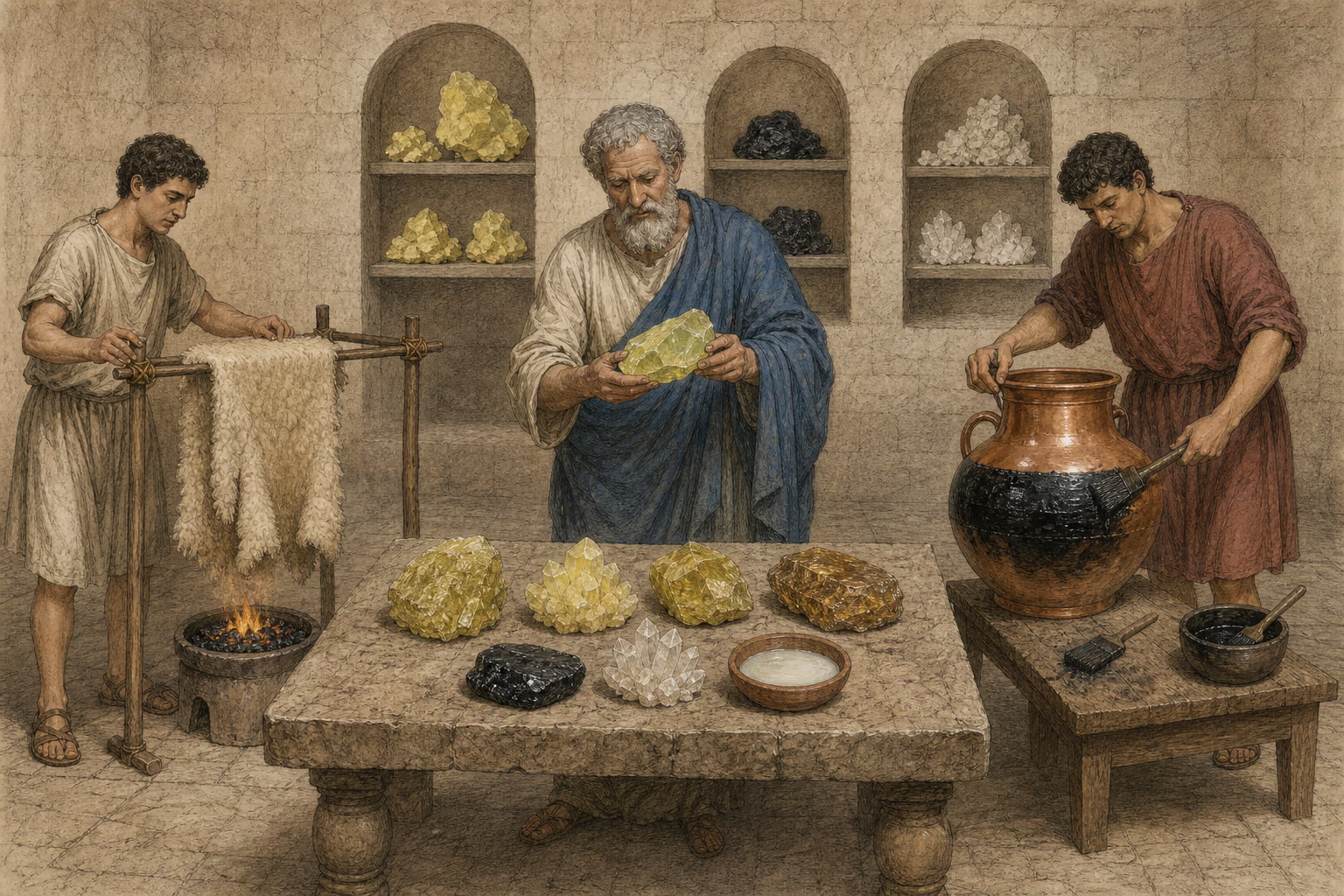
There are four kinds of sulphur; the first of which is “live” sulphur, known as “apyron” by the Greeks, and found in solid masses, or in other words, in blocks. This, too, is the only sulphur that is extracted in its native state, the others being found in a state of liquescence, and requiring to be purified by being boiled in oil. This kind is green and transparent, and is the only sulphur that is used for medicinal purposes. A second kind is known as the “glebaceous” sulphur, and is solely employed in the workshops of the fullers. The third kind, also, is only used for a single purpose, that of fumigating wool, a process which contributes very greatly to making the wool white and soft; “egula” is the name given to it. The fourth kind is used in the preparation of matches more particularly.
In addition to these several uses, sulphur is of such remarkable virtue, that if it is thrown upon the fire it will at once detect, by the smell, whether or not a person is subject to epilepsy. Anaxilaüs used to employ this substance by way of pastime: putting sulphur in a cup of wine, with some hot coals beneath, he would hand it round to the guests, the light given by it, while burning, throwing a ghastly paleness like that of death upon the face of each. Its properties are calorific and maturative, in addition to which, it disperses abscesses on the body: hence it is that it is used as an ingredient in plasters and emollient poultices. Applied to the loins and kidneys, with grease, when there are pains in those parts, it is marvellously effectual as a remedy. In combination with turpentine, it removes lichens on the face, and leprosy, the preparation being known as “harpax,” from the celerity with which it acts upon the skin; for which reason it ought to be removed every now and then. Employed as an electuary, it is good for asthma, purulent expectorations, and stings inflicted by scorpions. Live sulphur, mixed with nitre, and then bruised with vinegar and applied, causes morphew to disappear, and destroys nits in the hair; in combination, too, with sandarach and vinegar, it is good for diseases of the eyelids.
Sulphur has its place among our religious ceremonies, being used as a fumigation for purifying houses. Its virtues are also to be perceived in certain hot mineral waters; and there is no substance that ignites more readily, a proof that there is in it a great affinity to fire. Lightning and thunder are attended with a strong smell of sulphur, and the light produced by them is of a sulphureous complexion.
Nearly approaching to the nature of sulphur is that of bitumen, which in some places assumes the form of a slime, and in others that of an earth; a slime, thrown up, as already stated, by a certain lake in Judæa, and an earth, found in the vicinity of Sidon, a maritime town of Syria. In both these states, it admits of being thickened and condensed. There is also a liquid bitumen, that of Zacynthus, for example, and the bitumen that is imported from Babylon; which last kind is also white: the bitumen, too, of Apollonia is liquid. All these kinds, in Greek, have the one general name of “pissasphaltos,” from their strong resemblance to a compound of pitch and bitumen. There is also found an unctuous liquid bitumen, resembling oil, in a spring at Agrigentum, in Sicily, the waters of which are tainted by it. The inhabitants of the spot collect it on the panicles of reeds, to which it very readily adheres, and make use of it for burning in lamps, as a substitute for oil, as also for the cure of itch-scab in beasts of burden.
Some authorities include among the bitumens, naphtha, a substance which we have already mentioned in the Second Book; but the burning properties which it possesses, and its susceptibility of igniting, render it quite unfit for use. Bitumen, to be of good quality, should be extremely brilliant, heavy, and massive; it should also be moderately smooth, it being very much the practice to adulterate it with pitch. Its medicinal properties are similar to those of sulphur, it being naturally astringent, dispersive, contractive, and agglutinating: ignited, it drives away serpents by the smell. Babylonian bitumen is very efficacious, it is said, for the cure of cataract and albugo, as also of leprosy, lichens, and pruriginous affections. Bitumen is employed, too, in the form of a liniment, for gout; and every variety of it is useful for making bandolines for eye-lashes that are refractory and impede the sight. Applied topically with nitre, it is curative of tooth-ache, and, taken internally, with wine, it alleviates chronic coughs and difficulty of respiration. It is administered in a similar manner for dysentery, and is very good for arresting looseness of the bowels. Taken internally with vinegar, it dissolves and brings away coagulated blood. It modifies pains also in the loins and joints, and, applied with barley-meal, it forms a peculiar kind of plaster, to which it has given its name. It stanches blood also, heals wounds, and unites the sinews when severed. Bitumen is administered for quartan fevers, in doses of one drachma to an equal quantity of hedyosmos, the whole kneaded up with one obolus of myrrh. The smell of burnt bitumen detects a tendency to epilepsy, and, applied to the nostrils with wine and castoreum, it dispels suffocations of the uterus. Employed as a fumigation, it acts as a check upon procidence of the uterus, and, taken internally with wine, it has the effect of an emmenagogue.
Another use that is made of it, is for coating the inside of copper vessels, it rendering them proof against the action of fire. It has been already stated that bitumen was formerly employed for staining copper and coating statues. It has been used, too, as a substitute for lime; the walls of Babylon, for instance, which are cemented with it. In the smithies they are in the habit of varnishing iron and heads of nails with it, and of using it for many other purposes as well.
Not less important, or indeed very dissimilar, are the uses that are made of alumen; by which name is understood a sort of brine which exudes from the earth. Of this, too, there are several kinds. In Cyprus there is a white alumen, and another kind of a darker colour. The difference, however, in their colour is but trifling in reality, though the uses made of them are very dissimilar; the white liquid alumen being employed for dyeing wool of bright colours, and the black, on the other hand, for giving wool a tawny or a sombre tint. Gold, too, is purified by the agency of black alumen. Every kind of alumen is a compound of slime and water, or in other words, is a liquid product exuding from the earth; the concretion of it commencing in winter, and being completed by the action of the summer sun. That portion of it which is the first matured, is the whitest in appearance.
The countries which produce this substance, are Spain, Ægypt, Armenia, Macedonia, Pontus, Africa, and the islands of Sardinia, Melos, Lipara, and Strongyle: the most esteemed, however, is that of Egypt, the next best being the produce of Melos. Of this last kind there are also two varieties, the liquid alumen, and the solid. Liquid alumen, to be good, should be of a limpid, milky, appearance: when rubbed between the fingers it should be free from grit, and productive of a slight sensation of heat. The name given to it is “phorimon.” The mode of detecting whether or not it has been adulterated, is by the application of pomegranate-juice; for if genuine, it will turn black on combining with the juice. The other, or solid alumen, is pale and rough in appearance, and turns black on the application of nut-galls; for which reason it is known by the name of “paraphoron.”
Liquid alumen is naturally astringent, indurative, and corrosive: used in combination with honey, it heals ulcerations of the mouth, pimples, and pruriginous eruptions. The remedy, when thus used, is employed in the bath, the proportions being two parts of honey to one of alumen. It has the effect, also, of checking and dispersing perspiration, and of neutralizing offensive odours of the arm-pits. It is taken too, in the form of pills, for affections of the spleen, and for the purpose of carrying off blood by the urine: incorporated with nitre and melanthium, it is curative of itch-scab.
There is one kind of solid alumen, known to the Greeks as “schiston,” which splits into filaments of a whitish colour; for which reason some have preferred giving it the name of “trichitis.” It is produced from the mineral ore known to us as “chalcitis,” from which copper is also produced, it being a sort of exudation from that mineral, coagulated into the form of scum. This kind of alumen is less desiccative than the others, and is not so useful as a check upon bad humours of the body. Used, however, either in the form of a liniment or of an injection, it is highly beneficial to the ears; as also for ulcerations of the mouth, and for tooth-ache, if retained with the saliva in the mouth. It is employed also as a serviceable ingredient in compositions for the eyes, and for the generative organs in either sex. The mode of preparing it is to roast it in crucibles, until it has quite lost its liquid form.
There is another variety of alumen also, of a less active nature, and known as “strongyle;” which is again subdivided into two kinds; the fungous, which easily dissolves in any liquid, and is looked upon as altogether worthless; and the porous, which is full of small holes like a sponge, and in pieces of a globular form, more nearly approaching white alumen in appearance. It has a certain degree, too, of unctuousness, is free from grit, friable, and not apt to blacken the fingers. This last kind is calcined by itself upon hot coals, unmixed with any other substance, until it is entirely reduced to ashes.
The best kind of all, however, is that called “molinum,” as coming from the Isle of Melos, as already mentioned; none being more effectual for acting as an astringent, staining black, and indurating, and none assuming a closer consistency. It removes granulations of the eye-lids, and, in a calcined state, is still more efficacious for checking defluxions of the eyes: in this last form, too, it is employed for the cure of pruriginous eruptions on the body. Whether taken internally, or employed externally, it arrests discharges of blood; and if it is applied with vinegar to a part from which the hair has been first removed, it will change into a soft down the hair which replaces it. The leading property of every kind of alumen is its remarkable astringency, to which, in fact, it is indebted for its name with the Greeks. It is for this property that the various kinds are, all of them, so remarkably good for the eyes. In combination with grease, they arrest discharges of blood; and they are employed in a similar manner for checking the spread of putrid ulcers, and for removing sores upon the bodies of infants.
Alumen has a desiccative effect upon dropsical eruptions; and, in combination with pomegranate juice, it removes diseases of the ears, malformed nails, indurations resulting from cicatrization, hangnails, and chilblains. Calcined, with vinegar or nut-galls, in equal proportions, it is curative of phagedænic ulcers; and, in combination with extracted juice of cabbage, of leprosy. Used in the proportion of one part of alumen to two of salt, it arrests the progress of serpiginous eruptions; and an infusion of it in water destroys lice and other parasitical insects that infest the hair. Employed in a similar manner, it is good for burns; and, in combination with the serous part of pitch, for furfuraceous eruptions on the body. It is used also as an injection for dysentery, and, employed in the form of a gargle, it braces the uvula and tonsillary glands. For all those maladies which we have mentioned as being treated with the other kinds of alumen, that imported from Melos, be it understood, is still more efficacious. As to the other uses that are made of it for industrial purposes, such as preparing hides and wool, for example, they have been mentioned already.