LIBER XXXV · CAPUT 2
THE HONOUR ATTACHED TO PORTRAITS
Latine · Mayhoff 1906
Imaginum quidem pictura, qua maxime similes in aevum propagabantur figurae, in totum exolevit. aerei ponuntur clipei argentea facie, surdo figurarum discrimine; statuarum capita permutantur, volgatis iam pridem salibus etiam carminum. adeo materiam conspici malunt omnes quam se nosci. et inter haec pinacothecas veteribus tabulis consuunt alienasque effigies colunt, ipsi honorem non nisi in pretio ducentes, ut frangat heres furisque detrahat laqueo. itaque nullius effigie vivente imagines pecuniae, non suas, relincunt. iidem palaestras athletarum imaginibus et ceromata sua exornant, Epicuri voltus per cubicula gestant ac circumferunt secum. natali eius* sacrificant, feriasque omni mense *vicesima luna* custodiunt, quas icadas vocant, ii maxime, qui se ne viventes quidem nosci volunt. ita est profecto: artes desidia perdidit, et quoniam animorum imagines non sunt, negleguntur etiam corporum. aliter apud maiores in atriis haec erant, quae spectarentur; non signa externorum artificum nec aera aut marmora: expressi cera vultus singulis disponebantur armariis, ut essent imagines, quae comitarentur gentilicia funera, semperque defuncto aliquo totus aderat familiae eius qui umquam fuerat populus. stemmata vero lineis discurrebant ad imagines pictas. tabulina codicibus implebantur et monimentis rerum in magistratu gestarum. aliae foris et circa limina animorum ingentium imagines erant adfixis hostium spoliis, quae nec emptori refigere liceret, triumphabantque etiam dominis mutatis aeternae domus. erat haec stimulatio ingens, exprobrantibus tectis cotidie inbellem dominum intrare in alienum triumphum. exstat Messalae oratoris indignatio, quae prohibuit inseri genti suae Laevinorum alienam imaginem. similis causa Messalae seni expressit volumina illa quae de familiis condidit, cum Scipionis Pomponiani transisset atrium vidissetque adoptione testamentaria Salvittones— hoc enim fuerat cognomen—Africanorum dedecori inrepentes Scipionum nomini. Sed—pace Messalarum dixisse liceat—etiam mentiri clarorum imagines erat aliquis virtutum amor multoque honestius quam mereri, ne quis suas expeteret.
Non est praetereundum et novicium inventum, siquidem non ex auro argentove, at certe ex aere in bibliothecis dicantur illis, quorum inmortales animae in locis iisdem locuntur, quin immo etiam quae non sunt finguntur, pariuntque desideria non traditos vultus, sicut in Homero evenit. quo mains, ut equidem arbitror, nullum est felicitatis specimen quam semper omnes scire cupere, qualis fuerit aliquis. Asini Pollionis hoc Romae inventum, qui primus bibliothecam dicando ingenia hominum rem publica m fecit. an priores coeperint Alexandreae et Pergami reges, qui bibliothecas magno certamine instituere, non facile dixerim. imaginum amorem flagrasse quondam testes sunt Atticus ille Ciceronis edito de iis volumine, M. Varro benignissimo invento insertis voluminum suorum fecunditati etiam septingentorum inlustrium aliquo modo imaginibus, non passus intercidere figuras aut vetustatem aevi contra homines valere, inventor muneris etiam dis invidiosi, quando inmortalitatem non solum dedit, verum etiam in omnes terras misit, ut praesentes esse ubique ceu di possent. et hoc quidem alienis ille praestitit.
English · Bostock & Riley 1855–57
Correct portraits of individuals were formerly transmitted to future ages by painting; but this has now completely fallen into desuetude. Brazen shields are now set up, and silver faces, with only some obscure traces of the countenance; the very heads, too, of statues are changed, a thing that has given rise before now to many a current sarcastic line; so true it is that people prefer showing off the valuable material, to having a faithful likeness. And yet, at the same time, we tapestry the walls of our galleries with old pictures, and we prize the portraits of strangers; while as to those made in honour of ourselves, we esteem them only for the value of the material, for some heir to break up and melt, and so forestall the noose and slip-knot of the thief. Thus it is that we possess the portraits of no living individuals, and leave behind us the pictures of our wealth, not of our persons.
And yet the very same persons adorn the palæstra and the anointing-room with portraits of athletes, and both hang up in their chamber and carry about them a likeness of Epicurus. On the twentieth day of each moon they celebrate his birthday by a sacrifice, and keep his festival, known as the “Icas,” every month: and these too, people who wish to live without being known! So it is, most assuredly, our indolence has lost sight of the arts, and since our minds are destitute of any characteristic features, those of our bodies are neglected also.
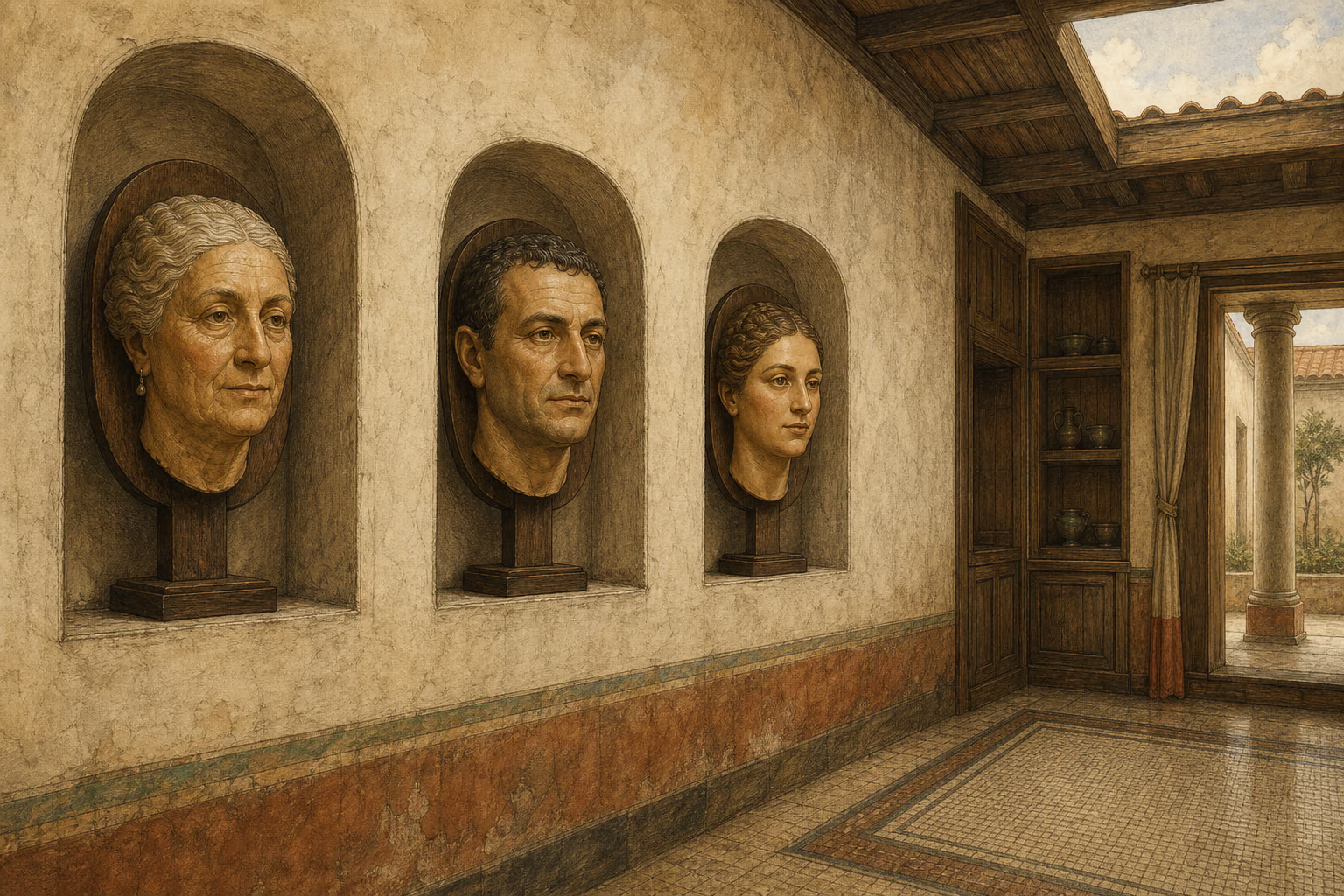
But on the contrary, in the days of our ancestors, it was these that were to be seen in their halls, and not statues made by foreign artists, or works in bronze or marble: portraits modelled in wax were arranged, each in its separate niche, to be always in readiness to accompany the funeral processions of the family; occasions on which every member of the family that had ever existed was always present. The pedigree, too, of the individual was traced in lines upon each of these coloured portraits. Their muniment-rooms, too, were filled with archives and memoirs, stating what each had done when holding the magistracy. On the outside, again, of their houses, and around the thresholds of their doors, were placed other statues of those mighty spirits, in the spoils of the enemy there affixed, memorials which a purchaser even was not allowed to displace; so that the very house continued to triumph even after it had changed its master. A powerful stimulus to emulation this, when the walls each day reproached an unwarlike owner for having thus intruded upon the triumphs of another! There is still extant an address by the orator Messala, full of indignation, in which he forbids that there should be inserted among the images of his family any of those of the stranger race of the Lævini. It was the same feeling, too, that extorted from old Messala those compilations of his “On the Families of Rome;” when, upon passing through the hall of Scipio Pomponianus, he observed that, in consequence of a testamentary adoption, the Salvittos —for that had been their surname—to the disgrace of the Africani, had surreptitiously contrived to assume the name of the Scipios. But the Messalas must pardon me if I remark, that to lay a claim, though an untruthful one, to the statues of illustrious men, shows some love for their virtues, and is much more honourable than to have such a character as to merit that no one should wish to claim them.
There is a new invention too, which we must not omit to notice. Not only do we consecrate in our libraries, in gold or silver, or at all events, in bronze, those whose immortal spirits hold converse with us in those places, but we even go so far as to reproduce the ideal of features, all remembrance of which has ceased to exist; and our regrets give existence to likenesses that have not been transmitted to us, as in the case of Homer, for example. And indeed, it is my opinion, that nothing can be a greater proof of having achieved success in life, than a lasting desire on the part of one’s fellow-men, to know what one’s features were. This practice of grouping portraits was first introduced at Rome by Asinius Pollio, who was also the first to establish a public library, and so make the works of genius the property of the public. Whether the kings of Alexandria and of Pergamus, who had so energetically rivalled each other in forming libraries, had previously introduced this practice, I cannot so easily say.
That a strong passion for portraits formerly existed, is attested both by Atticus, the friend of Cicero, who wrote a work on this subject, and by M. Varro, who conceived the very liberal idea of inserting, by some means or other, in his numerous volumes, the portraits of seven hundred individuals; as he could not bear the idea that all traces of their features should be lost, or that the lapse of centuries should get the better of mankind. Thus was he the inventor of a benefit to his fellow-men, that might have been envied by the gods themselves; for not only did he confer upon them immortality, but he transmitted them, too, to all parts of the earth; so that everywhere it might be possible for them to be present, and for each to occupy his niche. This service, too, Varro conferred upon persons who were no members of his own family.