LIBER XXXVI · CAPUT 22
STONES FOR MORTARS USED FOR MEDICINAL AND OTHER PURPOSES. ETESIAN STONE. THEBAIC STONE. CHALAZIAN STONE
Latine · Mayhoff 1906
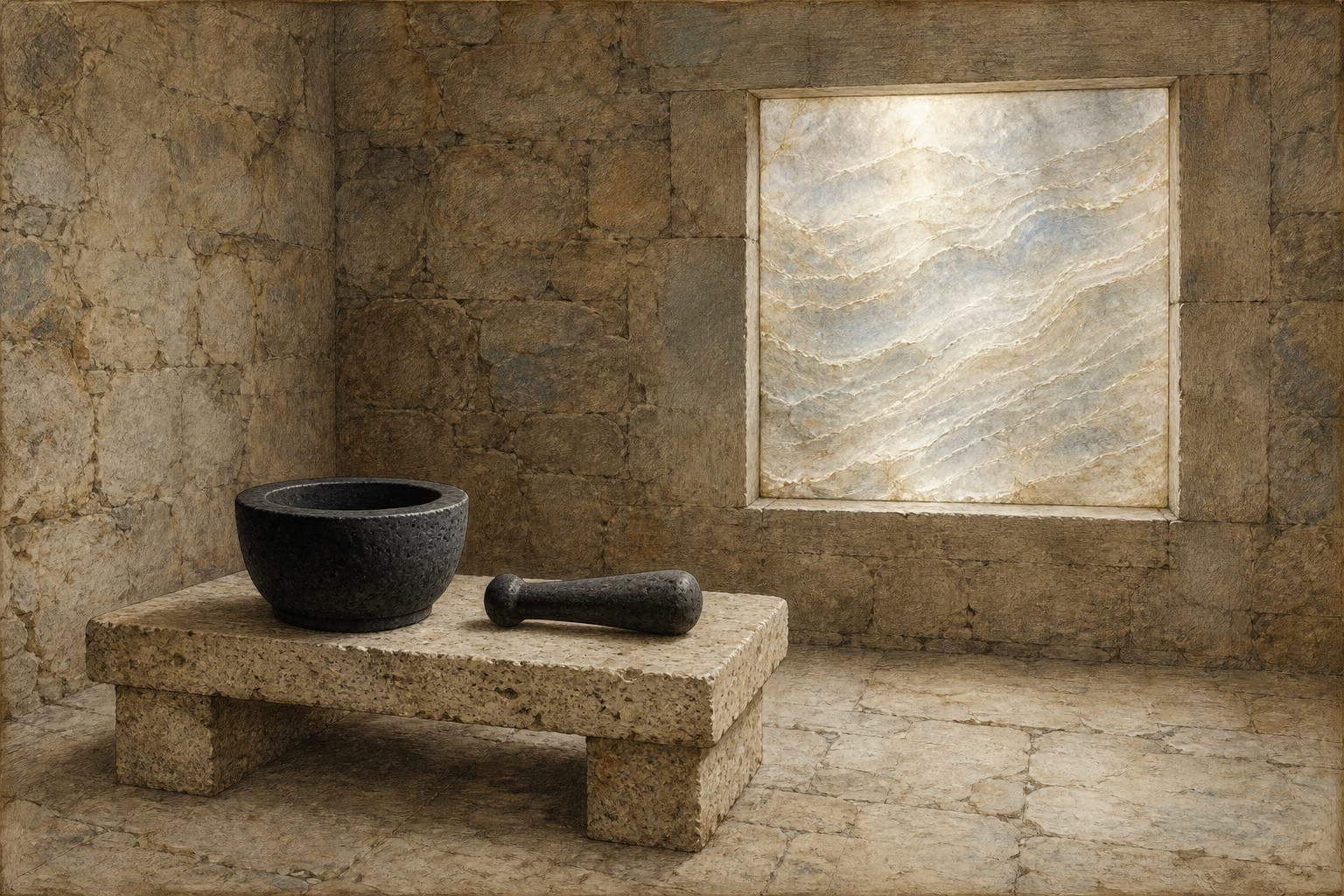
Auctoribus curae fuere lapides mortariorum quoque, nec medicinalium tantum aut ad pigmenta pertinentium. Etesium lapidem in iis praetulere ceteris, mox Thebaicum, quem pyrropoecilon appellavimus—aliqui psaranum vocant—, tertium ex chalazio chrysiten, medicis autem ex basanite. hic enim lapis nihil ex sese remittit. ii lapides, qui sucum reddunt, oculorum medicamentis utiles existimantur; ideo Aethiopici ad ea maxime probantur. Taenarium lapidem et Phoeniceum et haematiten iis medicamentis prodesse tradunt, quae ex croco componantur; ex alio Taenario, qui niger est, et ex Pario lapide non aeque medicis utilem, potioremque ex alabastrite Aegyptio vel ex ophite albo. est enim hoc genus ophitis, ex quo vasa et cados etiam faciunt.
In Siphno lapis est, qui cavatur tornaturque in vasa vel coquendis cibis utilia vel ad esculentorum usus, quod et in Comensi Italiae lapide viridi accidere scimus, sed in Siphnio singulare quod excalfactus oleo nigrescit durescitque natura mollissimus. tanta qualitatium differentia est, nam mollitiae trans Alpis praecipua sunt exempla. in Belgica provincia candidum lapidem serra, qua lignum, faciliusque etiam secant tantum ad tegularum et imbricum vicem vel, si libeat, quae vocant pavonacea tegendi genera.
Et hi quidem sectiles sunt, specularis vero, quoniam et hic lapidis nomen optinet, faciliore multo natura finditur in quamlibeat tenues crustas. Hispania hunc tantum citerior olim dabat, nec tota, sed intra C??? passuum circa Segobrigam urbem, iam et Cypros et Cappadocia et Sicilia et nuper inventum Africa, postferendos tamen omnes Hispaniae, Cappadocia amplissimos magnitudine, sed obscuros. sunt et in Bononiensi Italiae parte breves, macula complexu silicis alligata, quorum tamen appareat natura similis. puteis in Hispania effoditur e profunda altitudine, nec non et saxo inclusus sub terra invenitur extrahiturque aut exciditur, sed maioreex parte fossili natura, absolutus in se caementi modo, numquam adhuc quinque pedum longitudine amplior. umorem hunc terrae quadam anima crystalli modo glaciari et in lapidem concrescere manifesto apparet, quod cum ferae decidere in puteos tales, medullae in ossibus earum post unam hiemem in eandem lapidis naturam figurantur. invenitur et niger aliquando, sed candido natura mira, cum sit mollitia nota, perpetiendi soles rigoresque, nec senescit, si modo iniuria absit, cum hoc etiam in caementis multorum generum accidat. invenere et alium usum in ramentis squamaque, Circum maximum ludis Circensibus sternendi ut sit in commendatione candor.
Nerone principe in Cappadocia repertus est lapis duritia marmoris, candidus atque tralucens etiam qua parte fulvae inciderant venae, ex argumento phengites appellatus. hoc construxerat aedem Fortunae, quam Seiani appellant, a Servio rege sacratam, amplexus aurea domo; quare etiam foribus opertis interdiu claritas ibi diurna erat alio quam specularium modo tamquam inclusa luce, non transmissa.—In Arabia quoque esse lapidem vitri modo tralucidum, quo utantur pro specularibus, Iuba auctor est.
Nunc ad operarios lapides transisse conveniat primumque cotes ferro acuendo. multa earum genera: Creticae diu maximam laudem habuere, secundam Laconicae e Taygeto monte, oleo utraeque indigentes. inter aquarias Naxiae laus maxima fuit, mox Armeniacae, de quibus diximus. ex oleo et aqua Ciliciae pollent, ex aqua Arsinoiticae. repertae sunt et in Italia aqua trahentes aciem acerrimae effectu, nec non et trans Alpis, quas passernices vocant. quarta ratio est saliva hominis proficientium in tonstrinarum officinis. Laminitanae ex Hispania citeriore in eo genere praecipuae.
E reliqua multitudine lapidum tofus aedificiis inutilis est mortalitate, mollitia. quaedam tamen loca non alium habent, sicuti Carthago in Africa. exestur halitu maris, friatur vento, everberatur imbri. sed cura tuentur picando parietes, quoniam et tectorii calce eroditur, sciteque dictum est ad tecta eos pice, ad vina calce uti, quoniam sic musta condiunt. allia mollitia circa Romam Fidenati et Albano. in Umbria quoque et Venetia albus lapis dentata serra secatur. hi tractabiles in opere laborem quoque tolerant, sub tecto dumtaxat; aspergine et gelu pruinisque rumpuntur in testas, nec contra auram maris robusti. Tiburtini, ad reliqua fortes, vapore dissiliunt.
Nigri silices optimi, quibusdam in locis et rubentes. nonnusquam vero et albi, sicut in Tarquiniensi Anicianis lapicidiniscirca lacum Volsiniensem et in Statoniensi, quibus ne ignis quidem noceat. iidem et in monimentis scalpti contra vetustatem quoque incorrupti permanent; ex iis formae fiunt, in quibus aera funduntur. est et viridis lapis vehementer igni resistens, sed nusquam copiosus et, ubi invenitur, lapis, non saxum, est. e reliquis pallidus in caemento raro utilis, globosus contra iniurias fortis, sed structurae infidelis, nisi multa suffrenatione devinctus. nec certior fluviatilis, semper veluti madens. remedium est in lapide dubio aestate eum eximere nec ante biennium inserere tecto, domitum tempestatibus. quae ex eo laesa fuerint, subterraneae structurae aptentur utilius; quae restiterint, tutum est vel caelo committere.
Graeci e lapide duro aut silice aequato struunt veluti latericios parietes. cum ita fecerunt, isodomon vocant genus structurae; at cum inaequali crassitudine structa sunt coria, pseudisodomon. tertium est emplecton; tantummodo frontibus politis reliqua fortuita conlocant. alternas coagmentationes fieri, ut commissuras antecedentium medii lapides optineant, necessarium est, in medio quoque pariete, si res patiatur; si minus, utique a lateribus. medios parietes farcire fractis caementis diatonicon vocant. reticulata structura, qua frequentissime Romae struunt, rimis opportuna est. structuram ad normam et libellam fieri, ad perpendiculum respondere oportet.
English · Bostock & Riley 1855–57
Authors, too, have paid some attention to the stones in use for mortars, not only those employed for the trituration of drugs and pigments, but for other purposes as well. In this respect they have given the preference to Etesian stone before all others, and, next to that, to Thebaic stone, already mentioned as being called “pyrrhopœcilon,” and known as “psaranus” by some. The third rank has been assigned to chrysites, a stone nearly allied to Chalazian stone. For medicinal purposes, however, basanites has been preferred, this being a stone that remits no particles from its surface.
Those stones which yield a liquid, are generally looked upon as good for the trituration of ophthalmic preparations; and hence it is, that the Æthiopian stone is so much in request for the purpose. Tænarian stone, they say, Phœnician stone, and hæmatites, are good for the preparation of those medicinal compositions in which saffron forms an ingredient; but they also speak of another Tænarian stone, of a dark colour, which, like Parian stone, is not so well adapted for medicinal purposes. We learn from them, too, that Egyptian alabastrites, or white ophites, from the virtues inherent in them, are considered still better adapted for these purposes than the kinds last mentioned. It is this kind of ophites, too, from which vessels, and casks even, are made.
At Siphnos, there is a kind of stone which is hollowed and turned in the lathe, for making cooking-utensils and vessels for keeping provisions; a thing too, that, to my own knowledge, is done with the green stone of Comum in Italy. With reference, however, to the stone of Siphnos, it is a singular fact, that, when heated in oil, though naturally very soft, it becomes hard and black; so great a difference is there in the qualities of stone.
There are some remarkable instances, too, beyond the Alps, of the natural softness of some kinds of stone. In the province of the Belgæ, there is a white stone which admits of being cut with the saw that is used for wood, and with greater facility even. This stone is used as a substitute for roof-tiles and gutter-tiles, and even for the kind of roofing known as the pavonaceous style, if that is preferred. Such are the stones that admit of being cut into thin slabs.
As to specular stone—for this, too, is ranked as one of the stones—it admits of being divided with still greater facility, and can be split into leaves as thin as may be desired. The province of Nearer Spain used formerly to be the only one that furnished it—not, indeed, the whole of that country, but a district extending for a hundred miles around the city of Segobrica. But at the present day, Cyprus, Cappadocia, and Sicily, supply us with it; and, still more recently, it has been discovered in Africa: they are all, however, looked upon as inferior to the stone which comes from Spain. The sheets from Cappadocia are the largest in size; but then they are clouded. This stone is to be found also in the territory of Bononia, in Italy; but in small pieces only, covered with spots and encrusted in a bed of silex, there being a considerable affinity, it would appear, in their nature.
In Spain, the specular-stone is extracted from shafts sunk in the earth to a very considerable depth; though it is occasionally to be found just beneath the surface, enclosed in the solid rock, and extracted without difficulty, or else cut away from its bed. In most cases, however, it admits of being dug up, being of an isolated nature, and lying in pieces, like rag-stone, but never known as yet to exceed five feet in length. It would appear that this substance is originally a liquid, which, by an animating power in the earth, becomes congealed like crystal; and it is very evident that it is the result of petrifaction, from the fact that, when animals have fallen into the shafts from which it is extracted, the marrow of their bones becomes transformed into stone of a similar nature, by the end of a single winter. In some cases, too, it is found of a black colour: but the white stone has the marvellous property, soft as it is known to be, of resisting the action of the sun and of cold. Nor will it, if it is only protected from accidents, become deteriorated by lapse of time, a thing that is so generally the case with many other kinds of stone that are used for building purposes. The shavings, too, and scales of this stone, have been used of late for another purpose; the Circus Maximus having been strewed with them at the celebration of the games, with the object of producing an agreeable whiteness.
During the reign of Nero, there was a stone found in Cappadocia, as hard as marble, white, and transparent even in those parts where red veins were to be seen upon it; a property which has obtained for it the name of “phengites.” It was with this stone that Nero rebuilt the Temple of Fortune, surnamed Seia, originally consecrated by King Servius, enclosing it within the precincts of his Golden Palace. Hence it was that, even when the doors were closed, there was light in the interior during the day; not transmitted from without, as would be the case through a medium of specular-stone, but having all the appearance of being enclosed within the building.
In Arabia, too, according to Juba, there is a stone, transparent like glass, which is used for the same purposes as specular-stone.
We must now pass on to the stones that are employed for handicrafts, and, first of all, whetstones for sharpening iron. Of these stones there are numerous varieties; the Cretan stones having been long held in the highest estimation, and the next best being those of Mount Taygetus, in Laconia; both of which are used as hones, and require oil. Among the water-whetstones, the first rank belonged to those of Naxos, and the second to the stones of Armenia, both of them already mentioned. The stones of Cilicia are of excellent quality, whether used with oil or with water; those of Arsinöe, too, are very good, but with water only. Whetstones have been found also in Italy, which with water give a remarkably keen edge; and from the countries beyond the Alps, we have the whetstones known as “passernices.”
To the fourth class belong the hones which give an edge by the agency of human saliva, and are much in use in barbers’ shops. They are worthless, however, for all other purposes, in consequence of their soft and brittle nature: those from the district of Laminium, in Nearer Spain, are the best of the kind.
Among the multitude of stones which still remain undescribed, there is tophus; material totally unsuited for building purposes, in consequence of its perishableness. Still, however, there are some localities which have no other, Carthage, in Africa, for example. It is eaten away by the emanations from the sea, crumbled to dust by the wind, and shattered by the pelting of the rain: but human industry has found the means of protecting walls of houses built of it, with a coating of pitch, as a plaster of lime would corrode it. Hence it is, that we have the well-known saying, “that the Carthaginians use pitch for their houses and lime for their wines,” this last being the method used by them in the preparation of their must.
In the territories of Fidenæ and Alba, in the vicinity of Rome, we find other soft kinds of stone; and, in Umbria and Venetia, there is a stone which admits of being cut with the teeth of a saw. These stones are easy to be worked, and are capable of supporting a considerable weight, if they are only kept sheltered from the weather. Rain, however, frost, and dew, split them to pieces, nor can they resist the humidity of the sea-air. The stone of Tibur can stand everything except heat, which makes it crack.
The black silex is in general the best; but in some localities, it is the red, and occasionally the white; as in the Anician quarries at Tarquinii, near Lake Volsinius, for example, and those at Statonia, the stone of which is proof against fire even. These stones, sculptured for monumental purposes, are subject to no deterioration by lapse of time: moulds, too, are made from them, for the purpose of fusing copper. There is a green silex, also, which offers a most powerful resistance to the action of fire, but is never found in any large quantities, and, in all cases, in an isolated form, and not as a constituent part of solid rock. Of the other kinds, the pale silex is but rarely used for erections: being of globular form, it is not liable to injury, but at the same time it is insecure for building purposes, unless it is well braced and tightly held together. Nor yet does river silex offer any greater security, for it always has the appearance of being wet.
When the nature of stone is doubtful, the proper precaution is, to quarry it in summer, and not to use it for building before the end of a couple of years, leaving it in the meantime to be well seasoned by the weather. The slabs which have been damaged will be found to be better suited for the foundations under ground: while those, on the other hand, which have remained uninjured, may be employed with safety, and exposed to the open air even.
The Greeks construct party-walls, resembling those of brickwork, of hard stone or of silex, squared. This kind of stonework is what they call “isodomon,” it being ” pseudisodomon” when the wall is built of materials of unequal dimensions. A third kind of stonework is called “emplecton,” the two exteriors only being made with regularity, the rest of the material being thrown in at random. It is necessary that the stones should lie over one another alternately, in such a way that the middle of one stone meets the point of junction of the two below it; and this, too, in the middle of the wall, if possible; but if not, at all events, at the sides. When the middle of the wall is filled up with broken stones, the work is known as “diatoichon.”
The reticulated kind of building, which is mostly in use at Rome, is very liable to crack. All building should be done by line and rule, and ought to be strictly on the perpendicular.