LIBER XXXVI · CAPUT 5
THE FIRST ARTISTS WHO EXCELLED IN THE SCULPTURE OF MARBLE, AND THE VARIOUS PERIODS AT WHICH THEY FLOURISHED. THE MAUSOLEUM IN CARIA. THE MOST CELEBRATED SCULPTORS AND WORKS IN MARBLE, TWO HUNDRED AND TWENTY-FIVE IN NUMBER
Latine · Mayhoff 1906
Cum hi essent, iam fuerat in Chio insula Melas scalptor, dein filius eius Micciades ac deinde nepos Archermus, cuius filii Bupalus et Athenis vel clarissimi in ea scientia fuere Hipponactis poetae aetate, quem certum est LX olympiade fuisse. quodsi quis horum familiam ad proavum usque retro agat, inveniat artis eius originem cum olympiadum initio coepisse. Hipponacti notabilis foeditas voltus erat; quam ob rem imaginem eius lascivia iocosam hi proposuere ridentium circulis, quod Hipponax indignatus destrinxit amaritudinem carminum in tantum, ut credatur aliquis ad laqueum eos conpulisse. quod falsum est. conplura enim in finitimis insulis simulacra postea fecere, sicut in Delo, quibus subiecerunt carmen non vitibus tantum censeri Chion, sed et operibus Archermi filiorum. ostendunt et Iasii Dianam manibus eorum factam. in ipsa Chio narrata est operis eorum Dianae facies in sublimi posita, cuius voltum intrantes tristem, abeuntes exhilaratum putant. Romae eorum signa sunt in Palatina aede Apollinis in fastigio et omnibus fere, quae fecit divus Augustus. patris quoque eorum et Deli fuere opera et in Lesbo insula. Dipoeni quidem Ambracia, Argos, Cleonae operibus refertae fuere.
Omnes autem candido tantum marmore usi sunt e Paro insula, quem lapidem coepere lychniten appellare, quoniam ad lucernas in cuniculis caederetur, ut auctor est Varro, multis postea candidioribus repertis, nuper vero etiam in Lunensium lapicidinis. sed in Pariorum mirabile proditur, glaeba lapidis unius cuneis dividentium soluta, imaginem Sileni intus extitisse.
Non omittendum hanc artem tanto vetustiorem fuisse quam picturam aut statuariam, quarum utraque cum Phidia coepit octogensima tertia olympiade, post annos circiter CCCXXXII et ipsum Phidian tradunt scalpsisse marmora, Veneremque eius esse Romae in Octaviae operibus eximiae pulchritudinis. Alcamenen Atheniensem, quod certum est, docuit in primis nobilem, cuius sunt opera Athenis complura in aedibus sacris praeclarumque Veneris extra muros, quae appellatur ʼἀφροδίτη ἐν κήποις. huic summam manum ipse Phidias inposuisse dicitur. eiusdem discipulus fuit Agoracritus Parius, et aetate gratus, itaque e suis operibus pleraque nomini eius donasse fertur. certavere autem inter se ambo discipuli Venere facienda, vicitque Alcamenes non opere, sed civitatis suffragiis contra peregrinum suo faventis. quare Agoracritus ea lege signum suum vendidisse traditur, ne Athenis esset, et appellasse Nemesin. id positum est Rhamnunte pago Atticae, quod M. Vrro omnibus signis praetulit. est et in Matris Magnae delubro eadem civitate Agoracriti opus. Phidian clarissimum esse per omnes gentes, quae Iovis Olympii famam intellegunt, nemo dubitat, sed ut laudari merito sciant etiam qui opera eius non videre, proferemus argumenta parva et ingenii tantum. neque ad hoc Iovis Olympii pulchritudine utemur, non Minervae Athenis factae amplitudine, cum sit ea cubitorum XXVI—ebore haec et auro constat—, sed in scuto eius Amazonum proelium caelavit intumescente ambitu, in parmae eiusdem concava parte deorum et Gigantum dimicationes, in soleis vero Lapitharum et Centaurorum. adeo momenta omnia capacia artis illi fuere. in basi autem quod caelatum est, πανδώρας γένεσιν appellant: dii sunt nascenti....s xx numero. Victoria praecipue mirabili, periti mirantur et serpentem ac sub ipsa cuspide aeream sphingem. haec sint obiter dictaideT artifice numquam satis laudato, simul ut noscatur illam magnificentiam aequalem fuisse et in parvis.
Praxitelis aetatem inter statuarios diximus, qui marmoris gloria superavit etiam semet. opera eius sunt Athenis in Ceramico, sed ante omnia est non solum Praxitelis, verum in toto orbe terrarum Venus, quam ut viderent, multi navigaverunt Cnidum. duas fecerat simulque vendebat, alteram velata specie, quam ob id praetulerunt quorum condicio erat, Coi, cum eodem pretio detulisset, severum id ac pudicum arbitrantes; reiectam Cnidii emerunt, inmensa differentia famae. voluit eam a Cnidiis postea mercari rex Nicomedes, totum aes alienum, quod erat ingens, civitatis dissoluturum se promittens. omnia perpeti maluere, nec inmerito; illo enim signo Praxiteles nobilitavit Cnidum. aedicula eius tota aperitur, ut conspici possit undique effigies deae, favente ipsa, ut creditur, facta. nec minor ex quacumque parte admiratio est. ferunt amore captum quendam, cum delituisset noctu, simulacro cohaesisse, eiusque cupiditatis esse indicem maculam. sunt in Cnido et alia signa marmorea inlustrium artificum, Liber pater Bryaxidis et alter Scopae et Minerva, nee maius aliud Veneris Praxiteliae specimen quam quod inter haec sola memoratur. eiusdem est et Cupido, obiectus a Cicerone Verri ille, propter quem Thespiae visebantur, nunc in Octaviae scholis positus; eiusdem et alter nudus in Pario colonia Propontidis, par Veneri Cnidiae nobilitate et iniuria; adamavit enim Alcetas Rhodius atque in eo quoque simile amoris vestigium reliquit. Romae Praxitelis opera sunt Flora, Triptolemus, Ceres in hortis Servilianis, Boni Eventus et Bonae Fortunae simulacra in Capitolio, item Maenades et quas Thyiadas vocant et Caryatidas, et Sileni in Pollionis Asini monimentis et Apollo et Neptunus.—Praxitelis filius Cephisodotus et artis heres fuit. cuius laudatum est Pergami symplegma nobile digitis corpori verius quam marmori inpressis. Romae eius opera sunt Latona in Palatii delubro, Venus in Pollionis Asini monumentis et intra Octaviae porticus in Iunonis aede Aesculapius ac Diana.
Scopae laus cum his certat. is fecit Venerem et Pothon, qui Samothrace sanctissimis caerimoniis coluntur, item Apollinem Palatinum, Vestam sedentem laudatam in Servilianis hortis duosque campteras circa eam, quorum pares in Asini monimentis sunt, uhi et canephoros eiusdem. sed in maxima dignatione delubro Cn. Domitii in circo Flaminio Neptunus ipse et Thetis atque Achilles, Nereides supra delphinos et cete aut hippocampos sedentes, item Tritones chorusque Phorci et pistrices ac multa alia marina, omnia eiusdem manu, praeclarum opus, etiam si totius vitae fuisset. nunc vero praeter supra dicta quaeque nescimus Mars etiamnum est sedens colossiaeus eiusdem manu in templo Bruti Callaeci apud circum eundem, praeterea Venus in eodem loco nuda, Praxiteliam illam antecedens et quemcumque alium locum nobilitatura.
Romae quidem multitudo operum et iam obliteratio ac magis officiorum negotiorumque acervi omnes a contemplatione tamen abducunt, quoniam otiosorum et in magno loci silentio talis admiratio est. qua de causa ignoratur artifex eius quoque Veneris, quam Vespasianus imperator in operibus Pacis suae dicavit antiquorum dignam fama. par haesitatio est in templo Apollinis Sosiani, Niobae liberos morientes Scopas an Praxiteles fecerit; item Ianus pater, in suo templo dicatus ab Augusto ex Aegypto advectus, utrius manu sit, iam quidem et auro occultatus. similiter in curia Octaviae quaeritur de Cupidine fulmen tenente; id demum adfirmatur, Alcibiaden esse, principem forma in ea aetate. multa in eadem schola sine auctoribus placent: Satyri quattuor, ex quibus unus Liberum patrem palla velatum umeris praefert, alter Liberam similiter, tertius ploratum infantis cohibet, quartus cratere alterius sitim sedat, duaeque Aurae velificantes sua veste. nec minor quaestio est in Saeptis, Olympum et Pana, Chironem cum Achille qui fecerint, praesertim cum capitali satisdatione fama iudicet dignos.
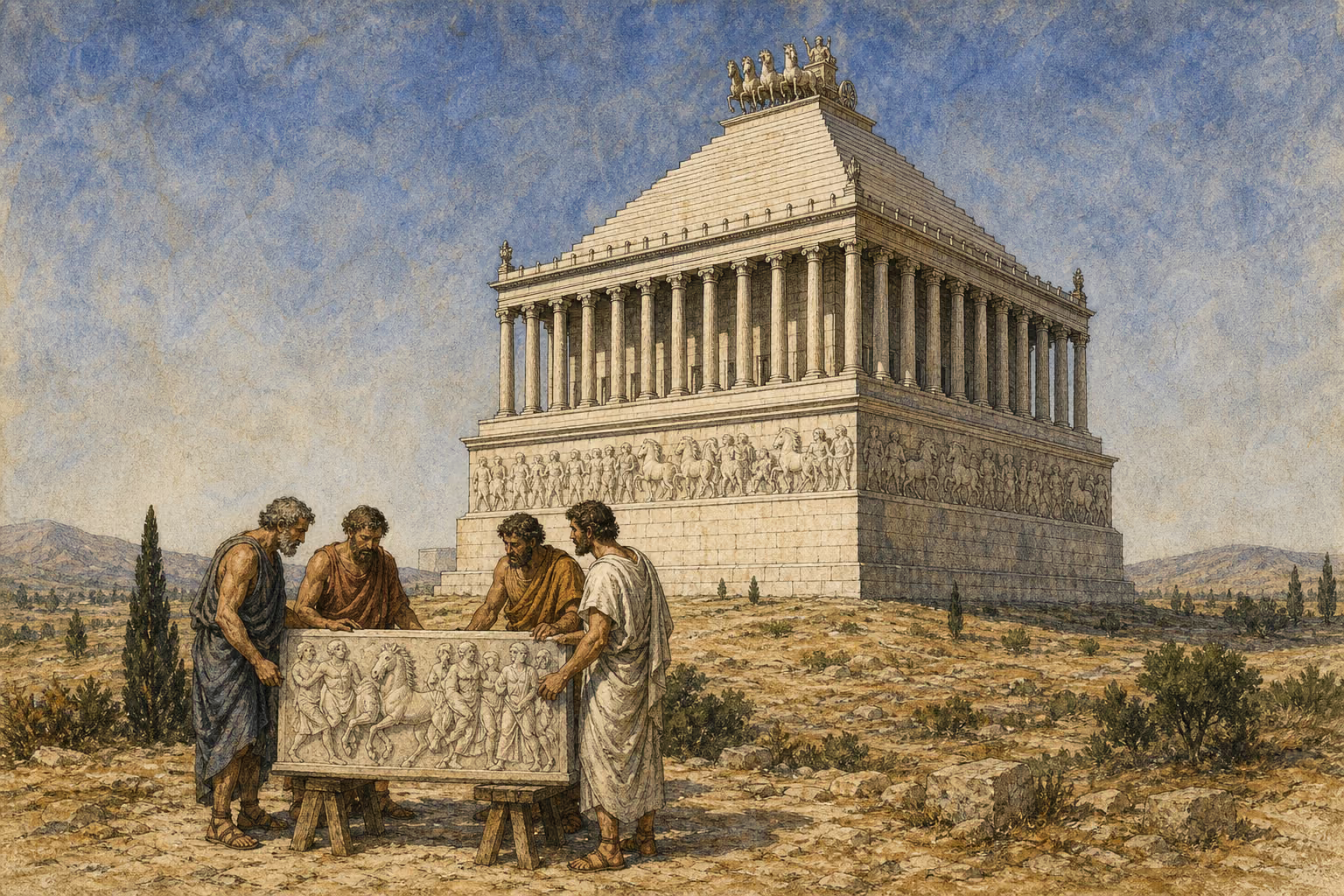
Scopas habuit aemulos eadem aetate Bryaxim et Timotheum et Leocharen, de quibus simul dicendum est, quoniam pariter caelavere Mausoleum. sepulchrum hoc est ab uxore Artemisia. factum Mausolo, Cariae regulo, qui obiit olympiadis CVII anno secundo. opus id ut esset inter septem miracula, hi maxime fecere artifices. patet ab austro et septentrione sexagenos ternos pedes, brevius a frontibus, toto circumitu pedes CCCCXXXX, attollitur in altitudinem XXV cubitis, cingitur columnis XXXVI. pteron vocavere circumitum. ab oriente caelavit Scopas, a septentrione Bryaxis, a meridie Timotheus, ab occasu Leochares, priusque quam peragerent, regina obiit. non tamen recesserunt nisi absoluto, iam id gloriae ipsorum artisque monimentum iudicantes; hodieque certant manus. accessit et quintus artifex. namque supra pteron pyramis altitudine m inferiorem aequat, viginti quattuor gradibus in metae cacumen se contrahens; in summo est quadriga marmorea, quam fecit Pythis. haec adiecta CXXXX pedum altitudine totum opus includit.—Timothei manu Diana Romae est in Palatio Apollinis delubro, cui signo caput reposuit Avianius Evander.
In magna admriratione est Hercules Menestrati et Hecate Ephesi in templo Dianae post aedem, in cuius contemplatione admonent aeditui parcere oculis; tanta marmoris radiatio est.—(Non postferuntur et Charites in propylo Atheniensium, quas Socrates fecit, aliuis ille quam pictor, idem ut aliqui putant).—nam Myronis illius, qui in aere laudatur, anus ebria est Zmyrnae in primis incluta.
Pollio Asinius, ut fuit acris vehementiae, sic quoque spectari monumenta sua voluit. in iissunt Centauri Nymphas gerentes Arcesilae, Thespiades Cleomenis, Oceanus et Iuppiter Heniochi, Appiades Stephani, Hermerotes Taurisci, non caelatoris illius, sed Tralliani, Iuppiter hospitalis Papyli, Praxitelis discipuli, Zethus et Amphion ac Dirce et taurus vinculumque ex eodem lapide, a Rhodo advecta opera Apollonii et Taurisci. parentum hi certamen de se fecere, Menecraten videri professi, sed esse naturalem Artemidorum. eodem loco Liber pater Eutychidis laudatur, ad Octaviae vero porticum Apollo Philisci Rhodii in delubro suo, item Latona et Diana et Musae novem et alter Apollo nudus. eum, qui citharam in eodem templo tenet, Timarchides fecit, intra Octaviae vero porticus aedem Iunonis ipsam deam Dionysius et Polycles aliam, Venerem eodem loco Philiscus, cetera signa Praxiteles. iidem Polycles et Dionysius, Timarchidis filii, Iovem, qui est in proxima aede, fecerunt, Pana et Olympum luctantes eodem loco Heliodorus, quod est alterum in terris symplegma nobile, Venerem lavantem sese Daedalsas, stantem Polycharmus. ex honore apparet, in magna auctoritate habitum Lysiae opus, quod in Palatio super arcum divus Augustus honori Octavi patris sui dicavit in aedicula columnis adornata, id est quadriga currusque et Apollo ac Diana ex uno lapide. in hortis Servilianis reperio laudatos Calamidis Apollinem illius caelatoris, Dercylidis pyctas, Amphistrati Callisthenen historiarum scriptorem.— Nec deinde multo plurium fama est, quorundam claritati in operibus eximiisobstante numero artificum, quoniam nec unus occupat gloriam nec plures pariter nuncupari possunt, sicut in Laocoonte, qui est in Titi imperatoris domo, opus omnibus et picturae et statuariae artis praeferendum. ex uno lapide eum ac liberos draconumque mirabiles nexus de consilii sententia fecere summi artifices Hagesander et Polydorus et Athenodorus Rhodii. similiter Palatinas domos Caesarum replevere probatissimis signis Craterus cum Pythodoro, Polydeuces cum Hermolao, Pythodorus alius cum Artemone, at singularis Aphrodisius Trallianus. Agrippae Pantheum decoravit Diogenes Atheniensis; in columnis templi eius Caryatides probantur inter pauca operum, sicut in fastigio posita signa, sed propter altitudinem loci minus celebrata. inhonorus est nec in templo ullo Hercules, ad quem Poeni omnibus annis humana sacrificaverant victima, humi stans ante aditum porticus ad nationes. sitae fuere et Thespiades ad aedem Felicitatis, quarum unam amavit eques 1 Romanus lunius Pisciculus, ut tradit Varro, admirator et Pasitelis, qui et quinque volumina scripsit nobilium operum in toto orbe. natus hic in Graeca Italiae ora et civitate Romana donatus cum iis oppidis, Iovem fecit eboreum in Metelli aede, qua campus petitur. accidit ei, cum in navalibus, ubi ferae Africanae erant, per caveam intuens leonem caelaret, ut ex alia cavea panthera erumperet, non levi periculo diligentissimi artificis. fecisse opera complura dicitur; quae fecerit, nominatim non refertur. Arcesilaum quoque magnificat Varro, cuius se marmoream habuisse leaenam aligerosque ludentes cum ea Cupidines, quorum alii religatam tenerent, alii cornu cogerent bibere, alii calciarent soccis, omnes ex uno lapide. idem et a Coponio quattuordecim nationes, quae sunt circa Pompeium, factas auctor est.—Invenio et Canachum laudatum inter statuarios fecisse marmorea. nec Sauram atque Batrachum obliterari convenit, qui fecere templa Octaviae porticibus inclusa, natione ipsi Lacones. quidam et opibus praepotentes fuisse eos putant ac sua inpensa construxisse, inscriptionem sperantes, qua negata hoc tamen alio modo usurpasse. sunt certe etiam nunc in columnarum spiris inscalptae nominum eorum argumento lacerta atque rana. in Iovis aede ex iis pictura cultusque reliquus omnis femineis argumentis constat; erat enim facta Iunoni, sed, cum inferrentur signa, permutasse geruli traduntur, et id religione custoditum, velut ipsis diis sedem ita partitis. ergo et in lunonis aede cultus est qui lovis esse debuit.
Sunt et in parvolis marmoreis famam consecuti Myrmecides, cuius quadrigam cum agitatore operuit alis musca, et Callicrates, cuius formicarum pedes atque alia membra pervidere non est.
English · Bostock & Riley 1855–57
Before these artists were in existence, there had already appeared Melas, a sculptor of the Isle of Chios; and, in succession to him, his son Micciades, and his grandson Archermus; whose sons, Bupalus and Athenis, afterwards attained the highest eminence in the art. These last were contemporaries of the poet Hipponax, who, it is well known, lived in the sixtieth Olympiad. Now, if a person only reckons, going upwards from their time to that of their great-grandfather, he will find that the art of sculpture must have necessarily originated about the commencement of the era of the Olympiads. Hipponax being a man notorious for his ugliness, the two artists, by way of joke, exhibited a statue of him for the ridicule of the public. Indignant at this, the poet emptied upon them all the bitterness of his verses; to such an extent indeed, that, as some believe, they were driven to hang themselves in despair. This, however, is not the fact; for, at a later period, these artists executed a number of statues in the neighbouring islands; at Delos for example, with an inscription subjoined to the effect, that Chios was rendered famous not only by its vines but by the works of the sons of Archermus as well. The people of Lasos still show a Diana that was made by them; and we find mention also made of a Diana at Chios, the work of their hands: it is erected on an elevated spot, and the features appear stern to a person as he enters, and joyous as he departs. At Rome, there are some statues by these artists on the summit of the Temple of the Palatine Apollo, and, indeed, in most of the buildings that were erected by the late Emperor Augustus. At Delos and in the Isle of Lesbos there were formerly some sculptures by their father to be seen. Ambracia too, Argos, and Cleonæ, were filled with productions of the sculptor Dipœnus.
All these artists, however, used nothing but the white marble of the Isle of Paros, a stone which was known as “lychnites” at first, because, according to Varro, it was cut in the quarries by lamplight. Since their time, many other whiter marbles have been discovered, and very recently that of the quarries of Luna. With reference to the marble of Paros, there is one very marvellous circumstance related; in a single block that was split with wedges, a figure of Silenus made its appearance.
We must not omit to remark, that the art of sculpture is of much more ancient date than those of painting and of statuary in bronze; both of which commenced with Phidias, in the eighty-third Olympiad, or in other words, about three hundred and thirty-two years later. Indeed, it is said, that Phidias himself worked in marble, and that there is a Venus of his at Rome, a work of extraordinary beauty, in the buildings of Octavia. A thing, however, that is universally admitted, is the fact that he was the instructor of Alcamenes, the Athenian, one of the most famous among the sculptors. By this last artist, there are numerous statues in the temples at Athens; as also, without the walls there, the celebrated Venus, known as the Aphrodite ἐν κήποις, work to which Phidias himself, it is said, put the finishing hand. Another disciple also of Phidias was Agoracritus of Paros, a great favourite with his master, on account of his extremely youthful age; and for which reason, it is said, Phidias gave his own name to many of that artist’s works. The two pupils entering into a contest as to the superior execution of a statue of Venus, Alcamenes was successful; not that his work was superior, but because his fellow-citizens chose to give their suffrages in his favour in preference to a stranger. It was for this reason, it is said, that Agoracritus sold his statue, on the express condition that it should never be taken to Athens, and changed its name to that of Nemesis. It was accordingly erected at Rhamnus, a borough of Attica, and M. Varro has considered it superior to every other statue. There is also to be seen in the Temple of the Great Mother, in the same city, another work by Agoracritus.
Among all nations which the fame of the Olympian Jupiter has reached, Phidias is looked upon, beyond all doubt, as the most famous of artists: but to let those who have never even seen his works, know how deservedly he is esteemed, we will take this opportunity of adducing a few slight proofs of the genius which he displayed. In doing this, we shall not appeal to the beauty of his Olympian Jupiter, nor yet to the vast proportions of his Athenian Minerva, six and twenty cubits in height, and composed of ivory and gold; but it is to the shield of this last statue that we shall draw attention; upon the convex face of which he has chased a combat of the Amazons, while, upon the concave side of it, he has represented the battle between the Gods and the Giants. Upon the sandals again, we see the wars of the Lapithæ and Centaurs, so careful has he been to fill every smallest portion of his work with some proof or other of his artistic skill. To the story chased upon the pedestal of the statue, the name of the “Birth of Pandora” has been given; and the figures of new-born gods to be seen upon it are no less than twenty in number. The figure of Victory, in particular, is most admirable, and connoisseurs are greatly struck with the serpent and the sphinx in bronze lying beneath the point of the spear. Let thus much be said incidentally in reference to an artist who can never be sufficiently praised; if only to let it be understood that the richness of his genius was always equal to itself, even in the very smallest details.
When speaking of the statuaries, we have already given the period at which Praxiteles flourished; an artist, who, in the glory which he acquired by his works in marble, surpassed even himself. There are some works of his in the Ceramicus at Athens; but, superior to all the statues, not only of Praxiteles, but of any other artist that ever existed, is his Cnidian Venus; for the inspection of which, many persons before now have purposely undertaken a voyage to Cnidos. The artist made two statues of the goddess, and offered them both for sale: one of them was represented with drapery, and for this reason was preferred by the people of Cos, who had the choice; the second was offered them at the same price, but, on the grounds of propriety and modesty, they thought fit to choose the other. Upon this, the Cnidians purchased the rejected statue, and immensely superior has it always been held in general estimation. At a later period, King Nicomedes wished to purchase this statue of the Cnidians, and made them an offer to pay off the whole of their public debt, which was very large. They preferred, however, to submit to any extremity rather than part with it; and with good reason, for by this statue Praxiteles has perpetuated the glory of Cnidos. The little temple in which it is placed is open on all sides, so that the beauties of the statue admit of being seen from every point of view; an arrangement which was favoured by the goddess herself, it is generally believed. Indeed, from whatever point it is viewed, its execution is equally worthy of admiration. A certain individual, it is said, became enamoured of this statue, and, concealing himself in the temple during the night, gratified his lustful passion upon it, traces of which are to be seen in a stain left upon the marble.
There are also at Cnidos some other statues in marble, the productions of illustrious artists; a Father Liber by Bryaxis, another by Scopas, and a Minerva by the same hand: indeed, there is no greater proof of the supreme excellence of the Venus of Praxiteles than the fact that, amid such productions as these, it is the only one that we generally find noticed. By Praxiteles, too, there is a Cupid, a statue which occasioned one of the charges brought by Cicero against Verres, and for the sake of seeing which persons used to visit Thespiæ: at the present day, it is to be seen in the Schools of Octavia. By the same artist there is also another Cupid, without drapery, at Parium, a colony of the Propontis; equal to the Cnidian Venus in the fineness of its execution, and said to have been the object of a similar outrage. For one Alcetas, a Rhodian, becoming deeply enamoured of it, left upon the marble similar traces of the violence of his passion.
At Rome there are, by Praxiteles, a Flora, a Triptolemus, and a Ceres, in the Gardens of Servilius; statues of Good Success and Good Fortune, in the Capitol; as also some Mænades, and figures known as Thyiades and Caryatides; some Sileni, to be seen in the memorial buildings of Asinius Pollio, and statues of Apollo and Neptune.
Cephisodotus, the son of Praxiteles, inherited his father’s talent. There is, by him, at Pergamus, a splendid Group of Wrestlers, a work that has been highly praised, and in which the fingers have all the appearance of being impressed upon real flesh rather than upon marble. At Rome there are by him, a Latona, in the Temple of the Palatium; a Venus, in the buildings that are memorials of Asinius Pollio; and an Æsculapius, and a Diana, in the Temple of Juno situate within the Porticos of Octavia.
Scopas rivals these artists in fame: there are by him, a Venus and a Pothos, statues which are venerated at Samothrace with the most august ceremonials. He was also the sculptor of the Palatine Apollo; a Vesta seated, in the Gardens of Servilius, and represented with two Bends around her, a work that has been highly praised; two similar Bends, to be seen upon the buildings of Asinius Pollio; and some figures of Canephori in the same place. But the most highly esteemed of all his works, are those in the Temple erected by Cneius Domitius, in the Flaminian Circus; a figure of Neptune himself, a Thetis and Achilles, Nereids seated upon dolphins, cetaceous fishes, and sea-horses, Tritons, the train of Phorcus, whales, and numerous other sea-monsters, all by the same hand; an admirable piece of workmanship, even if it had taken a whole life to complete it. In addition to the works by him already mentioned, and others of the existence of which we are ignorant, there is still to be seen a colossal Mars of his, seated, in the Temple erected by Brutus Callæcus, also in the Flaminian Circus; as also, a naked Venus, of anterior date to that by Praxiteles, and a production that would be quite sufficient to establish the renown of any other place.
At Rome, it is true, it is quite lost sight of amid such a vast multitude of similar works of art: and then besides, the inattention to these matters that is induced by such vast numbers of duties and so many items of business, quite precludes the generality of persons from devoting their thoughts to the subject. For, in fact, the admiration that is due to this art, not only demands an abundance of leisure, but requires that profound silence should reign upon the spot. Hence it is, that the artist is now forgotten, who executed the statue of Venus that was dedicated by the Emperor Vespasianus in his Temple of Peace, a work well worthy of the high repute of ancient times. With reference, too, to the Dying Children of Niobe, in the Temple of the Sosian Apollo, there is an equal degree of uncertainty, whether it is the work of Scopas or of Praxiteles. So, too, as to the Father Janus, a work that was brought from Egypt and dedicated in his Temple by Augustus, it is a question by which of these two artists it was made: at the present day, however, it is quite hidden from us by the quantity of gold that covers it. The same question, too, arises with reference to the Cupid brandishing a Thunderbolt, now to be seen in the Curia of Octavia: the only thing, in fact, that is affirmed with any degree of certainty respecting it, is, that it is a likeness of Alcibiades, who was the handsomest man of his day. There are, too, in the Schools of Octavia, many other highly attractive works, the authors of which are now unknown: four Satyrs, for example, one of which carries in his arms a Father Liber, robed in the palla; another similarly supports the Goddess Libera; a third is pacifying a child who is crying; and a fourth is giving a child some water to drink, from a cup; two Zephyrs also, who agitate their flowing drapery with their breath. No less is the uncertainty that prevails as to the authors of the statues now to be seen in the Septa; an Olympus and Pan, and a Charon and Achilles; and yet their high reputation has caused them to be deemed valuable enough for their keepers to be made answerable for their safety at the cost of their lives.
Scopas had for rivals and contemporaries, Bryaxis, Timotheus, and Leochares, artists whom we are bound to mention together, from the fact that they worked together at the Mausoleum; such being the name of the tomb that was erected by his wife Artemisia in honour of Mausolus, a petty king of Caria, who died in the second year of the hundred and seventh Olympiad. It was through the exertions of these artists more particularly, that this work came to be reckoned one of the Seven Wonders of the World. The circumference of this building is, in all, four hundred and forty feet, and the breadth from north to south sixty-three, the two fronts being not so wide in extent. It is twenty-five cubits in height, and is surrounded with six-and-thirty columns, the outer circumference being known as the “Pteron.” The east side was sculptured by Scopas, the north by Bryaxis, the south by Timotheus, and the west by Leochares; but, before their task was completed, Queen Artemisia died. They did not leave their work, however, until it was finished, considering that it was at once a memorial of their own fame and of the sculptor’s art: and, to this day even, it is undecided which of them has excelled. A fifth artist also took part in the work; for above the Pteron there is a pyramid erected, equal in height to the building below, and formed of four and twenty steps, which gradually taper upwards towards the summit; a platform, crowned with a representation of a four-horse chariot by Pythis. This addition makes the total height of the work one hundred and forty feet.
There is at Rome, by Timotheus, a Diana, in the Temple of Apollo in the Palatium, the head of which has been replaced by Avianius Evander. A Hercules, too, by Menestratus, is greatly admired; and there is a Hecate of his at Ephesus, in the Temple of Diana there, behind the sanctuary. The keepers of the temple recommend persons, when viewing it, to be careful of their eyes, so remarkably radiant is the marble. No less esteemed, too, are the statues of the Graces, in the Propylæum at Athens; the workmanship of Socrates the sculptor, a different person from the painter of that name, though identical with him in the opinion of some. As to Myron, who is so highly praised for his works in bronze, there is by him at Smyrna, An Old Woman Intoxicated, a work that is held in high estimation.
Asinius Pollio, a man of a warm and ardent temperament, was determined that the buildings which he erected as memorials of himself should be made as attractive as possible; for here we see groups representing, Nymphs carried off by Centaurs, a work of Arcesilas: the Thespiades, by Cleomenes: Oceanus and Jupiter, by Heniochus: the Appiades, by Stephanus: Hermerotes, by Tauriscus, not the chaser in silver, already mentioned, but a native of Tralles: a Jupiter Hospitalis by Papylus, a pupil of Praxiteles: Zethus and Amphion, with Dirce, the Bull, and the halter, all sculptured from a single block of marble, the work of Apollonius and Tauriscus, and brought to Rome from Rhodes. These two artists made it a sort of rivalry as to their parentage, for they declared that, although Apollodorus was their natural progenitor, Menecrates would appear to have been their father. In the same place, too, there is a Father Liber, by Eutychides, highly praised. Near the Portico of Octavia, there is an Apollo, by Philiscus of Rhodes, placed in the Temple of that God; a Latona and Diana also; the Nine Muses; and another Apollo, without drapery. The Apollo holding the Lyre, in the same temple, was executed by Timarchides. In the Temple of Juno, within the Porticos of Octavia, there is a figure of that goddess, executed by Dionysius, and another by Polycles, as also other statues by Praxiteles. This Polycles, too, in conjunction with Dionysius, the son of Timarchides, made the statue of Jupiter, which is to be seen in the adjoining temple. The figures of Pan and Olympus Wrestling, in the same place, are by Heliodorus; and they are considered to be the next finest group of this nature in all the world. The same artist also executed a Venus at the Bath, and Polycharmus another Venus, in an erect posture.
By the honourable place which the work of Lysias occupies, we may see in what high esteem it was held by the late Emperor Augustus, who consecrated it in honour of his father Octavius, in the Palatium, placing it on an arch within a small temple, adorned with columns: it is the figure of a four-horse chariot, with an Apollo and Diana, all sculptured from a single block. I find it stated, also, that the Apollo by Calamis, the chaser already mentioned, the Pugilists by Dercylides, and the statue of Callisthenes the historian, by Amphistratus, all of them now in the Gardens of Servilius, are works highly esteemed.
Beyond these, there are not many sculptors of high repute; for, in the case of several works of very great excellence, the number of artists that have been engaged upon them has proved a considerable obstacle to the fame of each, no individual being able to engross the whole of the credit, and it being impossible to award it in due proportion to the names of the several artists combined. Such is the case with the Laocoön, for example, in the palace of the Emperor Titus, a work that may be looked upon as preferable to any other production of the art of painting or of statuary. It is sculptured from a single block, both the main figure as well as the children, and the serpents with their marvellous folds. This group was made in concert by three most eminent artists, Agesander, Polydorus, and Athenodorus, natives of Rhodes. In similar manner also, the palaces of the Cæsars, in the Palatium, have been filled with most splendid statuary, the work of Craterus, in conjunction with Pythodorus, of Polydeuces with Hermoläus, and of another Pythodorus with Artemon; some of the statues, also, are by Aphrodisius of Tralles, who worked alone. The Pantheon of Agrippa has been decorated by Diogenes of Athens, and the Caryatides, by him, which form the columns of that temple, are looked upon as master-pieces of excellence: the same, too, with the statues that are placed upon the roof, though, in consequence of the height, they have not had an opportunity of being so well appreciated.
Without glory, and excluded from every temple, is the statue of Hercules, in honour of whom the Carthaginians were accustomed to sacrifice human victims every year: it stands upon the ground before the entrance of the Portico of the Nations. There were erected, too, near the Temple of Felicity, the statues of the Thespian Muses; of one of which, according to Varro, Junius Pisciculus, a Roman of equestrian rank, became enamoured. Pasiteles, too, speaks in terms of high admiration of them, the artist who wrote five Books on the most celebrated works throughout the world. Born upon the Grecian shores of Italy, and presented with the Roman citizenship granted to the cities of those parts, Pasiteles constructed the ivory statue of Jupiter which is now in the Temple of Metellus, on the road to the Campus Martius. It so happened, that being one day at the Docks, where there were some wild beasts from Africa, while he was viewing through the bars of a cage a lion which he was engaged in drawing, a panther made its escape from another cage, to the no small danger of this most careful artist. He executed many other works, it is said, but we do not find the names of them specifically mentioned.
Arcesilaüs, also, is an artist highly extolled by Varro; who states that he had in his possession a Lioness in marble of his, and Winged Cupids playing with it, some holding it with cords, and others making it drink from a horn, the whole sculptured from a single block: he says, also, that the fourteen figures around the Theatre of Pompeius, representing different Nations, are the work of Coponius.
I find it stated that Canachus, an artist highly praised among the statuaries in bronze, executed some works also in marble. Saurus, too, and Batrachus must not be forgotten, Lacedæmonians by birth, who built the temples enclosed by the Porticos of Octavia. Some are of opinion that these artists were very wealthy men, and that they erected these buildings at their own expense, expecting to be allowed to inscribe their names thereon; but that, this indulgence being refused them, they adopted another method of attaining their object. At all events, there are still to be seen, at the present day, on the spirals of the columns, the figures of a lizard and a frog, emblematical of their names. In the Temple of Jupiter by the same artists, the paintings, as well as all the other ornaments, bear reference to the worship of a goddess. The fact is, that when the temple of Juno was completed, the porters, as it is said, who were entrusted with the carriage of the statues, made an exchange of them; and, on religious grounds, the mistake was left uncorrected, from an impression that it had been by the intervention of the divinities themselves, that this seat of worship had been thus shared between them. Hence it is that we see in the Temple of Juno, also, the ornaments which properly pertain to the worship of Jupiter.
Some minute works in marble have also gained reputation for their artists: by Myrmecides, there was a four-horse chariot, so small that it could be covered, driver and all, by the wings of a fly; and by Callicrates, some ants, in marble, the feet and other limbs of which were so fine as to escape the sight.