LIBER XXXVI · CAPUT 6
AT WHAT PERIOD MARBLE WAS FIRST USED IN BUILDINGS
Latine · Mayhoff 1906
Haec sint dicta de marmoris scalptoribus summaque claritate artificum, quo in tractatu subit mentem non fuisse tum auctoritatem maculoso marmori. fecere et e Thasio, Cycladum insularum aequo, et e Lesbio; lividius hoc paulo. versicolores quidem maculas et in totum marmorum apparatum etiam Menander, diligentissimus luxuriae interpres, primus et raro attigit. columnis demum utebantur in templis, nec lautitiae causa—nondum enim ista intellegebantur—, sed quia firmiores aliter statui non poterant. sic est inchoatum Athenis templum Iovis Olympii, ex quo Sulla Capitolinis aedibus advexerat columnas. fuit tamen inter lapidem atque marmor differentia iam et apud Homerum; dicit enim marmoreo saxo percussum, sed hactenus, regias quoque domus, cum lautissime, praeter aes, aurum, electrum, argentum ebore tantum adornans. primum, ut arbitror, versicolores istas maculas Chiorum lapicidinae ostenderunt, cum exstruerent muros, faceto in id M. Ciceronis sale—omnibus enim ostentabant ut magnificum—: multo, inquit, magis mirarer, si Tiburtino lapide fecissetis. et, Hercules, non fuisset picturis honos ullus, non modo tantus, aliqua marmorum auctoritate.
Secandi in crustas nescio an Cariae fuerit inventum. antiquissima, quod equidem inveniam, Halicarnasi domus Mausoli Proconnesio marmore exculta est latericiis parietibus. is obiit olympiadis CVII anno secundo, urbis Romae CDIII.
Primum Romae parietes crusta marmoris operuisse totos domus suae in Caelio monte Cornelius Nepos tradit Mamurram, Formiis natum equitem Romanum, praefectum fabrum C. Caesaris in Gallia, ne quid indignitati desit, tali auctore inventa re. hic namque est Mamurra Catulli Veroniensis carminibus proscissus, quem, ut res est, domus ipsius clarius quam Catullus dixit habere quidquid habuisset Comata Gallia. namque adicit idem Nepos primum totis aedibus nullam nisi e marmore columnam habuisse et omnes solidas e Carystio aut Luniensi. M. Lepidus Q. Catuli in consulatu conlega primus omnium limina ex Numidico marmore in domo posuit magna reprensione. is fuit consul anno urbis DCLXXVI. hoc primum invecti Numidici marmoris vestigium invenio, non in columnis tamen crustisve, ut supra Carystii, sed in massa ac vilissimo liminum usu. post hunc Lepidum quadriennio L. Lucullus consul fuit, qui nomen, ut ex re apparet, Luculleo marmori dedit, admodum delectatus illo, primusque Romam invexit, atrum alioqui, cum cetera maculis aut coloribus commendentur. nascitur autem in Melo insula, solumque paene hoc marmor ab amatore nomen accepit. inter hos primum, ut arbitror, marmoreos parietes habuit scaena M. Scauri, non facile dixerim secto an solidis glaebis polito, sicuti est hodie Iovis Tonantis aedis in Capitolio. nondum enim secti marmoris vestigia invenio in Italia.
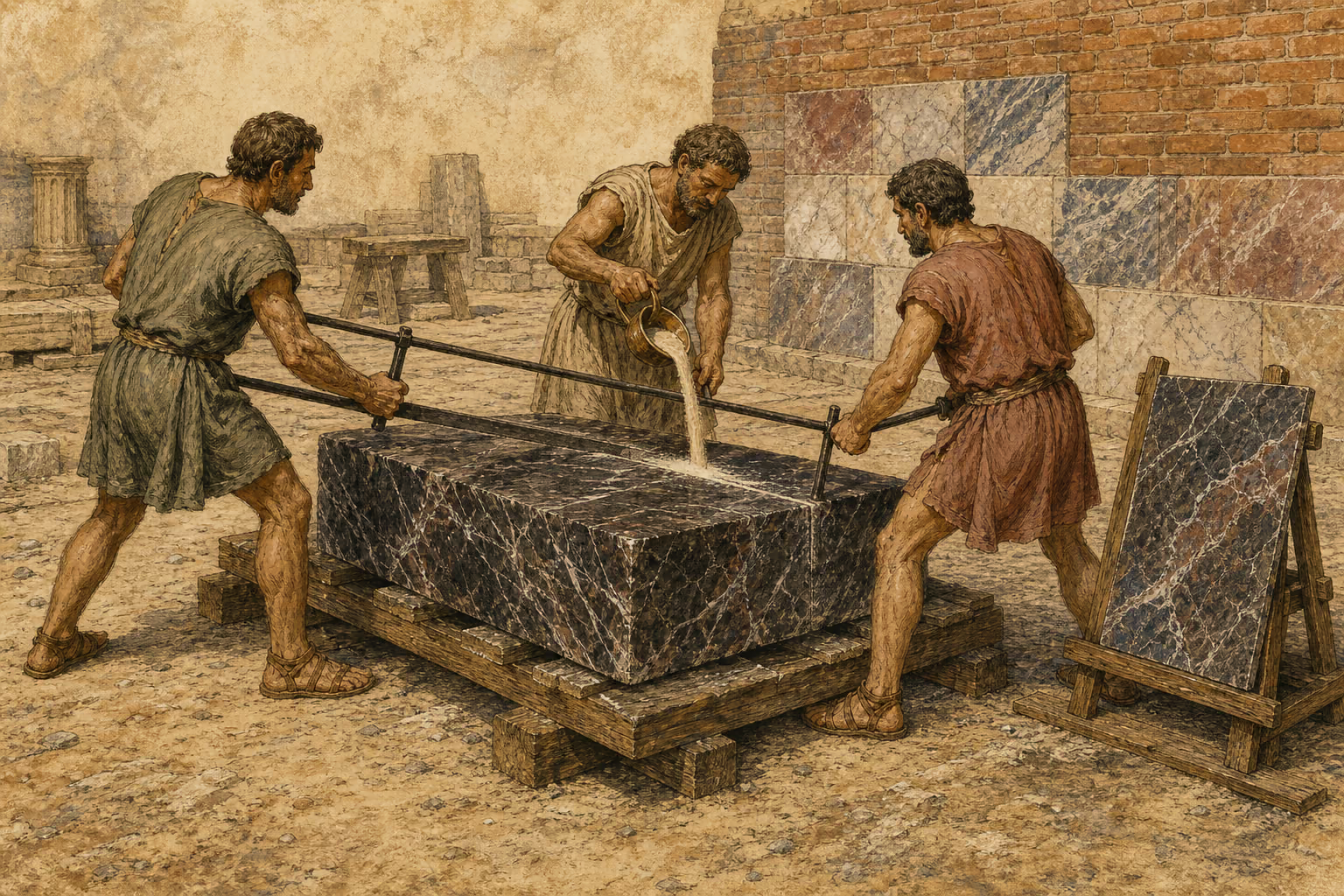
Sed quisquis primus invenit secare luxuriaque dividere, inportuni ingenii fuit. harena hoc fit et ferro videtur fieri, serra in praetenui linea premente harenas versandoque tractu ipso secante. Aethiopica haec maxime probatur, nam id quoque accessit, ut ab Aethiopia usque peteretur quod secaret marmora, immo vero etiam in Indos, quo margaritas quoque peti severis moribus indignum erat. haec proxime laudatur; mollior tamen quae Aethiopica, illa nulla scabritie secat, Indica non aeque levat, sed combusta ea polientes marmora fricare iubentur. simile et Naxiae vitium est et Coptitidi, quae vocatur Aegyptia. haec fuere antiqua genera marmoribus secandis. postea reperta est non minus probanda ex quodam Hadriatici maris vado, aestu nudante, observatione non facili. iam quidem quacumque harena secare e fluviis omnibus fraus artificum ausa est, quod dispendium admodum pauci intellegunt. crassior enim harena laxioribus segmentis terit et plus erodit marmoris maiusque opus scabritia politurae relinquit; ita sectae attenuantur crustae. rursus Thebaica polituris accommodatur et quae fit e poro lapide aut e pumice.—
English · Bostock & Riley 1855–57
This must suffice for the sculptors in marble, and the works that have gained the highest repute; with reference to which subject it occurs to me to remark, that spotted marbles were not then in fashion. In making their statues, these artists used the marble of Thasos also, one of the Cyclades, and of Lesbos, this last being rather more livid than the other. The poet Menander, in fact, who was a very careful enquirer into all matters of luxury, is the first who has spoken, and that but rarely, of variegated marbles, and, indeed, of the employment of marble in general. Columns of this material were at first employed in temples, not on grounds of superior elegance, (for that was not thought of, as yet), but because no material could be found of a more substantial nature. It was under these circumstances, that the Temple of the Olympian Jupiter was commenced at Athens, the columns of which were brought by Sylla to Rome, for the buildings in the Capitol.
Still, however, there had been a distinction drawn between ordinary stone and marble, in the days of Homer even. The poet speaks in one passage of a person being struck down with a huge mass of marble; but that is all; and when he describes the abodes of royalty adorned with every elegance, besides brass, gold, electrum, and silver, he only mentions ivory. Variegated marbles, in my opinion, were first discovered in the quarries of Chios, when the inhabitants were building the walls of their city; a circumstance which gave rise to a facetious repartee on the part of M. Cicero. It being the practice with them to show these walls to everybody, as something magnificent; “I should admire them much more,” said he, “if you had built them of the stone used at Tibur.” And, by Hercules! the art of painting never would have been held in such esteem, or, indeed, in any esteem at all, if variegated marbles had been held in admiration.
I am not sure whether the art of cutting marble into slabs, is not an invention for which we are indebted to the people of Caria. The most ancient instance of this practice, so far as I know of, is found in the palace of Mausolus, at Halicarnassus, the walls of which, in brick, are covered with marble of Proconnesus. Mausolus died in the second year of the hundred and seventh Olympiad, being the year of Rome, 403.
The first person at Rome who covered the whole of the walls of his house with marble, according to Cornelius Nepos, was Mamurra, who dwelt upon the Cælian Hill, a member of the equestrian order, and a native of Formiæ, who had been præfect of the engineers under C. Cæsar in Gaul. Such was the individual, that nothing may be wanting to the indignity of the example, who first adopted this practice; the same Mamurra, in fact, who has been so torn to pieces in the verses of Catullus of Verona. Indeed, his own house proclaimed more loudly than Catullus could proclaim it, that he had come into possession of all that Gallia Comata had had to possess. For Nepos adds, as well, that he was the first to have all the columns of his house made of nothing but solid marble, and that, too, marble of Carystus or of Luna.
M. Lepidus, who was consul with Q. Catulus, was the first to have the lintels of his house made of Numidian marble, a thing for which he was greatly censured: he was consul in the year of Rome, 676. This is the earliest instance that I can find of the introduction of Numidian marble; not in the form of pillars, however, or of slabs, as was the case with the marble of Carystus, above-mentioned, but in blocks, and that too, for the comparatively ignoble purpose of making the thresholds of doors. Four-years after this Lepidus, L. Lucullus was consul; the same person who gave its name, it is very evident, to the Lucullan marble; for, taking a great fancy to it, he introduced it at Rome. While other kinds of marble are valued for their spots or their colours, this marble is entirely black. It is found in the island of Melos, and is pretty nearly the only marble that has taken its name from the person who first introduced it. Among these personages, Scaurus, in my opinion, was the first to build a theatre with walls of marble: but whether they were only coated with slabs of marble or were made of solid blocks highly polished, such as we now see in the Temple of Jupiter Tonans, in the Capitol, I cannot exactly say: for, up to this period, I cannot find any vestiges of the use of marble slabs in Italy.
But whoever it was that first invented the art of thus cutting marble, and so multiplying the appliances of luxury, he displayed considerable ingenuity, though to little purpose. This division, though apparently effected by the aid of iron, is in reality effected by sand; the saw acting only by pressing upon the sand within a very fine cleft in the stone, as it is moved to and fro.
The sand of Æthiopia is the most highly esteemed for this purpose; for, to add to the trouble that is entailed, we have to send to Æthiopia for the purpose of preparing our marble—aye, and as far as India even; whereas in former times, the severity of the Roman manners thought it beneath them to repair thither in search of such costly things even as pearls! This Indian sand is held in the next highest degree of estimation, the Æthiopian being of a softer nature, and better adapted for dividing the stone without leaving any roughness on the surface; whereas the sand from India does not leave so smooth a face upon it. Still, however, for polishing marble, we find it recommended to rub it with Indian sand calcined. The sand of Naxos has the same defect; as also that from Coptos, generally known as “Egyptian” sand.
The above were the several varieties of sand used by the ancients in dividing marble. More recently, a sand has been discovered that is equally approved of for this purpose; in a certain creek of the Adriatic Sea, which is left dry at low water only; a thing that renders it not very easy to be found. At the present day, however, the fraudulent tendencies of our workers in marble have emboldened them to use any kind of river-sand for the purpose; a mischief which very few employers rightly appreciate. For, the coarser the sand, the wider is the division made in the stone, the greater the quantity of material consumed, and the more extensive the labour required for polishing the rough surface that is left; a result of which is that the slabs lose so much more in thickness. For giving the last polish to marble, Thebaic stone is considered well adapted, as also porous stone, or pumice, powdered fine.