LIBER XXXVI · CAPUT 7
STONE OF NAXOS. STONE OF ARMENIA
Latine · Mayhoff 1906
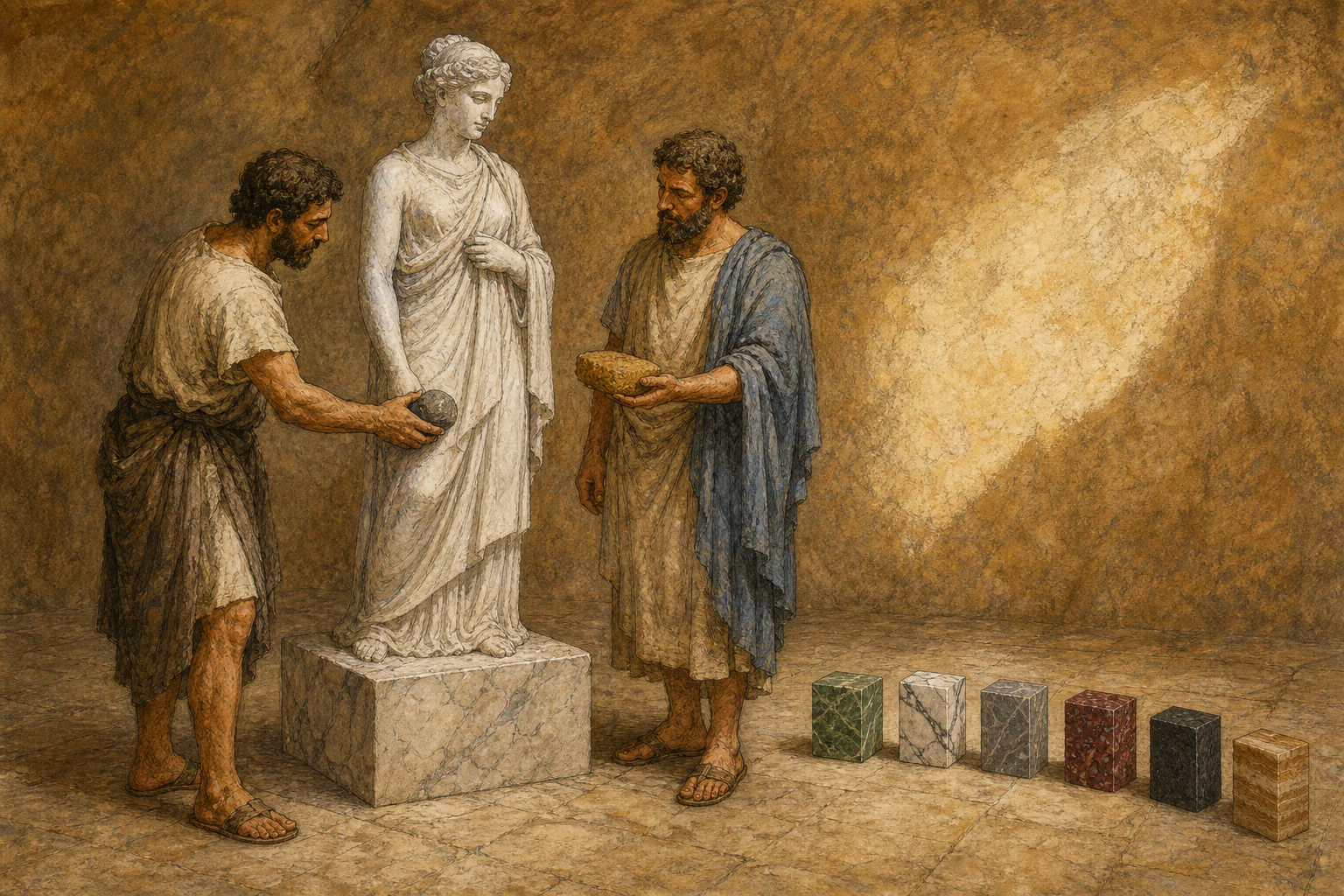
Signis e marmore poliendis gemmisque etiam scalpendis atque limandis Naxium diu placuit ante alia. ita vocantur cotes in Cypro insula genitae. vicere postea ex Armenia invectae.
Marmorum genera et colores non attinet dicere in tanta notitia nee facile est enumerare in tanta multitudine. quoto cuique enim loco non suum marmor invenitur? et tamen celeberrimi generis dicta sunt in ambitu terrarum cum gentibus suis. non omnia autem in lapicidinis gignuntur, sed multa et sub terra sparsa, pretiosissimi quidem generis, sicut Lacedaemonium viride cunctisque hilarius, sicut et Augusteum ac deinde Tibereum, in Aegypto Augusti ac Tiberii primum principatu reperta. differentia eorum est ab ophite, cumsit illud serpentium maculis simile, unde et nomen accepit, quod haec maculas diverso modo colligunt, Augusteum undatim crispum in vertices, Tibereum sparsa, non convoluta, canitie. neque ex ophite columnae nisi parvae admodum inveniuntur. duo eius genera: molle candidi, nigricantis durum. dicuntur ambo capitis dolores sedare adalligati et serpentium ictus. quidam phreneticis ac lethargicis adalligari iubent candicantem. contra serpentes autem a quibusdam praecipue laudatur ex iis quem tephrian appellant a colore cineris. vocatur et Memphites a loco, gemmantis naturae. huius usus conteri et iis, quae urenda sint aut secanda, ex aceto inlini; obstupescit ita corpus nec sentit cruciatum. rubet porphyrites in eadem Aegypto; ex eodem candidis intervenientibus punctis leptopsephos vocatur. quantislibet molibus caedendis sufficiunt lapicidinae. statuas ex eo Claudio Caesari procurator eius in urbem ex Aegypto advexit Vitrasius Pollio, non admodum probata novitate; nemo certe postea imitatus est. invenit eadem Aegyptus in Aethiopia quem vocant basaniten, ferrei coloris atque duritiae, unde et nomen ei dedit. numquam hic maior repertus est quam in templo Pacis ab imperatore Vespasiano Augusto dicatus argumento Nili, sedecim liberis circa ludentibus, per quos totidem cubita summi incrementi augentis se amnis eius intelleguntur. non absimilis illi narratur in Thebis delubro Serapis, ut putant, Memnonis statuae dicatus, quem cotidiano solis ortu contactum radiis crepare tradunt.
Onychem in Arabiae tantum montibus nec usquam aliubi nasci putavere nostri veteres, Sudines in Carmania. potoriis primum vasis inde factis, dein pedibus lectorum sellisque, Nepos Cornelius tradit magno fuisse miraculo, cum P. Lentulus Spinther amphoras ex eo Chiorum magnitudine cadorum ostendisset, post quinquennium deinde XXXII pedum longitudinis columnas vidisse se. variatum in hoc lapide et postea est, namque pro miraculo insigni quattuor modicas in theatro suo Cornelius Balbus posuit; nos ampliores xxx vidimus in cenatione, quam Callistus Caesaris Claudi libertorum, potentia notus, sibi exaedificaverat.
English · Bostock & Riley 1855–57
For polishing marble statues, as also for cutting and giving a polish to precious stones, the preference was long given to the stone of Naxos, such being the name of a kind of touchstone that is found in the Isle of Cyprus. More recently, however, the stones imported from Armenia for this purpose have displaced those of Naxos.
The marbles are too well known to make it necessary for me to enumerate their several colours and varieties; and, indeed, so numerous are they, that it would be no easy task to do so. For what place is there, in fact, that has not a marble of its own? In addition to which, in our description of the earth and its various peoples, we have already made it our care to mention the more celebrated kinds of marble. Still, however, they are not all of them produced from quarries, but in many instances lie scattered just beneath the surface of the earth; some of them the most precious even, the green Lacedæmonian marble, for example, more brilliant in colour than any other; the Augustan also; and, more recently, the Tiberian; which were first discovered, in the reigns respectively of Augustus and Tiberius, in Egypt. These two marbles differ from ophites in the circumstance that the latter is marked with streaks which resemble serpents in appearance, whence its name. There is also this difference between the two marbles themselves, in the arrangement of their spots: the Augustan marble has them undulated and curling to a point; whereas in the Tiberian the streaks are white, not involved, but lying wide asunder.
Of ophites, there are only some very small pillars known to have been made. There are two varieties of it, one white and soft, the other inclining to black, and hard. Both kinds, it is said, worn as an amulet, are a cure for head-ache, and for wounds inflicted by serpents. Some, too, recommend the white ophites as an amulet for phrenitis and lethargy. As a counter-poison to serpents, some persons speak more particularly in praise of the ophites that is known as “tephrias,” from its ashy colour. There is also a marble known as “memphites,” from the place where it is found, and of a nature somewhat analogous to the precious stones. For medicinal purposes, it is triturated and applied in the form of a liniment, with vinegar, to such parts of the body as require cauterizing or incision; the flesh becoming quite benumbed, and thereby rendered insensible to pain.
Porphyrites, which is another production of Egypt, is of a red colour: the kind that is mottled with white blotches is known as “leptospsephos.” The quarries there are able to furnish blocks of any dimensions, however large. Vitrasius Pollio, who was steward in Egypt for the Emperor Claudius, brought to Rome from Egypt some statues made of this stone; a novelty which was not very highly approved of, as no one has since followed his example. The Egyptians, too, have discovered in Æthiopia the stone known as “basanites;” which in colour and hardness resembles iron, whence the name that has been given to it. A larger block of it has never been known than the one forming the group which has been dedicated by the Emperor Vespasianus Augustus in the Temple of Peace. It represents the river Nilus with sixteen children sporting around it, symbolical of the sixteen cubits, the extreme height to which, in the most favourable seasons, that river should rise. It is stated, too, that in the Temple of Serapis at Thebes, there is a block not unlike it, which forms the statue of Memnon there; remarkable, it is said, for emitting a sound each morning when first touched by the rays of the rising sun.
Our forefathers imagined that onyx was only to be found in the mountains of Arabia, and nowhere else; but Sudines was aware that it is also found in Carmania. Drinking-vessels were made of it at first, and then the feet of beds and chairs. Cornelius Nepos relates that great was the astonishment, when P. Lentulus Spinther exhibited amphoræ made of this material, as large as Chian wine-vessels in size; “and yet, five years after,” says he, “I saw columns of this material, no less than two-and-thirty feet in height.” At a more recent period again, some change took place with reference to this stone; for four small pillars of it were erected by Cornelius Balbus in his Theatre as something quite marvellous: and I myself have seen thirty columns, of larger size, in the banquetting-room which Callistus erected, the freedman of Claudius, so well known for the influence which he possessed.