LIBER V · CAPUT 9
EGYPT AND THEBAIS
Latine · Mayhoff 1906
Adhaeret Asia, quam patere a Canopico ostio ad Ponti ostium Timosthenes |XXVI|.XXXVIII p. tradit, ab ore autem Ponti ad os Maeotis Eratosthenes |XV|.XLV, universam vero cum Aegypto ad Tanain Artemidorus et Isidorus L???.XIII.DCCL. maria eius conplura ab accolis traxere nomina: quare simul indicabuntur.
Proxima Africae incolitur Aegyptus, introrsus ad meridiem recedens, done a tergo praetendantur Aethiopes. inferiorem eius partem Nilus dextera laevaque divisus amplexu suo determinat, Canopico ostio ab Africa, ab Asia Pelusiaco, CLXX passuum intervallo. quam ob causam inter insulas quidam Aegyptum retulere, ita se findente Nilo, ut triquetram terrae figuram efficiat, ideoque multi Graecae litterae vocabulo Delta appellavere Aegyptum. mensura ab unitate alvei, unde se primum findit in latera, ad Canopicum ostium CXLVI, ad Pelusiacum CLVI est. summa pars contermina Aethiopiae Thebais vocatur. dividitur in praefecturas oppidorum, quasνόμους vocant: Ombiten, Apollonopoliten, Hermonthiten, Thiniten, Phaturiten, Coptiten, Tentyriten, Diospoliten, Antaeopoliten, Aphroditopoliten, Lycopoliten. quae iuxta Pelusium est regio nomos habet Pharbaethiten, Bubastiten, Sethroiten, Taniten. reliqua autem Arabicum, Hammoniacum tendentem ad Hammonis Iovis oraculum, Oxyrynchiten, Leontopoliten, Athribiten, Cynopoliten, Hermopoliten, Xoiten, Mendesium, Sebennyten, Cabasiten, Latopoliten, Heliopoliten, Prosopiten, Panopoliten, Busiriten, Onuphiten, Saiten, Ptenethum, Ptemphum, Naucratiten, Meteliten, Gynaecopoliten, Menelaiten, Alexandriae regionem, item Libyae, Mareotis. Heracleopolites est in insula Nili longa p. L???, in qua et oppidum, Herculis appellatum. Arsinoitae duo sunt; hi et Memphites usque ad summum Delta perveniunt, cui sunt contermini ex Africa duo Oasitae. quidam ex iis aliqua nomina permutant et substituunt alios nomos, ut Heroopoliten et Crocodilopoliten. inter Arsinoiten autem ac Memphiten lacus fuit circuitu CCL aut, ut Mucianus tradit, CCCCL et altitudinis quinquaginta passuum, manu factus, a rege qui fecerat Moeridis appellatus. inde LXII p. abest Memphis, quondam arx Aegypti regum, unde ad Hammonis oraculum XII dierum iter, ad scissuram autem Nili, quod appellavimus Delta, XV.
Nilus incertis ortus fontibus, ut per deserta et ardentia et inmenso longitudinis spatio ambulans famaque tantum inermi quaesitus sine bellis, quae ceteras omnes terras invenere, originem, ut Iuba rex potuit exquirere, in monte inferioris Mauretaniae non procul oceano habet lacu protinus stagnante, quem vocant Nilidem. ibi pisces reperiuntur alabetae, coracini, siluri. crocodilus quoque inde ob argumentum hoc Caesareae in Iseo dicatus ab eo spectatur hodie. praeterea observatum est, prout in Mauretania nives imbresve satiaverint, ita Nilum increscere. ex hoc lacu profusus indignatur fluere per harenosa et squalentia conditque se aliquot dierum itinere, mox alio lacu maiore in Caesariensis Mauretaniae gente Masaesylum erumpit et hominum coetus veluti circumspicit, isdem animalium argumentis. iterum harenis receptus conditur rursus XX dierum desertis ad proximos Aethiopas atque, ubi iterum sensit hominem, prosilit, fonte, ut verisimile est, illo quem Nigrim vocavere. inde Africam ab Aethiopia dispescens, etiamsi non protinus populis, feris tamen et beluis frequens silvarumque opifex, medios Aethiopas secat, cognominatus Astapus, quod illarum gentium lingua significat aquam e tenebris profluentem. insulas ita innumeras spargit quasdamque tam vastae magnitudinis, quamquam rapida celeritate, ut tamen dierum V cursu, non breviore, transvolet, circa clarissimam earum Meroen Astabores laevo alveo dictus, hoc est ramus aquae venientis e tenebris, dextra vero Astosapes, quod lateris significationem adicit, nec ante Nilus quam se totum aquis rursus concordibus iunxit, sic quoque etiamnum Giris ante nominatus per aliquot milia et in totum Homero Aegyptus aliisque Triton. subinde insulis impactus, totidem incitatus inritamentis, postremo inclusus montibus, nec aliunde torrentior, vectus aquis properantibus ad locum Aethiopum, qui Catadupi vocantur, novissimo catarracte inter occursantes scopulos non fluere inmenso fragore creditur, sed ruere. postea lenis et confractis aquis domitaque violentia, aliquid et spatio fessus, multis quamvis faucibus in Aegyptium mare se evomat, certis tamen diebus auctu magno per totam spatiatus Aegyptum fecundus innatat terrae.
Causas huius incrementi varias prodidere, sed maxime probabiles etesiarum eo tempore ex adverso flantium repercussum, ultra in ora acto mari, aut imbres Aethiopiae aestivos, isdem etesiis nubila illo ferentibus e reliquo orbe. Timaeus mathematicus occultam protulit rationem: Phialam appellari fontem eius, mergique in cuniculos ipsum amnem vapore anhelantem, fumidis cautibus ubi conditur. verum sole per eos dies comminus facto extrahi ardoris vi et suspensum abundare ac, ne devoretur, abscondi. id evenire a canis ortu per introitum solis in leonem, contra perpendiculum fontis sidere stante, cum eo tractu absumantur umbrae, plerisque e diverso opinatis largiorem fluere ad septentriones sole discedente, quod in cancro et leone evenit, ideoque tunc minus siccari, rursus in capricornum et austrinum polum reverso sorberi et ob id parcius fluere. sed Timaeo si quis extrahi posse credat, umbrarum defectus iis diebus et locis sine fine adest.
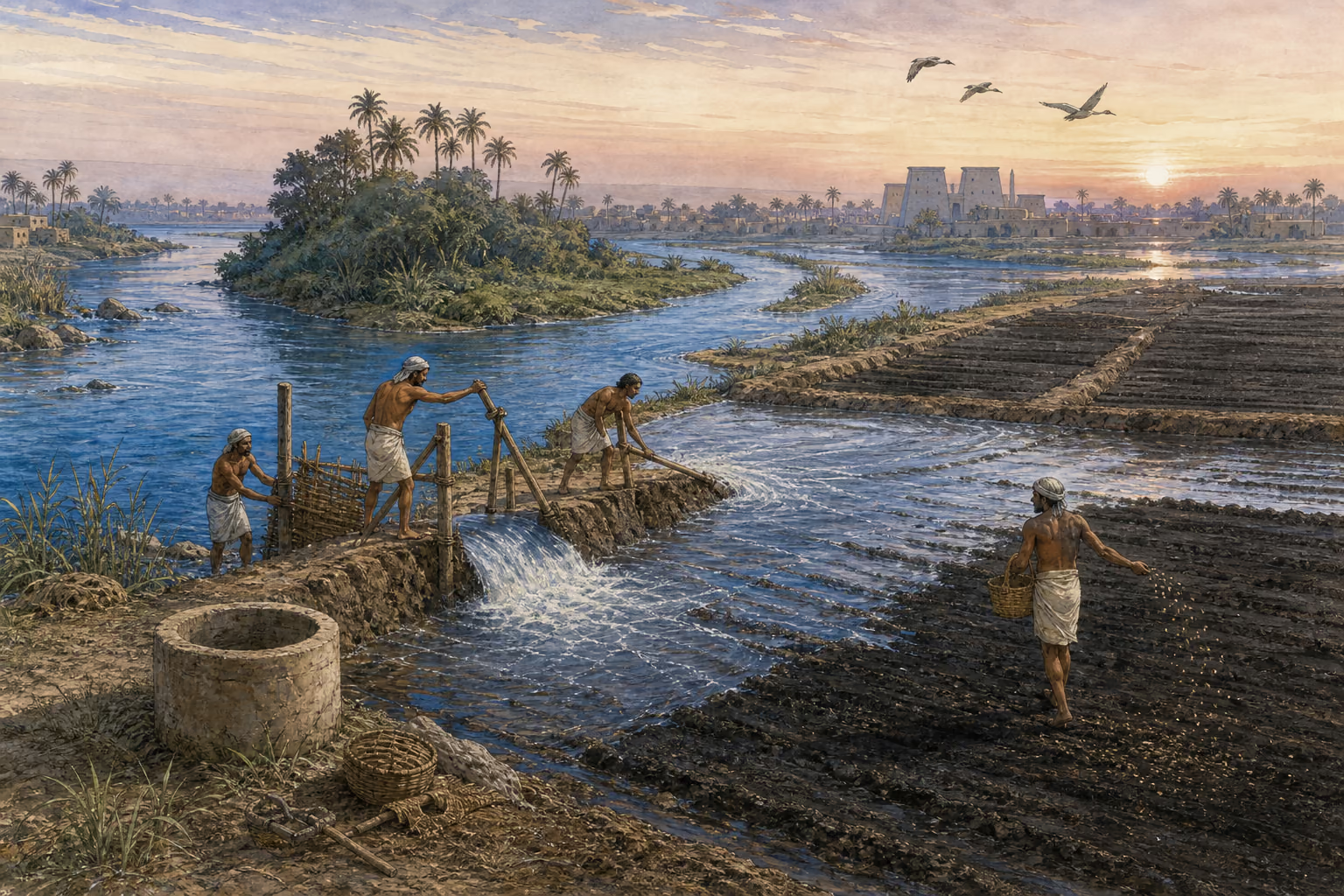
Incipit crescere luna nova, quaecumque post solstitium est, sensim modiceque cancrum sole transeunte, abundantissime autem leonem, et residit in virgine isdem quibus adcrevit modis. in totum autem revocatur intra ripas in libra, ut tradit Herodotus, centesimo die. cum crescit, reges aut praefectos navigare eo nefas iudicatum est. auctus per puteos mensurae notis deprehenduntur. Iustum incrementum est cubitorum XVI. minores aquae non omnia rigant, ampliores detinent tardius recedendo. hae serendi tempora absumunt solo madente, illae non dant sitiente. utrumque reputat provincia. in XII cubitis famem sentit, in XIII etiamnum esurit, XIIII cubita hilaritatem adferunt, XV securitatem, XVI delicias. maximum incrementum ad hoc aevi fuit cubitorum XVIII Claudio principe, minimum V Pharsalico bello, veluti necem Magni prodigio quodam flumine aversante. cum stetere aquae, apertis molibus admittuntur. ut quaeque liberata est terra, seritur. idem amnis unus omnium nullas exspirat auras.
Dicionis Aegyptiae esse incipit a fine Aethiopiae Syene; ita vocatur paeninsula M passuum ambitu, in qua castra sunt, latere Arabiae, et ex adverso insula estIIII, Philae, DC p. a Nili fissura, unde appellari diximus Delta. hoc spatium edidit Artemidorus et in eo CCL oppida fuisse, Iuba CCCC p., Aristocreon ab Elephantide ad mare DCCL. Elephantis insula intra novissimum catarracten IIII p. et supra Syenen XVI habitatur, navigationis Aegyptiae finis, ab Alexandria DLXXXV p.: in tantum erravere supra scripti. ibi Aethiopicae veneunt naves; namque eas plicatiles umeris transferunt, quotiens ad catarractas ventum est.
Aegyptus super ceteram antiquitatis gloriam XX urbium sibi Amase regnante habitata praefert, nunc quoque multis etiamsi ignobilibus frequens. celebrantur tamen Apollinis, mox Leucotheae, Diospolis Magna, eadem Thebe portarum centum nobilis fama, Coptos, Indicarum Arabicarumque mercium Nilo proximum emporium, mox Veneris oppidum et iterum Iovis ac Tentyris, infra quod Abydus, Memnonis regia et Osiris templo inclutum, VII.D p. in Libyam remotum a flumine. dein Ptolemais et Panopolis ac Veneris iterum et in Libyco Lycon, ubi montes finiunt Thebaidem. ab iis oppida Mercuri, Alabastron, Canum et supra dictum Herculis. deinde Arsinoes ac iam dicta Memphis, inter quam et Arsinoiten nomon in Libyco turres quae pyramides vocantur, et labyrinthus, in Moeridis lacu nullo addito ligno exaedificatus, et oppidum Crialon. unum praeterea intus et Arabiae conterminum claritatis magnae, Solis oppidum.
English · Bostock & Riley 1855–57
Joining on to Africa is Asia, the extent of which, according to Timosthenes, from the Canopic mouth of the Nile to the mouth of the Euxine, is 2639 miles. From the mouth of the Euxine to that of Lake Mæotis is, according to Eratosthenes, 1545 miles. The whole distance to the Tanais, including Egypt, is, according to Artemidorus and Isidorus, 6375 miles. The seas of Egypt, which are several in number, have received their names from those who dwell upon their shores, for which reason they will be mentioned together.
Egypt is the country which lies next to Africa; in the interior it runs in a southerly direction, as far as the territory of the Æthiopians, who lie extended at the back of it. The river Nile, dividing itself, forms on the right and left the boundary of its lower part, which it embraces on every side. By the Canopic mouth of that river it is separated from Africa, and by the Pelusiac from Asia, there being a distance between the two of 170 miles. For this reason it is that some persons have reckoned Egypt among the islands, the Nile so dividing itself as to give a triangular form to the land which it encloses: from which circumstance also many persons have named Egypt the Delta, after that of the Greek letter so called. The distance from the spot where the channel of the river first divides into branches, to the Canopic mouth, is 146 miles, and to the Pelusiac, 166.
The upper part of Egypt, which borders on Æthiopia, is known as Thebais. This district is divided into prefectures of towns, which are generally designated as “Nomes.” These are Ombites, Apollopolites, Hermonthites, Thinites, Phaturites, Coptites, Tentyrites, Diopolites, Antæopolites, Aphroditopolites, and Lycopolites. The district which lies in the vicinity of Pelusium contains the following Nomes, Pharbæthites, Bubastites, Sethroites, and Tanites. The remaining Nomes are those called the Arabian; the Hammonian, which lies on the road to the oracle of Jupiter Hammon; and those known by the names of Oxyrynchites, Leontopolites, Athribites, Cynopolites, Hermopolites, Xoites, Mendesium, Sebennytes, Cabasites, Latopolites, Heliopolites, Prosopites, Panopolites, Busirites, Onuphites, Saïtes, Ptenethu, Phthemphu, Naucratites, Metelites, Gynæcopolites, Menelaites,—all in the region of Alexandria, besides Mareotis in Libya.
Heracleopolites is a Nome on an island of the Nile, fifty miles in length, upon which there is a city, called the ‘City of Hercules.’ There are two places called Arsinoïtes: these and Memphites extend to the apex of the Delta; adjoining to which, on the side of Africa, are the two Nomes of Oasites. Some writers vary in some of these names and substitute for them other Nomes, such as Heroöpolites and Crocodilopolites. Between Arsinoïtes and Memphites, a lake, 250 miles, or, according to what Mucianus says, 450 miles in circumference and fifty paces deep, has been formed by artificial means: after the king by whose orders it was made, it is called by the name of Mœris. The distance from thence to Memphis is nearly sixty-two miles, a place which was formerly the citadel of the kings of Egypt; from thence to the oracle of Hammon it is twelve days’ journey. Memphis is fifteen miles from the spot where the river Nile divides into the different channels which we have mentioned as forming the Delta.
The sources of the Nile are unascertained, and, travelling as it does for an immense distance through deserts and burning sands, it is only known to us by common report, having neither experienced the vicissitudes of warfare, nor been visited by those arms which have so effectually explored all other regions. It rises, so far indeed as King Juba was enabled to ascertain, in a mountain of Lower Mauritania, not far from the ocean; immediately after which it forms a lake of standing water, which bears the name of Nilides. In this lake are found the several kinds of fish known by the names of alabeta, coracinus, and silurus; a crocodile also was brought thence as a proof that this really is the Nile, and was consecrated by Juba himself in the temple of Isis at Cæsarea, where it may be seen at the present day. In addition to these facts, it has been observed that the waters of the Nile rise in the same proportion in which the snows and rains of Mauritania increase. Pouring forth from this lake, the river disdains to flow through arid and sandy deserts, and for a distance of several days’ journey conceals itself; after which it bursts forth at another lake of greater magnitude in the country of the Massæsyli, a people of Mauritania Cæsariensis, and thence casts a glance around, as it were, upon the communities of men in its vicinity, giving proofs of its identity in the same peculiarities of the animals which it produces. It then buries itself once again in the sands of the desert, and remains concealed for a distance of twenty days’ journey, till it has reached the confines of Æthiopia. Here, when it has once more become sensible of the presence of man, it again emerges, at the same source, in all probability, to which writers have given the name of Niger, or Black. After this, forming the boundary-line between Africa and Æthiopia, its banks, though not immediately peopled by man, are the resort of numbers of wild beasts and animals of various kinds. Giving birth in its course to dense forests of trees, it travels through the middle of Æthiopia, under the name of Astapus, a word which signifies, in the language of the nations who dwell in those regions, “water issuing from the shades below.” Proceeding onwards, it divides innumerable islands in its course, and some of them of such vast magnitude, that although its tide runs with the greatest rapidity, it is not less than five days in passing them. When making the circuit of Meroë, the most famous of these islands, the left branch of the river is called Astobores, or, in other words, “an arm of the water that issues from the shades,” while the right arm has the name of Astosapes, which adds to its original signification the meaning of “side.” It does not obtain the name of “Nile” until its waters have again met and are united in a single stream; and even then, for some miles both above and below the point of confluence, it has the name of Siris. Homer has given to the whole of this river the name of Ægyptus, while other writers again have called it Triton. Every now and then its course is interrupted by islands which intervene, and which only serve as so many incentives to add to the impetuosity of its torrent; and though at last it is hemmed in by mountains on either side, in no part is the tide more rapid and precipitate. Its waters then hastening onwards, it is borne along to the spot in the country of the Æthiopians which is known by the name of “Catadupi;” where, at the last Cataract, the complaint is, not that it flows, but that it rushes, with an immense noise between the rocks that lie in its way: after which it becomes more smooth, the violence of its waters is broken and subdued, and, wearied out as it were by the length of the distance it has travelled, it discharges itself, though by many mouths, into the Egyptian sea. During certain days of the year, however, the volume of its waters is greatly increased, and as it traverses the whole of Egypt, it inundates the earth, and, by so doing, greatly promotes its fertility.
There have been various reasons suggested for this increase of the river. Of these, however, the most probable are, either that its waters are driven back by the Etesian winds, which are blowing at this season of the year from an opposite direction, and that the sea which lies beyond is driven into the mouths of the river; or else that its waters are swollen by the summer rains of Æthiopia, which fall from the clouds conveyed thither by the Etesian winds from other parts of the earth. Timæus the mathematician has alleged a reason of an occult nature: he says that the source of the river is known by the name of Phiala, and that the stream buries itself in channels underground, where it sends forth vapours generated by the heat among the steaming rocks amid which it conceals itself; but that, during the days of the inundation, in consequence of the sun approaching nearer to the earth, the waters are drawn forth by the influence of his heat, and on being thus exposed to the air, overflow; after which, in order that it may not be utterly dried up, the stream hides itself once more. He says that this takes place at the rising of the Dog-Star, when the sun enters the sign of Leo, and stands in a vertical position over the source of the river, at which time at that spot there is no shadow thrown. Most authors, however, are of opinion, on the contrary, that the river flows in greater volume when the sun takes his departure for the north, which he does when he enters the signs of Cancer and Leo, because its waters then are not dried up to so great an extent; while on the other hand, when he returns towards the south pole and re-enters Capricorn, its waters are absorbed by the heat, and consequently flow in less abundance. If there is any one inclined to be of opinion, with Timæus, that the waters of the river may be drawn out of the earth by the heat, it will be as well for him to bear in mind the fact, that the absence of shadow is a phænomenon which lasts continuously in these regions.
The Nile begins to increase at the next new moon after the summer solstice, and rises slowly and gradually as the sun passes through the sign of Cancer; it is at its greatest height while the sun is passing through Leo, and it falls as slowly and gradually as it arose while he is passing through the sign of Virgo. It has totally subsided between its banks, as we learn from Herodotus, on the hundredth day, when the sun has entered Libra. While it is rising it has been pronounced criminal for kings or prefects even to sail upon its waters. The measure of its increase is ascertained by means of wells. Its most desirable height is sixteen cubits; if the waters do not attain that height, the overflow is not universal; but if they exceed that measure, by their slowness in receding they tend to retard the process of cultivation. In the latter case the time for sowing is lost, in consequence of the moisture of the soil; in the former, the ground is so parched that the seed-time comes to no purpose. The country has reason to make careful note of either extreme. When the water rises to only twelve cubits, it experiences the horrors of famine; when it attains thirteen, hunger is still the result; a rise of fourteen cubits is productive of gladness; a rise of fifteen sets all anxieties at rest; while an increase of sixteen is productive of unbounded transports of joy. The greatest increase known, up to the present time, is that of eighteen cubits, which took place in the time of the Emperor Claudius; the smallest rise was that of five, in the year of the battle of Pharsalia, the river by this prodigy testifying its horror, as it were, at the murder of Pompeius Magnus. When the waters have reached their greatest height, the people open the embankments and admit them to the lands. As each district is left by the waters, the business of sowing commences. This is the only river in existence that emits no vapours.
The Nile first enters the Egyptian territory at Syene, on the frontiers of Æthiopia; that is the name of a peninsula a mile in circumference, upon which Castra is situate, on the side of Arabia. Opposite to it are the four islands of Philæ, at a distance of 600 miles from the place where the Nile divides into two channels; at which spot, as we have already stated, the Delta, as it is called, begins. This, at least, is the distance, according to Artemidorus, who also informs us that there were in it 250 towns; Juba says, however, that the distance between these places is 400 miles. Aristocreon says that the distance from Elephantis to the sea is 750 miles; Elephantis being an inhabited island four miles below the last Cataract, sixteen beyond Syene, 585 from Alexandria, and the extreme limit of the navigation of Egypt. To such an extent as this have the above-named authors been mistaken! This island is the place of rendezvous for the vessels of the Æthiopians; they are made to fold up, and the people carry them on their shoulders whenever they come to the Cataracts.
Egypt, besides its boast of extreme antiquity, asserts that it contained, in the reign of King Amasis, 20,000 inhabited cities: in our day they are still very numerous, though no longer of any particular note. Still however we find the following ones mentioned as of great renown—the city of Apollo; next, that of Leucothea; then Great Diospolis, otherwise Thebes, known to fame for its hundred gates; Coptos, which from its proximity to the Nile, forms its nearest emporium for the merchandise of India and Arabia; then the town of Venus, and then another town of Jupiter. After this comes Tentyris, below which is Abydus, the royal abode of Memnon, and famous for a temple of Osiris, which is situate in Libya, at a distance from the river of seven miles and a half. Next to it comes Ptolemais, then Panopolis, and then another town of Venus, and, on the Libyan side, Lycon, where the mountains form the boundary of the province of Thebais. On passing these, we come to the towns of Mercury, Alabastron, the town of Dogs, and that of Hercules already mentioned. We next come to Arsinoë, and Memphis, which has been previously mentioned; between which last and the Nome of Arsinoïtes, upon the Libyan side, are the towers known as the Pyramids, the Labyrinth on Lake Mœris, in the construction of which no wood was employed, and the town of Crialon. Besides these, there is one place in the interior, on the confines of Arabia, of great celebrity, the City of the Sun.