LIBER VI · CAPUT 17
THE NATIONS OF SCYTHIA AND THE COUNTRIES ON THE EASTERN OCEAN
Latine · Mayhoff 1906
Vltra sunt Scytharum populi. Persae illos Sacas universos appellavere a proxima gente, antiqui Aramios, Scythae ipsi Persas Chorsaros et Caucasum montem Croucasim, hoc est nive candidum. multitude populorum innumera et quae cum Parthis ex aequo degat. celeberrimi eorum Sacae, Massagetae, Dahae, Essedones, Astacae, Rumnici, Pestici, Homodoti, Histi, Edones, Camae, Camacae, Euchatae, Cotieri, Authusiani, Psacae, Arimaspi, Antacati, Chroasai, Oetaei. ibi Napaei interisse dicuntur a Palaeis. nobilia apud eos flumina Mandragaeum et Caspasum. nec in alia parte maior auctorum inconstantia, credo propter innumeras vagasque gentes. haustum ipsius maris duleem esse et Alexander Magnus prodidit et M. Varro talem perlatum Pompeio iuxta res gerenti Mithridatico bello, magnitudine haut dubie influentium amnium victo sale. adicit idem Pompei ductu exploratum, in Bactros septem diebus ex India perveniri ad Bactrum flumen quod in Oxum influat, et ex eo per Caspium in Cyrum subvectos, et V nonamplius dierum terreno itinere ad Phasim in Pontum Indicas posse devehi merces.
Insulae toto eo mari multae, volgata una maxime Zazata.
A Caspio mari Scythicoque oceano in Eoum cursus inflectitur, ad orientem conversa litorum fronte. inhabitabilis eius prima pars a Scythico promunturio ob nives; proxima inculta saevitia gentium. Anthropophagi Scythae insident humanis corporibus vescentes; ideo iuxta vastae solitudines ferarumque multitude, haut dissimilem hominum inmanitatem obsidens. iterum deinde Scythae iterumque deserta cum beluis usque ad iugum incubans mari quod vocant Tabim. nec ante dimidiam ferme longitudinem eius orae, quae spectat aestivum oriented, inhabitatur illa regio. primi sunt hominum qui noscantur Seres, lanicio silvarum nobiles, perfusam aqua depectentes frondium canitiem, unde geminus feminis nostris labos redordiendi fila rursusque texendi: tam multiplici opere, tam longinquo orbe petitur ut in publico matrona traluceat. Seres mites quidem, sed et ipsi feris similes coetum reliquorum mortalium fugiunt, commercia exspectant. primum eorum noscitur flumen Psitharas, proximum Cambari, tertium Lanos, a quo promunturium Chryse, sinus Cirnaba, flumen Atianos, sinus et gens hominum Attacorum, apricis ab omni noxio adflatu seclusa collibus, eadem, qua Hyperborei degunt, temperie. de iis privatim condidit volumen Amometus, sicut Hecataeus de Hyperboreis. ab Attacoris gentes Phuni et Thocari et, iam Indorum, Casiri introrsus ad Scythas versi — humanis corporibus vescuntur —, Nomades quoque Indiae vagantur. sunt qui ab aquilone contingi ab ipsis Ciconas dixere et Brisaros.
Sed unde plane constent gentes, Hemodi montes adsurgunt Indorumque gens incipit, non Eoo tantum mari adiacens, verum et meridiano quod Indicum appellavimus. quae pars orienti est adversa, recto praetenditur spatio ad flexum et initio Indici maris |XVIII| |LXXV| colligit, deinde quae se flexit in meridiem, XXIIII. LXXV, ut Eratosthenes tradit, usque ad Indum amnem, qui est ab occidente finis Indiae. conplures autem totam eius longitudinem XL dierum noctiumque velifico navium cursu determinavere et a septentrione ad meridiem XXVIII. L???, Agrippa longitudinis |XXXIII|, latitudinis |XIII| prodidit. Posidonius ab aestivo solis ortu ad hibernum exortum metatus est eam, adversam Galliam statuens, quam ab occidente aestivo ad occidentem hibernum metabatur, totam a favonio; itaque adversum eius venti adflatum iuvare Indiam salubremque fieri haut dubia ratione docuit. alia illi caeli facies, alii siderum ortus; binae aestates in anno, binae messes, media inter illas hieme etesiarum flatus, nostra vero bruma lenes ibi aurae, mare navigabile. gentes ei urbesque innumerae, si quis omnes persequi velit. etenim patefacta est non modo Alexandri Magni armis regumque qui successere ei, circumvectis etiam in Hyrcanium mare et Caspium Seleuco et Antiocho praefectoque classis eorum Patrocle, verum et aliis auctoribus Graecis, qui cum regibus Indicis morati, sicut Megasthenes et Dionysius a Philadelpho missus, ex ea causa vires quoque gentium prodidere. non tamen est diligentiae locus: adeo diversa et incredibilia traduntur. Alexandri Magni comites in eo tractu Indiae, quem is subegerit, scripserunt V??? oppidorum fuisse, nullum Coo minus, gentiumVIIII, Indiamque tertiam partem esse terrarum omnium, multitudinem populorum innumeram, probabili sane ratione: Indi enim gentium prope soli numquam migravere finibus suis. colliguntur a Libero Patre ad Alexandrum Magnum reges eorum CLIII annis VI. CCCCLI; adiciunt et menses III. amnium mira vastitas; proditur Alexandrum nullo die minus stadia DC navigasse Indo nec potuisse ante menses V enavigare adiectis paucis diebus, et tamen minorem Gauge esse constat. Seneca, etiam apud nos temptata Indiae commentatione, LX amnes eius prodidit, gentes duodeviginti centumque. par labos sit montes enumerare. iunguntur inter se Imavus, Hemodus, Paropanisus, Caucasus, a quibus tota decurrit in planitiem inmensam et Aegypto similem.
Verum ut terrena demonstratio intellegatur, Alexandri Magni vestigiis insistimus. Diognetus et Baeton, itinerum eius mensores, scripsere a Portis Caspiis Hecatompylon Parthorum quot diximus milia esse, inde Alexandriam Arion, quam urbem is rex condidit, DLXXV, Prophthasiam Drangarum CXCVIIII, Arachosiorum oppidum DLXV, Ortospanum CLXXV, inde ad Alexandri oppidum L??? — in quibusdam exemplaribus diversi numeri reperiuntur —; hanc urbem sub ipso Caucaso esse positam; ab ea ad flumen Copheta et oppidum Indorum PeucolatimCCXXXVII, unde ad flumen Indum et oppidum TaxillaLX, ad Hydaspen fluvium clarum CXX, ad Hypasim non ignobiliorem [XXV. IIIICCCLXXXX, qui fuit Alexandri itinerum terminus, exuperato tamen amne arisque in adversa ripa dicatis. epistulae quoque regis ipsius consentiunt his. reliqua inde Seleuco Nicatori peragrata sunt: ad SydrumCLXVIIII, lomanem amnem tantundem — aliqua exemplaria adiciunt V??? passuum—, inde ad Gangen CXII. D, ad RhodaphanDLXVIIII — alii CCCXXV in hoc spatio produnt —, ad Callinipaza oppidum CLXVII.D — alii CCLXV —, inde ad confluentem Iomanis et Gangis DCXXV — plerique adiciunt XIII.D —, ad oppidum Palibothra CCCCXXV, ad ostium Gangis DCXXXVII.D. gentes, quas memorare non pigeat, a montibus Hemodis, quorum promunturium Imaus vocatur incolarum lingua nivosumsic significante, Isari, Cosiri, Izi et per iuga Chirotosagi multarumque gentium cognomen Bragmanae, quorum Mactocalingae; flumina Prinas et Cainnas, quod in Gangen influit, ambo navigabilia; gentes Calingae mari proximi et supra Mandaei, Malli quorum mons Mallus, finisque tractus eius Ganges.
English · Bostock & Riley 1855–57
Beyond this river are the peoples of Scythia. The Persians have called them by the general name of Sacæ, which properly belongs to only the nearest nation of them. The more ancient writers give them the name of Aramii. The Scythians themselves give the name of “Chorsari” to the Persians, and they call Mount Caucasus Graucasis, which means “white with snow.” The multitude of these Scythian nations is quite innumerable: in their life and habits they much resemble the people of Parthia. The tribes among them that are better known are the Sacæ, the Massagetæ, the Dahæ, the Essedones, the Ariacæ, the Rhymmici, the Pæsici, the Amardi, the Histi, the Edones, the Camæ, the Camacæ, the Euchatæ, the Cotieri, the Anthusiani, the Psacæ, the Arimaspi, the Antacati, the Chroasai, and the Œtei; among them the Napæi are said to have been destroyed by the Palæi. The rivers in their country that are the best known, are the Mandragæus and the Carpasus. Indeed upon no subject that I know of are there greater discrepancies among writers, from the circumstance, I suppose, of these nations being so extremely numerous, and of such migratory habits. Alexander the Great has left it stated that the water of this sea is fresh, and M. Varro informs us, that some of it, of a similar character, was brought to Pompey, when holding the chief command in the Mithridatic war in its vicinity; the salt, no doubt, being overpowered by the volume of water discharged by the rivers which flow into it. He adds also, that under the direction of Pompey, it was ascertained that it is seven days’ journey from India to the river Icarus, in the country of the Bactri, which discharges itself into the Oxus, and that the merchandize of India being conveyed from it through the Caspian Sea into the Cyrus, may be brought by land to Phasis in Pontus, in five days at most. There are numerous islands throughout the whole of the Caspian sea: the only one that is well known is that of Tazata.
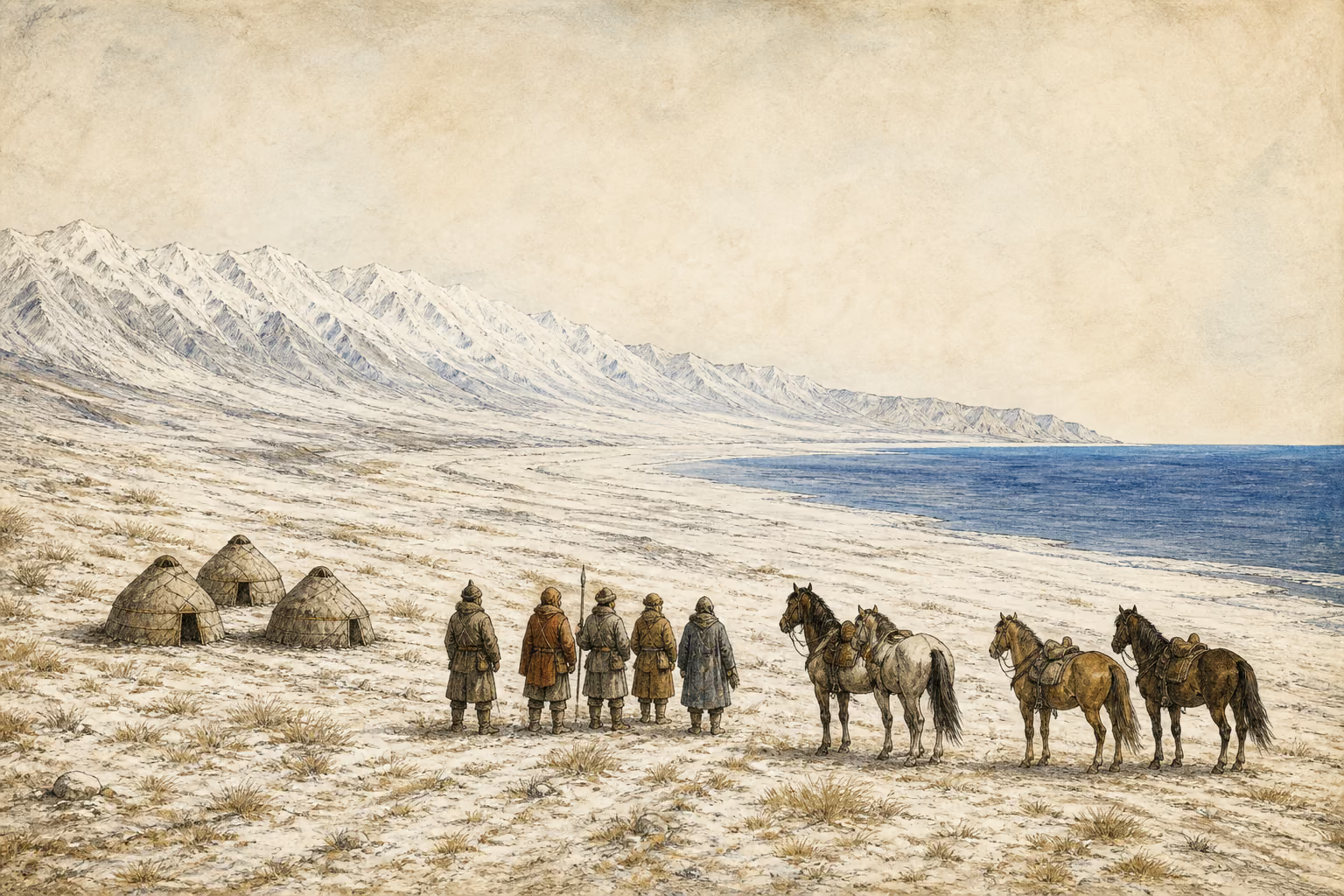
After we have passed the Caspian Sea and the Scythian Ocean, our course takes an easterly direction, such being the turn here taken by the line of the coast. The first portion of these shores, after we pass the Scythian Promontory, is totally uninhabitable, owing to the snow, and the regions adjoining are uncultivated, in consequence of the savage state of the nations which dwell there. Here are the abodes of the Scythian Anthropophagi, who feed on human flesh. Hence it is that all around them consists of vast deserts, inhabited by multitudes of wild beasts, which are continually lying in wait, ready to fall upon human beings just as savage as themselves. After leaving these, we again come to a nation of the Scythians, and then again to desert tracts tenanted by wild beasts, until we reach a chain of mountains which runs up to the sea, and bears the name of Tabis. It is not, however, before we have traversed very nearly one half of the coast that looks towards the north-east, that we find it occupied by inhabitants.
The first people that are known of here are the Seres, so famous for the wool that is found in their forests. After steeping it in water, they comb off a white down that adheres to the leaves; and then to the females of our part of the world they give the twofold task of unravelling their textures, and of weaving the threads afresh. So manifold is the labour, and so distant are the regions which are thus ransacked to supply a dress through which our ladies may in public display their charms. The Seres are of inoffensive manners, but, bearing a strong resemblance therein to all savage nations, they shun all intercourse with the rest of mankind, and await the approach of those who wish to traffic with them. The first river that is known in their territory is the Psitharas, next to that the Cambari, and the third the Laros; after which we come to the Promontory of Chryse, the Gulf of Cynaba, the river Atianos, and the nation of the Attacori on the gulf of that name, a people protected by their sunny hills from all noxious blasts, and living in a climate of the same temperature as that of the Hyperborei. Amometus has written a work entirely devoted to the history of these people, just as Hecatæus has done in his treatise on the Hyperborei. After the Attacori, we find the nations of the Phruri and the Tochari, and, in the interior, the Casiri, a people of India, who look toward the Scythians, and feed on human flesh. Here are also numerous wandering Nomad tribes of India. There are some authors who state that in a north-easterly direction these nations touch upon the Cicones and the Brysari.
But we come now to nations as to which there is a more general agreement among writers. Where the chain of Emodus rises, the nations of India begin, which borders not only on the Eastern sea, but on the Southern as well, which we have already mentioned as being called the Indian Ocean. That part which faces the east runs in a straight line a distance of eighteen hundred and seventy-five miles until it comes to a bend, at which the Indian Ocean begins. Here it takes a turn to the south, and continues to run in that direction a distance of two thousand four hundred and seventy-five miles, according to Eratosthenes, as far as the river Indus, the boundary of India on the west. Many authors have represented the entire length of the Indian coast as being forty days’ and nights’ sail, and as being, from north to south, two thousand eight hundred and fifty miles. Agrippa states its length to be three thousand three hundred miles, and its breadth, two thousand three hundred. Posidonius has given its measurement as lying from north-east to south-east, placing it opposite to Gaul, of which country he has given the measurement as lying from north-west to south-west; making the whole of India to lie due west of Gaul. Hence, as he has shewn by undoubted proofs, India lying opposite to Gaul must be refreshed by the blowing of that wind, and derive its salubrity therefrom.
In this region, the appearance of the heavens is totally changed, and quite different is the rising of the stars; there are two summers in the year, and two harvests, while the winter intervenes between them during the time that the Etesian winds are blowing: during our winter too, they enjoy light breezes, and their seas are navigable. In this country there are nations and cities which would be found to be quite innumerable, if a person should attempt to enumerate them. For it has been explored not only by the arms of Alexander the Great and of the kings who succeeded him, by Seleucus and Antiochus, who sailed round even to the Caspian and Hyrcanian Sea, and by Patrocles, the admiral of their fleet, but has been treated of by several other Greek writers who resided at the courts of Indian kings, such, for instance, as Megasthenes, and by Dionysius, who was sent thither by Philadelphus, expressly for the purpose: all of whom have enlarged upon the power and vast resources of these nations. Still, however, there is no possibility of being rigorously exact, so different are the accounts given, and often of a nature so incredible. The followers of Alexander the Great have stated in their writings, that there were no less than five thousand cities in that portion of India which they vanquished by force of arms, not one of which was smaller than that of Cos; that its nations were eight in number, that India forms one-third of the whole earth, and that its populations are innumerable—a thing which is certainly far from improbable, seeing that the Indians are nearly the only race of people who have never migrated from their own territories. From the time of Father Liber to that of Alexander the Great, one hundred and fifty-three kings of India are reckoned, extending over a period of six thousand four hundred and fifty-one years and three months. The vast extent of their rivers is quite marvellous; it is stated that on no one day did Alexander the Great sail less than six hundred stadia on the Indus, and still was unable to reach its mouth in less than five months and some few days: and yet it is a well-known fact that this river is not so large as the Ganges. Seneca, one of our fellow-countrymen, who has written a treatise upon the subject of India, has given its rivers as sixty-five in number, and its nations as one hundred and eighteen. The difficulty too would be quite as great, if we were to attempt to enumerate its mountains. The chains of Emaüs, of Emodus, of Paropanisus, and of Caucasus, are all connected, the one with the other; and from their foot, the country of India runs down in the form of a vast plain, bearing a very considerable resemblance to that of Egypt.
However, that we may come to a better understanding relative to the description of these regions, we will follow in the track of Alexander the Great. Diognetus and Bæton, whose duty it was to ascertain the distances and length of his expeditions, have written that from the Caspian Gates to Hecatompylon, the city of the Parthians, the distance is the number of miles which we have already stated; and that from thence to Alexandria, of the Arii, which city was founded by the same king, the distance is five hundred and seventy-five miles; from thence to Prophthasia, the city of the Drangæ, one hundred and ninety-nine; from thence to the city of the Arachosii, five hundred and sixty-five; from thence to Ortospanum, one hundred and seventy-five; and from thence to the city built by Alexander, fifty, miles. In some copies, however, the numbers are found differently stated; and we find this last city even placed at the very foot of Mount Caucasus! From this place to the river Cophes and Peucolaitis, a city of India, is two hundred and thirty-seven miles; from thence to the river Indus and the city of Taxilla sixty; from thence to the famous river Hydaspes one hundred and twenty; and from thence to the Hypasis, a river no less famous, two hundred and ninety miles, and three hundred and ninety paces. This last was the extreme limit of the expedition of Alexander, though he crossed the river and dedicated certain altars on the opposite side. The dispatches written by order of that king fully agree with the distances above stated.
The remaining distances beyond the above point were ascertained on the expedition of Seleucus Nicator. They are, to the river Sydrus, one hundred and sixty-eight miles; to the river Jomanes, the same; some copies, however, add to this last distance five miles; thence to the Ganges, one hundred and twelve miles; to Rhodapha, five hundred and sixty-nine—though, according to some writers, this last distance is only three hundred and twenty-five miles; to the town of Calinipaxa, one hundred and sixty-seven, according to some, two hundred and sixty-five; thence to the confluence of the river Jomanes and Ganges, six hundred and twenty-five; most writers, however, add thirteen miles to this last distance; thence to the city of Palibothra, four hundred and twenty-five—and thence to the mouth of the Ganges, six hundred and thirty-seven miles and a half.
The nations whom it may be not altogether inopportune to mention, after passing the Emodian Mountains, a cross range of which is called “Imaus,” a word which, in the language of the natives, signifies “snowy,” are the Isari, the Cosyri, the Izi, and, upon the chain of mountains, the Chisiotosagi, with numerous peoples, which have the surname of Brachmanæ, among whom are the Maccocalingæ. There are also the rivers Prinas and Cainas, which last flows into the Ganges, both of them navigable streams. The nation of the Calingæ comes nearest to the sea, and above them are the Mandei and the Malli. In the territory of the last-named people is a mountain called Mallus: the boundary of this region is the river Ganges.