LIBER VI · CAPUT 22
TAPROBANE
Latine · Mayhoff 1906
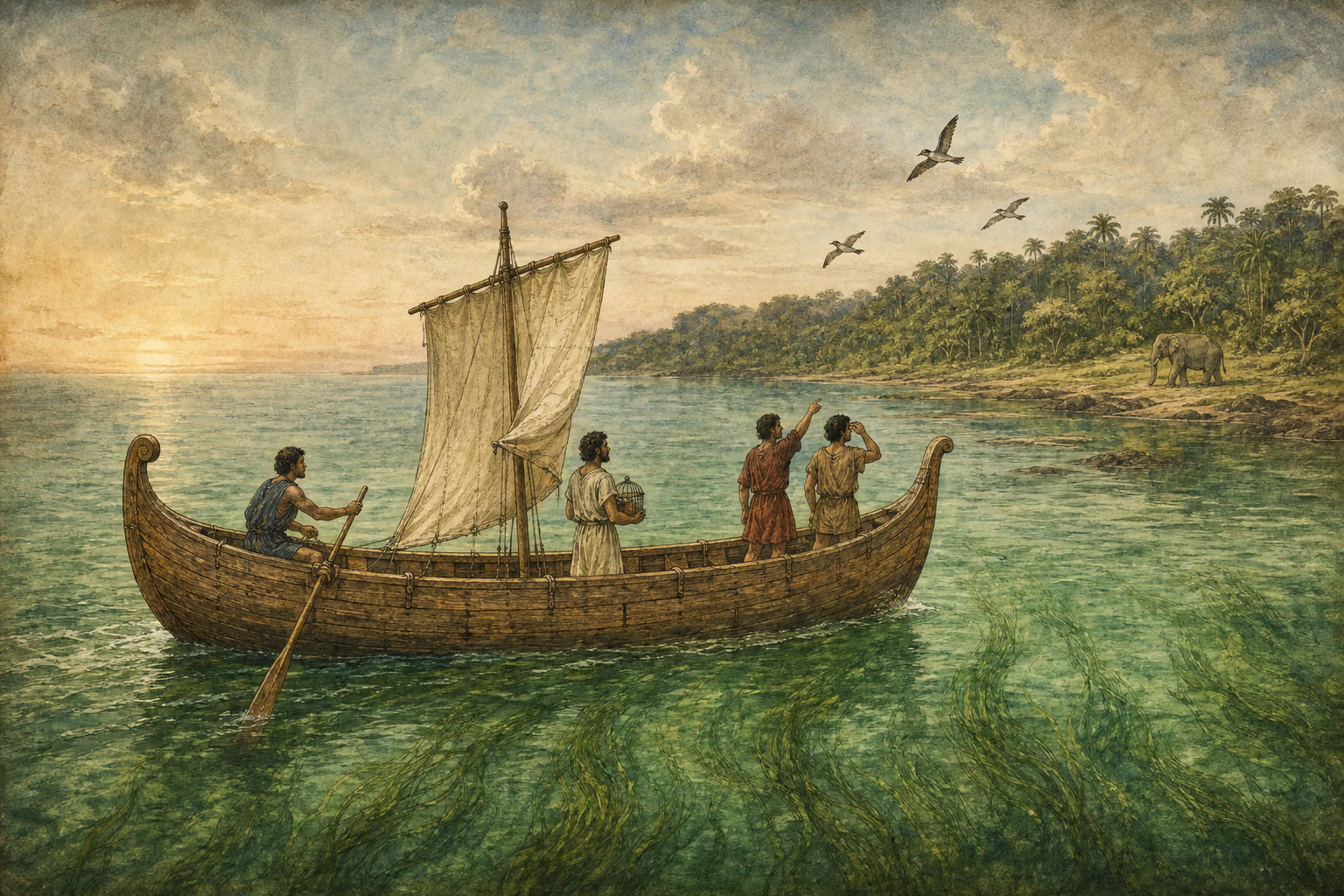
Taprobanen alterum orbem terrarum esse diu existimatum est Antichthonum appellatione. ut insulam liqueret esse Alexandri Magni aetas resque praestitere. Onesicritus, classis eius praefectus, elephantos ibi maiores bellicosioresque quam in India gigni scripsit, Megasthenes flumine dividi, incolasque Palaeogonos appellari, auri margaritarumque grandium fertiliores quam Indos. Eratosthenes et mensuram prodidit, longitudinis VII stadium, latitudinis V???, nec urbes esse, sed vicos DCCL. incipit ab Eoo mari inter ortum occasumque solis Indiae praetenta et quondam credita XX dierum navigatione a Prasiana gente distare, mox, quia papyraceis navibus armamentisque Nili peteretur, ad nostrarum navium cursus VII dierum intervallo taxata. mare interest vadosum, senis non amplius altitudinis passibus, sed certis canalibus ita profundum, ut nullae anchorae sidant. ob id navibus utrimque prorae, ne per angustias alvei circumagi sit necesse; magnitudo ad terna milia amphorum. siderum in navigando nulla observatio; septentrio non cernitur. volucres secum vehunt emittentes saepius meatumque earum terram petentium comitantur. nec plus quaternis mensibus anno navigant. cavent a solstitio maxime centum dies, tune illo mari hiberno.
Hactenus a priscis memorata. nobis diligentior notitia Claudi principatu contigit legatis etiam ex ea insula advectis. id accidit hoc modo. Anni Plocami, qui maris Rubri vectigal a fisco redemerat, libertus circa Arabiam navigans aquilonibus raptus praeter Carmaniam, XV die Hippuros portum eius invectus, hospitali regis dementia sex mensum tempore inbutus adloquio percunctanti postea narravit Romanos et Caesarem. mirum in modum in auditis iustitiam ille suspexit, quod pari pondere denarii essent in captiva pecunia, cum diversae imagines indicarent a pluribus factos, et hoc maxime sollicitatus ad amicitiam legatos quattuor misit principe eorum Rachia. ex iis cognitum, D esse oppida, portum contra meridiem adpositum oppido Palaesimundo, omnium ibi clarissimo ac regio, CC plebis. stagnum intus Megisba CCCLXXV p. ambitu, insulas pabuli tantum fertiles conplexum; ex eo duos amnes erumpere, Palaesimundum iuxta oppidum eiusdem nominis influentem in portum tribus alveis, quinque stadiorum artissimo, XV amplissimo, alterum ad septentriones Indiamque versum, Cydara nomine. proximum esse Indiae promunturium quod vocetur Coliacum, quadridui navigatione, medio in cursu Solis insula occurrente. mare id colore perviridi, praeterea fruticosum arboribus, iubas earum gubernaculis deterentibus. septentriones vergiliasque apud nos veluti in novo caelo mirabantur, ne lunam quidem apud ipsos nisi ab octava in XVI supra terram aspici fatentes; Canopum lucere noctibus, sidus ingens et clarum. sed maxime mirum iis erat umbras suas in nostrum caelum cadere, non in suum, solemque a laeva oriri et in dexteram occidere potius quam e diverso. iidem narravere latus insulae quod praetenderetur Indiae X??? stadiorum esse ab oriente hiberno; ultra monies Hemodos Seras quoque ab ipsis aspici, notos etiam commercio; patrem Rachiae commeasse eo; advenis ibi feras occursare, ipsos vero excedere hominum magnitudinem, rutilis comis, caeruleis oculis, oris sono truci, nullo commercio linguae. cetera eadem quae nostri negotiatores: fluminis ulteriore ripa merces positas iuxta venalia tolli ab iis, si placeat permutatio, non aliter odio iustiore luxuriae quam si perducta mens illuc usque cogitet, quid et quo petatur et quare. sed ne Taprobane quidem, quamvis extra orbem a natura relegata, nostris vitiis caret. aurum argentumque et ibi in pretio; marmor testudini simile, margaritae gemmaeque in honore; multo praestantior est totus luxuriae nostrae cumulus. ipsorum opes maiores esse dicebant, sed apud nos opulentiae maiorem usum. servum nemini, non in diem aut interdiu somnum, aedificia modice ab humo exstantia, annonam numquam augeri, non fora litesve esse, coli Herculem, eligi regem a populo senecta clementiaque, liberos non habentem, et, si postea gignat, abdicari, ne fiat hereditarium regnum. rectores ei a populo XXX dari, nec nisi plurium sententia quemquam capitis damnari; sic quoque appellationem esse ad populum et LXX indices dari: si liberent ii reum, amplius XXX iis nullam esse dignationem, gravissimo probro. regi cultum Liberi Patris, ceteris Arabum. regem, si quid delinquat, morte multari, nullo interemente, aversantibus cunctis et commercia etiam sermonis negantibus. festa venatione absumi; gratissimam eam tigribus elephantisque constare. agros diligenter coli, vitis usum non esse, pomis abundare. esse et in piscatu voluptatem, testudinum maxime, quarum superficie familias habitantium contegi: tanta reperiri magnitudine. vitam hominum centum annis modicam.
English · Bostock & Riley 1855–57
Taprobane, under the name of the “land of the Antichthones,” was long looked upon as another world: the age and the arms of Alexander the Great were the first to give satisfactory proof that it is an island. Onesicritus, the commander of his fleet, has informed us that the elephants of this island are larger, and better adapted for warfare than those of India; and from Megasthenes we learn that it is divided by a river, that the inhabitants have the name of Palæogoni, and that their country is more productive of gold and pearls of great size than even India. Eratosthenes has also given the dimensions of this island, as being seven thousand stadia in length, and five thousand in breadth: he states also that there are no cities, but villages to the number of seven hundred. It begins at the Eastern sea, and lies extended opposite to India, east and west. This island was in former times supposed to be twenty days’ sail from the country of the Prasii, but in later times, whereas the navigation was formerly confined to vessels constructed of papyrus with the tackle peculiar to the Nile, the distance has been estimated at no more than seven days’ sail, in reference to the speed which can be attained by vessels of our construction. The sea that lies between the island and the mainland is full of shallows, not more than six paces in depth; but in certain channels it is of such extraordinary depth, that no anchor has ever found a bottom. For this reason it is that the vessels are constructed with prows at either end; so that there may be no necessity for tacking while navigating these channels, which are extremely narrow. The tonnage of these vessels is three thousand amphoræ. In traversing their seas, the people of Taprobane take no observations of the stars, and indeed the Greater Bear is not visible to them; but they carry birds out to sea, which they let go from time to time, and so follow their course as they make for the land. They devote only four months in the year to the pursuits of navigation, and are particularly careful not to trust themselves on the sea during the next hundred days after our summer solstice, for in those seas it is at that time the middle of winter.
Thus much we learn from the ancient writers; it has fallen to our lot, however, to obtain a still more accurate knowledge of these people; for during the reign of the Emperor Claudius, an embassy came from even this distant island to Rome. The circumstances under which this took place were as follow: Annius Plocamus had farmed from the treasury the revenues arising from the Red Sea. A certain freedman of his, while sailing around Arabia, was carried away by a gale from the north beyond the coast of Carmania. In the course of fifteen days he had drifted to Hippuros, a port of Taprobane, where he was most kindly and hospitably received by the king; and having, after a study of six months, become well acquainted with the language, was enabled to answer all his enquiries relative to the Romans and their emperor. But of all that he heard, the king was more particularly struck with surprise at our rigid notions of justice, on ascertaining that among the money found on the captive, the denarii were all of equal weight, although the different figures on them plainly showed that they had been struck in the reigns of several emperors. By this circumstance in especial, the king was prompted to form an alliance with the Romans, and accordingly sent to Rome an embassy, consisting of four persons, the chief of whom was Rachias.
From these persons we learned that in Taprobane there are five hundred towns, and that there is a harbour that lies facing the south, and adjoining the city of Palæsimundus, the most famous city in the isle, the king’s place of residence, and containing a population of two hundred thousand. They also informed us that in the interior there is a lake called Megisba, three hundred and seventy-five miles in circumference, and containing islands which are fertile, though for pasturage only. In this lake they informed us two rivers take their rise, one of which, called Palæsimundus, flows into the harbour near the city of that name, by three channels, the narrowest of which is five stadia in width, the largest fifteen; while the other, Cydara by name, takes a direction northward, towards the Indian coast. We learned also that the nearest point of the Indian coast is a promontory known as Coliacum, distant from the island four days’ sail, and that midway between them lies the island of the Sun. They stated also that those seas are of a deep green tint; besides which, there are numerous trees growing at the bottom, so much so, that the rudders of the vessels frequently break off portions of their foliage. They were much astonished at the constellations which are visible to us, the Greater Bear and the Pleiades, as though they had now beheld a new expanse of the heavens; and they declared that in their country the moon can only be seen above the horizon from the eighth to its sixteenth day. They also stated that Canopus, a large bright star, gives light to them by night. But what surprised them more than anything, was that the shadow of their bodies was thrown towards our hemisphere and not theirs, and that the sun arose on the left hand and set on the right, and not in the opposite direction. They also informed us that the side of their island which lies opposite to India is ten thousand stadia in length, and runs in a south-easterly direction—that beyond the Emodian Mountains they look towards the Seræ, whose acquaintance they had also made in the pursuits of commerce; that the father of Rachias had frequently visited their country, and that the Seræ always came to meet them on their arrival. These people, they said, exceeded the ordinary human height, had flaxen hair, and blue eyes, and made an uncouth sort of noise by way of talking, having no language of their own for the purpose of communicating their thoughts. The rest of their information was of a similar nature to that communicated by our merchants. It was to the effect that the merchandize on sale was left by them upon the opposite bank of a river on their coast, and it was then removed by the natives, if they thought proper to deal on terms of exchange. On no grounds ought luxury with greater reason to be detested by us, than if we only transport our thoughts to these scenes, and then reflect, what are its demands, to what distant spots it sends in order to satisfy them, and for how mean and how unworthy an end!
But yet Taprobane even, isolated as it is by nature from the rest of the world, is not exempt from our vices. Gold and silver are held in esteem even there. They have a marble which resembles tortoise-shell in appearance; this, as well as their pearls and precious stones, is highly valued; all our luxuries in fact, those even of the most exquisite nature, are there carried to the very highest pitch. They asserted that their wealth is much greater than ours, but admitted that we know better than they how to obtain real enjoyment from opulence.
In this island no slavery exists; they do not prolong their sleep to day-break, nor indeed during any part of the day; their buildings are only of a moderate height from the ground; the price of corn is always the same; they have no courts of law and no litigation. Hercules is the deity whom they worship; and their king is chosen by the people, an aged man always, distinguished for his mild and clement disposition, and without children. If after he has been elected king, he happens to become the father of children, his abdication is the consequence; this is done that there may be no danger of the sovereign power becoming hereditary. Thirty advisers are provided for him by the people, and it is only by the advice of the majority of them that any man is condemned to capital punishment. Even then, the person so condemned has a right of appealing to the people, in which case a jury consisting of seventy persons is appointed. Should these acquit the accused, the thirty counsellors are no longer held in any estimation, but are visited with the greatest disgrace. The king wears the costume of Father Liber, while the rest of the people dress like the natives of Arabia. The king, if he is found guilty of any offence, is condemned to death; but no one slays him; all turn their backs upon him, and refuse to hold any communication or even discourse with him. Their festivals are celebrated with the chase, the most valued sports being the pursuit of the tiger and the elephant. The lands are carefully tilled; the vine is not cultivated there, but of other fruits there is great abundance. They take great delight in fishing, and especially in catching turtles; beneath the shells of which whole families find an abode, of such vast size are they to be found. These people look upon a hundred years as a comparatively short life. Thus much have we learned respecting Taprobane.
We will now proceed to give some further particulars relative to the four Satrapies, of which we have postponed further mention till the present occasion.