LIBER VI · CAPUT 23
VOYAGES TO INDIA
Latine · Mayhoff 1906
Haec conperta de Taprobane. quattuor satrapiae, quas in hunc locum distulimus, ita se habent. a proximis Indo gentibus montana. Capisene habuit Capisam urbem, quam diruit Cyrus. Arachosia cum flumine et oppido eiusdem fiominis, quod quidam Cufim dixere, a Samiramide conditum. amnis Erymandus, praefluens Parabesten Arachosiorum. proximos his a meridie ad partem Arachotarum faciunt Dexendrusos, a septentrione Paropanisidas, Cartana oppidum sub Caucaso, quod postea Tetragonis dictum. haec regio est ex adverso Bactriae, Ariorum deinde cuius oppidum Alexandria, a conditore dictum, Sydraci, Dangalae, Parapinae, Cataces, Mazi; ad Caucasum Cadrusi, oppidum ab Alexandro conditum. infra haec omnia planiora. ab Indo Ariana regio, ambusta fervoribus desertisque circumdata, multa tamen interfusa opacitate cultores congregat circa duos maxime fluvios, Tonberon et Arosapen. oppidum Artacoana, Arius amnis, qui praefluit Alexandriam ab Alexandro conditam. patet oppidum stadia XXX multoque pulchrius sicut antiquius Artacabene, iterum ab Antiocho munitum, stadia quinquaginta. Dorsigi gens; amnes Pharnacotis, Ophradus; Prop hthasia, oppidum Zarasparum, Drangae, Euergetae, Zarangae, Gedrusi, oppida Peucolis, Lyphorta, Methorcum; deserta; amnis Manain, Acutri gens, flumen Eorum, gens Orbi, flumen navigabile Pomanus Pandarum finibus, item Cabirus Suarorum, ostio portuosum, oppidum Condigramma, flumen Cophes. influunt in eum navigabilia Saddaros, Parospus, Sodamus. Arianae partem esse Daritim aliqui volunt mensuramque produnt utriusque longitudinem |XVIII|, latitudinem dimidio minorem quam Indiae. alii Gedrusos et Sires posuere per CXXXVIII p., mox Ichthyophagos Oritas propria, non Indorum, lingua loquentes per CC p. Ichthyophagos omnes Alexander vetuit piscibus vivere. deinde posuere Arbiorum gentem per CC p. ultra deserta; dein Carmania ac Persis atque Arabia.
Sed priusquam generatim haec persequamur, indicari convenit quae prodidit Onesicritus classe Alexandri circumvectus in mediterranea Persidis ex India, enarrata proxime a Iuba, deinde eam navigationem, quae his annis comperta servatur hodie.
Onesicriti et Nearchi navigatio nec nominaomnia habet mansionum nec spatia, primumque Xylinepolis ab Alexandro condita, unde ceperunt exordium, iuxta quod flumen aut ubi fuerit non satis explanatur. haec tamen digna memoratu produntur ab is: oppidum a Nearcho conditum in navigatione et flumen Arbium navium capax; contra insula, distans LXX stadiis, Alexandria condita a Leonnato iussu Alexandri in finibus gentis, Argeruus portu salubri, flumen Tonberum navigabile, circa quod Pasirae; deinde Ichthyophagi tam longo tractu, ut XXX dierum spatio praenavigaverint; insula quae Solis appellatur et eadem Nympharum Cubile, rubens, in qua nullum non animal absumitur incertis causis; Ori gens, flumen Carmaniae Hyctanis, portuosum et auro fertile. ab eo primum septentriones apparuisse adnotavere, arcturum neque omnibus cerni noctibus nec totis umquam. Achaemenidas usque illo tenuisse. aeris et ferri metalla et arrenici ac mini exerceri. inde promunturium Carmaniae est, ex quo in adversam oram ad gentem Arabiae Macas traiectus distat L??? p.; insulae tres, quarum Oracta tantum habitatur aquosa, a continenteXXV p., insulae quattuor iam in sinu ante Persida — circa has hydri marini vicenum cubitorum adnatantes terruere classem —, insula Athotadrus, item Gauratae, in quibus Gyani gens; flumen Hyperis in medio sinu Persico, onerariarum navium capax, flumen Sitioganus, quo Pasargadas septimo die navigatur, flumen navigabile Phristimus, insula sine nomine, flumen Granis modicarum navium — per Susianen fluit, dextra eius accolunt Dexi montani, qui bitumen perficiunt —, flumen Zarotis, ostio difficili nisi peritis, insulae duae parvae; inde vadosa navigatio, palustri similis, per euripos tamen quosdam peragitur; ostium Euphratis, lacus quem faciunt Eulaeus et Tigris iuxta Characen, inde Tigri Susa. festos dies ibi agentem Alexandrum invenerunt septimo mense post quam digressus ab iis fuerat Patalis, tertio navigationis. sic Alexandri classis navigavit; postea ab Syagro Arabiae promunturio Patalen favonio, quem hippalum ibi vocant, peti certissimum videbatur, |XIII|.XXXII p. aestimatione.
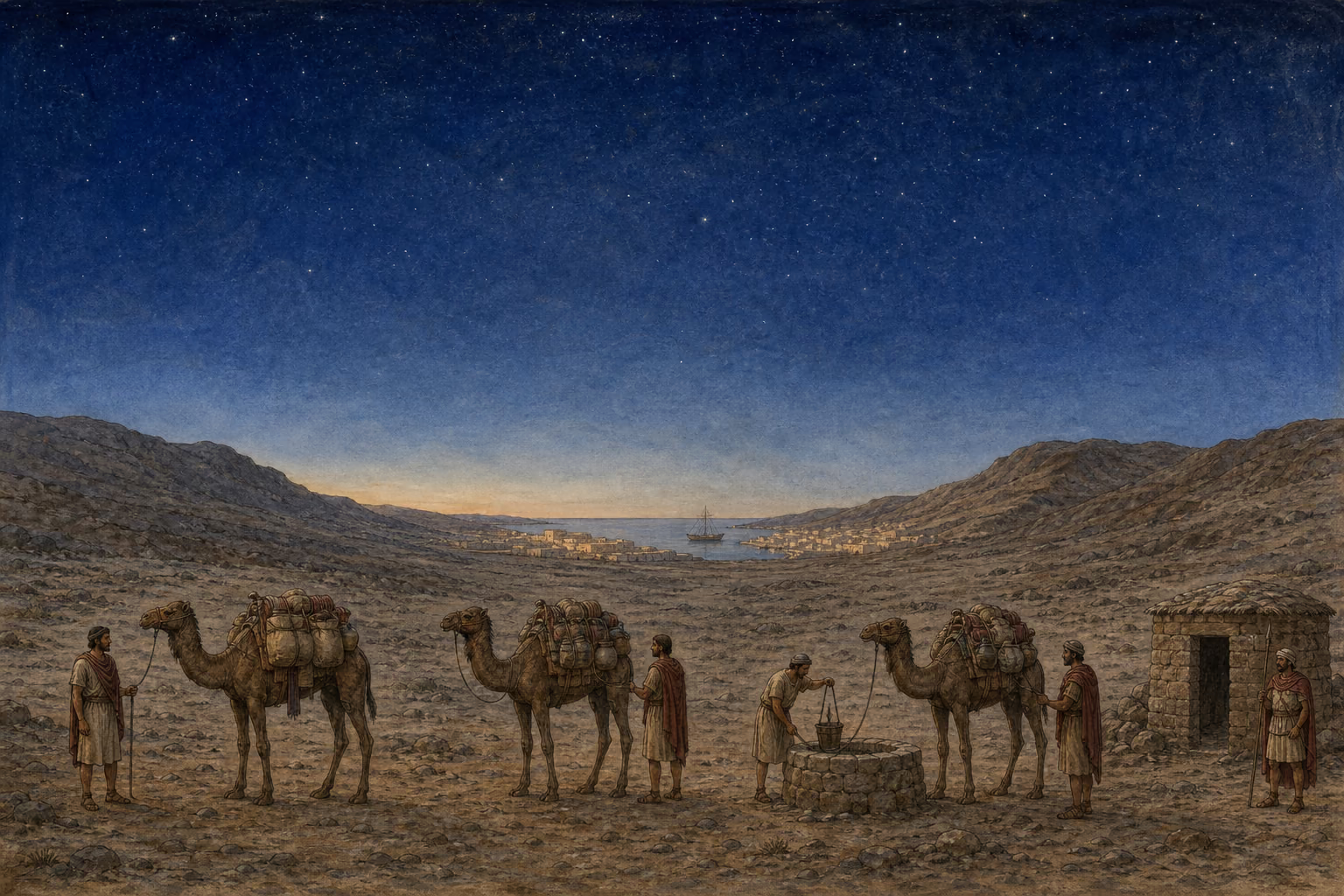
Secuta aetas propiorem cursum tutioremque iudicavit, si ab eodem promunturio Sigerum portum Indiae peteret, diuque ita navigatum est, donec conpendia invenit mercator lucroque India admota est: quippe omnibus annis navigatur, sagittariorum cohortibus inpositis; etenim piratae maxime infestabant. nec pigebit totum cursum ab Aegypto exponere, nunc primum certa notitia patescente: digna res, nullo anno minus HS.D??? imperii nostri exhauriente. India et merces remittente, quae apud nos centiplicato veneant. MMp. ab Alexandria abest oppidum Iuliopolis; inde navigant Nilo Coptum CCCVIIII p., qui cursus etesiis flantibus peragitur XII diebus. a Copto camelis itur, aquationum ratione mansionibus dispositis: prima appellatur HydreumaXXXII, secunda in monte diei itinere, tertia in altero Hydreumate a Copto LXXXV, deinde in monte; mox ad Hydreuma Apollinis a Copto CLXXXIIII, rursus in monte; mox ad Novum Hydreuma a Copto CCXXXVI. est et aliud Hydreuma Vetus — Trogodyticum nominatur —, ubi praesidium excubat deverticulo duum milium; distat a Novo Hydreumate VII. inde Berenice oppidum, ubi portus Rubri maris, a Copto CCLVII p. sed quia maior pars itineris conficitur noctibus propter aestus et stativis dies absumuntur, totumn a Copto Berenicen iter duodecimo die peragitur. navigare incipiunt aestate media ante canis ortum aut ab exortu protinus veniuntque tricesimo circiter die Ocelim Arabiae aut Canen turiferae regionis. est et tertius portus qui vocatur Muza, quem Indica navigatio non petit nec nisi turis odorumque Arabicorum mercatores. intus oppidum, regia eius, appellatur Sapphar, aliudque Save. Indos autem petentibus ultilissimum est ab Oceli egredi; inde vento hippalo navigant diebus XL ad primum emporium Indiae Muzirim. non expetendum propter vicinos piratas, qui optinent locum nomine Nitrias, neque est abundans mercibus; praeterea longe a terra abest navium statio, lintribusque adferuntur onera et egeruntur. regnabat ibi, cum proderem haec, Caelobothras. alius utilior portus gentis Neacyndon, qui vocatur Becare. ibi regnabat Pandion, longe ab emporio in mediterraneo distante oppido quod vocatur Modura. regio autem, ex qua piper monoxylis lintribus Becaren convehunt, vocatur Cottonara. quae omnia gentium portuumve aut oppidorum nomina apud neminem priorum reperiuntur, quo apparet mutari locorum status. ex India renavigant mense Aegyptio Tybi incipiente, nostro Decembri, aut utique Mechiris Aegyptii intra diem sextum, quod fit intra idus Ianuarias nostras: ita evenit ut eodem anno remeent. navigant autem ex India vento volturno et, cum intravere Rubrum mare, Africo vel austro. nunc revertemur ad propositum.
Carmaniae oram patere duodeciens quinquaginta milia passuum Nearchus scripsit. ab initio eius ad flumen Sabim C??? p.; inde vineas coli et arva ad flumen Ananim XXV milium spatio; regio vocatur Armuzia. oppida Carmaniae Zetis et Alexandria.
Inrumpit deinde et in hac parte geminum mare in terras, quod Rubrum dixere nostri, Graeci Erythrum a rege Erythra aut, ut alii, solis repercussu talem reddi existimantes colorem, alii ab harena terraque, alii tali aquae ipsius natura.
English · Bostock & Riley 1855–57
After passing the nations in the vicinity of the Indus, we come to the mountain districts. The territory of Capisene formerly had a city, called Capisa, which was destroyed by Cyrus. Arachosia has a river and a city of the same name; the city was built by Semiramis; by some writers it is called Cophen. The river Erymanthus flows past Parabeste, which belongs to the Arachosii. Writers make the Dexendrusi come next, forming the boundary of the Arachotæ on the southern side, and of the Paropanisadæ on the north. The city of Cartana lies at the foot of Caucasus; in later times it has been called Tetragonis. This region lies over against that of the Bactri, who come next, and whose chief city is Alexandria, so called from the name of its founder. We then come to the Syndraci, the Dangalæ, the Parapinæ, the Catuces, and the Mazi: and then at the foot of Caucasus, to the Cadrusi, whose town was built by Alexander.
Below all these countries, is the line of coast which we come to after leaving the Indus. Ariana is a region parched by the sun and surrounded by deserts; still, however, as the face of the country is every here and there diversified with well-shaded spots, it finds communities grouped together to cultivate it, and more especially around the two rivers, known as the Tonberos and the Arosapes. There is also the town of Artacoana, and the river Arius, which flows past Alexandria, a city founded by Alexander; this place is thirty stadia in extent. Much more beautiful than it, as well as of much greater antiquity, is Artacabane, fortified a second time by Antiochus, and fifty stadia in breadth. We then come to the nation of the Dorisdorsigi, and the rivers Pharnaracotis, and Ophradus; and then to Prophthasia, a city of the Zaraspades, the Drangæ, the Evergetæ, the Zarangæ, and the Gedrusi; the towns of Pucolis, Lyphorta, the desert of the Methorgi, the river Manais, the nation of the Acutri, the river Eorum, the nation of the Orbi, the Pomanus, a navigable river in the territories of the Pandares, the Apirus in the country of the Suari, with a good harbour at its mouth, the city of Condigramma, and the river Cophes; into which last flow the navigable streams of the Saddaros, the Parospus, and the Sodanus. Some writers will also have it that Daritis forms part of Ariana, and give the length of them both as nineteen hundred and fifty miles, and the breadth one half of that of India. Others again have spread the Gedrusi and the Pasires over an extent of one hundred and thirty-eight miles, and place next to them the Ichthyophagi Oritæ, a people who speak a language peculiar to themselves, and not the Indian dialect, extending over a space of two hundred miles. Alexander forbade the whole of the Ichthyophagi to live any longer on fish. Next after these the writers have placed extensive deserts, and then Carmania, Persia, and Arabia.
But before we enter into any details respecting these countries, it will be as well to mention what Onesicritus has stated, who commanded the fleet of Alexander, and sailed from India into the heart of Persia, and what has been more recently related by Juba; after which I shall speak of the route along these seas which has been discovered in later years and is followed at the present day. The journal of the voyage of Onesicritus and Nearchus has neither the names of the stations, nor yet the distances set down in it; and, first of all, it is not sufficiently explained where Xylenepolis was, and near what river, a place founded by Alexander, and from which, upon setting out, they took their departure. Still, however, the following places are mentioned by them, which are worthy of our notice. The town of Arbis, founded by Nearchus on the occasion of this voyage; the river Nabrus, navigable for vessels, and opposite to it an island, at a distance of seventy stadia; Alexandria, built by Leonnatus by order of Alexander in the territories of this people; Argenus, with a very convenient harbour; the river Tonberos, a navigable stream, around whose banks are the Pasiræ; then come the Ichthyophagi, who extend over so large a tract of coast that it took thirty days to sail past their territory; and an island known by the names of the “Island of the Sun” and the “Bed of the Nymphs,” the earth of which is red, and in which every animal instantly dies; the cause of which, however, has not been ascertained. Next to these is the nation of the Ori, and then the Hyctanis, a river of Carmania, with an excellent harbour at its mouth, and producing gold; at this spot the writers state that for the first time they caught sight of the Great Bear. The star Arcturus too, they tell us, was not to be seen here every night, and never, when it was seen, during the whole of it. Up to this spot extended the empire of the Achæmenidæ, and in these districts are to be found mines of copper, iron, arsenic, and red lead.
They next came to the Promontory of Carmania, from which the distance across to the opposite coast, where the Macæ, a nation of Arabia, dwell, is fifty miles; and then to three islands, of which that of Oracla is alone inhabited, being the only one supplied with fresh water; it is distant from the mainland twenty-five miles; quite in the Gulf, and facing Persia, there are four other islands. About these islands sea-serpents were seen swimming towards them, twenty cubits in length, which struck the fleet with great alarm. They then came to the island of Athothradus, and those called the Gauratæ, upon which dwells the nation of the Gyani; the river Hyperis, which discharges itself midway into the Persian Gulf, and is navigable for merchant ships; the river Sitiogagus, from which to Pasargadæ is seven days’ sail; a navigable river known as the Phristimus, and an island without a name; and then the river Granis, navigable for vessels of small burden, and flowing through Susiane; the Deximontani, a people who manufacture bitumen, dwell on its right bank. The river Zarotis comes next, difficult of entrance at its mouth, except by those who are well acquainted with it; and then two small islands; after which the fleet sailed through shallows which looked very much like a marsh, but were rendered navigable by certain channels which had been cut there. They then arrived at the mouth of the Euphrates, and from thence passed into a lake which is formed by the rivers Eulæus and Tigris, in the vicinity of Charax, after which they arrived at Susa, on the river Tigris. Here, after a voyage of three months, they found Alexander celebrating a festival, seven months after he had left them at Patale. Such was the voyage performed by the fleet of Alexander.
In later times it has been considered a well-ascertained fact that the voyage from Syagrus, the Promontory of Arabia, to Patale, reckoned at thirteen hundred and thirty-five miles, can be performed most advantageously with the aid of a westerly wind, which is there known by the name of Hippalus.
The age that followed pointed out a shorter route, and a safer one, to those who might happen to sail from the same promontory for Sigerus, a port of India; and for a long time this route was followed, until at last a still shorter cut was discovered by a merchant, and the thirst for gain brought India even still nearer to us. At the present day voyages are made to India every year: and companies of archers are carried on board the vessels, as those seas are greatly infested with pirates.
It will not be amiss too, on the present occasion, to set forth the whole of the route from Egypt, which has been stated to us of late, upon information on which reliance may be placed, and is here published for the first time. The subject is one well worthy of our notice, seeing that in no year does India drain our empire of less than five hundred and fifty millions of sesterces, giving back her own wares in exchange, which are sold among us at fully one hundred times their prime cost.
Two miles distant from Alexandria is the town of Juliopolis. The distance thence to Coptos, up the Nile, is three hundred and eight miles; the voyage is performed, when the Etesian winds are blowing, in twelve days. From Coptos the journey is made with the aid of camels, stations being arranged at intervals for the supply of fresh water. The first of these stations is called Hydreuma, and is distant twenty-two miles; the second is situate on a mountain, at a distance of one day’s journey from the last; the third is at a second Hydreuma, distant from Coptos ninety-five miles; the fourth is on a mountain; the next to that is at another Hydreuma, that of Apollo, and is distant from Coptos one hundred and eighty-four miles; after which, there is another on a mountain. There is then another station at a place called the New Hydreuma, distant from Coptos two hundred and thirty miles: and next to it there is another, called the Old Hydreuma, or the Troglodytic, where a detachment is always on guard, with a caravansary that affords lodging for two thousand persons. This last is distant from the New Hydreuma seven miles. After leaving it we come to the city of Berenice, situate upon a harbour of the Red Sea, and distant from Coptos two hundred and fifty-seven miles. The greater part of this distance is generally travelled by night, on account of the extreme heat, the day being spent at the stations; in consequence of which it takes twelve days to perform the whole journey from Coptos to Berenice.
Passengers generally set sail at midsummer, before the rising of the Dog-star, or else immediately after, and in about thirty days arrive at Ocelis in Arabia, or else at Cane, in the region which bears frankincense. There is also a third port of Arabia, Muza by name; it is not, however, used by persons on their passage to India, as only those touch at it who deal in incense and the perfumes of Arabia. More in the interior there is a city; the residence of the king there is called Sapphar, and there is another city known by the name of Save. To those who are bound for India, Ocelis is the best place for embarcation. If the wind, called Hippalus, happens to be blowing, it is possible to arrive in forty days at the nearest mart of India, Muziris by name. This, however, is not a very desirable place for disembarcation, on account of the pirates which frequent its vicinity, where they occupy a place called Nitrias; nor, in fact, is it very rich in articles of merchandize. Besides, the road-stead for shipping is a considerable distance from the shore, and the cargoes have to be conveyed in boats, either for loading or discharging. At the moment that I am writing these pages, the name of the king of this place is Cælobothras. Another port, and a much more convenient one, is that which lies in the territory of the people called Neacyndi, Barace by name. Here king Pandion used to reign, dwelling at a considerable distance from the mart in the interior, at a city known as Modiera. The district from which pepper is carried down to Barace in boats hollowed out of a single tree, is known as Cottonara. None of these names of nations, ports, and cities are to be found in any of the former writers, from which circumstance it would appear that the localities have since changed their names. Travellers set sail from India on their return to Europe, at the beginning of the Egyptian month Tybis, which is our December, or at all events before the sixth day of the Egyptian month Mechir, the same as our ides of January: if they do this, they can go and return in the same year. They set sail from India with a south-east wind, and upon entering the Red Sea, catch the south-west or south. We will now return to our main subject.
Nearchus states in his writings that the coast of Carmania extends a distance of twelve hundred and fifty miles. From its frontier to the river Sabis is one hundred miles. At this spot begins the cultivation of the vine; which with the tillage of the fields, extends as far as the river Ananis, a distance of twenty-five miles. This region is known by the name of Armuzia. The cities of Carmania are Zetis and Alexandria.
The sea then makes a two-fold indentation in the land upon these coasts, under the name of Rubrum or “Red,” given to it by our countrymen; while the Greeks have called it Erythrum, from king Erythras, or, according to some writers, from its red colour, which they think is produced by the reflection of the sun’s rays; others again are of opinion that it arises from the sand and the complexion of the soil, others from some peculiarity in the nature of the water.