LIBER VI · CAPUT 26
MESOPOTAMIA
Latine · Mayhoff 1906
Necessarium est hoc in loco signare et Medorum situm terrarumque faciem circumagere ad Persicum mare, quo facilius dein reliqua noscantur. namque Media, ab occasu transversa oblique Parthiae occurrens, utraque regna praecludit. habet ergo ipsa ab ortu Caspios et Parthos, a meridie Sittacenen et Susianen, Persida, ab occasu Adiabenen, ab septentrione Armeniam. Persae Rubrum mare semper accoluere, propter quod is sinus Persicus vocatur. regio ibi maritima Ceribobus; qua vero ipsa subit ad Medos, Climax Megale appellatur locus arduo montis ascensu per gradus, introitu angusto, ad Persepolim, caput regni, dirutam ab Alexandro. praeterea habet in extremis finibus Laodiceam ab Antiocho conditam. inde ad orientem Magi optinent Phrasargida castellum, in quo Cyri sepulchrum; est et horum Ecbatana oppidum, translatum ab Dario rege ad montes. inter Parthos et Arianos excurrunt Paraetaceni. his gentibus et Euphrate inferiora regna cluduntur. reliqua dicemus a Mesopotamia, excepto mucrone eius Arabumque populis in priore dictis volumine.
Mesopotamia tota Assyriorum fuit, vicatim dispersa praeter Babylona et Ninum. Macedones eam in urbes congregavere propter ubertatem soli. oppida praeter iam dicta habet Seleuciam, Laodiceam, Artemitam; item in Arabum gente qui Orroei vocantur et Mardani Antiochiam, quae a praefecto Mesopotamiae Nicanore condita Arabis vocatur. iunguntur his Arabes introrsus Eldamari, supra quos ad Pallacontam flumen Bura oppidum, Salmani et Masei Arabes; Gordyaeis vero iuncti Azoni, per quos Zerbis fluvius in Tigrim cadit, Azonis Silices montani et Orontes, quorum ad occidentem oppidum Gaugamela, item Suae in rupibus. supra Silicas Sitrae, per quos Lycus ex Armenia fertur; ab Sitris ad hibernum exortum Azochis oppidum, mox in campestribus oppida Diospege, Polytelia, Stratonicea, Anthemus. in vicinia Euphratis Nicephorion, quod diximus, Alexander iussit condi propter loci opportunitatem. dicta est et in Zeugmate Apamea, ex qua orientem petentes excipit oppidum Caphrena munitum, quondam stadiorum LXX amplitudine et satraparum regia appellatum, quo tributa conferebantur, nunc in arcem redactum. durant, ut fuere, Thebata et, ductu Pompei Magni terminus Romani imperi, Oruros, a Zeugmate L???.CC. sunt qui tradunt Euphraten Gobaris praefecti opere diductum esse ubi diximus findi, ne praecipiti cursu Babylona infestaret, ab Assyriis vero universis appellatum Narmalchan, quod significat regium flumen. qua dirivatur, oppidum fuit Agranis e maximis, quod diruere Persae. Babylon, Chaldaicarum gentium caput, diu summam claritatem inter urbes obtinuit toto orbe, propter quod reliqua pars Mesopotamiae Assyriaeque Babylonia appellata est, LX p. amplexa II muris ducenos pedes altis, quinquagenos latis, in singulos pedes ternis digitis mensura ampliore quam nostra, interfluo Euphrate, mirabili opere utroque. durat adhuc ibi Iovis Beli templum; inventor hic fuit sideralis scientiae. cetero ad solitudinem rediit exhausta vicinitate Seleuciae, ob id conditae a Nicatore intra XL lapidem in confluente Euphratis fossa perducti atque Tigris: quae tamen Babylonia cognominatur, libera hodie ac sui iuris Macedonumque moris. ferunt ei plebis urbanae DC esse, sittam vero moenium aquilae pandentis alas, agrum totius orientis fertilissimum. invicem ad hanc exhauriendam Ctesiphontem iuxta tertium ab ea lapidem in Chalonitide condidere Parthi, quod nunc caput est regnorum, et postquam nihil proficiebatur, nuper Vologesus rex aliud oppidum Vologesocertam in vicino condidit. sunt etiamnum in Mesopotamia oppida Hipparenum, Chaldaeorum doctrina et hoc, sicut Babylon, iuxta fluvium [Narragam ] qui cadit in Narragam, unde civitati nomen. muros Hipparenorum Persae diruere. Orcheni quoque, tertia Chaldaeorum doctrina, in eodem situ locantur ad meridiem versi. ab his Notitae et Orothophanitae et Gnesiochartae.
Euphrate navigari Babylonerl e Persico mari CCCCXII p. tradunt Nearchus et Onesicritus; qui vero postea scripsere, ad SeleuciamCCCCXL; Iuba a Babylone Cha- racenCLXXV. D. fluere aliqui ultra Babylona continuo alveo, prius quam distrahitur ad rigua, LXXXVII, universo autem cursu |XII| p. inconstantiam mensurae diversitas auctorum facit, cum Persae quoque schoenos et parasangas alii alia mensura determinent. ubi desiit alveo munire, ad confinium Characis accedente tractu, statim infestant Attali latrones, Arabum gens, ultra quos Scenitae, ambitu vero Euphratis Nomades Arabiae usque ad deserta Syriae, unde in meridiem flecti eum diximus, solitudines Palmyrenas relinquentem. Seleucia abest a capite Mesopotamiae Euphrate navigantibus |XI|.XXV p., a mari Rubro, si Tigri navigetur, CCCXX, a ZeugmateDCCXXIIII, Zeugma ab Seleucia Syriae ad nostrum litus CLXXV. haec est ibi latitudo terrarum inter duo maria, Parthici vero regni DCCCCXLIIII.
English · Bostock & Riley 1855–57
It is requisite in this place to trace the localities of the Medi also, and to describe in succession the features of the country as far as the Persian Sea, in order that the account which follows may be the better understood. Media lies crosswise to the west, and so presenting itself obliquely to Parthia, closes the entrance of both kingdoms into which it is divided. It has, then, on the east, the Caspii and the Parthi; on the south, Sittacene, Susiane, and Persis; on the west, Adsiabene; and on the north, Armenia. The Persæ have always inhabited the shores of the Red Sea, for which reason it has received the name of the Persian Gulf. This maritime region of Persis has the name of Ciribo; on the side on which it runs up to that of the Medi, there is a place known by the name of Climax Megale, where the mountains are ascended by a steep flight of stairs, and so afford a narrow passage which leads to Persepolis, the former capital of the kingdom, destroyed by Alexander. It has also, at its extreme frontier, Laodicea, founded by Antiochus. To the east of this place is the fortress of Passagarda, held by the Magi, at which spot is the tomb of Cyrus; also Ecbatana, a city of theirs, the inhabitants of which were removed by Darius to the mountains. Between the Parthi and the Ariani projects the territory of the Parætaceni. By these nations and the river Euphrates are the Lower kingdoms of Parthia bounded; of the others we shall speak after Mesopotamia, which we shall now describe, with the exception of that angle of it and the peoples of Arabia, which have been already mentioned in a former book.
The whole of Mesopotamia formerly belonged to the Assyrians, being covered with nothing but villages, with the exception of Babylonia and Ninus. The Macedonians formed these communities into cities, being prompted thereto by the extraordinary fertility of the soil. Besides the cities already mentioned, it contains those of Seleucia, Laodicea, Artemita; and in Arabia, the peoples known as the Orei and the Mardani, besides Antiochia, founded by Nicanor, the governor of Mesopotamia, and called Arabis. Joining up to these in the interior is an Arabian people, called the Eldamani, and above them, upon the river Pallaconta, the town of Bura, and the Arabian peoples known as the Salmani and the Masei. Up to the Gordyæi join the Aloni, through whose territory runs the river Zerbis, which falls into the Tigris; next are the Azones, the Silici, a mountain tribe, and the Orontes, to the west of whom lies the town of Gaugamela, as also Suë, situate upon the rocks. Beyond these are the Silici, surnamed Classitæ, through whose district runs the river Lycus on its passage from Armenia, the Absithris running south-east, the town of Accobis, and then in the plains the towns of Diospage, Polytelia, Stratonice, and Anthermis. In the vicinity of the Euphrates is Nicephorion, of which we have already stated that Alexander, struck with the favourable situation of the spot, ordered it to be built. We have also similarly made mention of Apamea on the Zeugma. Leaving that city and going eastward, we come to Caphrena, a fortified town, formerly seventy stadia in extent, and called the “Court of the Satraps.” It was to this place that the tribute was conveyed; now it is reduced to a mere fortress. Thæbata is still in the same state as formerly: after which comes Oruros, which under Pompeius Magnus formed the extreme limit of the Roman Empire, distant from Zeugma two hundred and fifty miles. There are writers who say that the Euphrates was drawn off by an artificial channel by the governor Gobares, at the point where we have stated that it branches off, in order that it might not commit damage in the city of Babylonia, in consequence of the extreme rapidity of its course. The Assyrians universally call this river by the name of Narmalcha, which signifies the “royal river.” At the point where its waters divide, there was in former times a very large city, called Agranis, which the Persæ have destroyed.
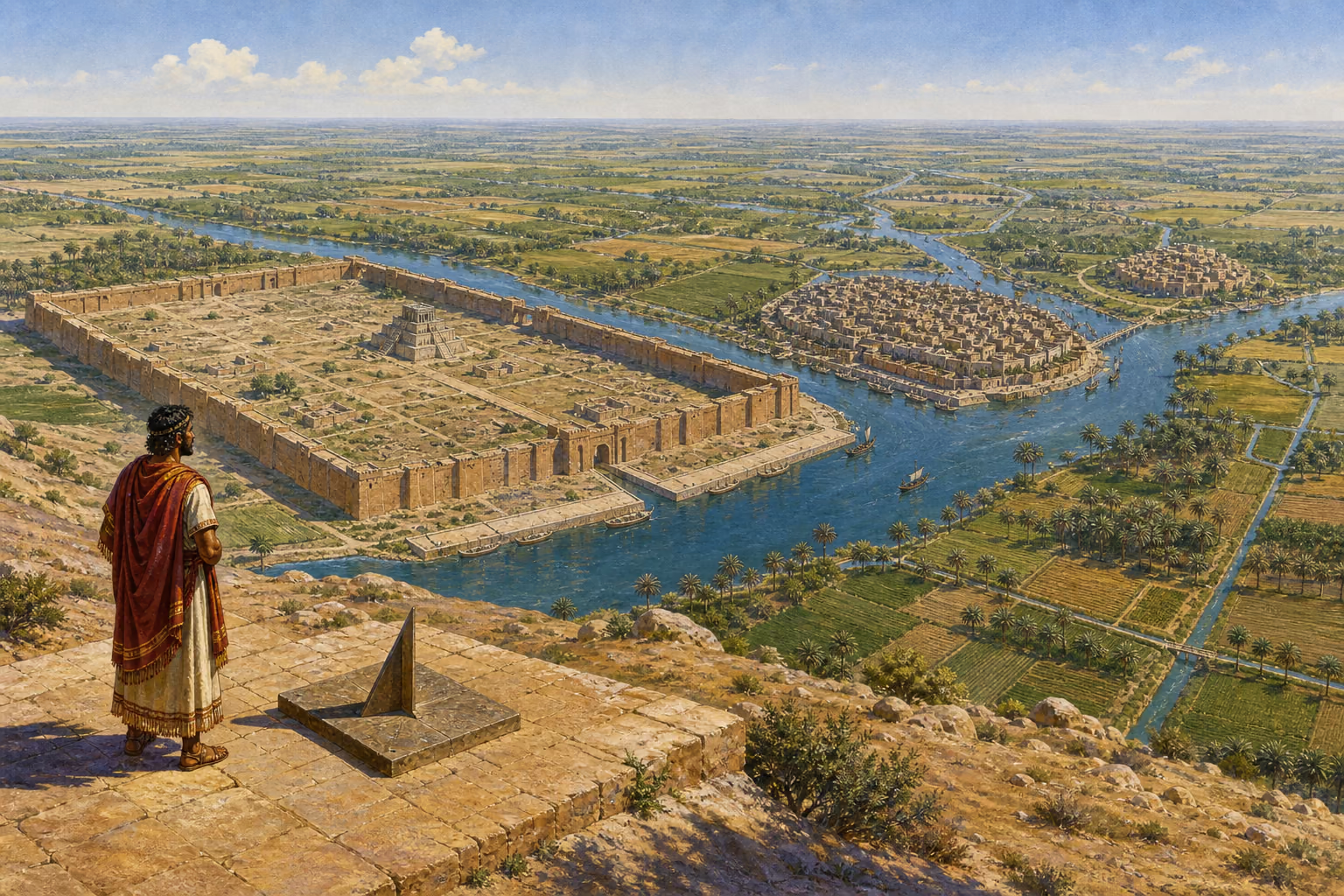
Babylon, the capital of the nations of Chaldæa, long enjoyed the greatest celebrity of all cities throughout the whole world: and it is from this place that the remaining parts of Mesopotamia and Assyria received the name of Babylonia. The circuit of its walls, which were two hundred feet in height, was sixty miles. These walls were also fifty feet in breadth, reckoning to every foot three fingers’ breadth beyond the ordinary measure of our foot. The river Euphrates flowed through the city, with quays of marvellous workmanship erected on either side. The temple there of Jupiter Belus is still in existence; he was the first inventor of the science of Astronomy. In all other respects it has been reduced to a desert, having been drained of its population in consequence of its vicinity to Seleucia, founded for that purpose by Nicator, at a distance of ninety miles, on the confluence of the Tigris and the canal that leads from the Euphrates. Seleucia, however, still bears the surname of Babylonia: it is a free and independent city, and retains the features of the Macedonian manners. It is said that the population of this city amounts to six hundred thousand, and that the outline of its walls resembles an eagle with expanded wings: its territory, they say, is the most fertile in all the East. The Parthi again, in its turn, founded Ctesiphon, for the purpose of drawing away the population of Seleucia, at a distance of nearly three miles, and in the district of Chalonitis; Ctesiphon is now the capital of all the Parthian kingdoms. Finding, however, that this city did not answer the intended purpose, king Vologesus has of late years founded another city in its vicinity, Vologesocerta by name. Besides the above, there are still the following towns in Mesopotamia: Hipparenum, rendered famous, like Babylon, by the learning of the Chaldæi, and situate near the river Narraga, which falls into the Narroga, from which a city so called has taken its name. The Persæ destroyed the walls of Hipparenum. Orchenus also, a third place of learning of the Chaldæi, is situate in the same district, towards the south; after which come the Notitæ, the Orothophanitæ, and the Grecichartæ. From Nearchus and Onesicritus we learn that the distance by water from the Persian Sea to Babylon, up the Euphrates, is four hundred and twelve miles; other authors, however, who have written since their time, say that the distance to Seleucia is four hundred and forty miles: and Juba says that the distance from Babylon to Charax is one hundred and seventy-five. Some writers state that the Euphrates continues to flow with an undivided channel for a distance of eighty-seven miles beyond Babylon, before its waters are diverted from their channel for the purposes of irrigation; and that the whole length of its course is not less than twelve hundred miles. The circumstance that so many different authors have treated of this subject, accounts for all these variations, seeing that even the Persian writers themselves do not agree as to what is the length of their schæni and parasangæ, each assigning to them a different length.
When the Euphrates ceases, by running in its channel, to afford protection to those who dwell on its banks, which it does when it approaches the confines of Charax, the country is immediately infested by the Attali, a predatory people of Arabia, beyond whom are found the Scenitæ. The banks along this river are occupied by the Nomades of Arabia, as far as the deserts of Syria, from which, as we have already stated, it takes a turn to the south, and leaves the solitary deserts of Palmyra. Seleucia is distant, by way of the Euphrates, from the beginning of Mesopotamia, eleven hundred and twenty -five; from the Red Sea, by way of the Tigris, two hundred and twenty; and from Zeugma, seven hundred and twenty-three, miles. Zeugma is distant from Seleucia in Syria, on the shores of our sea, one hundred and seventy-five miles. Such is the extent of the land that lies in these parts between the two seas. The length of the kingdom of Parthia is nine hundred and eighteen miles.
There is, besides the above, another town in Mesopotamia, on the banks of the Tigris and near its confluence with the Euphrates, the name of which is Digba.