LIBER VI · CAPUT 27
THE TIGRIS
Latine · Mayhoff 1906
Est etiamnum oppidum Mesopotamiae in ripa Tigris circa confluentes, quod vocant Digbam. sed et de Tigri ipso dixisse conveniat.
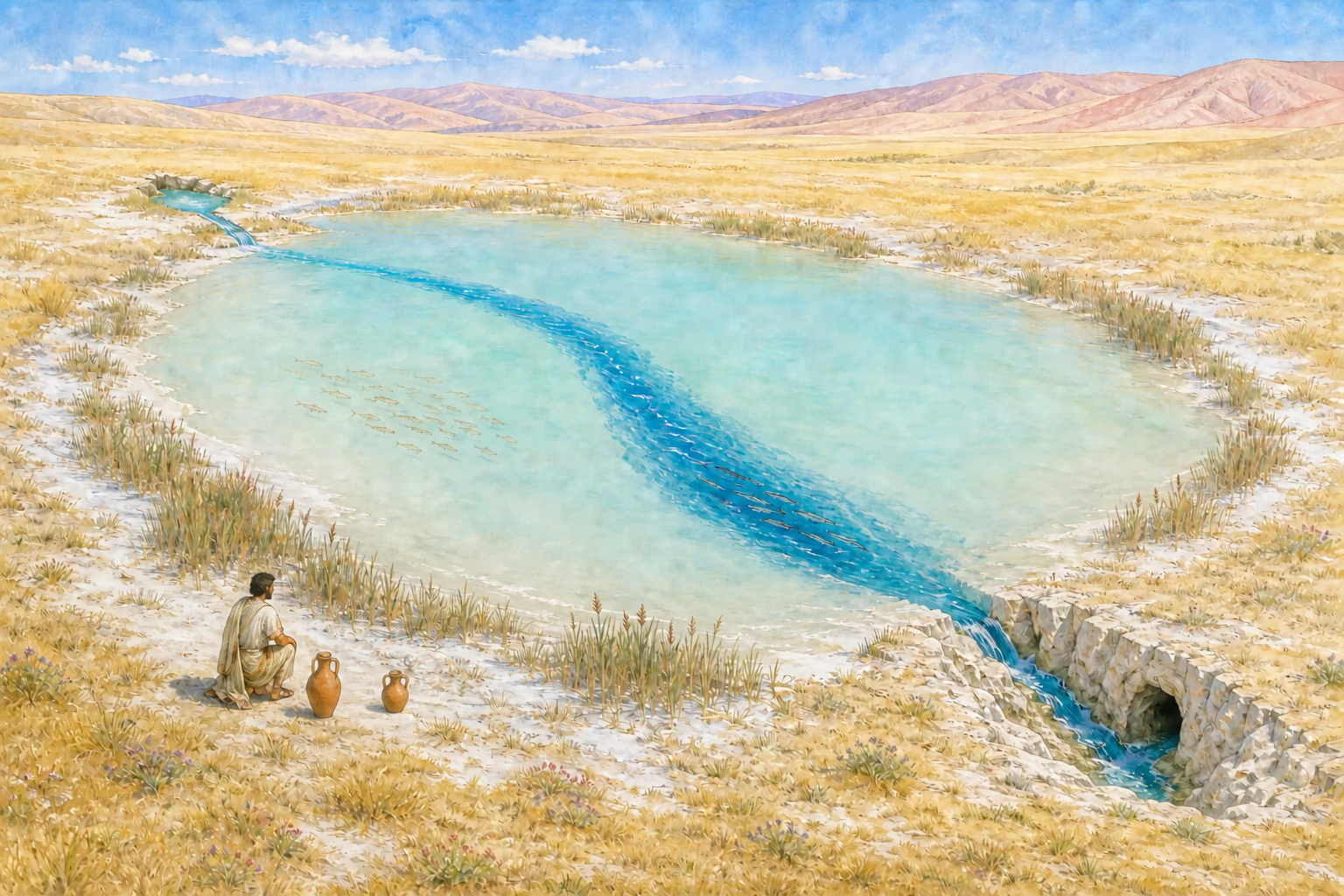
Oritur in regione Armeniae Maioris, fonte conspicuo in planitie. loco nomen Elegosine est; ipsi qua tardior fluit Diglito; unde concitatur, a celeritate Tigris incipit vocari: ita appellant Medi sagittam. influit in lacum Aretissam, omnia inlata pondera sustinentem et nitrum nebulis exhalantem. unum genus ei piscium est, idque transcurrentis non miscetur alveo, sicut neque e Tigri pisces in lacum transnatant. fertur autem et cursu et colore dissimilis transvectusque occurrente Tauro monte in specum mergitur subterque lapsus a latere altero eius erumpit. locus vocatur Zoaranda; eundem esse manifestum, quod demersa perfert. alterum deinde transit lacum, qui Thospites appellatur, rursusque in cuniculos mergitur, postXXII p. circa Nymphaeum redditur. tam vicinum Arsaniae fluere eum in regione Arrhene Claudius Caesar auctor est, ut, cum intumuere, confluant nec tamen misceantur leviorque Arsanias innatet MMMM ferme spatio, mox divisus in Euphraten mergatur. Tigris autem, ex Armenia acceptis fluminibus claris Parthenia ac Nicephorione, Arabas Orroeos Adiabenosque disterminans et quam diximus Mesopotamiam faciens, lustratis montibus Gordyaeorum circa Apameam Mesenes oppidum, citra Seleuciam Babyloniam CXXV p. divisus in alveos duos, altero meridiem ac Seleuciam petit Mesenen perfundens, altero ad septentrionem flexus eiusdem gentis tergo campos Cauchas secat. ubi remeavere aquae, Pasitigris appellatur, postea recipit ex Media Choaspen atque, ut diximus, inter Seleuciam et Ctesiphontem vectus in lacus Chaldaicos se fundit eosque LXII p. amplitudine implet; mox vasto alveo profusus dextra Characis oppidi infertur mari Persico X??? p. ore. inter duorum amnium ostia XXV p. fuere, ut alii tradunt, VII, utroque navigabili. sed longo tempore Euphraten praeclusere Orcheni et accolae agros rigantes, nec nisi per Tigrim defertur in mare.
Proxima Tigri regio Parapotamia appellatur. in ea dictum est de Mesene; oppidum eius Dabitha. cui iungitur Chalonitis cum Ctesiphonte, non palmetis modo, verum el olea pomisque arbusta. ad eam pervenit Zagrus mons, ex Armenia inter Medos Adiabenosque veniens supra Paraetacenen et Persida. Chalonitis abest a PersideCCCLXXX p.; tantum a Caspio mari et a Syria abesse conpendio itineris aliqui tradunt. inter has gentes atque Mesenen Sittacene est, eadem Arbelitis et Palaestine dicta. oppidum eius Sittace Graecorum, ab ortu et Sabdata, ab occasu autem Antiochia inter duo flumina Tigrim et Tornadotum, item Apamea, cui nomen Antiochus matris suae inposuit; Tigri circumfunditur haec, dividitur Archoo. infra est Susiane, in qua vetus regia Persarum Susa, a Dario Hystaspis filio condita; abest ab Seleucia Babylonia CCCCL p., tantundem ab Ecbatanis Medorum per montem Carbantum. in septentrionali Tigris alveo oppidum est Barbitace; abest a Susis CXXXV p. ibi mortalium soli auri miro odio contrahunt id defodiuntque, ne cui sit in usu. Susianis ad orientem versus iunguntur Oxii latrones et Mizaeorum XL populi, liberae feritatis. supra eos parent Parthis Mardi et Saitae ii qui praetenduntur supra Elymaida, quam Persidi in ora iunximus. Susa a Persico mari absunt CCL p. qua subiit ad ear classis Alexandri Pasitigri, vicus ad lacum Chaldaicum vocatur Aple, unde Susa navigatione LXII. D p. absunt. Susianis ab oriente proximi sunt Cossiaei, supra Cossiaeos ad septentrionem Massabatene sub monte Cambalido, qui est Caucasi ramus, inde mollissimo transitu in Bactros.
Susianen ab Elymaide disterminat amnis Eulaeus, ortus in Medis modicoque spatio cuniculo conditus ac rursus exortus et per Massabatenen lapsus. circumit arcem Susorum ac Dianae templum augustissimum illis gentibus, et ipse in magna caerimonia, siquidem reges non ex alio bibunt et ob id in longinqua portant. recipit amnes Hedyphon praeter Asylum Persarum venientem, Adunam ex Susianis. oppidum iuxta eum Magoa, a Charace XV p.; quidam hoc in extrema Susiane ponunt solitudinibus proximum. infra Eulaeum Elymais est in ora iuncta Persidi, a flumine Orati ad Characem CCXL p. oppida eius Seleucia et Sostrate, adposita monti Chasiro. oram, quae praeiacet, minorum Syrtium vice diximus inaccessam caeno, plurimum limi deferentibus Brixa et Ortacia amnibus, madente et ipsa Elymaide in tantum, ut nullus sit nisi circuitu eius ad Persidem aditus. infestatur et serpentibus, quos flumina deportant. pars eius maxime invia Characene vocatur ab oppido Arabiae claudente regna ea, de quo dicemus exposita prius M. Agrippae sententia. namque is Mediam et Parthiam et Persidem ab oriente Indo, ab occidente Tigri, a septentrione Tauro Caucasio, a meridie Rubro mai terminatas patere in longitudinem |XIII|.XX p., in latitudinem DCCCXL prodidit, praeterea per se Mesopotamiam, ab oriente Tigri, ab occasu Euphrate, a septentrione Tauro, a meridie maria Persico inclusam, longitudineDCCC p., latitudine CCCLX.
Charax, oppidum Persici sinus intimum, a quo Arabia Eudaemon cognominata excurrit, habitatur in colle manu facto inter confluentes dextra Tigrim, laeva Eulaeum, II p. laxitate. conditum est primum ab Alexandro Magno, colonis ex urbe regia Durine, quae tur interiit, deductis, militum inutilibus ibi relictis; Alexandriam appellari iusserat pagumque Pellaeum a patria sua, quem proprie Macedonum fecerat. flumina id oppidum expugnavere; postea restituit Antiochus quintus regum et suo nomine appellavit, iterumque infestatum Spaosines Sagdodonaci filius, rex finitimorum Arabum, quem Iuba satrapen Antiochi fuisse falso tradit oppositis molibus restituit nomenque suum dedit, emunito situ iuxta in longitudinem VI p., in latitudinem paulo minus. prius fuit a litore stadiis X — maritimum etiam Vipsania porticus habet —, Iuba vero prodente L??? p.; nunc abesse a litore CXX legati Arabum nostrique negotiatores, qui inde venere, adfirmant. nec ulla in parte plus aut celerius profecere terrae fluminibus invectae. magis id mirum est, aestu longe ultra id accedente non repercussas. hoc in loco genitum esse Dionysium, terrarum orbis situs recentissimum auctorem, quem ad commentanda omnia in orienterl praemiserit Divus Augustus ituro in Armeniam ad Parthicas Arabicasque res maiore filio, non me praeterit nec sum oblitus sui quemque situs diligentissimum auctorem visum nobis introitu operis: in hac tamen parte arma Romana sequi placet nobis Iubamque regem, ad eundem Gaium Caesarem scriptis voluminibus de eadem expeditione Arabica.
English · Bostock & Riley 1855–57
But it will be as well now to give some particulars respecting the Tigris itself. This river rises in the region of Greater Armenia, from a very remarkable source, situate on a plain. The name of the spot is Elegosine, and the stream, as soon as it begins to flow, though with a slow current, has the name of Diglito. When its course becomes more rapid, it assumes the name of Tigris, given to it on account of its swiftness, that word signifying an arrow in the Median language. It then flows into Lake Arethusa, the waters of which are able to support all weighty substances thrown into them, and exhale nitrous vapours. This lake produces only one kind of fish, which, however, never enter the current of the river in its passage through the lake: and in a similar manner, the fish of the Tigris will never swim out of its stream into the waters of the lake. Distinguishable from the lake, both by the rapidity and the colour of its waters, the tide of the river is hurried along; after it has passed through and arrived at Mount Taurus, it disappears in a cavern of that mountain, and passing beneath it, bursts forth on the other side; the spot bears the name of Zoroande. That the waters on either side of the mountain are the same, is evident from the fact, that bodies thrown in on the one side will reappear on the other. It then passes through another lake, called Thospites, and once more burying itself in the earth, reappears, after running a distance of twenty-two miles, in the vicinity of Nymphæum. Claudius Cæsar informs us that, in the district of Arrene it flows so near to the river Arsanias, that when their waters swell they meet and flow together, but without, however, intermingling. For those of the Arsani, as he says, being lighter, float on the surface of the Tigris for a distance of nearly four miles, after which they separate, and the Arsanias flows into the Euphrates. The Tigris, after flowing through Armenia and receiving the well-known rivers Parthenias and Nicephorion, separates the Arabian Orei from the Adiabeni, and then forms by its course, as previously mentioned, the country of Mesopotamia. After traversing the mountains of the Gordyæi, it passes round Apamea, a town of Mesene, one hundred and twenty-five miles on this side of Babylonian Seleucia, and then divides into two channels, one of which runs southward, and flowing through Mesene, runs towards Seleucia, while the other takes a turn to the north and passes through the plains of the Cauchæ, at the back of the district of Mesene. When the waters have reunited, the river assumes the name of Pasitigris. After this, it receives the Choaspes, which comes from Media; and then, as we have already stated, flowing between Seleucia and Ctesiphon, discharges itself into the Chaldæan Lakes, which it supplies for a distance of seventy miles. Escaping from them by a vast channel, it passes the city of Charax to the right, and empties itself into the Persian Sea, being ten miles in width at the mouth. Between the mouths of the two rivers Tigris and the Euphrates, the distance was formerly twenty-five, or, according to some writers, seven miles only, both of them being navigable to the sea. But the Orcheni and others who dwell on its banks, have long since dammed up the waters of the Euphrates for the purposes of irrigation, and it can only discharge itself into the sea by the aid of the Tigris.
The country on the banks of the Tigris is called Parapotamia; we have already made mention of Mesene, one of its districts. Dabithac is a town there, adjoining to which is the district of Chalonitis, with the city of Ctesiphon, famous, not only for its palm-groves, but for its olives, fruits, and other shrubs. Mount Zagrus reaches as far as this district, and extends from Armenia between the Medi and the Adiabeni; above Parætacene and Persis. Chalonitis is distant from Persis three hundred and eighty miles; some writers say that by the shortest route it is the same distance from Assyria and the Caspian Sea.
Between these peoples and Mesene is Sittacene, which is also called Arbelitis and Palæstine. Its city of Sittace is of Greek origin; this and Sabdata lie to the east, and on the west is Antiochia, between the two rivers Tigris and Tornadotus, as also Apamea, to which Antiochus gave this name, being that of his mother. The Tigris surrounds this city, which is also traversed by the waters of the Archoüs. Below this district is Susiane, in which is the city of Susa, the ancient residence of the kings of Persia, built by Darius, the son of Hystaspes; it is distant from Seleucia Babylonia four hundred and fifty miles, and the same from Ecbatana of the Medi, by way of Mount Carbantus. Upon the northern channel of the river Tigris is the town of Babytace, distant from Susa one hundred and thirty-five miles. Here, for the only place in all the world, is gold held in abhorrence; the people collect it together and bury it in the earth, that it may be of use to no one. On the east of Susiane are the Oxii, a predatory people, and forty independent savage tribes of the Mizæi. Above these are the Mardi and the Saitæ, subject to Parthia: they extend above the district of Elymais, which we have already mentioned as joining up to the coast of Persis. Susa is distant two hundred and fifty miles from the Persian Sea. Near the spot where the fleet of Alexander came up the Pasitigris to Susa, there is a village situate on the Chaldæan Lake, Aple by name, from which to Susa is a distance of sixty miles and a half. Adjoining to the people of Susiane, on the east, are the Cossiæi; and above them, to the north, is Mesabatene, lying at the foot of Mount Cambalidus, a branch of the Caucasian chain: from this point the country of the Bactri is most accessible.
Susiane is separated from Elymais by the river Eulæus, which rises in Media, and, after concealing itself in the earth for a short distance, rises again and flows through Mesabatene. It then flows round the citadel of Susa and the temple of Diana, which is held in the highest veneration by all these nations; the river itself being the object of many pompous ceremonials; the kings, indeed, will drink of no other water, and for that reason carry it with them on their journies to any considerable distance. This river receives the waters of the Hedypnos, which passes Asylus, in Persis, and those of the Aduna, which rises in Susiane. Magoa is a town situate near it, and distant from Charax fifteen miles; some writers place this town at the very extremity of Susiane, and close to the deserts.
Below the Eulæus is Elymais, upon the coast adjoining to Persis, and extending from the river Orates to Charax, a distance of two hundred and forty miles. Its towns are Seleucia and Socrate, upon Mount Casyrus. The shore which lies in front of this district is, as we have already stated, rendered inaccessible by mud, the rivers Brixa and Ortacea bringing down vast quantities of slime from the interior,—Elymais itself being so marshy that it is impossible to reach Persis that way, unless by going completely round: it is also greatly infested with serpents, which are brought down by the waters of these rivers. That part of it which is the most inaccessible of all, bears the name of Characene, from Charax, the frontier city of the kingdoms of Arabia. Of this place we will now make mention, after first stating the opinions of M. Agrippa in relation to this subject. That author informs us that Media, Parthia, and Persis, are bounded on the east by the Indus, on the west by the Tigris, on the north by Taurus and Caucasus, and on the south by the Red Sea; that the length of these countries is thirteen hundred and twenty miles, and the breadth eight hundred and forty; and that, in addition to these, there is Mesopotamia, which, taken by itself, is bounded on the east by the Tigris, on the west by the Euphrates, on the north by the chain of Taurus, and on the south by the Persian Sea, being eight hundred miles in length, and three hundred and sixty in breadth.
Charax is a city situate at the furthest extremity of the Arabian Gulf, at which begins the more prominent portion of Arabia Felix: it is built on an artificial elevation, having the Tigris on the right, and the Eulæus on the left, and lies on a piece of ground three miles in extent, just between the confluence of those streams. It was first founded by Alexander the Great, with colonists from the royal city of Durine, which was then destroyed, and such of his soldiers as were invalided and left behind. By his order it was to be called Alexandria, and a borough called Pella, from his native place, was to be peopled solely by Macedonians; the city, however, was destroyed by inundations of the rivers. Antiochus, the fifth king of Syria, afterwards rebuilt this place and called it by his own name; and on its being again destroyed, Pasines, the son of Saggonadacus, and king of the neighbouring Arabians, whom Juba has incorrectly described as a satrap of king Antiochus, restored it, and raised embankments for its protection, calling it after himself. These embankments extended in length a distance of nearly three miles, in breadth a little less. It stood at first at a distance of ten stadia from the shore, and even had a harbour of its own. But according to Juba, it is fifty miles from the sea; and at the present day, the ambassadors from Arabia, and our own merchants who have visited the place, say that it stands at a distance of one hundred and twenty miles from the sea-shore. Indeed, in no part of the world have alluvial deposits been formed more rapidly by the rivers, and to a greater extent than here; and it is only a matter of surprise that the tides, which run to a considerable distance beyond this city, do not carry them back again. At this place was born Dionysius, the most recent author of a description of the world; he was sent by the late emperor Augustus to gather all necessary information in the East, when his eldest son was about to set out for Armenia to take the command against the Parthians and Arabians.
The fact has not escaped me, nor indeed have I forgotten, that at the beginning of this work I have remarked that each author appeared to be most accurate in the description of his own country; still, while I am speaking of these parts of the world, I prefer to follow the discoveries made by the Roman arms, and the description given by king Juba, in his work dedicated to Caius Cæsar above-mentioned, on the subject of the same expedition against Arabia.