LIBER VI · CAPUT 28
ARABIA
Latine · Mayhoff 1906
Arabia, gentium nulli postferenda amplitudine, longissime a monte Amano e regione Ciliciae Commagenesque descendit, ut diximus, multis gentibus eorum deductis illo a Tigrane Magno, sponte vero ad mare nostrum litusque Aegyptium, ut docuimus, nec non et in media Syriae ad Libanum montem penetrantibus Nubaeis, quibus iunguntur Ramisi, dein Teranei, dein Patami. ipsa vero paeninsula Arabia, inter duo maria Rubrum Persicumque procurrens, quodam naturae artificio ad similitudinem atque magnitudinem Italiae mari circumfusa, in eandem etiam caeli partem nulla differentia spectat, haec quoque in illo situ felix. populos eius a nostro mari usque ad Palmyrenae solitudines diximus: reliqua nunc inde peragemus.
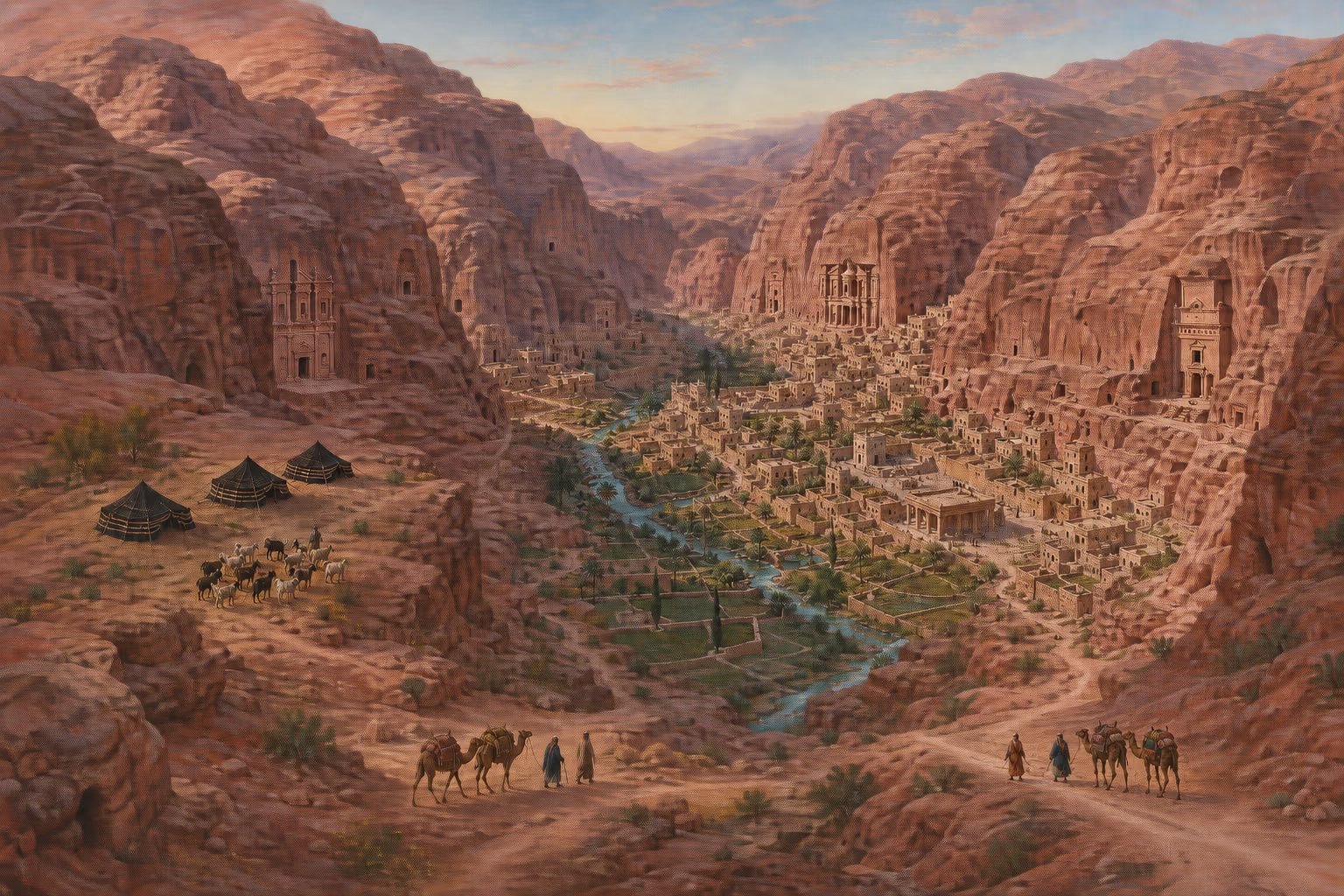
Nomadas infestatoresque Chaldaeorum Scenitae, ut diximus, cludunt, et ipsi vagi, sed a tabernaculis cognominati, quae ciliciis metantur ubi libuit. deinde Nabataei oppidum incolunt, Petram nomine. in convalle paulo minus II p. amplitudinis, circumdatum montibus inaccessis, amne interfluente. abest ab Gaza oppido litoris nostri DC, a sinu Persico CXXXV. huc convenit utrumque bivium, eorum qui ex Syria Palmyram petiere et eorum qui a Gaza venerunt. a Petra incoluere Omani ad Characen usque, oppidis quondam claris ab Samiramide conditis Abaesamide et Soractia; nunc sunt solitudines. deinde est oppidum quod Characenorum regi paret in Pasitigris ripa, Forat nomine, in quod a Petra conveniunt, Characenque inde XII p. secundo aestu navigant, e Parthico autem regno navigantibus vicus Teredon. infra confluentem Euphratis et Tigris laeva fluminis Chaldaei optinent, dextra Nomades Scenitae. quidam et alia duo oppida longis intervallis Tigri praenavigari tradunt, Barbatiam, mox Dumatham, quod abesse a Petra dierum X navigatione. nostri negotiatores dicunt Characenorum regi parere et Apameam, sitam ubi restagnatio Euphratis cum Tigri confluat; itaque molientes incursionem Parthos operibus obiectis inundatione arceri.
Nunc a Charace dicemus oram, Epiphani primum exquisitam. locus ubi Euphratis ostium fuit, flumen Salsum, promunturium Caldone, voragini similius quam rnari aestuarium per L??? orae, flumen Achenum, deserta C??? p. usque ad insulam Icarum, sinus Capeus, quem accolunt Gaulopes et Gattaei, sinus Gerrhaicus, oppidum Gerrha, V??? p. amplitudine; turres habet ex salis quadratis molibus. a litore L??? regio Attene, ex adverso Tylos insula, totidem milibus a litore, plurimis margaritis celeberrima cum oppido eiusdem nominis, iuxtaque altera minor, a promunturio eius XII.D p. ultra magnas aspici insulas tradunt, ad quas non sit perventum; huius ambitumCXII. D p., a Perside longius abesse, adiri uno alveo angusto. insula Ascliae, gentes Nochaeti, Zurazi, Borgodi, Catharraei, Nomades, flumen Cynos. ultra navigationem inconpertam ab eo latere propter scopulos tradit Iubapraetermissa mentione oppidi Omanorum Batrasavaves et Omanae, quod priores celebrem portum Carmaniae fecere, item Homnae et Attanae, quae nunc oppida maxime celebrari a Persico mari nostri negotiatores dicunt. a flumine Canis, ut luba, mons adusto similis, gentes Epimaranitae, mox Ichthyo- phagi, insula deserta, gentes Bathymi.... Eblythaei montes, insula Omoemus, portus Mochorbae, insulae Etaxalos, Inchobriche, gens Cadaei, insulae sine nominibus multae, celebres vero Isura, Rhinnea et proxima, in qua scriptae sunt stelae lapideae litteris incognitis, Coboea portus, Bragae insulae desertae, gens Taludaei, Dabanegoris regio, mons Orsa cum portu, sinus Duatas, insulae multae, mons Tricoryphos, regio Chardaleon, insulae Solanades, Cachina, item Ichthyophagorum. dein Clari, litus Mamaeum, ubi auri metalla, regio Canauna, gentes Apitami, Casani, insula Devade, fons Coralis, Carphati, insulae Alaea, Amnamethus, gens Darae, insulae Chelonitis, Ichthyophagon multae, Odanda deserta, Basa, multae Sabaeorum. flumina Thanar, Amnum, insulae Doricae, fontes Daulotos, Dora, insulae Pteros, Labatanis, Coboris, Sambrachate et oppidum eodem nomine in continente. a meridie insulae multae, maxima Camari, flumen Musecros, portus Laupas, Scenitae Sabaei, insulae multae, emporium eorum Acila, ex quo in Indiam navigatur, regio Amithoscatta, Damnia, Mizi maiores et minores, Drymatina, Macae; horum promunturium contra Carmaniam distat L??? p. mira res ibi traditur; Numenium, ab Antiocho rege Mesenae praepositum, ibi vicisse eodem die classe aestuque reverso iterum equitatu contra Persas dimicantem et gemina tropaea eodem in loco lovi ac Neptuno statuisse. insula in alto obiacet Ogyris, clara Erythra rege ibi sepulto; distat a continente CXXV p., circumiturCXII. D. nec minus altera clara in Azanio mari Dioscuridu, distans a Syagro extumo promunturio CCLXXX. reliqui in continente a noto etiamnum Autaridae, in montes VIII dierum transitus, gens Larendani et Catabani, Gebbanitae pluribus oppidis, sed maximis Nagia et Thomna, templorum LXV; haec est amplitudinis significatio. promunturium, a quo ad continentem Trogodytarum L???, Thoani, Actaei, Chatramotitae, Tonabaei, Antiadalaei, Lexianae, Agraei, Cerbani, Sabaei, Arabum propter tura clarissimi, ad utraque maria porrectis gentibus. oppida eorum in Rubro litore Merme, Marma, Corolia, Sabbatha; intus oppida Nascus, Cardava, Carnus et, quo merces odorunm deferunt, Thomala. pars eorum Atramitae, quorum caput Sabota LX templa muris includens; regia tamen est omnium Marebbata. sinum optinentXCIII, refertum insulis odoriferis. Atramitis in mediterraneo iunguntur Minaei. mare accolunt et Aelamitae oppido eiusdem nominis, iis iuncti Chaculatae, oppidum Sibi, quod Graeci Apaten vocant, Arsi, Codani, Vadaei oppido magno, Barasasaei, Lechieni, Sygaros insula, quam canes non intrant expositique circa litora errando moriuntur. sinus intimus, in quo Laeanitae, qui nomen ei dedere; regia eorum Agra et in sinu Laeana vel, ut alii, Aelana: nam et ipsum sinum nostri Laeaniticum scripsere, alii Aelaniticum, Artemidorus Alaeniticum, luba Leaniticum. circuitus Arabiae a Charace Laeana colligere proditurXLVII.LXV p., Iuba paulo minus |XL| putat. latissima est a septentrione inter oppida Herourn et Characem. nam et reliqua mediterranea eius dicantur. Nabataeis Thimaneos iunxerunt veteres, nunc sunt Taveni, Suelleni, Araceni, Arreni oppido in quod negotiatio omnis convenit, Hemnatae, Avalitae, oppida Domata, Haegra, Thamudaei, oppidum Baclanaza, Chariattaei, Toali, oppidum Phodaca, Minaei, a rege Cretae Minoe, ut existimant, originem trahentes, quorum Carmei; oppidum XIIII p. Maribba, Paramalacum, et ipsum non spernendum, item Canon. Rhadamaei — et horum origo Rhadamanthus putatur, frater Minois —, Homeritae Mesala oppido, Hamiroei, Gedranitae, Amphryaei, Lysanitae, Bachylitae, Samnaei, Amaitaei oppidis Nessa et Chenneseri, Zamareni oppidis Sagiatta, Canthace, Bacaschami Riphearina oppido, quo vocabulo hordeum appellant, Autaei, Ethravi, Cyrei Ehlataeis oppido, Chodae Aiathuri in montibus oppido XXV p., in quo fons Aenuscabales, quod significat camelorum, oppidum Ampelome, colonia Milesiorum, Athrida oppidum, Calingi, quorum Mariba oppidum significat dominos omnium, oppida Pallon, Murannimal iuxta flumen, per quod Euphraten emergere putant, gentes Agraei, Ammoni, oppidum Athenae, Caunaravi, quod significat ditissimos armento, Chorranitae, Cesani, Choani. fuerunt et Graeca oppida Arethusa, Larisa, Chalcis, deleta variis bellis.
Romana arma solus in ear terram adhuc intulit Aelius Gallus ex equestri ordine, nam C. Caesar Augusti filius prospexit tantum Arabiam. Gallus oppida diruit, non nominata auctoribus qui ante scripserunt, Negranam, Nestum, Nescam, Magusum, Caminacum, Labaetiam et supra dictam Maribam circuitu VI, item Caripetam, quo longissime processit. cetera explorata retulit: Nomadas lacte et ferina came vesci, reliquos vinum ut Indos palmis exprimere, oleam sesamae. numerosissimos esse Homeritas, Minaeis fertiles agros palmetis arbustos, in pecore divitias. Cerbanos et Agraeos armis praestare, maxime Chatramotitas. Carreis latissimos et fertilissimos agros, Sabaeos ditissimos silvarum fertilitate odorifera, auri metallis, agrorum riguis, mellis ceraeque proventu. de odoribus suo dicemus volumine. Arabes mitrati degunt aut intonso crine; barba abraditur praeterquam in superiore labro; aliis et haec intonsa. mirumque dictu, ex innumeris populis pars aequa in commerciis aut latrociniis degit. in universum gentes ditissimae, ut apud quas maximae opes Romanorum Parthorumque subsidant, vendentibus quae e mari aut silvis capiunt nihilque invicem redimentibus.
Nunc reliquam oram Arabiae contrariam persequemur. Timosthenes totum sinum quadridui navigatione in longitudinem taxavit, bidui in latitudinem, angustias VII. D p.; Eratosthenes ab ostio |XII| in quamque partem; Artemidorus Arabiae latere |XVII|.L???,
English · Bostock & Riley 1855–57
Arabia, inferior to no country throughout the whole world, is of immense extent, running downwards, as we have previously stated, from Mount Amanus, over against Cilicia and Commagene; many of the Arabian nations having been removed to those countries by Tigranes the Great, while others again have migrated of their own accord to the shores of our sea and the coast of Egypt, as we have already mentioned. The Nubei have even penetrated as far as Mount Libanus in the middle of Syria; in their turn they are bounded by the Ramisi, these by the Taranei, and these again by the Patami.
As for Arabia itself, it is a peninsula, running out between the Red and the Persian Seas; and it is by a kind of design, apparently on the part of nature, that it is surrounded by the sea in such a manner as to resemble very much the form and size of Italy, there being no difference either in the climate of the two countries, as they lie in the same latitudes. This, too, renders it equally fertile with the countries of Italy. We have already mentioned its peoples, which extend from our sea as far as the deserts of Palmyrene, and we shall now proceed to a description of the remainder. The Scenitæ, as we have already stated, border upon the Nomades and the tribes that ravage the territories of Chaldæa, being themselves of wandering habits, and receiving their name from the tents which constitute their dwellings; these are made of goats’ hair, and they pitch them wherever they please. Next after them are the Nabatæi, who have a city called Petra, which lies in a deep valley, somewhat less than two miles in width, and surrounded by inaccessible mountains, between which a river flows: it is distant from the city of Gaza, on our shores, six hundred miles, and from the Persian Gulf one hundred and thirty-five. At this place two roads meet, the one leading from Syria to Palmyra, and the other from Gaza. On leaving Petra we come to the Omani, who dwell as far as Charax, with their once famous cities which were built by Semiramis, Besannisa and Soractia by name; at the present day they are wildernesses. We next come to a city situate on the banks of the Pasitigris, Fora by name, and subject to the king of Charax: to this place people resort on their road from Petra, and sail thence to Charax, twelve miles distant, with the tide. If you are proceeding by water from the Parthian territories, you come to a village known as Teredon; and below the confluence of the Euphrates and Tigris, you have the Chaldæi dwelling on the left side of the river, and the Nomadic tribes of the Scenitæ on the right. Some writers also make mention of two other cities situate at long intervals, as you sail along the Tigris, Barbatia, and then Thumata, distant from Petra, they say, ten days’ sail; our merchants report that these places are subject to the king of Charax. The same writers also state, that Apamea is situate where the overflow of the Euphrates unites with the Tigris; and that when the Parthians meditate an incursion, the inhabitants dam up the river by embankments, and so inundate their country.
We will now proceed to describe the coast after leaving Charax, which was first explored by order of king Epiphanes. We first come to the place where the mouth of the Euphrates formerly existed, the river Salsus, and the Promontory of Chaldone, from which spot, the sea along the coast, for an extent of fifty miles, bears more the aspect of a series of whirlpools than of ordinary sea; the river Achenus, and then a desert tract for a space of one hundred miles, until we come to the island of Ichara; the gulf of Capeus, on the shores of which dwell the Gaulopes and the Chateni, and then the gulf of Gerra. Here we find the city of Gerra, five miles in circumference, with towers built of square blocks of salt. Fifty miles from the coast, lying in the interior, is the region of Attene, and opposite to Gerra is the island of Tylos, as many miles distant from the shore; it is famous for the vast number of its pearls, and has a town of the same name; in its vicinity there is a smaller island, distant from a promontory on the larger one twelve miles and a half. They say that beyond this large islands may be seen, upon which no one has ever landed: the circumference of the smaller island is one hundred and twelve miles and a half, and it is more than that distance from the Persian coast, being accessible by only one narrow channel. We then come to the island of Asclie, and the nations of the Nocheti, the Zurazi, the Borgodi, the Catharrei, the Nomades, and then the river Cynos. Beyond this, the navigation is impracticable on that side, according to Juba, on account of the rocks; and he has omitted all mention of Batrasave, a town of the Omani, and of the city of Omana, which former writers have made out to be a famous port of Carmania; as also of Homna and Attana, towns which at the present day, our merchants say, are by far the most famous ones in the Persian Sea. Passing the river Cynos, there is a mountain, Juba says, that bears marks of the action of fire; also, the nation of the Epimaranitæ, then a nation of Ichthyophagi, and then a desert island, and the nation of the Bathymi. We then come to the Eblitæan Mountains, the island of Omoënus, the port of Mochorbe, the islands of Etaxalos and Inchobrice, and the nation of the Cadæi. There are many islands also that have no name, but the better known ones are Isura, Rhinnea, and another still nearer the shore, upon which there are some stone pillars with an inscription in unknown characters. There are also the port of Gobœa, the desert islands called Bragæ, the nation of the Thaludæi, the region of Dabanegoris, Mount Orsa, with a harbour, the gulf of Duatus, with numerous islands, Mount Tricoryphos, the region of Cardaleon, and the islands called Solanades, Cachinna, and that of the Ichthyophagi. We then find the Clari, the shore of Mamæum, on which there are gold mines, the region of Canauna, the nations of the Apitami and the Casani, the island of Devade, the fountain of Coralis, the Carphati, the islands of Calaëu and Amnamethus, and the nation of the Darræ. Also, the island of Chelonitis, numerous islands of Ichthyophagi, the deserts of Odanda, Basa, many islands of the Sabæi, the rivers Thanar and Amnume, the islands of Dorice, and the fountains of Daulotos and Dora. We find also the islands of Pteros, Labatanis, Coboris, and Sambrachate, with a town of the same name on the mainland. Lying to the south are a great number of islands, the largest of which is Camari; also the river Musecros, and the port of Laupas. We then come to the Sabæi, a nation of Scenitæ, with numerous islands, and the city of Acila, which is their mart, and from which persons embark for India. We next come to the region of Amithoscutta, Damnia, the Greater and the Lesser Mizi, and the Drimati. The promontory of the Naumachæi, over against Carmania, is distant from it fifty miles. A wonderful circumstance is said to have happened here; Numenius, who was made governor of Mesena by king Antiochus, while fighting against the Persians, defeated them at sea, and at low water, by land, with an army of cavalry, on the same day; in memory of which event he erected a twofold trophy on the same spot, in honour of Jupiter and Neptune.
Opposite to this place, in the main sea, lies the island of Ogyris, famous for being the burial-place of king Erythras; it is distant from the mainland one hundred and twenty miles, being one hundred and twelve in circumference. No less famous is another island, called Dioscoridu, and lying in the Azanian Sea; it is distant two hundred and eighty miles from the extreme point of the Promontory of Syagrus.
The remaining places and nations on the mainland, lying still to the south, are the Ausaritæ, to whose country it is seven days’ journey among the mountains, the nations of the Larendani and the Catabani, and the Gebanitæ, who occupy a great number of towns, the largest of which are Nagia, and Thomna with sixty-five temples, a number which fully bespeaks its size. We then come to a promontory, from which to the mainland of the Troglodytæ it is fifty miles, and then the Thoani, the Actæi, the Chatramotitæ, the Tonabei, the Antidalei, the Lexianæ, the Agræi, the Cerbani, and the Sabæi, the best known of all the tribes of Arabia, on account of their frankincense; these nations extend from sea to sea. The towns which belong to them on the Red Sea are Marane, Marma, Corolia, and Sabatha; and in the interior, Nascus, Cardava, Carnus, and Thomala, from which they bring down their spices for exportation. One portion of this nation is the Atramitæ, whose capital, Sabota, has sixty temples within its walls. But the royal city of all these nations is Mariaba; it lies upon a bay, ninety-four miles in extent, and filled with islands that produce perfumes. Lying in the interior, and joining up to the Atramitæ, are the Minæi; the Elamitæ dwell on the sea-shore, in a city from which they take their name. Next to these are the Chaculatæ; then the town of Sibi, by the Greeks called Apate; the Arsi, the Codani, the Vadei, who dwell in a large town, the Barasasæi, the Lechieni, and the island of Sygaros, into the interior of which no dogs are admitted, and so being exposed on the sea-shore, they wander about there and are left to die. We then come to a gulf which runs far into the interior, upon which are situate the Læenitæ, who have given to it their name; also their royal city of Agra, and upon the gulf that of Læana, or as some call it Ælana; indeed, by some of our writers this has been called the Ælanitic Gulf, and by others again, the Ælenitic; Artemidorus calls it the Alenitic, and Juba the Lænitic. The circumference of Arabia, measured from Charax to Læana, is said to be four thousand six hundred and sixty-six miles, but Juba thinks that it is somewhat less than four thousand. Its widest part is at the north, between the cities of Heroopolis and Charax. We will now mention the remaining places and peoples of the interior of Arabia.
Up to the Nabatæi the ancients joined the Thimanei; at present they have next to them the Taveni, and then the Suelleni, the Arraceni, and the Areni, whose town is the centre of all the commerce of these parts. Next come the Hemnatæ, the Aualitæ, the towns of Domata and Hegra, the Tamudæi, with the town of Badanatha, the Carrei, with the town of Cariati, the Achoali, with the town of Foth, and the Minæi, who derive their origin, it is supposed, from Minos, king of Crete, and of whom the Carmæi are a tribe. Next comes a town, fourteen miles distant, called Marippa, and belonging to the Palamaces, a place by no means to be overlooked, and then Carnon. The Rhadamæi also—these too are supposed to derive their origin from Rhadamanthus, the brother of Minos—the Homeritæ, with their city of Masala, the Hamirei, the Gedranitæ, the Amphyræ, the Ilisanitæ, the Bachilitæ, the Samnæi, the Amitæi, with the towns of Nessa and Cennesseris, the Zamareni, with the towns of Sagiatta and Canthace, the Bacascami, the town of Riphearma, the name by which they call barley, the Autei, the Ethravi, the Cyrei and the Mathatæi, the Helmodenes, with the town of Ebode, the Agacturi, dwelling in the mountains, with a town twenty miles distant, in which is a fountain called Ænuscabales, which signifies “the town of the camels.” Ampelome also, a Milesian colony, the town of Athrida, the Calingii, whose city is called Mariva, and signifies “the lord of all men;” the towns of Palon and Murannimal, near a river by which it is thought that the Euphrates discharges itself, the nations of the Agrei and the Ammonii, the town of Athenæ, the Caunaravi, a name which signifies “most rich in herds,” the Coranitæ, the Œsani, and the Choani. Here were also formerly the Greek towns of Arethusa, Larisa, and Chalcis, which have been destroyed in various wars.
Ælius Gallus, a member of the Equestrian order, is the sole person who has hitherto carried the Roman arms into these lands, for Caius Cæsar, the son of Augustus, only had a distant view of Arabia. In his expedition, Gallus destroyed the following towns, the names of which are not given by the authors who had written before his time, Negrana, Nestum, Nesca, Masugum, Caminacum, Labecia, and Mariva above-mentioned, six miles in circumference, as also Caripeta, the furthest point of his expedition. He brought back with him the following discoveries—that the Nomades live upon milk and the flesh of wild beasts, and that the other nations, like the Indians, extract a sort of wine from the palm-tree, and oil from sesame. He says that the most numerous of these tribes are the Homeritæ and the Minæi, that their lands are fruitful in palms and shrubs, and that their chief wealth is centred in their flocks. We also learn from the same source that the Cerbani and the Agræi excel in arms, but more particularly the Chatramotitæ; that the territories of the Carrei are the most extensive and most fertile; but that the Sabæi are the richest of all in the great abundance of their spice-bearing groves, their mines of gold, their streams for irrigation, and their ample produce of honey and wax. Of their perfumes we shall have to treat more at large in the Book devoted to that subject. The Arabs either wear the mitra, or else go with their hair unshorn, while the beard is shaved, except upon the upper lip: some tribes, however, leave even the beard unshaved. A singular thing too, one half of these almost innumerable tribes live by the pursuits of commerce, the other half by rapine: take them all in all, they are the richest nations in the world, seeing that such vast wealth flows in upon them from both the Roman and the Parthian Empires; for they sell the produce of the sea or of their forests, while they purchase nothing whatever in return.
We will now trace the rest of the coast that lies opposite to that of Arabia. Timosthenes has estimated the length of the whole gulf at four days’ sail, and the breadth at two, making the Straits to be seven miles and a half in width. Eratosthenes says that the length of the shore from the mouth of the gulf is thirteen hundred miles on each side, while Artemidorus states that the length on the Arabian side is seventeen hundred and fifty miles,