LIBER VI · CAPUT 29
TROGLODYTICE
Latine · Mayhoff 1906
Trogodytico vero |XI|.LXXXVII.D p. Ptolemaida usque; Agrippa |XVII|.XXXII sine differentia laterum. plerique latitudinem CCCCLXXV prodiderunt, faucesque hiberno orienti obversas alii IIII, alii VII. D, alii XII patere.
Situs autem ita se habet: a sinu Laeanitico alter sinus quem Arabes Aean vocant, in quo Heroon oppidum est. fuit et Cambysu inter Nelos et Marchadas, deductis eo aegris exercitus. gens Tyro, Daneon portus, ex quo navigabilem alveum perducere in Nilum, qua parte ad Delta dictum decurrit, LXII. D intervallo quod inter flumen et Rubrum mare interest, primus omnium Sesostris Aegypti rex cogitavit, mox Darius Persarum, deinde Ptolemaeus sequens, qui et duxit fossam latitudine pedum C, altitudine XXX, in longitudinem XXXVII. D p. usque ad Fontes Amaros; ultra deterruit inundationis metus, excelsiore tribus cubitis Rubro mari conperto quam terra Aegypti. aliqui non eam adferunt causam, sed ne inmisso mari corrumperetur aqua Nili, quae sola potus praebet. nihilo minus iter totum terreno frequentatur a mari Aegyptio, quod est triplex; unum a Pelusio per harenas, in quo, nisi calami defixi regant, via non reperitur, subinde aura vestigia operiente; alterum ultra Casium montem, quod a LX p. redit in Pelusiacam viam — accolunt Arabes Autaei —; tertium a Gerrho, quod Agipsum vocant, per eosdem ArabasLX propius, sed asperum montibus et inops aquarum. eae omnes viae Arsinoen ducunt, conditam sororis nomine in sinu Carandra a Ptolemaeo Philadelpho, qui primus Trogodyticen excussit; amnem qui Arsinoen praefluit Ptolemaeum appellavit. mox oppidum parvum est Aenum — alii pro hoc Philoterias scribunt —, deinde sunt Asaraei, ex Trogodytarum conubiis Arabes feri, insulae Sapirine, Scytala, mox deserta ad Myos Hormon, ubi fons Tatnos, mons Aeas, insula lambe, portus multi, Berenice oppidum, matris Philadelphi nomine, ad quod iter a Copto diximus, Arabes Autaei et Gebadaei. Trogodytice, quam prisci Midoen, alii Midioen dixere, mons Pentedactylos, insulae Stenae Dirae aliquot, Halonesi non pauciores, Cardamine, Topazos, quae gemmae nomen dedit. sinus insulis refertus: ex his quae Mareu vocantur, aquosae, quae Eratonos, sitientes; regum hi praefecti fuere. introrsus Candaei, quos Ophiophagos vocant, serpentibus vesci adsueti; neque alia regio fertilior est earum. Iuba, qui videtur diligentissime persecutus haec, omisit in hoc tractu — nisi exemplarium vitium est — Berenicen alteram, quae Panchrysos cognominata est, et tertiam, quae Epi Dires, insignem loco: est enim sita in cervice longe procurrente, ubi fauces Rubri maris VII.D p. ab Arabia distant. insula ibi Citis, topazum ferens et ipsa. ultra silvae, ubi Ptolemais, a Philadelpho condita ad venatus elephantorum, ob id Epi Theras cognominata, iuxta lacum Monoleum. haec est regio secundo volumine a nobis significata, in qua XLV diebus ante solstitium totidemque postea hora sexta consumuntur umbrae et in meridiem reliquis horis cadunt, ceteris diebus in septentrionem, cum in Berenice quam primam posuimus ipso die solstitii sexta hora umbrae in totum absumantur nihilque adnotetur aliud novi, DCII p. intervallo a Ptolemaide: res ingentis exempli locusque subtilitatis inmensae, mundo ibi deprehenso, cum indubitata ratione umbrarum Eratosthenes mensuram terrae prodere inde conceperit. hine Azanium mare, promunturium quod aliqui Hippalum scripsere, lacus Mandalum, insula Colocasitis et in alto multae, in quibus testudo plurima. oppidum Sace, insula Daphnidis, oppidum Aduliton; Aegyptiorum hoc servi profugi a dominis condidere. maximum hic emporium Trogodytarum, etiam Aethiopum; abest a Ptolemaide V dierum navigatione. deferunt plurimum ebur, rhinocerotum cornua, hippopotamiorum coria, chelium testudinum, sphingia, mancipia. supra Aethiopas Aroteras insulae quae Aliaeu vocantur, item Bacchias et Antibacchias et Stratioton. hinc in ora Aethiopiae sinus incognitus, quod miremur, cum ulteriora mercatores scrutentur, promunturium in quo fons Cucios, expetitus navigantibus; ultra Isidis portus, decem dierum remigio ab oppido Adulitarum distans; in eum Trogodytis myrra confertur. insulae ante portum duae Pseudopylae vocantur, interiores totidem Pylae; in altera stelae lapideae litteris ignotis. ultra sinus Avalitu, dein insula Diodori et aliae desertae, per continentem quoque deserta, oppidum Gaza, promunturium et portus Mossylites, quo cinnamum devehitur. hucusque Sesostris exercitum duxit. aliqui unum Aethiopiae oppidum ultra ponunt in litore Baragaza.
A Mossylico promunturio Atlanticum mare incipere vult Iuba praeter Mauretanias suas Gadis usque navigandum coro, cuius tota sententia hoc in loco subtrahenda non est. a promunturio Indorum quod vocetur Lepte Acra, ab aliis Drepanum, proponit recto cursu praeter Exustamad Malichu insulamXV p. esse, inde ad locum quem vocant SceneosCCXXV p., inde ad insulas Adanu CL: sic fieri ad apertum mare |XVIII|.LXXV p. reliqui omnes propter ardorem solis navigari posse non putaverunt. quin et commercia ipsa infestant ex insulis Arabes, Ascitae appellati, quoniam bubulos utres binos insternentes ponte piraticam exercent sagittis venenatis. gentes Trogodytarum idem Iuba tradit Therothoas a venatu dictos, mirae velocitatis, sicut Ichthyophagos, natantes ceu maris animalia, Bangenos, Zangenas, Thalibas, Saxinas, Sirechas, Daremas, Domazenes. quin et accolas Nili a Syene non Aethiopum populos, sed Arabum esse dicit usque Meroen; Solis quoque oppidum, quod non procul Memphi in Aegypti situ diximus, Arabas conditores habere. sunt qui et ulteriorem ripam Aethiopiae auferant adnectantque Africae. [ripas autem incoluere propter aquam.] nos relicto cuique intellegendi arbitrio oppida quo traduntur ordine utrimque ponemus a Syene.
Et prius Arabiae latere gens Catadupi, deinde Syenitae, oppida Tacompson, quam quidam appellarunt Thaticen, Aramum, Sesamos, Andura, Nasarduma, Aindoma Come cum Arabeta et Boggia, Leupitorga, Tantarene, Emeae, Chindita, Noa, Goploa, Gistate, Megadale, Premni, Nups, Direa, Patigga, Bacata, Dumana, Radata, in quo felis aurea pro deo colebatur, Boron, in mediterraneo Mallo proximum Meroae. sic prodidit Bion. Iuba aliter: oppidum munitum Megatichos inter Aegyptum et Aethiopiam, quod Arabes Mirsion vocaverunt, dein Tacompson, Aramum, Sesamum, Pide, Mamuda, Orambim iuxta bituminis fontem, Amodata, Prosda, Parenta, Mania, Tessata, Gallas, Zoton, Grau Comen, Emeum, Pidibotas, Aendondacometas cometas, Nomadas in tabernaculis viventes, Cistaepen, Magadalen, Parvam Primin, Nups, Direlin, Patingan, Breves, Magasneos, Egasmala, Cramda, Denna, Cadeum, Atthena, Batta, Alanam, Macua, Scammos, Goram in insula, ab iis Abale, Androgalim, Serem, Mallos, Agocem.
Ex Africae latere tradita sunt eodem nomine Tacompsos altera sive pars prioris, Mogore, Saea, Aedosa, Penariae, Primis, Magassa, Buma, Linthuma, Spintum, Sidop, Censoe, Pindicitor, Acug, Orsum, Suara, Maumarum, Vrbim, Mulon, quod oppidum Graeci Hypaton vocarunt, Pagoarca, Zamnes, unde elephanti incipiant, Mambli, Berressa, Coetum. fuit quondam et Epis oppidum contra Meroen, antequam Bion scriberet deletum.
Haec sunt prodita usque Meroen, ex quibus hoc tempore nullum prope utroque latere exstat. certe solitudines nuper renuntiavere principi Neroni missi ab eo milites praetoriani cum tribuno ad explorandum, inter reliqua bella et Aethiopicum cogitanti. intravere autem et eo arma Romana Divi Augusti temporibus duce P.Petronio, et ipso equestris ordinis praefecto Aegypti. is oppida expugnavit, quae sola invenimus quo dicemus ordine, Pselcin, Primi, Bocchin, Forum Cambusis, Attenam, Stadissim, ubi Nilus praecipitans se fragore auditum accolis aufert. diripuit et Napata. longissime autem a Syene progressus est DCCCLXX p. nec tamen arma Romana ibi solitudinem fecerunt: Aegyptiorum bellis attrita est Aethiopia vicissim imperitando serviendoque, clara et potens etiam usque ad Troiana bella Memnone regnante. et Syriae imperitasse eam nostroque litori aetate regis Cephei patet Andromedae fabulis.
Simili modo et de mensura eius varia prodidere, primus Dalion ultra Meroen longe subvectus, mox Aristocreon et Bion et Basilis, Simonides minor etiam quinquennio in Meroe moratus, cum de Aethiopia scriberet. nam Timosthenes, classium Philadelphi praefectus, sine mensura dierum LX a Syene Meroen iter prodidit, Eratosthenes DCXXV, Artemidorus DC, Sebosus ab Aegypti extremis |XVI|.LXXV, unde proxime dicti |XII|.L???. verum omnis haec finita nuper disputatio est, quoniam a Syene DCCCC.LXXV Neronis exploratores renuntiavere his modis: a Syene Hieran sycaminon LIII p., inde Tama LXXII regione Euonymiton Aethiopum, PrimiCXX, Acinam LXIIII, PitaramXXV, TergedumCVI. insulam Gagauden esse in medio eo tractu; inde primum visas aves psittacos et ab altera, quae vocetur Artigula, animal sphingion, a Tergedo cynocephalos. inde NabataLXXX; oppidum id parvum inter praedicta solum. ab eo ad insulam Meroen CCCLX. herbas circa Meroen demum viridiores, silvarumque aliquid apparuisse et rhinocerotum elephantorumque vestigia. ipsum oppidum Meroen ab introitu insulae abesse LXX p., iuxtaque aliam insulam Tadu dextro subeuntibus alveo, quae portum faceret. aedificia oppidi pauca; regnare feminam Candacen, quod nomen multis iam annis ad reginas transiit; delubrum Hammonis et ibi religiosum et toto tractu sacella. cetero cum potirentur rerum Aethiopes, insula ea magnae claritatis fuit. tradunt arma- torum CCL dare solitam, artificumIII.alii reges Aethiopum XLV esse hodie traduntur.
English · Bostock & Riley 1855–57
and that along the Troglodytic coast, to Ptolemais, the distance is eleven hundred and thirty-seven and a half. Agrippa, however, maintains that there is no difference whatever in the length of the two sides, and makes it seventeen hundred and twenty-two miles. Most writers mention the length as being four hundred and seventy-five miles, and make the Straits to face the south-east, being twelve miles wide according to some, fifteen according to others.
The localities of this region are as follow: On passing the Ælanitic Gulf there is another gulf, by the Arabians called Sœa, upon which is situate the city of Heroön. The town of Cambysu also stood here formerly, between the Neli and the Marchades, Cambyses having established there the invalids of his army. We then come to the nation of the Tyri, and the port of the Danei, from which place an attempt has been made to form a navigable canal to the river Nile, at the spot where it enters the Delta previously mentioned, the distance between the river and the Red Sea being sixty-two miles. This was contemplated first of all by Sesostris, king of Egypt, afterwards by Darius, king of the Persians, and still later by Ptolemy II., who also made a canal, one hundred feet in width and forty deep, extending a distance of thirty-seven miles and a half, as far as the Bitter Springs. He was deterred from proceeding any further with this work by apprehensions of an inundation, upon finding that the Red Sea was three cubits higher than the land in the interior of Egypt. Some writers, however, do not allege this as the cause, but say that his reason was, a fear lest, in consequence of introducing the sea, the water of the Nile might be spoilt, that being the only source from which the Egyptians obtain water for drinking. Be this as it may, the whole of the journey from the Egyptian Sea is usually performed by land one of the three following ways:—Either from Pelusium across the sands, in doing which the only method of finding the way is by means of reeds fixed in the earth, the wind immediately effacing all traces of footsteps: by the route which begins two miles beyond Mount Casius, and at a distance of sixty miles enters the road from Pelusium, adjoining to which road the Arabian tribe of the Autei dwell; or else by a third route, which leads from Gerrum, and which they call Adipsos, passing through the same Arabians, and shorter by nearly sixty miles, but running over rugged mountains and through a district destitute of water. All these roads lead to Arsinoë, a city founded in honour of his sister’s name, upon the Gulf of Carandra, by Ptolemy Philadelphus, who was the first to explore Troglodytice, and called the river which flows before Arsinoë by the name of Ptolemæus. After this comes the little town of Enum, by some writers mentioned as Philotera; next to which are the Abasæi, a nation sprung from intermarriages with the Troglodytæ, then some wild Arabian tribes, the islands of Sapirine and Scytala, and after these, deserts as far as Myoshormon, where we find the fountain of Tatnos, Mount Æas, the island of Iambe, and numerous harbours. Berenice also, is here situate, so called after the name of the mother of Philadelphus, and to which there is a road from Coptos, as we have previously stated; then the Arabian Autei, and the Zebadei.
Troglodytice comes next, by the ancients called Midoë, and by some Michoë; here is Mount Pentedactylos, some islands called Stenæ Deiræ, the Halonnesi, a group of islands not less in number, Cardamine, and Topazos, which last has given its name to the precious stone so called. The gulf is full of islands; those known as Mareu are supplied with fresh water, those called Erenos, are without it; these were ruled by governors appointed by the kings. In the interior are the Candei, also called Ophiophagi, a people in the habit of eating serpents; there is no region in existence more productive of them.
Juba, who appears to have investigated all these matters with the greatest diligence, has omitted, in his description of these regions—unless, indeed, it be an error in the copying—another place called Berenice and surnamed Panchrysos, as also a third surnamed Epidires, and remarkable for the peculiarity of its site; for it lies on a long projecting neck of land, at the spot where the Straits at the mouth of the Red Sea separate the coast of Africa from Arabia by a distance of seven miles only: here too is the island of Cytis, which also produces the topaz.
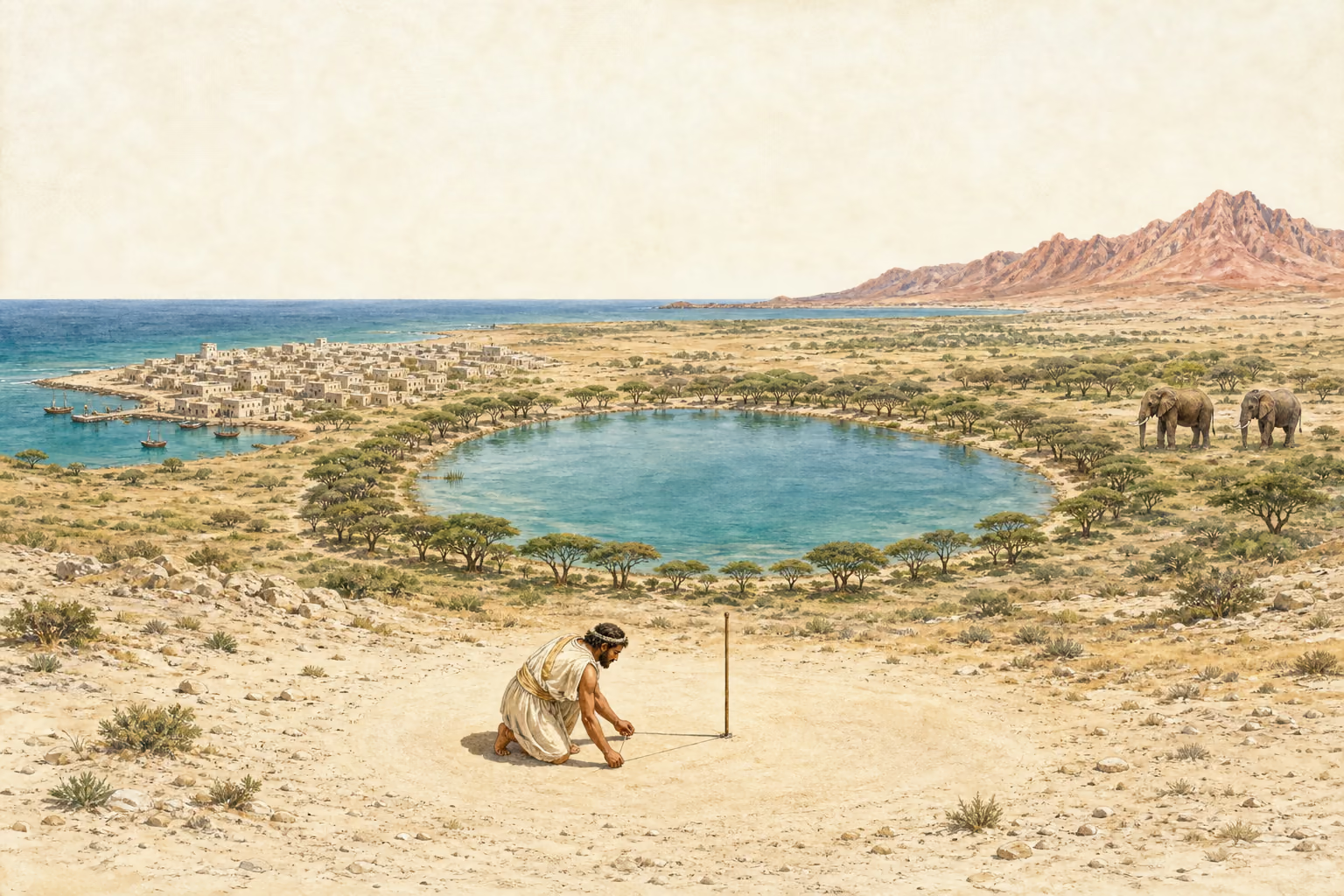
Beyond this are forests, in which is Ptolemais, built by Philadelphus for the chase of the elephant, and thence called Epitheras, situate near Lake Monoleus. This is the same region that has been already mentioned by us in the Second Book, and in which, during forty-five days before the summer solstice and for as many after, there is no shadow at the sixth hour, and during the other hours of the day it falls to the south; while at other times it falls to the north; whereas at the Berenice of which we first made mention, on the day of the summer solstice the shadow totally disappears at the sixth hour, but no other unusual phænomenon is observed. That place is situate at a distance of six hundred and two miles from Ptolemais, which has thus become the subject of a remarkable theory, and has promoted the exercise of a spirit of the most profound investigation; for it was at this spot that the extent of the earth was first ascertained, it being the fact that Erastosthenes, beginning at this place by the accurate calculation of the length of the shadow, was enabled to determine with exactness the dimensions of the earth.
After passing this place we come to the Azanian Sea, a promontory by some writers called Hispalus, Lake Mandalum, and the island of Colocasitis, with many others lying out in the main sea, upon which multitudes of turtles are found. We then come to the town of Suche, the island of Daphnidis, and the town of the Adulitæ, a place founded by Egyptian runaway slaves. This is the principal mart for the Troglodytæ, as also for the people of Æthiopia: it is distant from Ptolemais five days’ sail. To this place they bring ivory in large quantities, horns of the rhinoceros, hides of the hippopotamus, tortoise-shell, sphingiæ, and slaves. Beyond the Æthiopian Aroteræ are the islands known by the name of Aliæu, as also those of Bacchias, Antibacchias, and Stratioton. After passing these, on the coast of Æthiopia, there is a gulf which remains unexplored still; a circumstance the more to be wondered at, seeing that merchants have pursued their investigations to a greater distance than this. We then come to a promontory, upon which there is a spring called Cucios, much resorted to by mariners. Beyond it is the Port of Isis, distant ten days’ rowing from the town of the Adulitæ: myrrh is brought to this port by the Troglodytæ. The two islands before the harbour are called Pseudepylæ, and those in it, the same in number, are known as Pylæ; upon one of these there are some stone columns inscribed with unknown characters. Beyond these is the Gulf of Abalites, the island of Diodorus, and other desert islands; also, on the mainland, a succession of deserts, and then the town of Gaza, and the promontory and port of Mossylum, to the latter of which cinnamon is brought for exportation: it was thus far that Sesostris led his army.
Some writers place even beyond this, upon the shore, one town of Æthiopia, called Baricaza. Juba will have it that at the Promontory of Mossylum the Atlantic Sea begins, and that with a north-west wind we may sail past his native country, the Mauritanias, and arrive at Gades. We ought not on this occasion to curtail any portion of the opinions so expressed by him. He says that after we pass the promontory of the Indians, known as Lepteacra, and by others called Drepanum, the distance, in a straight line, beyond the island of Exusta and Malichu, is fifteen hundred miles; from thence to a place called Sceneos two hundred and twenty-five; and from thence to the island of Adanu one hundred and fifty miles; so that the distance to the open sea is altogether eighteen hundred and seventy-five miles. All the other writers, however, are of opinion that, in consequence of the intensity of the sun’s heat, this sea is not navigable; added to which, commerce is greatly exposed to the depredations of a piratical tribe of Arabians called Ascitæ, who dwell upon the islands: placing two inflated skins of oxen beneath a raft of wood, they ply their piratical vocation with the aid of poisoned arrows. We learn also from the same author that some nations of the Troglodytæ have the name of Therothoæ, being so called from their skill in hunting. They are remarkable for their swiftness, he says, just as the Ichthyophagi are, who can swim like the animals whose element is the sea. He speaks also of the Bangeni, the Gangoræ, the Chalybes, the Xoxinæ, the Sirechæ, the Daremæ, and the Domazames. Juba states, too, that the inhabitants who dwell on the banks of the Nile from Syene as far as Meroë, are not a people of Æthiopia, but Arabians; and that the city of the Sun, which we have mentioned as situate not far from Memphis, in our description of Egypt, was founded by Arabians. There are some writers who take away the further bank of the Nile from Æthiopia, and unite it to Africa; and they people its sides with tribes attracted thither by its water. We shall leave these matters, however, to the option of each, to form his opinion on them, and shall now proceed to mention the towns on each side in the order in which they are given.
On leaving Syene, and taking first the Arabian side, we find the nation of the Catadupi, then the Syenitæ, and the town of Tacompsos, by some called Thatice, as also Aramasos, Sesamos, Sanduma, Masindomacam, Arabeta and Boggia, Leupitorga, Tantarene, Mecindita, Noa, Gloploa, Gystate, Megada, Lea, Renni, Nups, Direa, Patiga, Bacata, Dumana, Rhadata, at which place a golden cat was worshipped as a god, Boron, in the interior, and Mallos, near Meroë; this is the account given by Bion.
Juba, however, gives another account; he says that there is a city on Mount Megatichos, which lies between Egypt and Æthiopia, by the Arabians known as Myrson, after which come Tacompsos, Aramus, Sesamos, Pide, Mamuda, Orambis, situate near a stream of bitumen, Amodita, Prosda, Parenta, Mama, Tesatta, Gallas, Zoton, Graucome, Emeus, the Pidibotæ, the Hebdomecontacometæ, Nomades, who dwell in tents, Cyste, Macadagale, Proaprimis, Nups, Detrelis, Patis, the Ganbreves, the Magasnei, Segasmala, Crandala, Denna, Cadeuma, Thena, Batta, Alana, Mascoa, the Scammi, Hora, situate on an island, and then Abala, Androgalis, Sesecre, the Malli, and Agole.
On the African side we find mentioned, either what is another place with the same name of Tacompsos, or else a part of the one before-mentioned, and after it Moggore, Sæa, Edos, Plenariæ, Pinnis, Magassa, Buma, Linthuma, Spintum, Sydop, the Censi, Pindicitora, Acug, Orsum, Sansa, Maumarum, Urbim, the town of Molum, by the Greeks called Hypaton, Pagoarca, Zmanes, at which point elephants begin to be found, the Mambli, Berressa, and Acetuma; there was formerly a town also called Epis, over against Meroë, which had, however, been destroyed before Bion wrote.
These are the names of places given as far as Meroë; but at the present day hardly any of them on either side of the river are in existence; at all events, the prætorian troops that were sent by the Emperor Nero under the command of a tribune, for the purposes of enquiry, when, among his other wars, he was contemplating an expedition against Æthiopia, brought back word that they had met with nothing but deserts on their route. The Roman arms also penetrated into these regions in the time of the late Emperor Augustus, under the command of P. Petronius, a man of Equestrian rank, and prefect of Egypt. That general took the following cities, the only ones we now find mentioned there, in the following order; Pselcis, Primis, Abuncis, Phthuris, Cambusis, Atteva, and Stadasis, where the river Nile, as it thunders down the precipices, has quite deprived the inhabitants of the power of hearing: he also sacked the town of Napata. The extreme distance to which he penetrated beyond Syene was nine hundred and seventy miles; but still, it was not the Roman arms that rendered these regions a desert. Æthiopia, in its turn gaining the mastery, and then again reduced to servitude, was at last worn out by its continual wars with Egypt, having been a famous and powerful country even at the time of the Trojan war, when Memnon was its king; it is also very evident from the fabulous stories about Andromeda, that it ruled over Syria in the time of king Cepheus, and that its sway extended as far as the shores of our sea.
In a similar manner, also, there have been conflicting accounts as to the extent of this country: first by Dalion, who travelled a considerable distance beyond Meroë, and after him by Aristocreon and Basilis, as well as the younger Simonides, who made a stay of five years at Meroë, when he wrote his account of Æthiopia. Timosthenes, however, the commander of the fleets of Philadelphus, without giving any other estimate as to the distance, says that Meroë is sixty days’ journey from Syene; while Eratosthenes states that the distance is six hundred and twenty-five miles, and Artemidorus six hundred. Sebosus says that from the extreme point of Egypt, the distance to Meroë is sixteen hundred and seventy-five miles, while the other writers last mentioned make it twelve hundred and fifty. All these differences, however, have since been settled; for the persons sent by Nero for the purposes of discovery have reported that the distance from Syene to Meroë is eight hundred and seventy-one miles, the following being the items. From Syene to Hiera Sycaminos they make to be fifty-four miles, from thence to Tama seventy-two, to the country of the Evonymitæ, the first region of Æthiopia, one hundred and twenty, to Acina fifty-four, to Pittara twenty-five, and to Tergedus one hundred and six. They state also that the island of Gagaudes lies at an equal distance from Syene and Meroë, and that it is at this place that the bird called the parrot was first seen; while at another island called Articula, the animal known as the sphingium was first discovered by them, and after passing Tergedus, the cynocephalus. The distance from thence to Napata is eighty miles, that little town being the only one of all of them that now survives. From thence to the island of Meroë the distance is three hundred and sixty miles. They also state that the grass in the vicinity of Meroë becomes of a greener and fresher colour, and that there is some slight appearance of forests, as also traces of the rhinoceros and elephant. They reported also that the city of Meroë stands at a distance of seventy miles from the first entrance of the island of Meroë, and that close to it is another island, Tadu by name, which forms a harbour facing those who enter the right hand channel of the river. The buildings in the city, they said, were but few in number, and they stated that a female, whose name was Candace, ruled over the district, that name having passed from queen to queen for many years. They related also that there was a temple of Jupiter Hammon there, held in great veneration, besides smaller shrines erected in honour of him throughout all the country. In addition to these particulars, they were informed that in the days of the Æthiopian dominion, the island of Meroë enjoyed great renown, and that, according to tradition, it was in the habit of maintaining two hundred thousand armed men, and four thousand artisans. The kings of Æthiopia are said even at the present day to be forty-five in number.