LIBER VI · CAPUT 30
ÆTHIOPIA
Latine · Mayhoff 1906
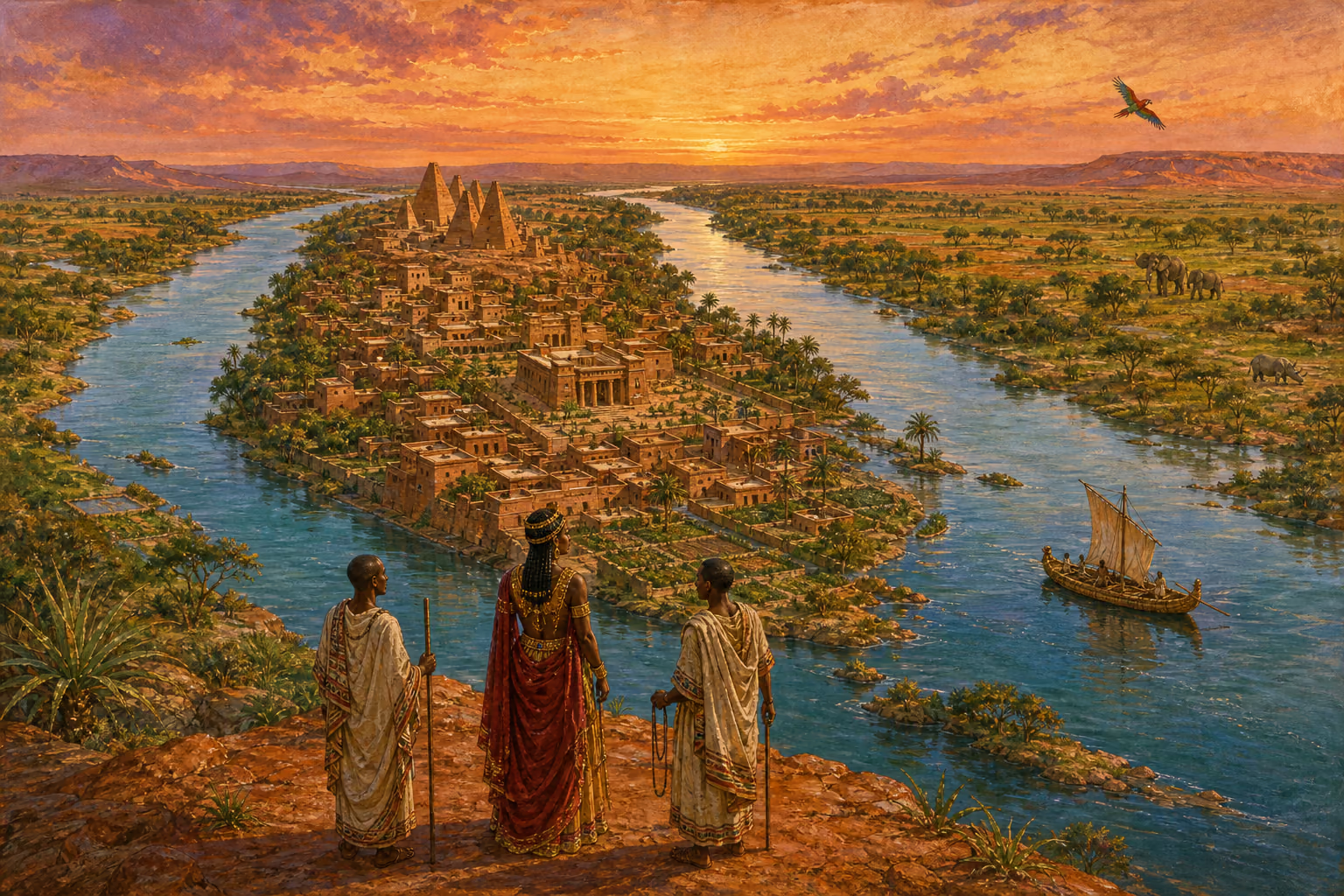
universa vero gens Aetheria appellata est, deinde Atlantia, mox a Vulcani filio Aethiope. animalium hominumque monstrificas effigies circa extremitates eius gigni minime mirum, artifici ad formanda corpora effigiesque caelandas mobilitate ignea. ferunt certe ab orientis parte intima gentes esse sine naribus, aequali totius oris planitie, alias superiore labro orbas, alias sine linguis. pars etiam ore concreto et naribus carens uno tantum foramine spirat potumque calamis avenae trahit et grana eiusdem avenae sponte provenientis ad vescendum. quibusdam pro sermone nutus motusque membrorum est. quibusdam ante Ptolemaeum Lathyrum regem Aegypti ignotus fuit usus ignium. quidam et Pygmaeorum gentem prodiderunt inter paludes ex quibus Nilus oriretur. in ora autem ubi dicemus continui montes ardentibus similes rubent.
Trogodytis et Rubro mari a Meroe tractus omnis superponitur, a Napata tridui itinere ad Rubrum litus, aqua pluvia ad usum conpluribus locis servata, fertilissima regione quae interest auri. ulteriora Atabuli, Aethiopum gens, tenent. dein contra Meroen Megabarri, quos aliqui Adiabaros nominavere; oppidum habent Apollinis. pars eorum Nomades quae elephantis vescitur. ex adverso in Africae parte Macrobii, rursus a Megabarris Memnones et Dabelli dierumque XX intervallo Critensi. ultra eos Dochi, dein Gymnetes, semper nudi, mox Anderae, Mattitae, Mesaches; hi pudore atri coloris tota corpora rubrica inlinunt. at ex Africae parte Medimni, dein Nomades, cynocephalorum lacte viventes, Alabi, Syrbotae, qui octonum cubitorum esse dicuntur. Aristocreon Libyae latere a Meroe oppidum Tollen dierum V itinere tradit; inde dierum XII Esar oppidum Aegyptiorum qui Psammetichum fugerint; in eo prodente se CCC habitasse; contra in Arabico latere Diaron oppidum esse eorum. Bio n autem Sapen vocat quod ille Esar; et ipso nomine advenas significari. caput eorum in insula Sembobitin, et tertium in Arabia Sinat. inter montes autem et Nilum Simbarri sunt, Phalliges, in ipsis vero montibus Asachae multis. nationibus. abesse a mari dicuntur dierum V itinere; vivunt elephantorum venatu. insula in Nilo Sembritarum reginae paret. ab ea Nubaei Aethiopes dierum VIII itinere; oppidum eorum Nilo inpositum Tenupsis. Sesambri, apud quos quadrupedes omnes sine auribus, etiam elephanti. at ex Africae parte Ptonebari, Ptoemphani, qui canem pro rege habent, motu eius imperia augurantes, Harusbi oppido longe ab Nilo sito, postea Archisarmi, Phalliges, Marigarri, Chasamari. Bion et alia oppida in insulis tradit: a Sembobiti Meroen versus dierum toto itinere XX proximae insulae oppidum Seberritarum sub reginaet aliud Asara, alterius oppidum Darden; tertiam Medoen vocant, in qua oppidum Asel, quartam eodem quo oppidum nomine Garroen. inde per ripas oppida Nautis, Modum, Demadatin, Secundum, Collocat, Secande, Navectabe cum agro Psegipta, Candragori, Arabam, Summaram. regio supra Sirbitum, ubi desinunt montes, traditur a quibusdam habere maritimos Aethiopas, Nisicathas, Nisitas, quod significat ternum et quaternum oculorum viros, non quia sic sint, sed quia sagittis praecipua contemplatione utantur. ab ea vero parte Nili, quae supra Syrtes Maiores oceanumque meridianum protendatur, Dalion Vacathos esse dicit, pluvia tantum aqua utentes, Cisoros, Logonporos ab Oecalicibus dierum V itinere, Vsibalchos, Isbelos, Perusios, Ballios, Cispios. reliqua deserta, dein fabulosa: ad occidentem versus Nigroe, quorum rex unum oculum in fronte habeat, Agriophagi, pantherarum leonumque maxime carnibus viventes, Pamphagi, omni mandentes, Anthropophagi, humana carne vescentes, Cynamolgi caninis capitibus, Artabatitae quadrupedes, ferarum modo vagi, deinde Hesperioe, Perorsi et quos in Mauretaniae confinio diximus. pars quaedam Aethiopum locustis tantum vivit fumo et sale duratis in annua alimenta; hi quadragesimum vitae annum non excedunt.
Aethiopum terram universam cum mari Rubro patere in longitudinem |XXI|.LXX p., in latitudinem cum superiore Aegyptpo |XII|.XCVI Agrippa existimavit. quidam longitudinem ita diviserunt: a Meroe Sirbitum XII dierum navigationem, ab ea XV ad Dabellos, ab his ad oceanum Aethiopicum VI dierum iter. in totum ab oceano ad Meroen DCXXV p. esse inter auctores fere convenit, inde Syenen quantum diximus. sita est Aethiopia ab oriente hiberno ad occidentem hibernum. meridiano cardine silvae, hebeno maxime, virent. a media eius parte imminens mari mons excelsus aeternis ardet ignibus, Theon Ochema dictus Graecis. a quo navigatione quadridui promunturium quod Hesperu Ceras vocatur, confine Africae iuxta Aethiopas Hesperios. quidam et in eo tractu modicos colles amoena opacitate vestitos Aegipanum Satyrorumque produnt.
English · Bostock & Riley 1855–57
The whole of this country has successively had the names of Ætheria, Atlantia, and last of all, Æthiopia, from Æthiops, the son of Vulcan. It is not at all surprising that towards the extremity of this region the men and animals assume a monstrous form, when we consider the changeableness and volubility of fire, the heat of which is the great agent in imparting various forms and shapes to bodies. Indeed, it is reported that in the interior, on the eastern side, there is a people that have no noses, the whole face presenting a plane surface; that others again are destitute of the upper lip, and others are without tongues. Others again, have the mouth grown together, and being destitute of nostrils, breathe through one passage only, imbibing their drink through it by means of the hollow stalk of the oat, which there grows spontaneously and supplies them with its grain for food. Some of these nations have to employ gestures by nodding the head and moving the limbs, instead of speech. Others again were unacquainted with the use of fire before the time of Ptolemy Lathyrus, king of Egypt. Some writers have also stated that there is a nation of Pygmies, which dwells among the marshes in which the river Nile takes its rise; while on the coast of Æthiopia, where we paused, there is a range of mountains, of a red colour, which have the appearance of being always burning.
All the country, after we pass Meroë, is bounded by the Troglodytæ and the Red Sea, it being three days’ journey from Napata to the shores of that sea; throughout the whole of this district the rain water is carefully preserved at several places, while the country that lies between is extremely productive of gold. The parts beyond this are inhabited by the Adabuli, a nation of Æthiopia; and here, over against Meroë, are the Megabarri, by some writers called the Adiabari; they occupy the city of Apollo; some of them, however, are Nomades, living on the flesh of elephants. Opposite to them, on the African side, dwell the Macrobii, and then again, beyond the Megabarri, there are the Memnones and the Dabeli, and, at a distance of twenty days’ journey, the Critensi. Beyond these are the Dochi, and then the Gymnetes, who always go naked; and after them the Andetæ, the Mothitæ, the Mesaches, and the Ipsodoræ, who are of a black tint, but stain the body all over with a kind of red earth. On the African side again there are the Medimni, and then a nation of Nomades, who live on the milk of the cynocephalus, and then the Aladi and the Syrbotæ, which last are said to be eight cubits in height.
Aristocreon informs us that on the Libyan side, at a distance of five days’ journey from Meroë, is the town of Tolles, and then at a further distance of twelve days’ journey, Esar, a town founded by the Egyptians who fled from Psammetichus; he states also that they dwelt there for a period of three hundred years, and that opposite, on the Arabian side, there is a town of theirs called Daron. The town, however, which he calls Esar, is by Bion called Sape, who says that the name means “the strangers:” their capital being Sembobitis, situate on an island, and a third place of theirs, Sinat in Arabia. Between the mountains and the river Nile are the Simbarri, the Palugges, and, on the mountains themselves, the Asachæ, who are divided into numerous peoples; they are said to be distant five days’ journey from the sea, and to procure their subsistence by the chase of the elephant. An island in the Nile, which belongs to the Semberritæ, is governed by a queen; beyond it are the Æthiopian Nubei, at a distance of eight days’ journey: their town is Tenupsis, situate on the Nile. There are the Sesambri also, a people among whom all the quadrupeds are without ears, the very elephants even. On the African side are the Tonobari, the Ptoenphæ, a people who have a dog for their king, and divine from his movements what are his commands; the Auruspi, who have a town at a considerable distance from the Nile, and then the Archisarmi, the Phaliges, the Marigerri, and the Casmari.
Bion makes mention also of some other towns situate on islands, the whole distance being twenty days’ journey from Sembobitis to Meroë; a town in an adjoining island, under the queen of the Semberritæ, with another called Asara, and another, in a second island, called Darde. The name of a third island is Medoë, upon which is the town of Asel, and a fourth is called Garodes, with a town upon it of the same name. Passing thence along the banks of the Nile, are the towns of Navi, Modunda, Andatis, Secundum, Colligat, Secande, Navectabe, Cumi, Agrospi, Ægipa, Candrogari, Araba, and Summara.
Beyond is the region of Sirbitum, at which the mountains terminate, and which by some writers is said to contain the maritime Æthiopians, the Nisacæthæ, and the Nisyti, a word which signifies “men with three or four eyes,”—not that the people really have that conformation, but because they are remarkable for the unerring aim of their arrows. On that side of the Nile which extends along the borders of the Southern Ocean beyond the Greater Syrtes, Dalion says that the people, who use rain-water only, are called the Cisori, and that the other nations are the Longompori, distant five days’ journey from the Œcalices, the Usibalci, the Isbeli, the Perusii, the Ballii, and the Cispii, the rest being deserts, and inhabited by the tribes of fable only. In a more westerly direction are the Nigroæ, whose king has only one eye, and that in the forehead, the Agriophagi, who live principally on the flesh of panthers and lions, the Pamphagi, who will eat anything, the Anthropophagi, who live on human flesh, the Cynamolgi, a people with the heads of dogs, the Artabatitæ, who have four feet, and wander about after the manner of wild beasts; and, after them, the Hesperiæ and the Perorsi, whom we have already spoken of as dwelling on the confines of Mauritania. Some tribes, too, of the Æthiopians subsist on nothing but locusts, which are smoke-dried and salted as their provision for the year; these people do not live beyond their fortieth year.
M. Agrippa was of opinion that the length of the whole country of the Æthiopians, including the Red Sea, was two thousand one hundred and seventy miles, and its breadth, including Upper Egypt, twelve hundred and ninety-seven. Some authors again have made the following divisions of its length; from Meroë to Sirbitum eleven days’ sail, from Sirbitum to the Dabelli fifteen days’, and from them to the Æthiopian Ocean six days’ journey. It is agreed by most authors, that the distance altogether, from the ocean to Meroë, is six hundred and twenty-five miles, and from Meroë to Syene, that which we have already mentioned. Æthiopia lies from south-east to south-west. Situate as it is, in a southern hemisphere, forests of ebony are to be seen of the brightest verdure; and in the midst of these regions there is a mountain of immense height, which overhangs the sea, and emits a perpetual flame. By the Greeks this mountain is called Theon Ochema, and at a distance of four days’ sail from it is a promontory, known as Hesperu Ceras, upon the confines of Africa, and close to the Hesperiæ, an Æthiopian nation. There are some writers who affirm that in these regions there are hills of a moderate height, which afford a pleasant shade from the groves with which they are clad, and are the haunts of Ægipans and Satyrs.