LIBER VI · CAPUT 31
ISLANDS OF THE ÆTHIOPIAN SEA
Latine · Mayhoff 1906
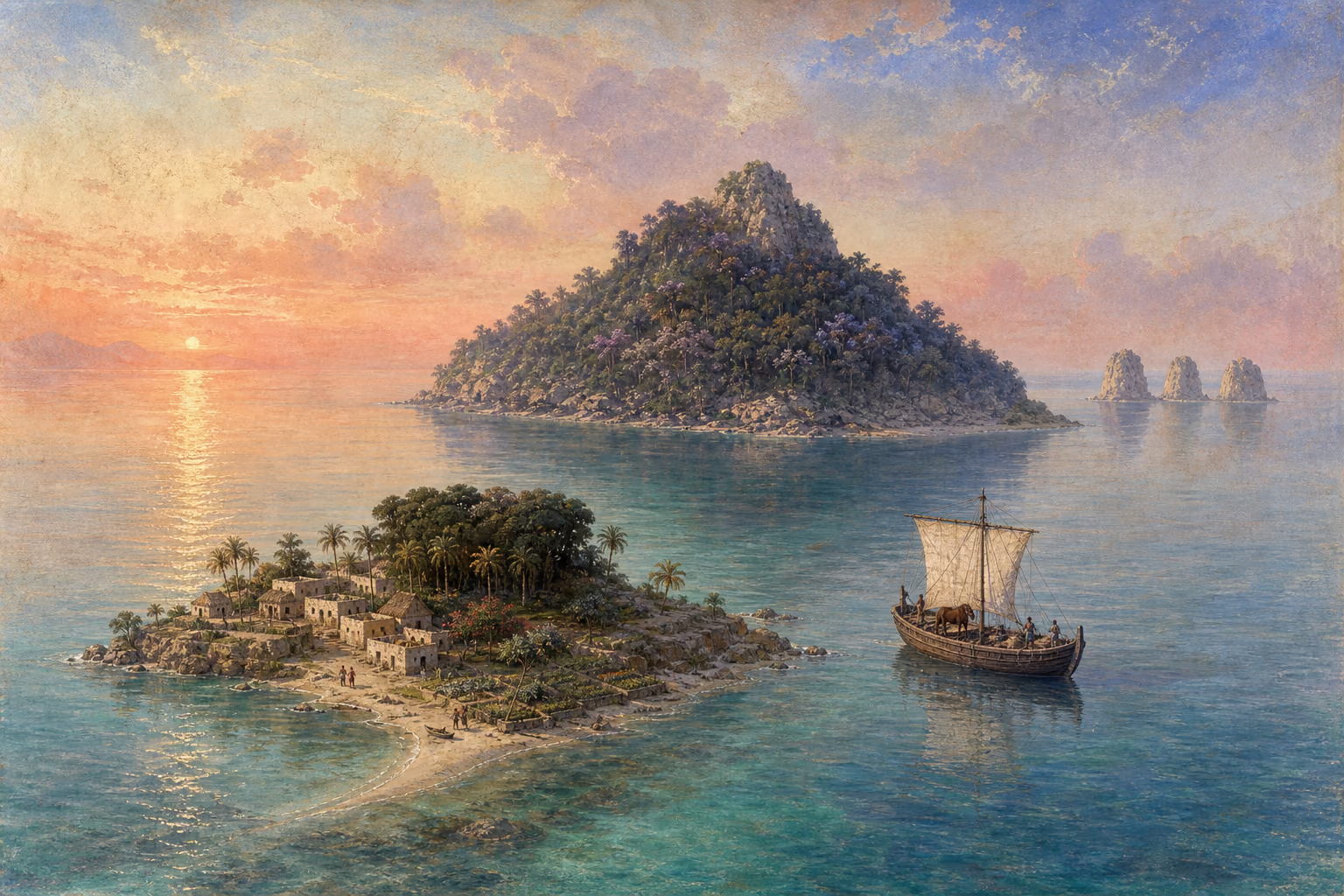
Insulas toto eo mari et Ephorus conplures esse tradidit et Eudoxus et Timosthenes, Clitarchus vero Alexandro regi renuntiatam adeo divitem, ut equos incolae talentis auri permutarent, alteram ubi sacer mons opacus silva repertus esset, destillante arboribus odore mirae suavitatis. contra sinum Persicum Cerne nominatur insula adversa Aethiopiae, cuius neque magnitudo neque intervallum a continente constat; Aethiopas tantum populos habere proditur. Ephorus auctor est a Rubro mari navigantes in eam non posse propter ardores ultra quasdam columnas — ita appellantur parvae insulae — provehi. Polybius in extrema Mauretania contra montem Atlantem a terra stadia VIII abesse prodidit Cernen, Nepos Cornelius ex adverso maxime Carthaginis a continente p. M, non ampliorem circuitu II. traditur et alia insula contra montem Atlantem, et ipsa Atlantis appellata. ab ea V dierum praenavigatione solitudines ad Aethiopas Hesperios et promunturium quod vocavimus Hesperu Ceras, inde primum circumagente se terrarum fronte in occasum ac mare Atlanticum. contra hoc quoque promunturium Gorgades insulae narrantur, Gorgonum quondam domus, bidui navigatione distantes a continente, ut tradit Xenophon Lampsacenus. penetravit in eas Hanno Poenorum imperator prodiditque hirta feminarum corpora, viros pernicitate evasisse; duarum Gorgadum cutes argumenti et miraculi gratia in lunonis templo posuit, spectatas usque ad Carthaginem captam. ultra has etiamnum duae Hesperidum insulae narrantur, adeoque omnia circa hoc incerta sunt, ut Statius Sebosus a Gorgonum insulis praenavigatione Atlantis dierum XL ad Hesperidum insulas cursum prodiderit, ab his ad Hesperu Ceras unius. nec Mauretaniae insularum certior fama est. paucas modo constat esse ex adverso Autololum a Iuba repertas, in quibus Gaetulicam purpuram tinguere instituerat.
English · Bostock & Riley 1855–57
We learn from Ephorus, as well as Eudoxus and Timosthenes, that there are great numbers of islands scattered all over this sea; Clitarchus says that king Alexander was informed of an island so rich that the inhabitants gave a talent of gold for a horse, and of another upon which there was found a sacred mountain, shaded with a grove, the trees of which emitted odours of wondrous sweetness; this last was situate over against the Persian Gulf. Cerne is the name of an island situate opposite to Æthiopia, the size of which has not been ascertained, nor yet its distance from the main land: it is said that its inhabitants are exclusively Æthiopians. Ephorus states that those who sail from the Red Sea into the Æthiopian Ocean cannot get beyond the Columnæ there, some little islands so called. Polybius says that Cerne is situate at the extremity of Mauritania, over against Mount Atlas, and at a distance of eight stadia from the land; while Cornelius Nepos states that it lies very nearly in the same meridian as Carthage, at a distance from the mainland of ten miles, and that it is not more than two miles in circumference. It is said also that there is another island situate over against Mount Atlas, being itself known by the name of Atlantis. Five days’ sail beyond it there are deserts, as far as the Æthiopian Hesperiæ and the promontory, which we have mentioned as being called Hesperu Ceras, a point at which the face of the land first takes a turn towards the west and the Atlantic Sea. Facing this promontory are also said to be the islands called the Gorgades, the former abodes of the Gorgons, two days’ sail from the mainland, according to Xenophon of Lampsacus. Hanno, a general of the Carthaginians, penetrated as far as these regions, and brought back an account that the bodies of the women were covered with hair, but that the men, through their swiftness of foot, made their escape; in proof of which singularity in their skin, and as evidence of a fact so miraculous, he placed the skins of two of these females in the temple of Juno, which were to be seen there until the capture of Carthage. Beyond these even, are said to be the two islands of the Hesperides; but so uncertain are all the accounts relative to this subject, that Statius Sebosus says that it is forty days’ sail, past the coast of the Atlas range, from the islands of the Gorgons to those of the Hesperides, and one day’s sail from these to the Hesperu Ceras. Nor have we any more certain information relative to the islands of Mauritania. We only know, as a fact well-ascertained, that some few were discovered by Juba over against the country of the Autololes, upon which he established a manufactory of Gætulian purple.