LIBER VI · CAPUT 32
THE FORTUNATE ISLANDS
Latine · Mayhoff 1906
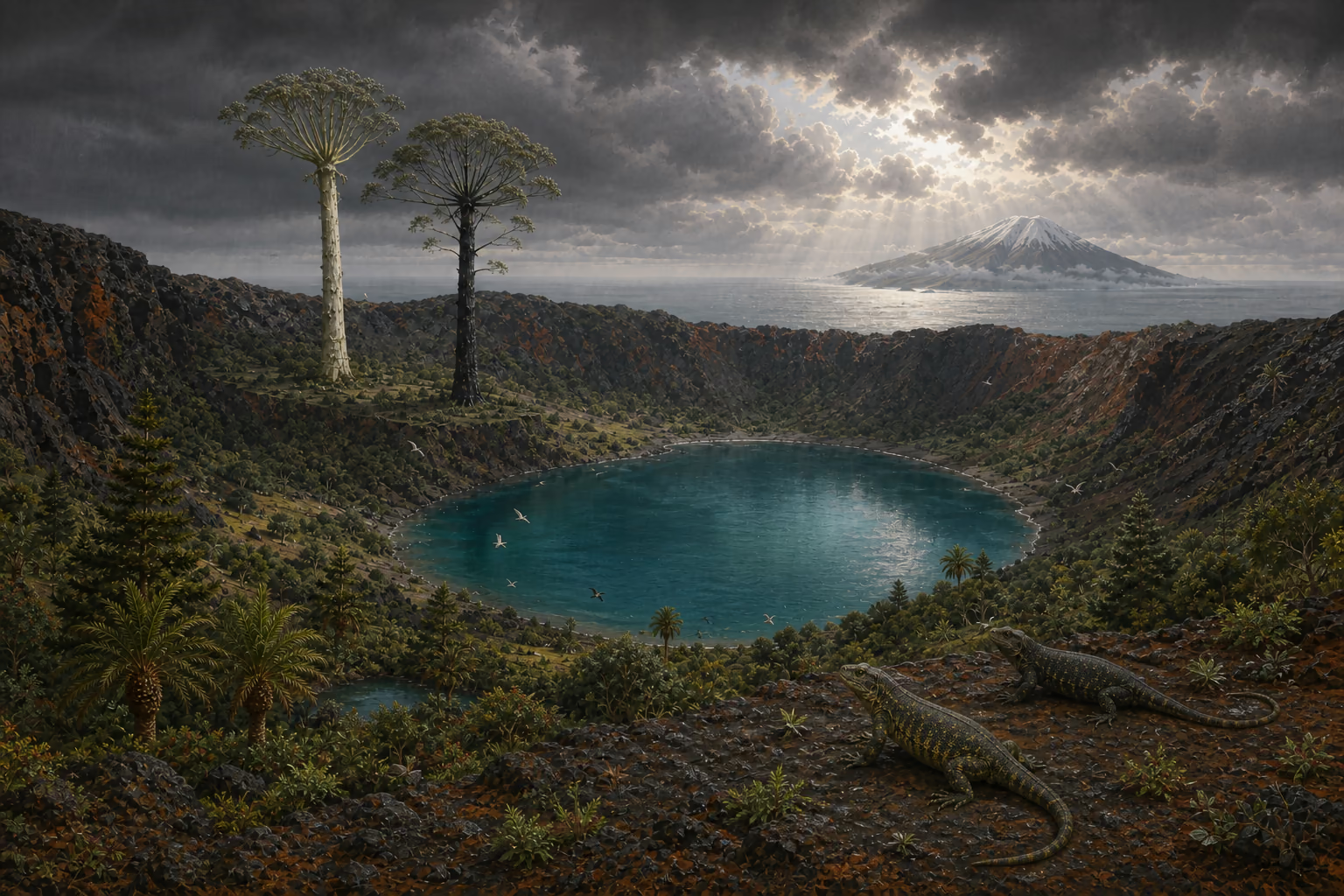
Sunt qui ultra eas Fortunatas putent esse quasdamque alias, quoin numero idem Sebosus etiam spatia conplexus lunoniam abesse a Gadibus DCCL p. tradit, ab ea tantundem ad occasum versus Pluvialiam Caprariamque; in Pluvialia non esse aquam nisi ex imbri. ab iis CCL Fortunatas contra laevam Mauretaniae in VIII horam solis; vocari Invallem a convexitate et Planasiam a specie, Invallis circuituCCC p.; arborum ibi proceritatem ad CXL pedes adulescere. Iuba de Fortunatis ita inquisivit: sub meridiem quoque positas esse prope occasum, a Purpurariis DCXXV p., sic ut CCL supra occasum navigetur, dein per CCCLXXV ortus petatur. primam vocari Ombrion, nullis aedificiorum vestigiis; habere in montibus stagnum, arbores similes ferulae, ex quibus aqua exprimatur, e nigris amara, ex candidioribus potui iucunda. alteram insulam Iunoniam appellari; in ea aediculam esse tantum lapide exstructam. ab ea in vicino eodem nomine minorem, deinde Caprariam, lacertis grandibus refertam. in conspectu earum esse Ninguariam, quae hoc nomen acceperit a perpetua nive, nebulosam. proximam ei Canariam vocari a multitudine canum ingentis magnitudinis — ex quibus perducti sunt Iubae duo —; apparere ibi vestigia aedificiorum. cum omnes autem copia pomorum et avium omnis generis abundent, hanc et palmetis caryotas ferentibus ac nuce pinea abundare; esse copiam et mellis, papyrum quoque et siluros in amnibus gigni. infestari eas beluis, quae expellantur adsidue, putrescentibus.
Et abunde orbe terrae extra intra indicato colligenda in artum mensura aequorum videtur.
English · Bostock & Riley 1855–57
There are some authors who think that beyond these are the Fortunate Islands, and some others; the number of which Sebosus gives, as well as the distances, informing us that Junonia is an island seven hundred and fifty miles distant from Gades. He states also that Pluvialia and Capraria are the same distance from Junonia, to the west; and that in Pluvialia the only fresh water to be obtained is rain water. He then states that at a distance of two hundred and fifty miles from these, opposite the left of Mauritania, and situate in the direction of the sun at the eighth hour, are the Fortunate Islands, one of which, from its undulating surface, has the name of Invallis, and another that of Planasia, from the peculiarity of its appearance. He states also that the circumference of Invallis is three hundred miles, and that trees grow to a height of one hundred and fourteen feet.
Relative to the Fortunate Islands, Juba has ascertained the following facts: that they are situate to the south in nearly a due westerly direction, and at a distance from the Purple Islands of six hundred and twenty-five miles, the sailing being made for two hundred and fifty miles due west, and then three hundred and seventy-five towards the east. He states that the first is called Ombrios, and that it presents no traces of buildings whatever; that among the mountains there is a lake, and some trees, which bear a strong resemblance to giant fennel, and from which water is extracted; that drawn from those that are black is of a bitter taste, but that produced by the white ones is agreeable and good for drinking. He states also that a second island has the name of Junonia, but that it contains nothing beyond a small temple of stone: also that in its vicinity there is another, but smaller, island of the same name, and then another called Capraria, which is infested by multitudes of huge lizards. According to the same author, in sight of these islands is Ninguaria, which has received that name from its perpetual snows; this island abounds also in fogs. The one next to it is Canaria; it contains vast multitudes of dogs of very large size, two of which were brought home to Juba: there are some traces of buildings to be seen here. While all these islands abound in fruit and birds of every kind, this one produces in great numbers the date palm which bears the caryota, also pine nuts. Honey too abounds here, and in the rivers papyrus, and the fish called silurus, are found. These islands, however, are greatly annoyed by the putrefying bodies of monsters, which are constantly thrown up by the sea.
Having now fully described the earth, both without as well as within, it seems only proper that we should succinctly state the length and breadth of its various seas.