LIBER VI · CAPUT 33
DIVISION OF THE EARTH INTO PARALLELS AND SHADOWS OF EQUAL LENGTH
Latine · Mayhoff 1906
Polybius a Gaditano freto longitudinem directo cursu ad os Maeotis |XXXIII|.XXXVII.D prodidit, ab eodem initio Siciliam |XII|.L???, Cretam CCCLXXV, Rhodum CLXXXVII.D, Chelidonias tantundem, Cyprum CCCXXV, inde Syriae Seleuciam Pieriam CXV, quae computatio efficit |XXIIII|.XL. Agrippa hoc idem intervallum a freto Gaditano ad sinum Issicum per longitudinem derectam |XXXXIIII|.XL taxat, in quo haud scio an sit error numeri, quoniam idem a Siculo freto Alexandriam cursus |XIIII|.L??? tradidit. universus autem circuitus per sinus dictos ab eodem exordio colligit intra Maeotim lacum |CLV|.VIIII, Artemidorus adicit DCCLVI, idem cum Maeotide |CLXXIII|.XC p. esse tradidit. haec est mensura inermium et pacata audacia fortunam provocantium hominum.
Nunc ipsarum partium magnitudo conparabitur, utcumque difficultatem adferet auctorum diversitas, aptissime tamen spectabitur ad longitudinem latitudine addita. est ergo ad hoc praescriptum Europae magnitude.... lon-gitudo |LXXXVII|.XIIII. Africae - ut media ex omni varietate prodentium sumatur computatio - efficit longitude |XXXVII|.XCVIII; latitudo, qua colitur, nusquam CCL excedit. sed quoniam in Cyrenaica eius parte DCCCCX eam fecit Agrippa, deserta eius ad Garamantas usque, qua noscebantur, complectens, universa mensura, quae veniet in comparationem, |XLVII|.VIII efficit. Asiae longitudo in confesso est L???.XIII.DCCL; latitudo sane computetur ab Aethiopico mari Alexandriam iuxta Nilum sitam, ut per Meroen et Syenen mensura currat, |XVIII|.LXXV. apparet ergo Europam paulo minus dimidia Asiae parte maiorem esse quam Asiam, eandem altero tanto et sexta parte Africae ampliorem quam Africam. quod si misceantur omnes summae, liquido patebit Europam totius terrae tertiam esse partem et octavam paulo amplius, Asiam vero quartam et quartam decimam, Africam autem quintam et insuper sexagesimam.
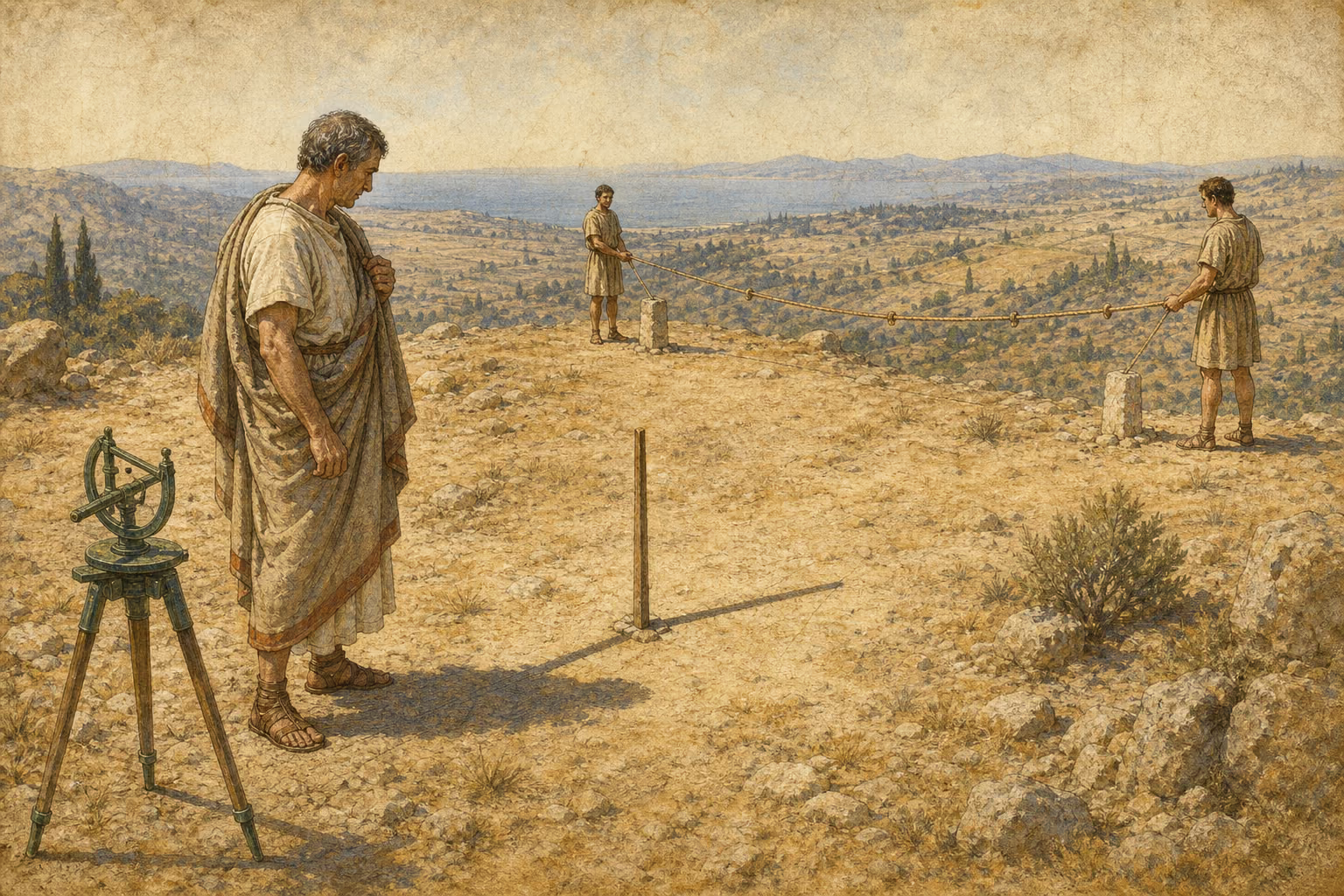
His addemus etiamnum unam Graecae inventionis scientiam vel exquisitissimae subtilitatis, ut nihil desit in spectando terrarum situ indicatisque regionibus noscatur et cum qua cuique siderum societas sit sive cognatio dierum ac noctium quibusque inter se pares umbrae et aequa mundi convexitas. ergo reddetur hoc etiam, terraeque universae in membra caeli digerentur. plura sunt autem segmenta munrdi, quae nostri circulos appellavere, Graeci parallelos.
English · Bostock & Riley 1855–57
Polybius has stated, that in a straight line from the Straits of Gades to the mouth of the Mæotis, it is a distance of three thousand four hundred and thirty-seven miles and a half, and that, starting from the same point, the distance in a straight line to Sicily is twelve hundred and fifty miles, from thence to Crete three hundred and seventy-five, to Rhodes one hundred and eighty-seven and a half, to the Chelidonian Islands the same distance, to Cyprus two hundred and twenty-five, and from thence to Seleucia Pieria, in Syria, one hundred and fifteen miles: the sum of all which distances amounts to two thousand three hundred and forty miles. Agrippa estimates this same distance, in a straight line from the Straits of Gades to the Gulf of Issus, at three thousand three hundred and forty miles; in which computation, however, I am not certain that there is not some error in the figures, seeing that the same author has stated that the distance from the Straits of Sicily to Alexandria is thirteen hundred and fifty miles. Taking the whole length of the sea-line throughout the gulfs above-mentioned, and beginning at the same point, he makes it ten thousand and fifty-eight miles; to which number Artemidorus has added seven hundred and fifty-six: the same author, including in his calculation the shores of the Mæotis, makes the whole distance seventeen thousand three hundred and ninety miles. Such is the measurement given by men who have penetrated into distant countries, unaided by force of arms, and have, with a boldness that exhibits itself in the times of peace even, challenged, as it were, Fortune herself.
I shall now proceed to compare the dimensions of the various parts of the earth, however great the difficulties which may arise from the discrepancy of the accounts given by various authors: the most convenient method, however, will be that of adding the breadth to the length. Following this mode of reckoning, the dimensions of Europe will be eight thousand two hundred and ninety-four miles; of Africa, to adopt a mean between all the various accounts given by authors, the length is three thousand seven hundred and ninety-four miles, while the breadth, so far as it is inhabited, in no part exceeds two hundred and fifty miles. But, as Agrippa, including its deserts, makes it from Cyrenaica, a part of it, to the country of the Garamantes, so far as was then known, a further distance of nine hundred and ten miles, the entire length, added together, will make a distance of four thousand six hundred and eight miles. The length of Asia is generally admitted to be six thousand three hundred and seventy-five miles, and the breadth, which ought, properly, to be reckoned from the Æthiopian Sea to Alexandria, near the river Nile, so as to run through Meroë and Syene, is eighteen hundred and seventy-five. It appears then that Europe is greater than Asia, by a little less than one half of Asia, and greater than Africa by as much again of Africa and one-sixth. If all these sums are added together, it will be clearly seen that Europe is one-third, and a little more than one-eighth part of one-third, Asia one-fourth and one-fourteenth part of one-fourth, and Africa, one-fifth and one-sixtieth part of one-fifth of the whole earth.
To the above we shall add even another instance of ingenious discovery by the Greeks, and indeed of the most minute skilfulness; that so nothing may be wanting to our investigation of the geographical divisions of the earth, and the various countries thereof which have been pointed out; that it may be the better understood, too, what affinity, or relationship as it were, exists between one region and another, in respect to the length of their days and nights, and in which of them the shadows are of equal length, and the distance from the pole is the same. I shall therefore give these particulars as well, and shall state the divisions of the whole earth in accordance with the various sections of the heavens. The lines or segments which divide the world are many in number; by our people they are known as “circuli” or circles, by the Greeks they are called “paralleli” or parallels.