LIBER VIII · CAPUT 16
THE DIFFERENT SPECIES OF LIONS
Latine · Mayhoff 1906
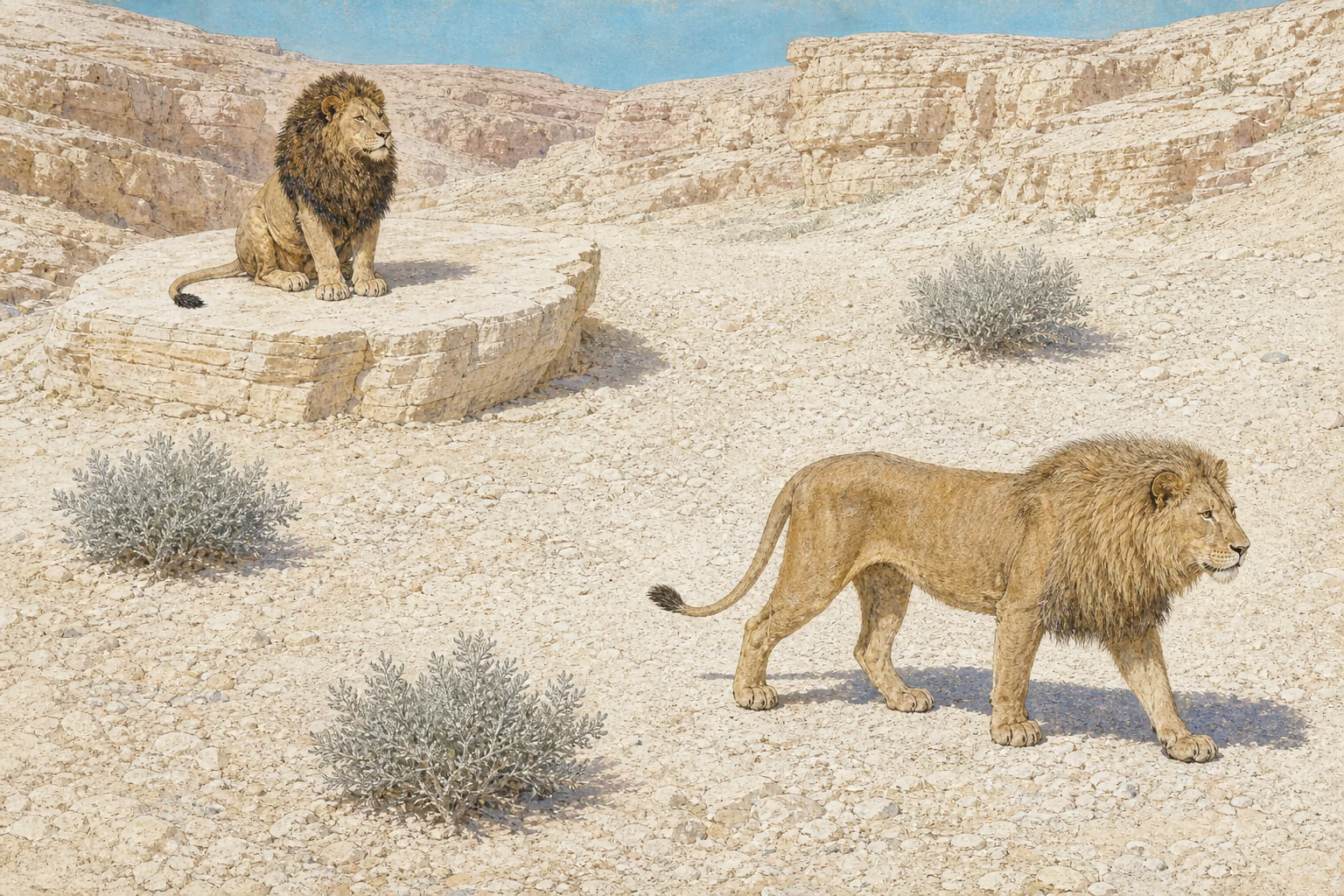
leoni praecipua generositas tunc, cum colla armosque vestiunt iubae; id enim aetate contingit e leone conceptis. quos vero pardi generavere, semper insigni hoc carent; simili modo feminae. magna his libido coitus et ob hoc maribus ira. Africa haec maxime spectat, inopia aquarum ad paucos amnes congregantibus se feris. ideo multiformes ibi animalium partus, varie feminis cuiusque generis mares aut vi aut voluptate miscente: unde etiam vulgare Graeciae dictum semper aliquid novi Africam adferre. odore pardi coitum sentit in adultera leo totaque vi consurgit in poenam; idcirco ea culpa flumine abluitur aut longius comitatur. semel autem edi partum, lacerato unguium acie utero in enixu, volgum credidisse video.
Aristoteles diversa tradit, vir quem in his magna secuturus ex parte praefandum reor. Alexandro Magno rege inflammato cupidine animalium naturas noscendi delegataque hac commentatione Aristoteli, summo in omni doctrina viro, aliquot milia hominum in totius Asiae Graeciaeque tractu parere iussa, omnium quos venatus, aucupia piscatusque alebant quibusque vivaria, armenta, alvaria, piscinae, aviaria in cura erant, ne quid usquam genitum ignoraretur ab eo. quos percunctando quinquaginta ferme volumina illa praeclara de animalibus condidit. quae a me collecta in artum cum iis, quae ignoraverat, quaeso ut legentes boni consulant, in universis rerum naturae operibus medioque clarissimi regum omnium desiderio cura nostra breviter peregrinantes. is ergo tradit leaenam primo fetu parere quinque catulos ac per annos singulis minus, ab uno sterilescere. informes minimasque carnes magnitudine mustellarum esse initio, semenstres vix ingredi posse nec nisi bimenstres moveri; in Europa autem inter Acheloum tantum Mestumque amnes leones esse, sed longe viribus praestantiores iis quos Africa aut Syria gignant.
Leonum duo genera, compactile et breve crispioribus iubis. hos pavidiores esse quam longos simplicique villo; eos contemptores vulnerum. urinam mares crure sublato reddere ut canes. gravem odorem, nec minus halitum. raros in potu vesci alternis diebus, a saturitate interim triduo cibis carere. quae possint, in mandendo solida devorare, nec capiente aviditatem alvo coniectis in fauces unguibus extrahere aut si fugiendum in satietate habeant. vitam iis longam docet argumento, quod plerique dentibus defecti reperiantur. Polybius, Aemiliani comes, in senecta hominem ab his adpeti refert, quoniam ad persequendas feras vires non suppetant; tune obsidere Africae urbes, eaque de causa cruci fixos vidisse se cum Scipione, quia ceteri metu poenae similis absterrerentur eadem noxa.
Leoni tantum ex feris clementia in supplices. prostratis parcit et, ubi saevit, in viros potius quam in feminas fremit, in infantes non nisi magna fame. credit Iuba pervenire intellectum ad eos precum; in captivam certe Gaetuliae reducem audivit multorum in silvis impetum esse mitigatum adloquio ausae dicere, se feminam, profugam, infirmam, supplicem animalis omnium generosissimi ceterisque imperitantis, indignam eius gloria praedam. varia circa hoc opinio ex ingenio cuiusque vel casu, mulceri alloquiis feras, quippe cum etiam serpentes extrahi cantu cogique in poenam verum falsumne sit, non vita decreverit. leonum animi index cauda, sicut et equorum aures; namque et has notas generosissimo cuique natura tribuit. inmota ergo placido, clemens blandienti, quod rarum est: crebrior enim iracundia, cuius in principio terra verberatur, incremento terga ceu quodam incitamento flagellantur. vis summa in pectore. ex omni vulnere sive ungue inpresso sive dente ater profluit sanguis. iidem satiati innoxii sunt. generositas in periculis maxime deprehenditur, non illo tantum modo, quo spernens tela diu se terrore solo tuetur ac velut cogi testatur cooriturque non tamquam periculo coactus, sed tamquam amentiae iratus. illa nobilior animi significatio: quamlibet magna canum et venantium urguente vi contemptim restitansque cedit in campis et ubi spectari potest; idem ubi virgulta silvasque penetravit, acerrimo cursu fertur velut abscondente turpitudinem loco. dum sequitur, insilit saltu, quo in fuga non utitur. vulneratus observatione mira percussorem novit et in quantalibet multitudine adpetit; eum vero, qui telum quidem miserit, sed non vulneraverit, correptum rotatumque sternit nec vulnerat. cum pro catulis feta dimicat, oculorum aciem traditur defigere in terram, ne venabula expavescat. cetero dolis carent et suspicione nec limis intuentur oculis aspicique simili modo nolunt. creditum est a moriente humum morderi lacrimamque leto dari. atque hoc tale tamque saevum animal rotarum orbes circumacti currusque inanes et gallinaceorum cristae cantusque etiam magis terrent, sed maxime ignes. aegritudinem fastidii tantum sentit, in qua medetur ei contumelia, in rabiem agente adnexarum lascivia simiarum; gustatus deinde sanguis in remedio est.
Leonum simul plurium pugnam Romae princeps dedit Scaevola P. F. in curuli aedilitate, centum autem iubatorum primus omnium L. Sulla, qui postea dictator fuit, in praetura. post eum Pompeius Magnus in circo DC, in iis iubatorum CCCXV, Caesar dictator CCCC.
Capere eos ardui erat quondam operis, foveisque maxime. principatu Claudii casus rationem docuit, pudendam paene talis ferae nomine, a pastore Gaetuliae sago contra ingruentis impetum obiecto, quod spectaculum in harenam protinus tralatum est, vix credibili modo torpescente tanta illa feritate quamvis levi iniectu operto capite, ita ut devinciatur non repugnans. videlicet omnis vis constat in oculis, quo minus mirum sit a Lysimacho Alexandri iussu simul incluso strangulatum leonem. iugo subdidit eos primusque Romae ad currum iunxit M. Antonius, et quidem civili bello, cum dimicatum esset in Pharsaliis campis, non sine ostento quodam temporum, generosos spiritus iugum subire illo prodigio significante. nam quod ita vectus est cum mima Cyt heride, super monstra etiam illarum calamitatium fuit. primus autem hominum leonem manu tractare ausus et ostendere mansuefactum Hanno e clarissimis Poenorum traditur damnatusque illo argumento, quoniam nihil non persuasurus vir tam artificis ingenii videbatur et male credi libertas ei, cui in tantum cessisset etiam feritas.
Sunt vero et fortuitae eorum quoque clementiae exempla. Mentor Syracusanus in Syria, leone obvio suppliciter volutante, attonitus pavore, cum refugienti undique fera opponeret sese et vestigia lamberet adulanti similis, animadvertit in pede eius tumorem vulnusque. extracto surculo liberavit cruciatu. pictura casum hunc testatur Syracusis. simili modo Elpis Samius natione in Africam delatus nave, iuxta litus conspecto leone hiatu minaci, arborem fuga petit Libero patre invocato, quoniam tum praecipuus votorum locus est, cum spei nullus est. set neque profugienti, cum potuisset, fera institerat et procumbens ad arborem hiatu, quo terruerat, miserationem quaerebat. os morsu avidiore inhaeserat dentibus cruciabatque inedia, non tantum poena in ipsis eius telis, suspectantem ac velut mutis precibus orantem, dum fortuitis fidens non est contra feram multoque diutius miraculo quam metu cessatum est. degressus tandem evellit praebenti et qua maxime opus esset adcommodanti. traduntque, quamdiu navis ea in litore steterit, retulisse gratiam venatus adgerendo. qua de causa Libero patri templum in Samo Elpis sacravit, quod ab eo facto Graeciκεχηνότος διονύσου appellavere. miremur postea vestigia hominum intellegi a feris, cum etiam auxilia ab uno animalium sperent? cur enim non ad alia iere aut unde medicas manus hominis sciunt? nisi forte vis malorum etiam feras omnia experiri cogit.
English · Bostock & Riley 1855–57
The noble appearance of the lion is more especially to be seen in that species which has the neck and shoulders covered with a mane, which is always acquired at the proper age by those produced from a lion; while, on the other hand, those that are the offspring of the pard, are always without this distinction. The female also has no mane. The sexual passions of these animals are very violent, and render the male quite furious. This is especially the case in Africa, where, in consequence of the great scarcity of water, the wild beasts assemble in great numbers on the banks of a few rivers. This is also the reason why so many curious varieties of animals are produced there, the males and females of various species coupling promiscuously with each other. Hence arose the saying, which was common in Greece even, that “Africa is always producing something new.” The lion recognizes, by the peculiar odour of the pard, when the lioness has been unfaithful to him, and avenges himself with the greatest fury. Hence it is, that the female, when she has been guilty of a lapse, washes herself, or else follows the lion at a considerable distance. I find that it was a common belief, that the lioness is able to bear young no more than once, because, while delivering herself, she tears her womb with her claws. Aristotle, however, gives a different account; a man of whom I think that I ought here to make some further mention, seeing that upon these subjects, I intend, in a great measure, to make him my guide. Alexander the Great, being inflamed with a strong desire to become acquainted with the natures of animals, entrusted the prosecution of this design to Aristotle, a man who held the highest rank in every branch of learning; for which purpose he placed under his command some thousands of men in every region of Asia and Greece, and comprising all those who followed the business of hunting, fowling, or fishing, or who had the care of parks, herds of cattle, the breeding of bees, fish-ponds, and aviaries, in order that no creature that was known to exist might escape his notice. By means of the information which he obtained from these persons, he was enabled to compose some fifty volumes, which are deservedly esteemed, on the subject of animals; of these I purpose to give an epitome, together with other facts with which Aristotle was unacquainted; and I beg the kind indulgence of my readers in their estimate of this work of mine, as by my aid they hastily travel through all the works of nature, and through the midst of subjects with which that most famous of all kings so ardently desired to be acquainted.
Aristotle then informs us, that the lioness, at the first birth, produces five whelps, and one less every succeeding year, until, after having produced one only, she ceases to bear. The young ones, when first born, are shapeless and extremely small in flesh, being no larger than a weasel; for six months they are scarcely able to walk, and until they are two months old, they cannot move. Lions, he says, are found in Europe, but only between the rivers Achelous and Nestus; being much superior in strength to those which are produced in Africa or Syria.
There are two species of lions; in the one the body is shorter and more compact, and the mane more crisp and curly; these are more timid than those with a longer body and straight hair, which, in fact, have no fear of wounds. The males raise the leg like the dog, when they pass their urine; which has a most disagreeable odour, the same being the case too with their breath. They seldom drink, and only take food every other day; when they have gorged themselves, they will sometimes go without food for three days. They swallow their food whole, without mastication, so far as they are able; and when they have taken more than the stomach can possibly receive, they extract part of it by thrusting their claws into the throat; the same too, if, when full, they have occasion to take to flight. That they are very long-lived is proved by the fact, that many of them are found without teeth. Polybius, the companion of Æmilianus, tells us, that when they become aged they will attack men, as they have no longer sufficient strength for the pursuit of wild beasts. It is then that they lay siege to the cities of Africa; and for this reason it was, that he, as well as Scipio, had seen some of them hung upon a cross; it being supposed that others, through dread of a similar punishment, might be deterred from committing the like outrages.
The lion is the only one of all the wild beasts that shows mercy to the suppliant; after it has conquered, it will spare, and when enraged, it will vent its fury rather upon men than women, and never upon children, unless when greatly pressed by hunger. It is the belief in Libya, that it fully understands the entreaties which are addressed to it. At all events, I have heard it asserted as a fact, that a female slave, who was returning from Gætulia, was attacked by a number of lions in the forests; upon which she summoned sufficient courage to address them, and said that she was a woman, a fugitive, helpless creature, that she implored the compassion of the most generous of animals, the one that has the command of all the others, and that she was a prey unworthy of their high repute—and by these means effectually soothed their ferocity. There are various opinions on this point, as to whether it is through some peculiar disposition of the animal, or merely by accident, that their fury is thus soothed by addressing them. As to what is alleged, too, about serpents, that they can be drawn from their holes by singing, and thus be made to yield themselves up to death, the truth or falsity of it has not by any means been satisfactorily ascertained.
The tail of the lion gives indication of the state of his feelings, just as the ears do in the horse; for these are the distinguishing signs which Nature has given to each of the most generous of animals. Hence it is that, when pleased, the tail is without motion, and the animal fawns upon those who caress him; a thing, however, that very rarely happens, for his most frequent state is that of rage. He begins by beating the earth with his tail; and as he becomes more furious, he lashes his sides, as if trying to excite himself. His greatest strength is situate in the breast. From every wound that he makes, whether it is with his claws or his teeth, a black blood issues. When his hunger is satisfied, he becomes harmless. The generous disposition of the lion is more especially manifested in time of danger; not only at the moment when, despising all weapons, he long defends himself solely by the terror which he inspires, and protests, as it were, that he is compelled thus to defend himself, but when he rises at last, not as though constrained by danger, but as if enraged by the mad folly of his adversaries. This, however, is a still more noble feature of his courage—however numerous the dogs and hunters may be that press upon him, as he makes his retreat he comes to a stand every now and then upon the level plain, while he is still in view, and scowls contemptuously upon them: but as soon as ever he has entered the thickets and dense forests, he scours away at the swiftest possible pace, as though aware that the place itself will shelter his shame. When in pursuit, the lion advances with a leap, but he does not do so when in flight. When wounded, he discovers, with wonderful sagacity, the person who struck the blow, and will find him out, however great may have been the multitude of his pursuers. If a person has thrown a dart at him, but has failed to inflict a wound, the animal seizes him, whirls him round and throws him to the ground, but without wounding him. When the lioness is defending her whelps, it is said that she fixes her eyes steadily on the ground, that she may not be frightened at the spears of the hunters. In all other respects, these animals are equally free from deceit and suspicion. They never look at an object obliquely, and they dislike being looked at themselves in such a manner. It is generally believed, that, when the lion is dying, he bites at the earth, and sheds tears at his fate. Powerful, however, and fierce as this animal is, he is terrified by the motion of wheels or of an empty chariot, and still more on seeing the crest or hearing the crowing of a cock; but most of all, is he afraid of fire. The only malady to which the lion is subject, is loss of appetite; this, however, is cured by putting insults upon him, by means of the pranks of monkeys placed about him, a thing which rouses his anger; immediately he tastes their blood, he is relieved.
Q. Scævola, the son of P. Scævola, when he was curule ædile, was the first to exhibit at Rome a combat of a number of lions; and L. Sylla, who was afterwards Dictator, during his prætorship, gave the spectacle of a fight of one hundred lions with manes. After him, Pompeius Magnus exhibited six hundred lions in the Circus, three hundred and fifteen of which had manes; Cæsar, the Dictator, exhibited four hundred.
It was formerly a very difficult matter to catch the lion, and it was mostly done by means of pit-falls. In the reign, however, of the Emperor Claudius, accident disclosed a method which appears almost disgraceful to the name of such an animal; a Gætulian shepherd stopped a lion, that was rushing furiously upon him, by merely throwing his cloak over the animal; a circumstance which afterwards afforded an exhibition in the arena of the Circus, when the frantic fury of the animal was paralyzed in a manner almost incredible by a light covering being thrown over its head, so much so, that it was put into chains without the least resistance; we must conclude, therefore, that all its strength lies in its eyes. This circumstance renders what was done by Lysimachus less wonderful, who strangled a lion, with which he had been shut up by command of Alexander.
Antony subjected lions to the yoke, and was the first at Rome to harness them to his chariot; and this during the civil war, after the battle on the plains of Pharsalia; not, indeed, without a kind of ominous presage, a prodigy that foretold at the time how that generous spirits were about to be subdued. But to have himself drawn along in this manner, in company with the actress Cytheris, was a thing that surpassed even the most monstrous spectacles that were to be seen at that calamitous period. It is said that Hanno, one of the most illustrious of the Carthaginians, was the first who ventured to touch the lion with the hand, and to exhibit it in a tame state. It was on this account that he was banished; for it was supposed, that a man so talented and so ingenious would have it in his power to persuade the people to anything, and it was looked upon as unsafe to trust the liberties of the country to one who had so eminently triumphed over even ferocity itself. There are some fortuitous occurrences cited also, which have given occasion to these animals to display their natural clemency. Mentor, a native of Syracuse, was met in Syria by a lion, who rolled before him in a suppliant manner; though smitten with fear and desirous to escape, the wild beast on every side opposed his flight, and licked his feet with a fawning air. Upon this, Mentor observed on the paw of the lion a swelling and a wound; from which, after extracting a splinter, he relieved the creature’s pain. There is a picture at Syracuse, which bears witness to the truth of this transaction.
In the same manner, too, Elpis, a native of Samos, on landing from a vessel on the coast of Africa, observed a lion near the beach, opening his mouth in a threatening manner; upon which he climbed a tree, in the hope of escaping, while, at the same time, he invoked the aid of Father Liber; for it is the appropriate time for invocations when there is no room left for hope. The wild beast did not pursue him as he fled, although he might easily have done so; but, lying down at the foot of the tree, by the open mouth which had caused so much terror, tried to excite his compassion. A bone, while he was devouring his food with too great avidity, had stuck fast between his teeth, and he was perishing with hunger; such being the punishment inflicted upon him by his own weapons, every now and then he would look up and supplicate him, as it were, with mute entreaties. Elpis, not wishing to risk trusting himself to so formidable a beast, remained stationary for some time, more at last from astonishment than from fear. At length, however, he descended from the tree and extracted the bone, the lion in the meanwhile extending his head, and aiding in the operation as far as it was necessary for him to do. The story goes on to say, that as long as the vessel remained off that coast, the lion showed his sense of gratitude by bringing whatever he had chanced to procure in the chase. In memory of this circumstance, Elpis consecrated a temple at Samos to Father Liber, which the Greeks, from the circumstance above related, called “the temple κεχηνότος Διονύσου,” or “of the open-mouthed Bacchus.” Can we wonder, after this, that the wild beasts should be able to recognize the footsteps of man, when of him alone of all animals they even hope for aid? For why should they not have recourse to others for assistance? Or how is it that they know that the hand of man has power to heal them? Unless, perhaps, it is that the violence of pain can force wild beasts even to risk every thing to obtain relief.