LIBER VIII · CAPUT 17
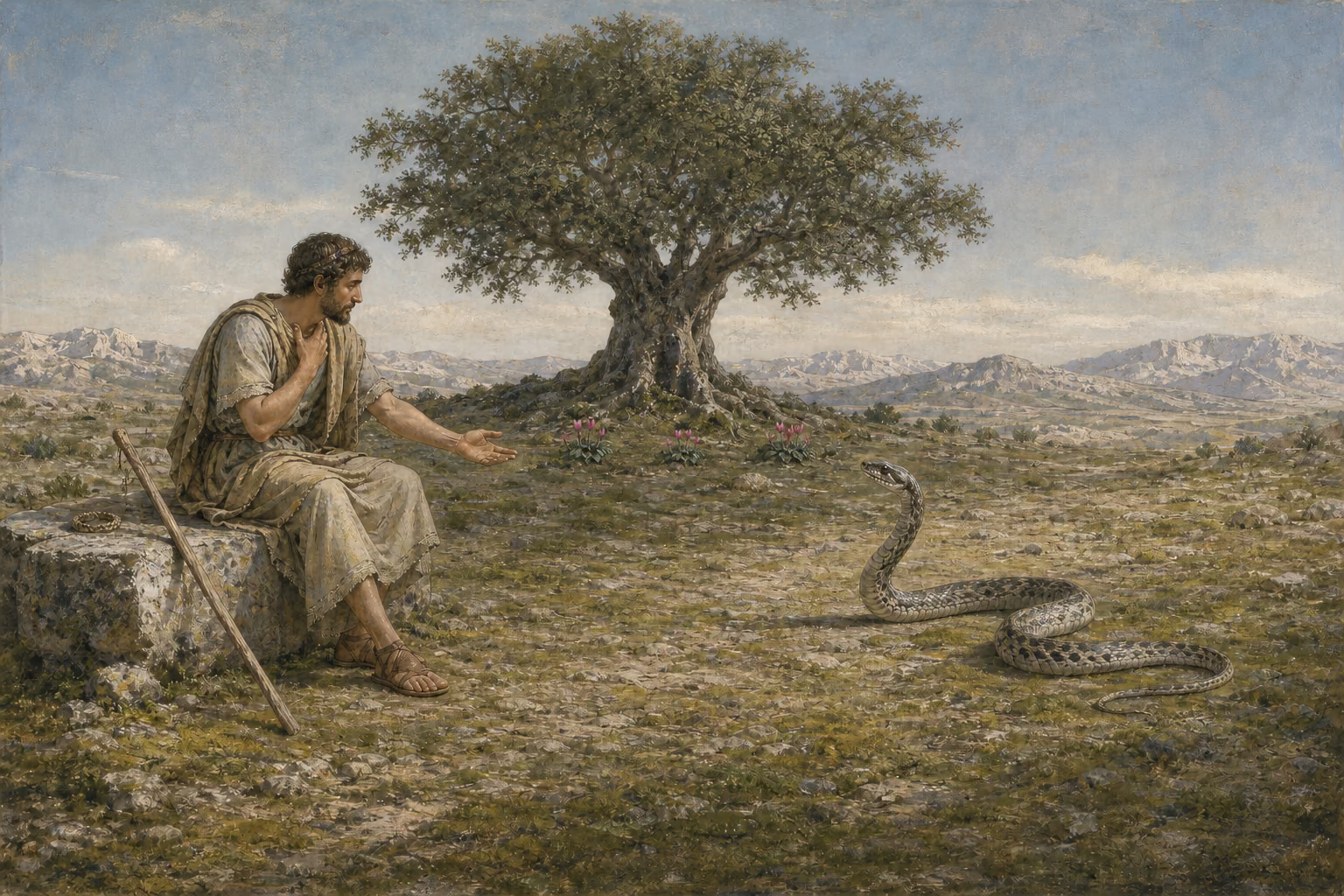
A MAN RECOGNIZED AND SAVED BY A DRAGON
Latine · Mayhoff 1906
Aeque memorandum et de panthera tradit Demetrius physicus: iacentem in media via hominis desiderio repente apparuisse patri cuiusdam Philini, adsectatoris sapientiae; ilium pavore coepisse regredi, feram vero circumvolutari non dubie blandientem seseque conflictantem maerore qui etiam in panthera intellegi posset. feta erat, catulis procul in foveam delapsis. primum ergo miserationis fuit non expavescere, proximum et curam intendere, secutusque qua trahebat vestem unguium levi iniectu, ut causam doloris intellexit simulque salutis suae mercedem, exemit catulos, ea cum his prosequente usque extra solitudines deductus laeta atque gestiente, ut facile appareret gratiam referre et nihil in vicem inputare, quod etiam in homine rarum est.
Haec fidem et Democrito adferunt, qui Thoantem in Arcadia servatum a dracone narrat. nutrierat eum puer dilectum admodum, parensque serpentis naturam et magnitudinem metuens in solitudines tulerat, in quibus circumvento latronum insidiis agnitoque voce subvenit. nam quae de infantibus ferarum lacte nutritis, cum essent expositi, produntur, sicut de conditoribus nostris a lupa, magnitudin i fatorum accepta fieri aequius quam ferarum naturae arbitror.
Panthera et tigris macularum varietate prope solae bestiarum spectantur, ceteris unus ac suus cuique generi color est, leonum tantum in Syria niger. pantheris in candido breves macularum oculi. ferunt odore earum mire sollicitari quadripedes cunctas, sed capitis torvitate terreri; quam ob rem occultato eo reliqua dulcedine invitatas corripiunt. sunt qui tradant in armo iis similem lunae esse maculam crescentem in orbem seque cavantem pari modo. nunc varias et pardos, qua mares sunt, appellant in eo omni genere, creberrimo in Africa Syriaque. quidam ab his pantheras candore solo discernunt, nec adhuc aliam differentiam inveni.
Senatus consultum fuit vetus, ne liceret Africanas in Italiam advehere. contra hoc tulit ad populum Cn. Aufidius tribunus plebis permisitque circensium gratia inportare. primus autem Scaurus aedilitate sua varias CL universas misit, dein Pompeius Magnus CCCCX, Divus Augustus CCCCXX. idem Q. Tuberone Paulo Fabio Maximo cos. IIII non. Mai. theatri Marcelli dedicatione tigrim primus omnium Romae ostendit in cavea mansuefactam, Divus vero Claudius simul IIII.
English · Bostock & Riley 1855–57
Demetrius, the natural philosopher, relates an equally remarkable instance, in relation to a panther. The animal was lying in the middle of the road, waiting for some one to pass that way, when he was suddenly perceived by the father of one Philinus, an ardent lover of wisdom. Seized with fear, he immediately began to retreat; while the beast rolled itself before him, evidently with the desire of caressing him, at the same time manifesting signs of grief, which could not be misunderstood in a panther even. The animal had young ones, which had happened to fall into a pit at some distance from the place. The first dictates of compassion banished all fear, and the next prompted him to assist the animal. He accordingly followed her, as she gently drew him on by fixing her claws in his garment; and as soon as he discovered what was the cause of her grief and the price of his own safety, he took the whelps out of the pit, and they followed her to the end of the desert; whither he was escorted by her, frisking with joy and gladness, in order that she might more appropriately testify how grateful she was, and how little she had given him in return; a mode of acting which is but rarely found, among men even.
Facts such as these induce us to give some credit to what Democritus relates, who says that a man, called Thoas, was preserved in Arcadia by a dragon. When a boy, he had become much attached to it, and had reared it very tenderly; but his father, being alarmed at the nature and monstrous size of the reptile, had taken and left it in the desert. Thoas being here attacked by some robbers who lay in ambush, he was delivered from them by the dragon, which recognized his voice and came to his assistance. But as to what has been said respecting infants that have been exposed and nourished by the milk of wild beasts, as in the case of the founders of our city by a wolf, I am disposed to attribute such cases as these rather to the greatness of the destinies which have to be fulfilled, than to any peculiarity in the nature of the animals themselves.
The panther and the tiger are nearly the only animals that are remarkable for a skin distinguished by the variety of its spots; whereas others have them of a single colour, appropriate to each species. The lions of Syria alone are black. The spots of the panther are like small eyes, upon a white ground. It is said that all quadrupeds are attracted in a most wonderful manner by their odour, while they are terrified by the fierceness of their aspect; for which reason the creature conceals its head, and then seizes upon the animals that are attracted to it by the sweetness of the odour. It is said by some, that the panther has, on the shoulder, a spot which bears the form of the moon; and that, like it, it regularly increases to full, and then diminishes to a crescent. At present, we apply the general names of varia and pard, (which last belongs to the males), to all the numerous species of this animal, which is very common in Africa and Syria. Some writers distinguish the panther, as being remarkable for its whiteness: but as yet I have not observed any other difference between them.
There was an ancient decree of the senate, which prohibited animals being imported from Africa into Italy; but Cn. Aufidius, the tribune of the people, procured a law repealing this, which allowed of their being brought over for the games of the Circus. Scaurus, in his ædileship, was the first who sent over the parti-coloured kind, one hundred and fifty in the whole; after which, Pompeius Magnus sent four hundred and ten, and the late Emperor Augustus four hundred and twenty.
The same emperor was the first person who exhibited at Rome a tame tiger on the stage. This was in the consulship of Q. Tubero and Fabius Maximus, at the dedication of the theatre of Marcellus, on the fourth day before the nones of May: the late Emperor Claudius exhibited four at one time.