LIBER IX · CAPUT 38
HOW WOOLS ARE DYED WITH THE JUICES OF THE PURPLE
Latine · Mayhoff 1906
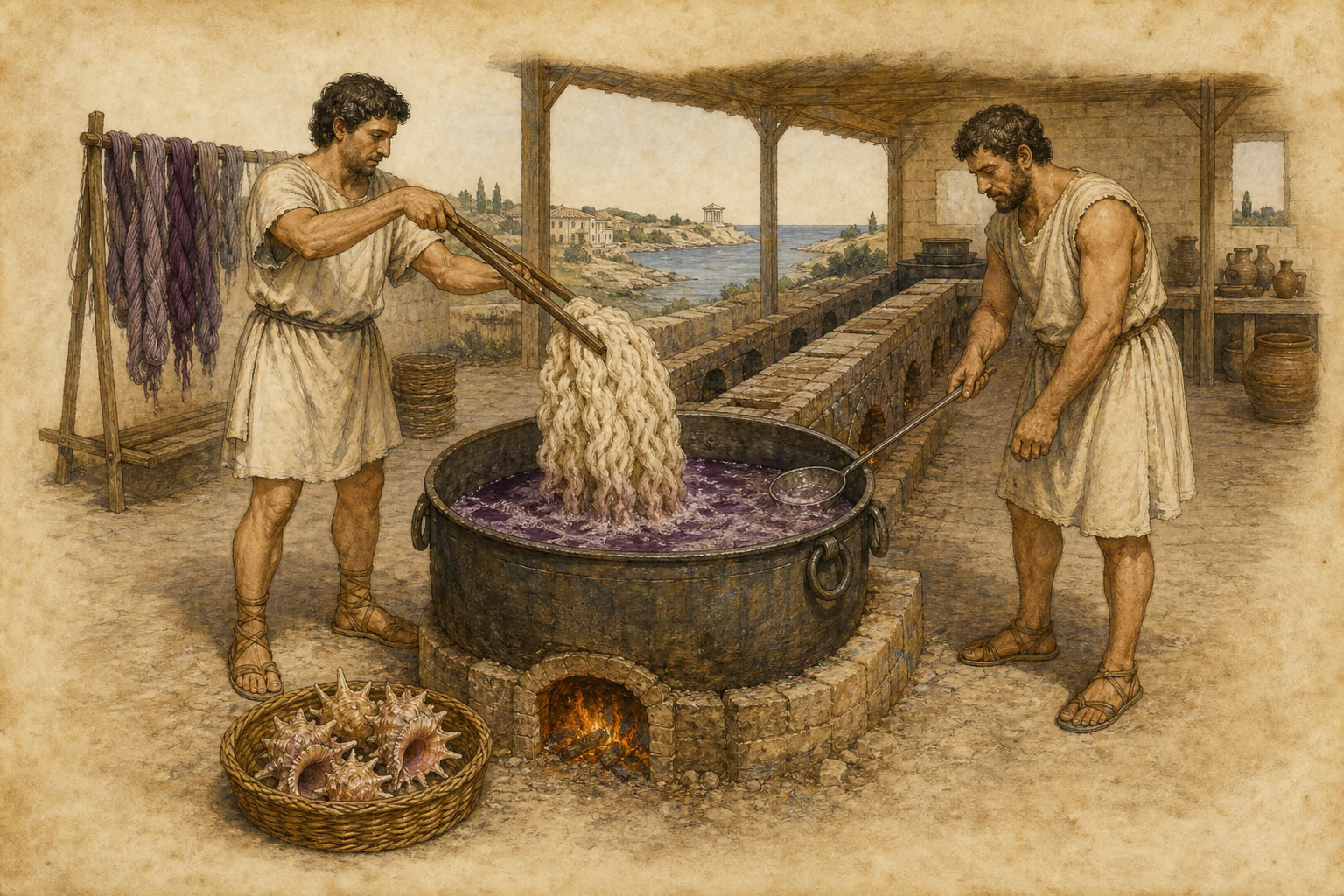
Capi eas post canis ortum ant ante vernum tempus utilissimum, quoniam, curl cerificavere, fluxos habent sucos. sed id tinguentium ma vertatur in eo. eximitur postea vena quam diximus, cui addi salem necessarium, sextarios ferme centenas in libras; macerari triduo iustum, quippe tanto maior vis, quanto recentior, fervere in plumbo, singulasque amphoras [centenas] aquae, quingentenas medicaminis libras aequali ac modico vapore torreri et ideo longinquae fornacis cuniculo. ita despumatis subinde carnibus, quas adhaesisse venis necesse est, decimo ferme die liquata cortina vellus elutriatum mergitur in experimentum et, donec spei satis fiat, uritur liquor. rubens color nigrante deterior. quinis lana potat horisrursusque mergitur carminata, donec omnem ebibat saniem. bucinum per se damnatur, quoniam fucum remittit: pelagio ad modum alligatur nimiaeque eius nigritiae dat austeritatem illam nitoremque qui quaeritur cocci. ita permixtis viribus alterum altero excitatur aut adstringitur. summa medicaminum in libras... vellerum bucini ducenae et e pelagio CXI. ita fit amethysti colos eximius ille. at Tyrius pelagio primum satiatur inmatura viridique cortina, mox permutatur in bucino. laus ei summa in colore sanguinis concreti, nigricans aspectu idemque suspectu refulgens. unde et Homero purpureus dicitur sanguis.
English · Bostock & Riley 1855–57
The most favourable season for taking these fish is after the rising of the Dog-star, or else before spring; for when they have once discharged their waxy secretion, their juices have no consistency: this, however, is a fact unknown in the dyers’ workshops, although it is a point of primary importance. After it is taken, the vein is extracted, which we have previously spoken of, to which it is requisite to add salt, a sextarius about to every hundred pounds of juice. It is sufficient to leave them to steep for a period of three days, and no more, for the fresher they are, the greater virtue there is in the liquor. It is then set to boil in vessels of tin, and every hundred amphoræ ought to be boiled down to five hundred pounds of dye, by the application of a moderate heat; for which purpose the vessel is placed at the end of a long funnel, which communicates with the furnace; while thus boiling, the liquor is skimmed from time to time, and with it the flesh, which necessarily adheres to the veins. About the tenth day, generally, the whole contents of the cauldron are in a liquified state, upon which a fleece, from which the grease has been cleansed, is plunged into it by way of making trial; but until such time as the colour is found to satisfy the wishes of those preparing it, the liquor is still kept on the boil. The tint that inclines to red is looked upon as inferior to that which is of a blackish hue. The wool is left to lie in soak for five hours, and then, after carding it, it is thrown in again, until it has fully imbibed the colour. The juice of the buccinum is considered very inferior if employed by itself, as it is found to discharge its colour; but when used in conjunction with that of the pelagiæ, it blends with it very well, gives a bright lustre to its colour, which is otherwise too dark, and imparts the shining crimson hue of the kermes-berry, a tint that is particularly valued. By the admixture of their respective virtues these colours are thus heightened or rendered sombre by the aid of one another. The proper proportions for mixing are, for fifty pounds of wool, two hundred pounds of juice of the buccinum and one hundred and eleven of juice of the pelagiæ. From this combination is produced the admirable tint known as amethyst colour. To produce the Tyrian hue the wool is soaked in the juice of the pelagiæ while the mixture is in an uncooked and raw state; after which its tint is changed by being dipped in the juice of the buccinum. It is considered of the best quality when it has exactly the colour of clotted blood, and is of a blackish hue to the sight, but of a shining appearance when held up to the light; hence it is that we find Homer speaking of “purple blood.”